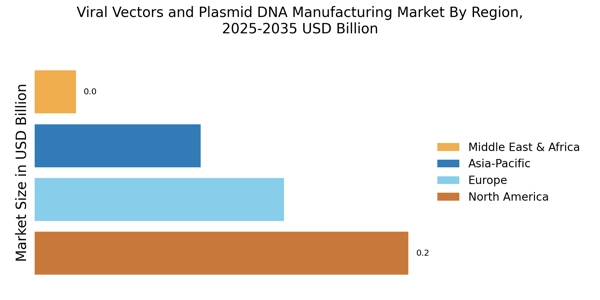
According to Market Research Future analysis, the Viral Vectors and Plasmid DNA Manufacturing Market Size was valued at USD 0.4 Billion in 2024 and the market is projected to grow from USD 0.453 Billion in 2025 to USD 1.574 Billion by 2035, registering a CAGR of 13.2% during 2025–2035. North America led the market with over 45% share, generating around USD 0.18 billion in revenue.
The Viral Vectors and Plasmid DNA Manufacturing Market is expanding due to rising demand for gene and cell therapies and increasing biopharmaceutical innovation. Key trends include advancements in vector engineering technologies, growing clinical trials for gene therapies, and rising investments in scalable manufacturing solutions to support precision medicine and advanced therapeutic development globally. According to the World Health Organization, noncommunicable diseases account for 74% of global deaths, driving demand for innovative treatments such as gene and cell therapies.
Key Market Trends & Highlights
The Viral Vectors and Plasmid DNA Manufacturing Market is experiencing robust growth driven by technological advancements and increasing demand for gene therapies.
- The market is witnessing a rising demand for gene therapies, particularly in North America, which remains the largest market.
- Technological advancements in production methods are enhancing efficiency and scalability, especially in the Asia-Pacific region.
- Collaborative research initiatives are fostering innovation, with gene therapy being the largest segment and vaccine development emerging as the fastest-growing.
- Key market drivers include the increasing prevalence of genetic disorders and expanding applications in vaccine development, which are propelling market growth.
Market Size & Forecast
| 2024 Market Size | 0.4 (USD Billion) |
| 2035 Market Size | 1.574 (USD Billion) |
| CAGR (2025 - 2035) | 13.26% |
Major Players
Companies such as Lonza (CH), Boehringer Ingelheim (DE), Sartorius (DE), Thermo Fisher Scientific(US), WuXi AppTec (CN), Cobra Biologics (GB), Viva Biotech (CN), Aldevron (US), MilliporeSigma (US), Celerion (US) are some of the major participants in the global market.