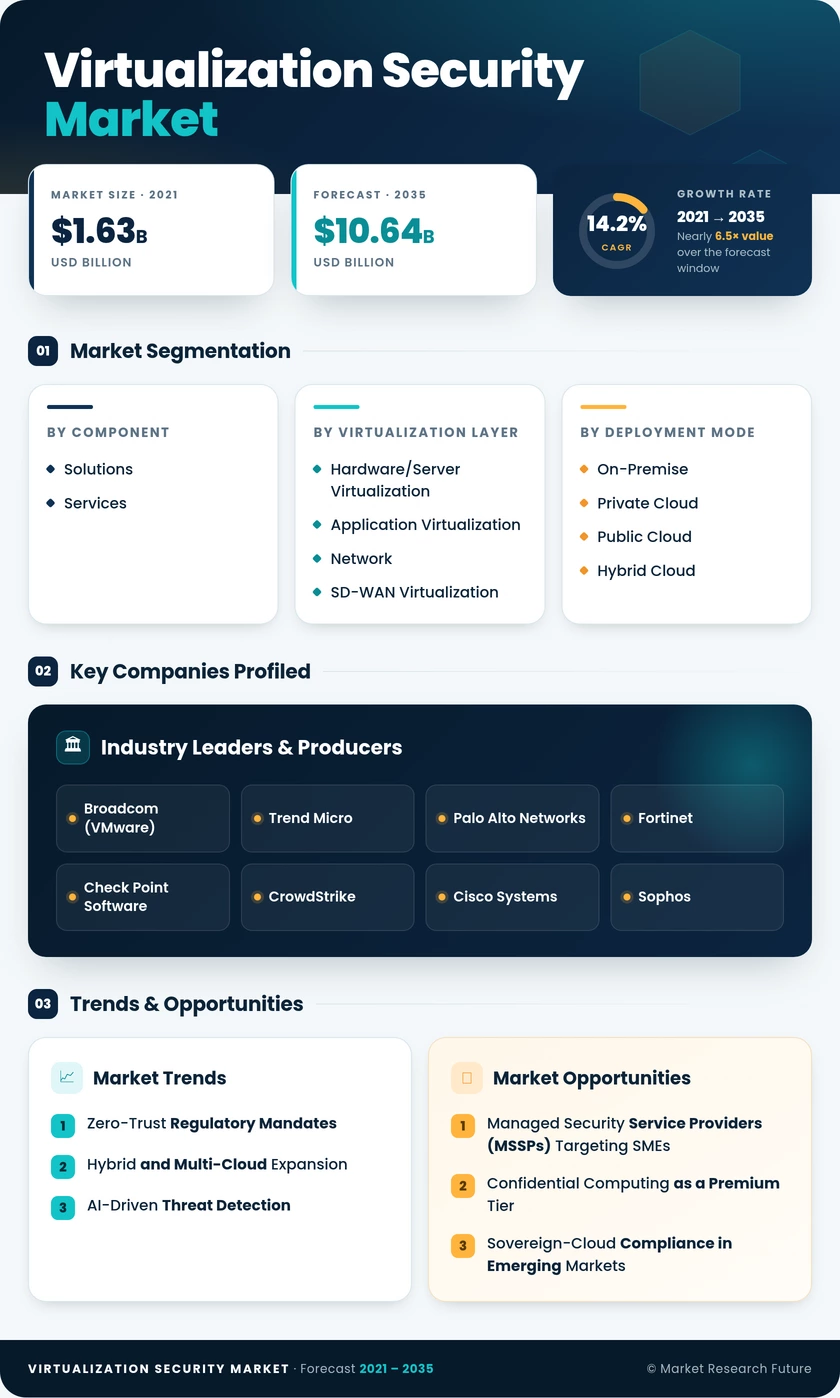
Segmentation Quick Reference
| Dimension | Sub-Segments | Dominant Segment | Fastest Growing Segment |
| Component | Solutions, Services | Solutions (58.5% share, 2025) | Services (17.3% CAGR) |
| Virtualization Layer | Hardware/Server Virtualization, Application Virtualization, Network and SD-WAN Virtualization | Hardware/Server Virtualization (42.2% share, 2025) | Network and SD-WAN Virtualization (16.6% CAGR) |
| Deployment Mode | On-Premise, Private Cloud, Public Cloud, Hybrid Cloud | Public Cloud (30.6% share, 2025) | Hybrid Cloud (16.1% CAGR) |
| End-User Industry | IT and Telecom, BFSI, Healthcare and Life Sciences, Government and Defense, Others | IT and Telecom (25.2% share, 2025) | Healthcare and Life Sciences (15.6% CAGR) |
| Organization Size | Large Enterprises, Small and Medium Enterprises | Large Enterprises (60.3% share, 2025) | Small and Medium Enterprises (16.9% CAGR) |
Market Segmentation Overview
By Component
| Sub-Segment | Key Trend |
| Solutions | Platform consolidation driving bundled workload protection, micro-segmentation, and compliance reporting into unified suites |
| Services | Managed detection and response (MDR) contracts growing as cybersecurity talent shortages push outsourcing |
Solutions encompass software platforms for hypervisor-level firewalling, runtime protection, and automated compliance scanning. Services cover managed security, consulting, integration, and training — a segment growing as organizations seek turnkey protection without building in-house teams.
By Virtualization Layer
| Sub-Segment | Key Trend |
| Hardware/Server Virtualization | Silicon-backed trust extensions (Intel TDX, AMD SEV-SNP) elevating hypervisor protection from software to hardware layer |
| Application Virtualization | VDI security demand increasing as hybrid work normalizes across regulated industries |
| Network and SD-WAN Virtualization | East-west traffic inspection and encrypted overlay segmentation becoming standard in enterprise WANs |
Hardware/server virtualization security remains foundational because it protects the compute substrate where workloads execute. Network virtualization security is gaining ground as SD-WAN adoption accelerates across distributed enterprise architectures.
By Deployment Mode
| Sub-Segment | Key Trend |
| On-Premise | Legacy regulated workloads maintaining on-site security appliances for air-gapped environments |
| Private Cloud | Broadcom-VMware subscription bundles lifting private-cloud security attach rates |
| Public Cloud | Multi-cloud sprawl requiring consistent cross-provider policy enforcement |
| Hybrid Cloud | Data-sovereignty regulations driving split-workload architectures that need unified security orchestration |
Hybrid cloud is the fastest-growing deployment mode, reflecting the reality that most enterprises will operate workloads across multiple environments through 2035, requiring security controls that follow data regardless of location.
By End-User Industry
| Sub-Segment | Key Trend |
| IT and Telecom | 5G core network virtualization creating millions of containerized workloads requiring individual policy enforcement |
| BFSI | Open-banking API proliferation and PCI-DSS v4.0 driving granular workload segmentation |
| Healthcare and Life Sciences | Connected medical devices and genomics platforms expanding the virtualized attack surface |
| Government and Defense | Zero-trust mandates (CISA, ENISA) requiring hypervisor-level micro-segmentation |
| Others | Manufacturing OT-IT convergence and retail cloud migration broadening demand |
IT and Telecom leads by revenue share due to the sheer scale of virtualized infrastructure operated by telecommunications providers. Healthcare is the fastest-growing vertical as digital-health investments expand the volume and sensitivity of virtualized workloads.
By Organization Size
| Sub-Segment | Key Trend |
| Large Enterprises | Multi-hypervisor estates requiring unified, cross-platform security policy orchestration |
| Small and Medium Enterprises | Cloud-delivered, consumption-based pricing lowering adoption barriers for sub-500 VM environments |
Large enterprises dominate current spending, but SME growth rates outpace the overall market as managed-service delivery models eliminate the need for dedicated in-house security operations teams.