×
Request Free Sample ×

Kindly complete the form below to receive a free sample of this Report

* Please use a valid business email

Leading companies partner with us for data-driven Insights

clients tt-cursor
Hero Background

Wafer Dicing Saws Market

ID: MRFR/PCM/22231-HCR
111 Pages
Snehal Singh
October 2025

Wafer Dicing Saws Market Research Report By Technology (Blade Dicing, Laser Dicing, Plasma Dicing, Water Jet Dicing, Abrasive Jet Dicing), By Dicing Blade Type (Single Blade, Multi-Blade, Diamond-Coated Blade, CBN-Coated Blade, Other Advanced Materials), By Substrate Type (Silicon, Sapphire, Gallium Arsenide, Glass, Other Substrates), By Application (Semiconductor Fabrication, MEMS Fabrication, Solar Cell Fabrication, Optical Component Fabrication, Other Applications), By End-User Industry (Electronics, Automotive, Telecommunications, Health... read more

Share:
Download PDF ×

We do not share your information with anyone. However, we may send you emails based on your report interest from time to time. You may contact us at any time to opt-out.

Wafer Dicing Saws Market Infographic
Purchase Options

Wafer Dicing Saws Market Summary

As per MRFR analysis, the Wafer Dicing Saws Market Size was estimated at 2.549 USD Billion in 2024. The Wafer Dicing Saws industry is projected to grow from 2.728 in 2025 to 5.372 by 2035, exhibiting a compound annual growth rate (CAGR) of 7.01 during the forecast period 2025 - 2035.

Key Market Trends & Highlights

The Wafer Dicing Saws Market is poised for growth driven by technological advancements and increasing demand for semiconductors.

  • North America remains the largest market for wafer dicing saws, reflecting robust industrial activity and technological innovation.
  • Asia-Pacific is emerging as the fastest-growing region, fueled by rapid advancements in semiconductor manufacturing.
  • Blade dicing continues to dominate the market, while laser dicing is gaining traction due to its efficiency and precision.
  • Technological advancements and the rising demand for semiconductors are key drivers propelling market growth.

Market Size & Forecast

2024 Market Size 2.549 (USD Billion)
2035 Market Size 5.372 (USD Billion)
CAGR (2025 - 2035) 7.01%

Major Players

DISCO Corporation (JP), Tokyo Seimitsu Co., Ltd. (JP), ASM International N.V. (NL), K&S (Kulicke and Soffa Industries, Inc.) (US), Microtech (US), SUSS MicroTec SE (DE), Accretech (AT), Nippon Avionics Co., Ltd. (JP)

Wafer Dicing Saws Market Trends

The Wafer Dicing Saws Market is currently experiencing a transformative phase, driven by advancements in semiconductor technology and the increasing demand for miniaturized electronic components. As industries such as consumer electronics, automotive, and telecommunications continue to evolve, the need for precise and efficient dicing solutions becomes paramount. This market appears to be characterized by a growing emphasis on automation and enhanced operational efficiency, which may lead to the development of more sophisticated dicing saws that can cater to diverse material types and thicknesses. Furthermore, the integration of artificial intelligence and machine learning into manufacturing processes suggests a potential shift towards smarter, more adaptive dicing systems that can optimize performance and reduce waste. In addition, the Wafer Dicing Saws Market seems to be influenced by the rising trend of sustainable manufacturing practices. Companies are increasingly focusing on reducing their environmental footprint, which may drive innovations in dicing saw technology that prioritize energy efficiency and material conservation. As the market evolves, collaboration between equipment manufacturers and semiconductor producers could foster the development of tailored solutions that meet specific industry needs. Overall, the Wafer Dicing Saws Market is poised for growth, with various factors indicating a dynamic landscape that could reshape the future of semiconductor fabrication and electronic component production.

Automation and Efficiency

The Wafer Dicing Saws Market is witnessing a trend towards automation, which enhances operational efficiency. Manufacturers are increasingly adopting automated systems to streamline production processes, reduce human error, and improve throughput. This shift may lead to the development of advanced dicing saws that incorporate robotics and smart technologies, allowing for more precise and consistent cutting.

Sustainability Initiatives

There is a growing emphasis on sustainability within the Wafer Dicing Saws Market. Companies are exploring eco-friendly practices and technologies that minimize waste and energy consumption. This trend may drive innovations in dicing saw design, focusing on materials and processes that align with environmental standards, thereby appealing to a more environmentally conscious consumer base.

Customization and Versatility

The demand for customized solutions is rising in the Wafer Dicing Saws Market. As industries require specific dicing capabilities for various materials and applications, manufacturers are likely to develop versatile saws that can accommodate a range of specifications. This trend suggests a move towards more adaptable equipment that can meet the diverse needs of different sectors.

Wafer Dicing Saws Market Drivers

Technological Advancements

The Wafer Dicing Saws Market is experiencing a surge in technological advancements, particularly in precision cutting and automation. Innovations such as laser dicing and advanced blade materials are enhancing the efficiency and accuracy of wafer dicing processes. These advancements not only reduce material waste but also improve yield rates, which is crucial in semiconductor manufacturing. As the demand for smaller and more powerful electronic devices increases, the need for high-precision dicing saws becomes more pronounced. The market is projected to grow at a compound annual growth rate (CAGR) of approximately 5.2% over the next few years, driven by these technological improvements that cater to the evolving needs of the electronics sector.

Rising Demand for Semiconductors

The Wafer Dicing Saws Market is significantly influenced by the rising demand for semiconductors across various sectors, including automotive, consumer electronics, and telecommunications. As industries increasingly rely on advanced semiconductor technologies, the need for efficient wafer dicing solutions becomes paramount. The semiconductor market is expected to reach a valuation of over 600 billion USD by 2025, which directly correlates with the growth of the wafer dicing saws market. This demand is further fueled by the proliferation of IoT devices and smart technologies, necessitating high-quality dicing saws to meet production requirements. Consequently, manufacturers are investing in advanced dicing technologies to enhance their production capabilities.

Increased Focus on Miniaturization

The trend towards miniaturization in electronic devices is a key driver for the Wafer Dicing Saws Market. As manufacturers strive to produce smaller, more compact components, the precision required in wafer dicing becomes increasingly critical. This trend is evident in sectors such as mobile devices, wearables, and medical technology, where space constraints demand high levels of accuracy in component fabrication. The market for miniaturized electronic components is projected to grow, thereby increasing the demand for advanced dicing saws that can handle intricate designs and tight tolerances. This focus on miniaturization not only drives innovation in dicing technologies but also enhances the overall efficiency of production processes.

Growing Adoption of Electric Vehicles

The Wafer Dicing Saws Market is poised to benefit from the growing adoption of electric vehicles (EVs). As the automotive industry shifts towards electrification, the demand for advanced semiconductor components used in EVs is on the rise. These components require precise dicing solutions to ensure optimal performance and reliability. The electric vehicle market is expected to witness substantial growth, with projections indicating that EV sales could reach 30 million units annually by 2030. This surge in demand for EVs translates into increased requirements for wafer dicing saws, as manufacturers seek to produce high-quality semiconductor devices that meet the stringent performance standards of the automotive sector.

Emerging Markets and Investment Opportunities

The Wafer Dicing Saws Market is also being driven by emerging markets that present new investment opportunities. Countries in Asia-Pacific and Latin America are witnessing rapid industrialization and technological advancements, leading to increased demand for semiconductor manufacturing. As these regions invest in their manufacturing capabilities, the need for efficient wafer dicing solutions becomes more pronounced. The expansion of semiconductor fabrication facilities in these emerging markets is likely to create a robust demand for advanced dicing saws. Furthermore, government initiatives aimed at boosting local manufacturing capabilities are expected to further stimulate growth in the wafer dicing saws market, making it an attractive area for investment.
Market Segment Insights

By Technology: Blade Dicing (Largest) vs. Laser Dicing (Fastest-Growing)

The Wafer Dicing Saws Market showcases a diversified technology landscape with Blade Dicing taking the lead in market share. Blade Dicing is favored for its efficiency and cost-effectiveness, making it a common choice across industries. In contrast, Laser Dicing is rapidly gaining traction, particularly in applications that require high precision, thus capturing a significant portion of the market. The variation in performance and applicability among these technologies significantly influences their respective shares.

Technology: Blade Dicing (Dominant) vs. Laser Dicing (Emerging)

Blade Dicing stands out as the dominant technology in the Wafer Dicing Saws Market, primarily due to its reliability and proven effectiveness in slicing through various materials. This method allows for a controlled dicing process, minimizing wastage and ensuring high yield rates. Meanwhile, Laser Dicing is emerging as a favorite for cutting-edge applications that demand superior accuracy, making it increasingly vital for the production of sophisticated electronic components. Both technologies cater to distinct needs, with Blade Dicing focusing on bulk processing and Laser Dicing appealing to niche markets that require intricate designs, driving innovation and competition in the sector.

By Dicing Blade Type: Diamond-Coated Blade (Largest) vs. Multi-Blade (Fastest-Growing)

In the Wafer Dicing Saws Market, the distribution of market share among the dicing blade types reveals that Diamond-Coated Blades hold the largest segment due to their superior cutting efficiency and longevity. Multi-Blade systems are gaining traction, offering manufacturers the ability to increase throughput and reduce operational costs, although they currently account for a smaller share compared to the dominant Diamond-Coated Blades. Both Single Blades and CBN-Coated Blades continue to compete in niche applications, while Other Advanced Materials serve specialized needs in high-tech industries. The growth trends in this segment are significantly driven by technological advancements and the increasing demand for precision in semiconductor manufacturing. As manufacturers seek to enhance production efficiency, the use of Multi-Blade systems increases due to their ability to cut multiple wafers simultaneously, thus positioning them as the fastest-growing choice. Moreover, the ongoing innovations in blade materials, including improvements in Diamond-Coated and CBN-Coated options, are expected to shape the competitive landscape, catering to diverse industry needs and driving further adoption of these advanced dicing solutions.

Dicing Blade Type: Diamond-Coated Blade (Dominant) vs. Multi-Blade (Emerging)

In the Wafer Dicing Saws Market, Diamond-Coated Blades are regarded as the dominant technology due to their ability to deliver high-quality cuts with minimal wear, making them indispensable for precision applications in semiconductor production. Their prolonged lifespan and efficiency in handling various materials enable manufacturers to optimize their operational costs effectively. In contrast, Multi-Blade systems are emerging as a preferred choice for manufacturers who prioritize speed and volume in their operations. These systems allow for simultaneous cutting of multiple wafers, drastically enhancing throughput. While Diamond-Coated Blades excel in quality and durability, Multi-Blade options are increasingly recognized for addressing the growing demand for efficient and cost-effective dicing solutions in a fast-paced market.

By Substrate Type: Silicon (Largest) vs. Sapphire (Fastest-Growing)

In the Wafer Dicing Saws Market, silicon substrates dominate the segment due to their widespread use in semiconductor manufacturing. This established market stronghold makes silicon the largest substrate type, being a preferred choice for many applications. In contrast, sapphire substrates are gaining traction, especially in optoelectronics and LED technologies, which positions them as the fastest-growing segment in this market configuration. This distribution highlights the varied applications and evolving technologies that favor specific substrate types.

Silicon (Dominant) vs. Sapphire (Emerging)

Silicon, often regarded as the backbone of the semiconductor industry, holds a dominant position in the Wafer Dicing Saws Market due to its excellent electrical properties and versatility. It is extensively utilized in various electronic devices, providing reliability and performance. On the other hand, sapphire substrates are emerging with rapid growth propelled by their unique characteristics like high thermal conductivity and optical transparency. This makes them ideal for applications in LEDs and high-frequency devices. As industries increasingly adopt advanced technologies, sapphire is anticipated to capture a significant market share, competing fiercely with traditional silicon. This competition promotes innovation and drives improvements in manufacturing processes.

By Application: Semiconductor Fabrication (Largest) vs. MEMS Fabrication (Fastest-Growing)

The Wafer Dicing Saws Market is characterized by a significant share of the Semiconductor Fabrication application, which leads the segment and plays a crucial role in the overall market dynamics. This application caters to the increasing demand for semiconductor devices in various industries. Meanwhile, the MEMS Fabrication segment is emerging rapidly, marking itself as the fastest-growing area, benefiting from technological advancements and increased adoption of MEMS devices in consumer electronics, automotive, and healthcare industries. Growth in the Wafer Dicing Saws Market is driven by the evolving requirements of the semiconductor industry, where precise dicing is essential for producing smaller and more efficient chips. Furthermore, as MEMS technology advances, there is a surge in demand for MEMS devices, leading to an acceleration in MEMS Fabrication. These trends are further supported by the rising utilization of renewable energy technologies, particularly in applications like solar cell fabrication, paving the way for diverse growth opportunities.

Semiconductor Fabrication (Dominant) vs. Optical Component Fabrication (Emerging)

In the Wafer Dicing Saws Market, Semiconductor Fabrication stands out as the dominant application, characterized by its extensive use in the production of microchips and electronic components. This segment remains integral to modern technology, supported by the ongoing trend towards miniaturization and advanced processing capabilities. Conversely, Optical Component Fabrication serves as an emerging application segment, gaining traction due to the increasing demand for high-performance optics in telecommunications, consumer electronics, and medical devices. The growth of optical technologies necessitates high precision in dicing processes, contributing to the rising prominence of this segment. As these technologies evolve, both segments are expected to drive innovation and efficiency within the Wafer Dicing Saws Market.

By End-User Industry: Electronics (Largest) vs. Automotive (Fastest-Growing)

The Wafer Dicing Saws Market exhibits a diverse distribution across several end-user industries, with electronics holding the largest market share. This segment comprises the demand for precision dicing solutions, linked to the growing semiconductor industry. Conversely, sectors like automotive are increasingly adopting advanced technologies such as electric vehicles that demand specific dicing solutions, leading to their rapid growth in this market.

Electronics: Dominant vs. Automotive: Emerging

The electronics segment stands as the dominant force in the Wafer Dicing Saws Market, driven by the continuous evolution of consumer electronics and the rise of platforms requiring intricate semiconductor designs. With a plethora of applications ranging from smartphones to high-performance computing, the demand in this sector is robust. On the other hand, the automotive segment, marked as emerging, is gaining traction with the push for automation and electric vehicles. This demand is spurred by the need for precise dicing of semiconductor devices that are integral to electric and autonomous vehicles, pointing toward a promising future for automotive applications in the market.

Get more detailed insights about Wafer Dicing Saws Market

Regional Insights

North America : Technological Innovation Leader

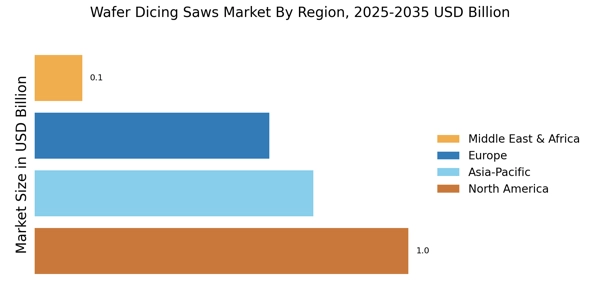
North America is a key player in the Wafer Dicing Saws Market, driven by technological advancements and a robust semiconductor industry. The region holds approximately 40% of the global market share, with the United States being the largest contributor, followed by Canada. Regulatory support for semiconductor manufacturing and innovation is a significant catalyst for growth, enhancing demand for precision dicing solutions. The competitive landscape in North America is characterized by the presence of major players such as K&S and Microtech, alongside established companies like DISCO Corporation and ASM International. The U.S. market is particularly strong due to its focus on R&D and high-quality manufacturing standards. This competitive environment fosters innovation and ensures that North America remains at the forefront of wafer dicing technology.

Europe : Emerging Market Dynamics

Europe is witnessing a growing demand for Wafer Dicing Saws Market, driven by the increasing adoption of advanced semiconductor technologies and a focus on sustainability. The region accounts for approximately 25% of the global market share, with Germany and France leading the charge. Regulatory frameworks promoting green technologies and energy efficiency are pivotal in shaping market dynamics, encouraging investments in innovative dicing solutions. Leading countries in Europe, particularly Germany, host key players like SUSS MicroTec and ASM International, contributing to a competitive landscape that emphasizes quality and precision. The presence of strong manufacturing capabilities and a skilled workforce further enhances the region's attractiveness for wafer dicing technologies. As the market evolves, collaboration among industry stakeholders is expected to drive further advancements.

Asia-Pacific : Rapid Growth and Adoption

Asia-Pacific is rapidly emerging as a powerhouse in the Wafer Dicing Saws Market, driven by the booming electronics and semiconductor sectors. The region holds approximately 30% of the global market share, with Japan and South Korea being the largest contributors. The increasing demand for consumer electronics and advancements in manufacturing technologies are key growth drivers, supported by favorable government policies promoting innovation and investment in high-tech industries. Japan, home to major players like DISCO Corporation and Tokyo Seimitsu, leads the competitive landscape, while South Korea follows closely with its strong semiconductor manufacturing base. The presence of these key players fosters a dynamic environment for technological advancements in wafer dicing. As the region continues to grow, collaboration between industry and government will be essential for sustaining momentum in this sector.

Middle East and Africa : Emerging Opportunities Ahead

The Middle East and Africa region is gradually emerging in the Wafer Dicing Saws Market, driven by increasing investments in technology and infrastructure. Although it currently holds about 5% of the global market share, there is significant potential for growth as countries in the region focus on diversifying their economies and enhancing their technological capabilities. Government initiatives aimed at fostering innovation and attracting foreign investment are crucial for market expansion. Countries like South Africa and the UAE are beginning to establish themselves as key players in the semiconductor industry, with a growing number of local and international companies entering the market. The competitive landscape is evolving, with an increasing emphasis on partnerships and collaborations to leverage technological advancements. As the region continues to develop, the demand for wafer dicing solutions is expected to rise significantly.

Wafer Dicing Saws Market Regional Image

Key Players and Competitive Insights

Major players in the Wafer Dicing Saws Market industry are constantly striving to gain a competitive edge by investing heavily in research and development activities. This has led to the development of innovative technologies that are improving the efficiency and precision of wafer dicing saws. Leading Wafer Dicing Saws Market players are also focusing on expanding their presence through strategic partnerships and acquisitions. This enables them to tap into new markets and cater to a wider customer base.

As a result of these competitive dynamics, the Wafer Dicing Saws Market is experiencing ongoing development and innovation, which is driving the industry forward.Disco Corporation, a prominent player in the Wafer Dicing Saws Market, is known for its advanced dicing technologies and manufacturing capabilities. The company offers a comprehensive range of wafer dicing saws designed to meet the specific requirements of various semiconductor applications. Disco Corporation has a strong presence in key semiconductor manufacturing regions, including Japan, Taiwan, and the United States.

It is committed to providing innovative solutions and partnering with customers to drive the advancement of the semiconductor industry.Another leading competitor in the Wafer Dicing Saws Market is ADT. The company specializes in developing and manufacturing high-precision dicing saws for the semiconductor industry. ADT's saws are known for their reliability, accuracy, and efficiency, making them a preferred choice among semiconductor manufacturers worldwide. The company has a presence with manufacturing facilities in Japan, Taiwan, and the United States. ADT is continuously investing in research and development to enhance its product offerings and maintain its competitive position in the market.

Key Companies in the Wafer Dicing Saws Market market include

Industry Developments

The Wafer Dicing Saws Market is projected to grow from USD 2.23 billion in 2023 to USD 4.1 billion by 2032, exhibiting a CAGR of 7.01% during the forecast period. The market growth is attributed to increasing demand for wafers in various electronic devices such as smartphones, laptops, and tablets. Additionally, the growing adoption of advanced packaging technologies, such as fan-out wafer-level packaging (FOWLP) and system-in-package (SiP), is expected to drive market growth.

Furthermore, the rising popularity of electric vehicles and the increasing demand for power electronics are anticipated to boost the demand for wafer dicing saws in the coming years. Recent developments in the market include the launch of new products with enhanced features and capabilities, such as higher precision and throughput. Key players in the market are focusing on strategic collaborations and acquisitions to expand their product portfolio and geographical reach.

Future Outlook

Wafer Dicing Saws Market Future Outlook

The Wafer Dicing Saws Market is projected to grow at a 7.01% CAGR from 2024 to 2035, driven by advancements in semiconductor technology and increasing demand for miniaturized electronic devices.

New opportunities lie in:

  • Development of automated dicing solutions for enhanced efficiency
  • Expansion into emerging markets with tailored product offerings
  • Integration of AI for predictive maintenance and operational optimization

By 2035, the Wafer Dicing Saws Market is expected to achieve robust growth and innovation.

Market Segmentation

Wafer Dicing Saws Market Technology Outlook

  • Blade Dicing
  • Laser Dicing
  • Plasma Dicing
  • Water Jet Dicing
  • Abrasive Jet Dicing

Wafer Dicing Saws Market Application Outlook

  • Semiconductor Fabrication
  • MEMS Fabrication
  • Solar Cell Fabrication
  • Optical Component Fabrication
  • Other Applications

Wafer Dicing Saws Market Substrate Type Outlook

  • Silicon
  • Sapphire
  • Gallium Arsenide
  • Glass
  • Other Substrates

Wafer Dicing Saws Market Dicing Blade Type Outlook

  • Single Blade
  • Multi-Blade
  • Diamond-Coated Blade
  • CBN-Coated Blade
  • Other Advanced Materials

Wafer Dicing Saws Market End-User Industry Outlook

  • Electronics
  • Automotive
  • Telecommunications
  • Healthcare
  • Aerospace and Defense

Report Scope

MARKET SIZE 20242.549(USD Billion)
MARKET SIZE 20252.728(USD Billion)
MARKET SIZE 20355.372(USD Billion)
COMPOUND ANNUAL GROWTH RATE (CAGR)7.01% (2024 - 2035)
REPORT COVERAGERevenue Forecast, Competitive Landscape, Growth Factors, and Trends
BASE YEAR2024
Market Forecast Period2025 - 2035
Historical Data2019 - 2024
Market Forecast UnitsUSD Billion
Key Companies ProfiledMarket analysis in progress
Segments CoveredMarket segmentation analysis in progress
Key Market OpportunitiesAdvancements in automation and precision drive growth in the Wafer Dicing Saws Market.
Key Market DynamicsTechnological advancements and increasing demand for miniaturization drive innovation in the Wafer Dicing Saws Market.
Countries CoveredNorth America, Europe, APAC, South America, MEA

Leave a Comment

FAQs

What is the projected market valuation of the Wafer Dicing Saws Market by 2035?

The Wafer Dicing Saws Market is projected to reach a valuation of 5.372 USD Billion by 2035.

What was the market valuation of the Wafer Dicing Saws Market in 2024?

In 2024, the Wafer Dicing Saws Market was valued at 2.549 USD Billion.

What is the expected CAGR for the Wafer Dicing Saws Market during the forecast period 2025 - 2035?

The expected CAGR for the Wafer Dicing Saws Market during the forecast period 2025 - 2035 is 7.01%.

Which technology segment is anticipated to have the highest growth in the Wafer Dicing Saws Market?

The Blade Dicing technology segment is anticipated to grow from 0.764 USD Billion in 2024 to 1.634 USD Billion by 2035.

What are the key players in the Wafer Dicing Saws Market?

Key players in the Wafer Dicing Saws Market include DISCO Corporation, Tokyo Seimitsu Co., Ltd., and ASM International N.V.

How does the market for Silicon substrates compare to other substrate types in 2024?

In 2024, the market for Silicon substrates was valued at 0.9 USD Billion, making it the largest substrate type in the Wafer Dicing Saws Market.

What is the projected market size for the Semiconductor Fabrication application by 2035?

The market size for the Semiconductor Fabrication application is projected to reach 3.215 USD Billion by 2035.

Which end-user industry is expected to drive the most growth in the Wafer Dicing Saws Market?

The Electronics end-user industry is expected to drive growth, with a market size projected to increase from 0.9 USD Billion in 2024 to 1.8 USD Billion by 2035.

What is the anticipated market size for Laser Dicing technology by 2035?

The Laser Dicing technology segment is anticipated to grow from 0.509 USD Billion in 2024 to 1.086 USD Billion by 2035.

How does the market for Multi-Blade dicing blades compare to Single Blade dicing blades in 2024?

In 2024, the market for Multi-Blade dicing blades was valued at 0.509 USD Billion, while Single Blade dicing blades were valued at 0.764 USD Billion.

Download Free Sample

Kindly complete the form below to receive a free sample of this Report

Compare Licence

×
Features License Type
Single User Multiuser License Enterprise User
Price $4,950 $5,950 $7,250
Maximum User Access Limit 1 User Upto 10 Users Unrestricted Access Throughout the Organization
Free Customization
Direct Access to Analyst
Deliverable Format
Platform Access
Discount on Next Purchase 10% 15% 15%
Printable Versions