Web Application Firewall Market

ID: MRFR/ICT/3093-HCR
200 Pages
Aarti Dhapte
Last Updated: June 22, 2026
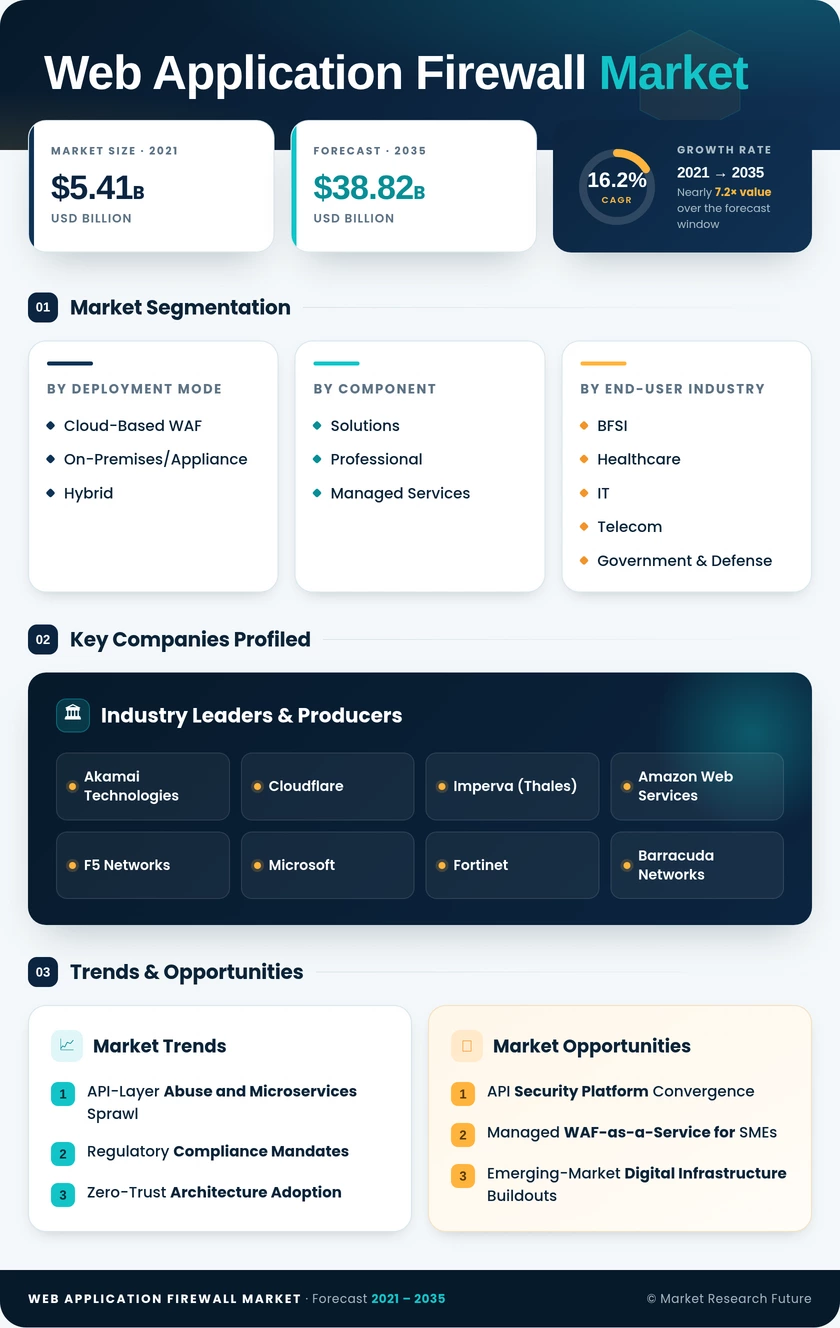
Web Application Firewall Market Size, Share and Research Report By Deployment Mode (Cloud-Based WAF, On-Premises/Appliance, Hybrid), By Component (Solutions, Professional and Managed Services), By End-User Industry (BFSI, Healthcare, IT and Telecom, Government & Defense, Retail & E-commerce, Others), By Enterprise Size (Large Enterprises, Small and Medium Enterprises) and By Regional (North America, Europe, South America, Asia Pacific, Middle East and Africa) - Industry Forecast to 2035.
Download PDF ×

We do not share your information with anyone. However, we may send you emails based on your report interest from time to time. You may contact us at any time to opt-out.

  1. 1 Market Overview |
    1. 1.1 Study Assumptions & Market Definition |
    2. 1.2 Scope of the Study |
    3. 1.3 Research Methodology
  2. 2 Market Summary & Key Takeaways
  3. 3 Market Dynamics |
    1. 3.1 Market Drivers Analysis | |
      1. 3.1.1 API-Layer Abuse and Microservices Sprawl | |
      2. 3.1.2 Regulatory Compliance Mandates (HIPAA, PCI DSS
      3. 3.1.3 Zero-Trust Architecture Adoption | |
      4. 3.1.4 Edge/CDN-Integrated Inspection Demand | |
      5. 3.1.5 SME Digital Transformation and Cloud-Subscription Economics | |
      6. 3.1.6 AI/ML-Powered Adaptive Threat Detection | |
      7. 3.1.7 Rising Bot-Management and Credential-Stuffing Attacks |
    2. 4.0, CRA) | |
    3. 3.2 Market Restraints Analysis | |
      1. 3.2.1 False-Positive Alert Fatigue and Tuning Overhead | |
      2. 3.2.2 TLS Encryption Complexity Limiting Deep Inspection | |
      3. 3.2.3 Cybersecurity Talent Shortage | |
      4. 3.2.4 Open-Source Rulesets Compressing Vendor Margins | |
      5. 3.2.5 Legacy Application Integration Friction |
    4. 3.3 Market Opportunity Analysis | |
      1. 3.3.1 API Security Platform Convergence | |
      2. 3.3.2 Managed WAF-as-a-Service for SMEs | |
      3. 3.3.3 Emerging-Market Digital Infrastructure Buildouts | |
      4. 3.3.4 SASE and SSE Platform Integration | |
      5. 3.3.5 AI-Driven Autonomous Threat Response |
    5. 3.4 Industry Value Chain Analysis |
    6. 3.5 Porter's Five Forces Analysis
  4. 4 Global Web Application Firewall Market Size & Forecast (2021–2035) |
    1. 4.1 Historical Market Size (2021–2025) |
    2. 4.2 Current & Forecast Market Size (2026–2035) |
    3. 4.3 Market Size by Revenue (USD Billion) |
    4. 4.4 Year-over-Year Growth Analysis
  5. 5 Segmentation Analysis |
    1. 5.1 By Deployment Mode | |
      1. 5.1.1 Cloud-Based WAF | |
      2. 5.1.2 On-Premises/Appliance | |
      3. 5.1.3 Hybrid |
    2. 5.2 By Component | |
      1. 5.2.1 Solutions | |
      2. 5.2.2 Professional and Managed Services |
    3. 5.3 By End-User Industry | |
      1. 5.3.1 BFSI | |
      2. 5.3.2 Healthcare | |
      3. 5.3.3 IT and Telecom | |
      4. 5.3.4 Government & Defense | |
      5. 5.3.5 Retail & E-commerce | |
      6. 5.3.6 Others |
    4. 5.4 By Enterprise Size | |
      1. 5.4.1 Large Enterprises | |
      2. 5.4.2 Small and Medium Enterprises
  6. 6 Regional Analysis |
    1. 6.1 North America | |
      1. 6.1.1 United States | |
      2. 6.1.2 Canada | |
      3. 6.1.3 Mexico |
    2. 6.2 Europe | |
      1. 6.2.1 Germany | |
      2. 6.2.2 United Kingdom | |
      3. 6.2.3 France | |
      4. 6.2.4 Italy | |
      5. 6.2.5 Spain | |
      6. 6.2.6 Nordic Countries | |
      7. 6.2.7 Russia | |
      8. 6.2.8 Rest of Europe |
    3. 6.3 Asia-Pacific | |
      1. 6.3.1 China | |
      2. 6.3.2 India | |
      3. 6.3.3 Japan | |
      4. 6.3.4 South Korea | |
      5. 6.3.5 ASEAN | |
      6. 6.3.6 Rest of Asia-Pacific |
    4. 6.4 South America | |
      1. 6.4.1 Brazil | |
      2. 6.4.2 Argentina | |
      3. 6.4.3 Rest of South America |
    5. 6.5 Middle East & Africa | |
      1. 6.5.1 Saudi Arabia | |
      2. 6.5.2 UAE | |
      3. 6.5.3 South Africa | |
      4. 6.5.4 Egypt | |
      5. 6.5.5 Rest of MEA
  7. 7 Competitive Landscape |
    1. 7.1 Market Share Analysis (2025) |
    2. 7.2 Competitive Benchmarking Matrix |
    3. 7.3 Company Profiles | |
      1. 7.3.1 Akamai Technologies | |
      2. 7.3.2 Cloudflare | |
      3. 7.3.3 Imperva (Thales) | |
      4. 7.3.4 Amazon Web Services | |
      5. 7.3.5 F5 Networks | |
      6. 7.3.6 Microsoft | |
      7. 7.3.7 Fortinet | |
      8. 7.3.8 Barracuda Networks | |
      9. 7.3.9 Radware | |
      10. 7.3.10 Fastly
  8. 8 Future Outlook & Strategic Recommendations (2026–2035) |
    1. 8.1 AI-Autonomous Security Operations |
    2. 8.2 Platform Consolidation and SASE Economics |
    3. 8.3 Quantum-Safe Inspection Readiness |
    4. 8.4 Sovereign-Cloud and Data-Residency Architectures
  9. 9 Recent Developments & News
  10. 10 Frequently Asked Questions (FAQs)
  11. 11 Report Scope & Methodology |
    1. 11.1 Study Period & Base Year |
    2. 11.2 Data Sources & Citations |
    3. 11.3 Abbreviations
  12. 12 LIST OF TABLES |
  13. TABLE 1 Global Web Application Firewall Market Size & Forecast, by Revenue (USD Billion), 2021–2035 |
  14. TABLE 2 Global Web Application Firewall Market — Year-over-Year Growth Analysis, 2021–2035 |
  15. TABLE 3 Driver Impact Analysis — Web Application Firewall Market |
  16. TABLE 4 Restraint Impact Analysis — Web Application Firewall Market |
  17. TABLE 5 Regional Market Summary — Web Application Firewall Market, 2025 |
  18. TABLE 6 North America Web Application Firewall Market, by Country |
  19. TABLE 7 Europe Web Application Firewall Market, by Country |
  20. TABLE 8 Asia-Pacific Web Application Firewall Market, by Country |
  21. TABLE 9 South America Web Application Firewall Market, by Country |
  22. TABLE 10 Middle East & Africa Web Application Firewall Market, by Country |
  23. TABLE 11 Web Application Firewall Market Size, by Deployment Mode, 2021–2035 |
  24. TABLE 12 Web Application Firewall Market Size, by Component, 2021–2035 |
  25. TABLE 13 Web Application Firewall Market Size, by End-User Industry, 2021–2035 |
  26. TABLE 14 Web Application Firewall Market Size, by Enterprise Size, 2021–2035 |
  27. TABLE 15 Competitive Benchmarking Matrix — Web Application Firewall Market, 2025 |
  28. TABLE 16 Report Scope & Methodology Summary |
  29. TABLE 17 Detailed Sources and Citations |
  30. TABLE 18 North America Web Application Firewall Market, by Deployment Mode, 2021–2035 |
  31. TABLE 19 North America Web Application Firewall Market, by Component, 2021–2035 |
  32. TABLE 20 North America Web Application Firewall Market, by End-User Industry, 2021–2035 |
  33. TABLE 21 North America Web Application Firewall Market, by Enterprise Size, 2021–2035 |
  34. TABLE 22 Europe Web Application Firewall Market, by Deployment Mode, 2021–2035 |
  35. TABLE 23 Europe Web Application Firewall Market, by Component, 2021–2035 |
  36. TABLE 24 Europe Web Application Firewall Market, by End-User Industry, 2021–2035 |
  37. TABLE 25 Europe Web Application Firewall Market, by Enterprise Size, 2021–2035 |
  38. TABLE 26 Asia-Pacific Web Application Firewall Market, by Deployment Mode, 2021–2035 |
  39. TABLE 27 Asia-Pacific Web Application Firewall Market, by Component, 2021–2035 |
  40. TABLE 28 Asia-Pacific Web Application Firewall Market, by End-User Industry, 2021–2035 |
  41. TABLE 29 Asia-Pacific Web Application Firewall Market, by Enterprise Size, 2021–2035 |
  42. TABLE 30 South America Web Application Firewall Market, by Deployment Mode, 2021–2035 |
  43. TABLE 31 South America Web Application Firewall Market, by Component, 2021–2035 |
  44. TABLE 32 South America Web Application Firewall Market, by End-User Industry, 2021–2035 |
  45. TABLE 33 South America Web Application Firewall Market, by Enterprise Size, 2021–2035 |
  46. TABLE 34 Middle East & Africa Web Application Firewall Market, by Deployment Mode, 2021–2035 |
  47. TABLE 35 Middle East & Africa Web Application Firewall Market, by Component, 2021–2035 |
  48. TABLE 36 Middle East & Africa Web Application Firewall Market, by End-User Industry, 2021–2035 |
  49. TABLE 37 Middle East & Africa Web Application Firewall Market, by Enterprise Size, 2021–2035
  50. 13 LIST OF FIGURES |
  51. FIGURE 1 Web Application Firewall Market Dynamics — Drivers, Restraints, and Opportunities |
  52. FIGURE 2 Industry Value Chain Analysis — Web Application Firewall Market |
  53. FIGURE 3 Porter's Five Forces Analysis — Web Application Firewall Market |
  54. FIGURE 4 Global Web Application Firewall Market Size Trend, 2021–2035 (USD Billion) |
  55. FIGURE 5 Web Application Firewall Market Share, by Deployment Mode, 2025 |
  56. FIGURE 6 Web Application Firewall Market Share, by Component, 2025 |
  57. FIGURE 7 Web Application Firewall Market Share, by End-User Industry, 2025 |
  58. FIGURE 8 Web Application Firewall Market Share, by Enterprise Size, 2025 |
  59. FIGURE 9 Web Application Firewall Market Share, by Region, 2025 |
  60. FIGURE 10 North America Web Application Firewall Market Share, by Country, 2025 |
  61. FIGURE 11 Europe Web Application Firewall Market Share, by Country, 2025 |
  62. FIGURE 12 Asia-Pacific Web Application Firewall Market Share, by Country, 2025 |
  63. FIGURE 13 South America Web Application Firewall Market Share, by Country, 2025 |
  64. FIGURE 14 Middle East & Africa Web Application Firewall Market Share, by Country, 2025 |
  65. FIGURE 15 Competitive Landscape Overview — Web Application Firewall Market

Segmentation Quick Reference

DimensionSub-SegmentsDominant Segment (2025)Fastest Growing Segment (2026–2035)
Deployment ModeWeb Application Firewall Market-Based WAF, On-Premises/Appliance, HybridWeb Application Firewall Market-Based WAFHybrid
ComponentSolutions, Professional and Managed ServicesSolutionsProfessional and Managed Services
End-User IndustryBFSI, Healthcare, IT and Telecom, Government & Defense, Retail & E-commerce, OthersBFSIHealthcare
Enterprise SizeLarge Enterprises, Small and Medium EnterprisesLarge EnterprisesSmall and Medium Enterprises
GeographyNorth America, Europe, Asia-Pacific, South America, Middle East & AfricaNorth AmericaMiddle East & Africa


Market Segmentation Overview

By Deployment Mode

Sub-SegmentKey Trend
Web Application Firewall Market-Based WAFConsumption-based pricing drives dominant adoption; elastic scaling during volumetric attacks
On-Premises/ApplianceRetained by regulated industries with strict data-residency requirements; declining share
HybridFastest-growing mode as organizations bridge public-cloud agility with on-premises compliance


Web Application Firewall Market-Based WAF continues to lead deployment preferences as organizations prioritize operational agility and rapid provisioning. Hybrid configurations are gaining momentum among enterprises that must comply with data-sovereignty regulations while accessing global cloud-threat-intelligence feeds.

By Component

Sub-SegmentKey Trend
SolutionsCore rule engines, bot-management modules, and API gateways anchor enterprise spending
Professional and Managed ServicesOutsourced SOC monitoring and compliance-as-a-service models accelerate adoption


Solutions capture the majority of revenue, but managed-services attach rates are climbing as the cybersecurity talent shortage pushes mid-market and SME buyers toward outcome-based purchasing.

By End-User Industry

Sub-SegmentKey Trend
BFSIPCI DSS 4.0 and open-banking API mandates sustain baseline demand
HealthcareHIPAA 2026 virtual-patching requirements create a compressed procurement cycle
IT and Telecom5G edge applications expand the attack surface and drive inspection demand
Government & DefenseZero-trust executive orders mandate application-layer controls
Retail & E-commerceBot-management and checkout-fraud prevention power WAF adoption
OthersEducation, utilities, and manufacturing digitization adds incremental demand


BFSI remains the largest vertical, while healthcare is emerging as the fastest-growing end-user segment due to the January 2026 HIPAA cybersecurity guidance.

By Enterprise Size

Sub-SegmentKey Trend
Large EnterprisesComplex multi-cloud architectures require advanced WAF orchestration and analytics
Small and Medium EnterprisesWeb Application Firewall Market-subscription economics and managed-service bundling drive record adoption rates


Large enterprises dominate current spending, but SMEs represent the highest-growth cohort as cloud-native WAF platforms eliminate appliance capex and reduce deployment complexity to hours rather than weeks.