White Box Server Market

Key Players: Quanta Computer, Wistron / Wiwynn, Inventec, MiTAC Holdings, Supermicro, Foxconn (Hon Hai Precision), Compal Electronics, Pegatron

White Box Server Market

White Box Server Market Size, Share and Research Report By Server Type (Rack Mounted Server, GPU Server, Twin Server, Blade Server, Storage Server), By Processor Type (X86 Servers, Non-X86 Servers), By Organization Size (Large Enterprise, Small and Medium Enterprise), By End-User Vertical (IT & Telecommunications, Healthcare, BFSI, Government & Defense, Retail & E-Commerce) and By Regional (North America, Europe, South America, Asia Pacific, Middle East and Africa) - Industry Forecast to 2035.
ID: MRFR/ICT/3933-HCR
100 Pages
Ankit Gupta, Aarti Dhapte
Last Updated: June 17, 2026

White Box Server Market Summary

The White Box Server Market reached a valuation of USD 22.48 Billion in 2025 and is projected to grow from USD 25.61 Billion in 2026 to USD 82.61 Billion by 2035, registering a CAGR of 13.9% across the forecast window. Two catalysts are accelerating this trajectory: hyperscale cloud operators — led by Meta, Microsoft, and Google — are aggressively shifting procurement toward original design manufacturers (ODMs) to shave 20–30% off per-unit costs [1], while the explosion of GPU-dense AI training clusters is creating demand for purpose-built rack architectures that traditional OEMs struggle to deliver at speed [2].

A generational hardware shift is underway. Legacy branded servers, once the default for enterprise data centers, are giving way to modular, specification-driven platforms designed under the Open Compute Project (OCP) framework. The OCP ecosystem — encompassing over 300 contributing members and 400+ accepted designs — has standardized everything from power shelves to liquid-cooling manifolds, slashing integration timelines from months to weeks [3]. Global investment in data-center capacity exceeded USD 350 Billion in 2024 alone, with a substantial share allocated to bare-metal server hardware procurement [4].

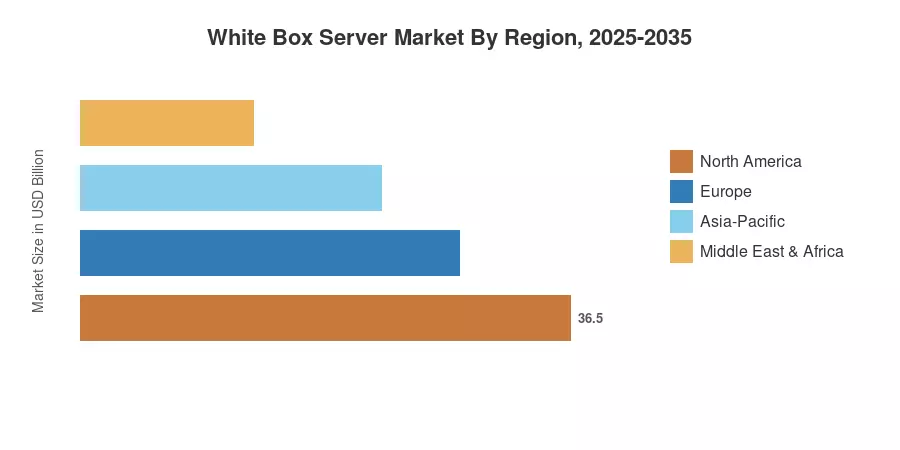
North America commands approximately 32.4% of the White Box Server Market, anchored by U.S. hyperscaler capital expenditure. Asia-Pacific is the fastest-growing region at an estimated CAGR of 16.3%, driven by Taiwan's ODM cluster and expanding cloud build-outs across India and Southeast Asia. Europe holds the second-largest share at roughly 24.8%, buoyed by EU digital-sovereignty mandates and growing colocation demand. As sovereign-cloud policies tighten and AI workloads diversify, the White Box Server Market is positioned for sustained double-digit expansion through 2035.


Key Report Takeaways

• By Server Type

  • Rack-mounted servers accounted for 38.6% of the White Box Server Market in 2025, reflecting their dominance in hyperscale and colocation deployments.
  • GPU servers are forecast to register the fastest segment CAGR of 15.5% through 2035, propelled by generative-AI training and inference infrastructure.

• By Processor & Organization

  • x86 architectures retained 85.2% of processor-type revenue in the White Box Server Market during 2025.
  • Small and medium enterprises are expanding adoption at an estimated CAGR of 14.8%, narrowing the gap with large-enterprise buyers.

• By Region

  • North America led the White Box Server Market with 32.4% share in 2025, driven by sustained hyperscaler CapEx.
  • Asia-Pacific is projected to post the fastest regional CAGR of 16.3% through 2035.


White Box Server Market Size and Forecast (2021–2035)

Market Research Future's sizing methodology combines bottom-up ODM shipment tracking with top-down cloud CapEx modeling, triangulated against publicly disclosed hyperscaler procurement data and OCP contribution filings. Historical values (2021–2024) draw from audited financial disclosures of leading Taiwanese ODMs — Quanta Computer, Wistron/Wiwynn, and Inventec — while the forecast incorporates planned data-center build-outs announced by major cloud operators through 2035 [5].
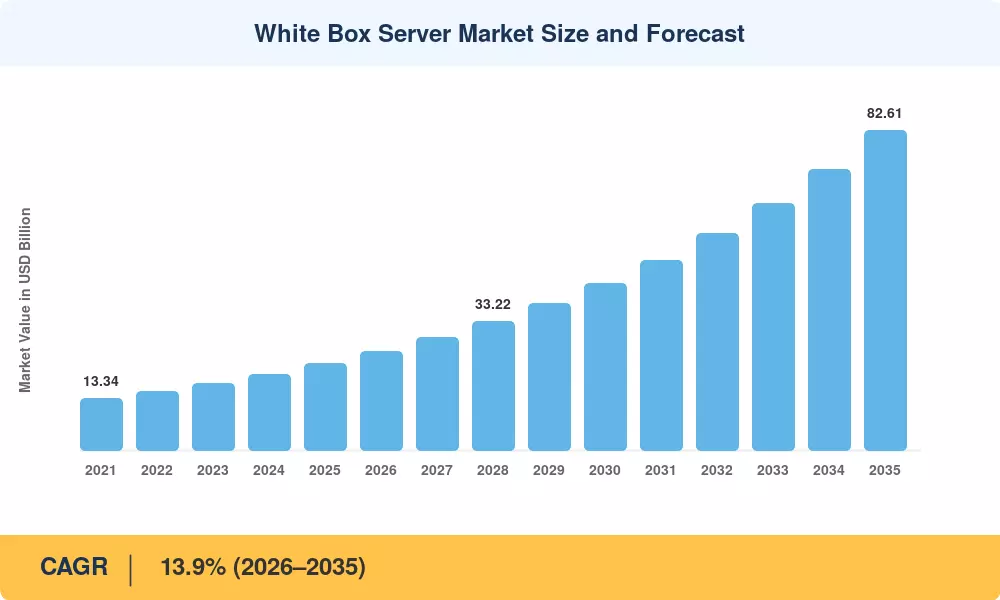
White Box Server Market Size and Forecast
Our Impact
Enabled $4.3B Revenue Impact for Fortune 500 and Leading Multinationals
Partnering with 2000+ Global Organizations Each Year
30K+ Citations by Top-Tier Firms in the Industry

Driver Impact Analysis

Driver ~% Impact on CAGR Geographic Relevance Impact Timeline
Hyperscale Cloud CapEx Expansion ~28% North America, Asia-Pacific Short-term (≤2 yr)
AI / GPU-Dense Workload Proliferation ~24% Global Short-term (≤2 yr)
OCP Standardization & Ecosystem Growth ~16% Global Medium-term (2–4 yr)
Total Cost of Ownership Advantage over OEM ~12% Europe, Asia-Pacific Medium-term (2–4 yr)
Sovereign Cloud & Data Localization Mandates ~9% Europe, MEA, South America Medium-term (2–4 yr)
Edge Computing & Distributed Inference Demand ~7% North America, Asia-Pacific Long-term (≥4 yr)
Liquid-Cooling & High-Density Rack Innovation ~4% Global Long-term (≥4 yr)


Hyperscale Cloud CapEx Expansion

The three largest U.S. hyperscalers — Amazon Web Services, Microsoft Azure, and Google Cloud — collectively committed over USD 160 Billion in capital expenditure for 2025, with approximately 65–70% directed toward server and networking hardware [1]. White box procurement from Taiwanese ODMs now represents the majority of these orders. Meta's 2024 disclosure that it would deploy more than 350,000 NVIDIA H100 GPUs through ODM-built racks underscored the scale at which branded-server alternatives have been displaced [6]. This CapEx surge creates a self-reinforcing cycle: as hyperscalers standardize on white-box platforms, component suppliers optimize production lines for those designs, further reducing unit costs.

AI and GPU-Dense Workload Proliferation

Training a single frontier large language model now requires clusters exceeding 25,000 GPUs, and inference demand for deployed models is growing at roughly 10× year-over-year [6]. Traditional OEM server chassis were not engineered for the thermal and power-density requirements of 700W+ accelerators. ODMs responded faster, delivering custom GPU trays with direct-to-chip liquid cooling within six-month design cycles — a timeline branded vendors struggle to match [8]. This agility has made the White Box Server Market the default supply channel for AI infrastructure.

OCP Standardization

The Open Compute Project released its fourth-generation server specifications in late 2024, covering 48V power distribution, disaggregated BMC management, and modular I/O mezz cards [3]. Over 60 data-center operators worldwide have adopted OCP-compliant rack designs, reducing integration engineering effort by an estimated 35% compared to proprietary alternatives. The ripple effect reaches procurement teams: standardized specs enable competitive bidding across multiple ODMs, exerting further price pressure that benefits the White Box Server Market.

Sovereign Cloud and Data Localization

The EU Data Act (effective September 2025) and India's Digital Personal Data Protection Act (2023) require in-country data processing for specified categories of citizen information [7]. Governments and regulated enterprises increasingly source white-box servers to build sovereign-cloud stacks at lower cost than licensed OEM solutions. Indonesia, Saudi Arabia, and Brazil have each announced national data-center incentive programs exceeding USD 1 Billion in combined public-private investment [13].


Restraints Impact Analysis

Restraint estimates follow the same directional methodology described in Section 4. Negative percentages represent estimated drag on the CAGR; they are not linearly subtracted from the growth rate.

Restraint ~% Drag on CAGR Geographic Relevance Impact Timeline
Supply Chain Concentration in Taiwan ~−8% Global Short-term (≤2 yr)
Limited After-Sales Support vs. OEM ~−6% Europe, South America Medium-term (2–4 yr)
Firmware & Security Certification Gaps ~−5% North America, Europe Medium-term (2–4 yr)
Tariff and Trade Policy Uncertainty ~−4% North America, Asia-Pacific Short-term (≤2 yr)
Component Allocation Conflicts during Shortage Cycles ~−3% Global Long-term (≥4 yr)


Supply Chain Concentration in Taiwan

Roughly 85% of global white-box server output originates from a handful of Taiwanese ODMs clustered in the Greater Taipei and Taoyuan corridors [16]. Geopolitical tensions across the Taiwan Strait and periodic seismic risks expose the White Box Server Market to concentrated supply disruption. The 2024 Hualien earthquake temporarily idled production at two major ODM campuses, delaying hyperscaler shipments by an estimated three weeks. Diversification into Malaysia, Mexico, and Vietnam is underway but remains below 10% of aggregate capacity.

Limited After-Sales Support

Enterprises migrating from branded servers to white-box alternatives often sacrifice global break-fix logistics and integrated firmware lifecycle management. While hyperscalers maintain internal hardware engineering teams capable of self-support, mid-market buyers with 500–2,000 servers lack this depth. The perception of higher operational risk constrains the White Box Server Market's penetration into verticals like banking and government, where SLA-backed vendor support is a procurement prerequisite.

Firmware and Security Certification

White-box platforms must navigate the same compliance landscape as OEM servers — FIPS 140-3, Common Criteria, and NIST SP 800-193 platform firmware resilience guidelines — without the dedicated certification teams that HP Enterprise, Dell, and Lenovo maintain [18]. Achieving and sustaining these certifications adds 6–12 months to product-readiness timelines, limiting adoption in defense, healthcare, and critical-infrastructure segments.


White Box Server Market Opportunities

AI Inference at the Edge

As inference transitions from centralized GPU clusters to dispersed edge nodes — cell towers, retail locations, manufacturing floors — the need for compact, thermally optimized white-box platforms is emerging [10]. This opportunity might provide an added USD 4-6 Billion in addressable revenue by 2032.


As-a-Service and Managed White-Box Offerings

Some ODMs are trying out hardware-as-a-service offerings that bundle server hardware, remote management, firmware upgrades, and lifecycle services. These products can fill the support gap seen in Section 5.2 to unleash mid-market enterprise demand and generate a recurring revenue stream for the White Box Server Market.


Emerging-Market Data-Center Build-Outs

More than USD 50 billion in data-center investment is collectively planned by Southeast Asia, the Middle East and Latin America through 2030 [13]. Cost-sensitive operators in these regions are natural white-box infrastructure customers, particularly in areas lacking OEM distribution and service networks.


Liquid-Cooling and High-Density Rack Integration

Next-generation circuits are driving the power envelope of GPUs beyond 1,000W per accelerator. OEMs still using air-cooled reference designs are at a design-win disadvantage relative to ODMs using factory-integrated direct-liquid-cooling manifolds [8]. This thermal-engineering expertise positions the White Box Server Market to dominate the fastest-expanding hardware sub-segment.


Data Monetization through Telemetry Platforms

ODMs and their cloud partners are exploring monetization of fleet-wide telemetry data — vibration patterns, thermal drift, failure-mode signatures — to feed predictive-maintenance AI models [21]. Anonymized benchmarking datasets could become a secondary revenue channel, adding value beyond hardware margins.


White Box Server Market Future Outlook

AI Infrastructure Scaling and Autonomous Operations

By 2030, inference workloads are expected to exceed training in total compute demand, fundamentally reshaping server fleet composition [6]. Autonomous data-center operations — encompassing AI-driven thermal management, predictive hardware decommissioning, and self-healing firmware — will lower operational costs by an estimated 15–20%, reinforcing the White Box Server Market's cost-competitiveness relative to managed OEM estates. The International Energy Agency projects global data-center electricity consumption will surpass 1,000 TWh by 2028, making energy-efficient server design a procurement priority [22].

Platform Economics and ODM Vertical Integration

Leading ODMs are integrating forward into system software, BMC firmware, and managed services, transforming from contract manufacturers into platform providers. Wiwynn's cloud management stack and Supermicro's turnkey rack-scale solutions illustrate this trend. The White Box Server Market will increasingly resemble a platform ecosystem rather than a commodity hardware bazaar, with differentiation hinging on software capabilities and design-win velocity.

Sustainability and Circular Hardware Models

The EU Corporate Sustainability Reporting Directive (CSRD) and California's SB 253 climate disclosure rule compel data-center operators to report Scope 3 emissions, including embodied carbon in server hardware [23]. ODMs that offer lifecycle carbon assessments, design-for-disassembly chassis, and certified refurbishment programs will gain preferred-vendor status. Circular-economy models — server remanufacturing, component harvesting, and second-life deployments — could extend useful hardware life from 4–5 years to 7–8 years, altering replacement-cycle assumptions for the White Box Server Market.

Chiplet Architectures and Heterogeneous Compute

The transition from monolithic dies to chiplet-based processor designs (AMD EPYC, Intel Granite Rapids, custom ARM Neoverse) enables ODMs to mix and match compute, I/O, and memory tiles for workload-specific server configurations [9]. This modularity reinforces the white-box value proposition: buyers can optimize silicon allocation without being locked into a single OEM's product roadmap. By 2033, heterogeneous compute — combining CPUs, GPUs, FPGAs, and domain-specific accelerators on a single baseboard — is projected to represent over 30% of new server shipments [14].


White Box Server Market Segmentation

By Server Type

Segment Key Metric Primary Demand Driver
Rack Mounted Server 38.6% share (2025) Hyperscale and colocation standardization
GPU Server CAGR 15.5% (2026–2035) AI training and inference clusters
Twin Server USD 2.14 Billion (2025) High-density virtualization
Blade Server 8.9% share (2025) Enterprise private-cloud consolidation
Storage Server CAGR 12.1% (2026–2035) Object-storage and analytics platforms


Rack-mounted servers remain the workhorse of the White Box Server Market, favored by hyperscalers for their standardized form factor and ease of hot-swap maintenance. The shift toward OCP-compliant Open Rack v3 designs has further cemented rack-mount dominance by enabling 48V power distribution and tool-less serviceability. GPU servers represent the most dynamic growth vector: NVIDIA's partnership with Taiwanese ODMs for HGX and MGX reference architectures has compressed design-to-deployment timelines, letting cloud operators refresh AI clusters on six-to-nine-month cadences rather than the 18-month cycles typical of OEM platforms [6].

By Processor Type

Segment Key Metric Primary Demand Driver
X86 Servers 85.2% share (2025) Broad software ecosystem; AMD EPYC gains
Non-X86 Servers CAGR 21.5% (2026–2035) ARM Neoverse; RISC-V custom silicon


x86 processors — spanning AMD EPYC and Intel Xeon families — underpin the overwhelming majority of the White Box Server Market, supported by decades of software-stack optimization. ARM-based alternatives are gaining traction rapidly: AWS Graviton, Ampere Altra, and NVIDIA Grace demonstrate that ARM can deliver competitive performance per watt for cloud-native and AI-inference workloads [9]. RISC-V remains nascent in server silicon but is attracting investment from China's domestic chip ecosystem and European research consortia, pointing to a more heterogeneous processor landscape by the early 2030s.

By Organization Size

Segment Key Metric Primary Demand Driver
Large Enterprise 58.8% share (2025) Scale economies; in-house engineering capability
Small and Medium Enterprise CAGR 14.8% (2026–2035) Managed white-box services; hosted private cloud


Large enterprises and hyperscalers dominate procurement, leveraging dedicated hardware-engineering teams to customize ODM designs. The White Box Server Market is increasingly accessible to SMEs; however, as managed-service providers offer turnkey white-box rack solutions with bundled support, firmware updates, and spare-parts logistics.

By End-User Vertical

Segment Key Metric Primary Demand Driver
IT & Telecommunications 25.8% share (2025) Cloud service delivery; 5G core
Healthcare CAGR 14.4% (2026–2035) Medical imaging AI; EHR platforms
BFSI USD 3.48 Billion (2025) Trading systems; regulatory compute
Government & Defense CAGR 13.6% (2026–2035) Sovereign cloud; national AI programs
Retail & E-Commerce 9.3% share (2025) Recommendation engines; logistics AI


IT and telecommunications firms anchor the White Box Server Market's end-user landscape, driven by cloud-service operators building out new regions and 5G-core network functions. Healthcare is emerging as the fastest-growing vertical: hospital systems and pharmaceutical companies are deploying GPU-accelerated servers for radiology AI, drug-discovery simulations, and genomic sequencing pipelines, often through white-box channels to keep per-node costs below the stringent budgets of publicly funded health systems [21].


Regional Market Share Analysis

Region Key Metric (2025) Primary Investment Themes
North America 32.4% share Hyperscaler CapEx; AI infrastructure
Europe 24.8% share Sovereign cloud; colocation expansion
Asia-Pacific CAGR 16.3% (2026–2035) ODM manufacturing; India cloud build-out
South America USD 1.75 Billion Data-localization mandates; fintech growth
Middle East & Africa USD 1.53 Billion National data-center programs; smart-city plans
Total USD 22.48 Billion

The White Box Server Market exhibits pronounced regional variation driven by data-center density, ODM proximity, regulatory posture, and cloud-adoption maturity.


North America

Country Key Metric Key Driver
United States 78.5% of regional share Hyperscaler HQ procurement
Canada CAGR 13.2% AI research corridors in Toronto and Montreal
Mexico USD 0.41 Billion (2025) Nearshoring of ODM assembly


The United States alone accounted for the majority of North American white-box server procurement in 2025, driven by the capital spending programs of AWS, Azure, Google, and Meta. U.S. Department of Energy supercomputing contracts increasingly specify OCP-compliant white-box nodes, reinforcing the White Box Server Market's position in federal and research segments [1]. Canada's AI ecosystem, anchored by the Vector Institute and CIFAR, is catalyzing GPU-server deployments across public cloud and university clusters. Mexico's emerging role as a nearshore assembly hub — with Foxconn and Wistron expanding Juárez and Guadalajara campuses — adds a manufacturing dimension to the region's growth profile.

Europe

Country Key Metric Key Driver
Germany 22.3% of regional share Industrial cloud and Industrie 4.0
United Kingdom CAGR 14.1% Fintech and sovereign AI programs
France USD 0.72 Billion (2025) OVHcloud and Scaleway expansion
Italy CAGR 12.8% Colocation campus development
Spain USD 0.38 Billion (2025) Renewable-powered data centers
Nordic Countries 11.4% of regional share Cold-climate cooling advantages
Russia CAGR 9.5% Domestic import-substitution mandates
Rest of Europe USD 0.61 Billion (2025) EU cohesion fund allocations


Europe's White Box Server Market benefits from the EU's push for digital sovereignty under the European Data Act and the IPCEI-CIS (Important Projects of Common European Interest — Cloud Infrastructure and Services) initiative, which has earmarked over EUR 4.6 Billion in state aid for EU-based cloud infrastructure [7]. Germany's Industrie 4.0 deployments are driving on-premises white-box adoption in manufacturing, while the UK government's 2024 AI Opportunities Action Plan committed GBP 1.3 Billion to national compute capacity, much of it procured through ODM channels.

Asia-Pacific

Country Key Metric Key Driver
China 36.8% of regional share Domestic cloud giants (Alibaba, Tencent, Baidu)
India CAGR 18.2% Digital India; Jio and Airtel cloud CapEx
Japan USD 1.14 Billion (2025) Enterprise IT modernization
South Korea CAGR 15.4% Samsung SDS, Naver Cloud build-out
ASEAN USD 0.92 Billion (2025) Indonesia and Malaysia data-center hubs
Rest of Asia-Pacific CAGR 13.5% Regional connectivity investments


Asia-Pacific is the growth engine for the White Box Server Market. Taiwan's ODM corridor — Quanta, Wistron/Wiwynn, Inventec, MiTAC — produces the vast majority of the world's white-box servers and benefits from proximity to TSMC's advanced packaging lines. China's domestic cloud operators procure heavily from local and Taiwanese ODMs under favorable trade terms. India's data-center market surpassed 1 GW of IT load capacity in 2024, with Reliance Jio, Bharti Airtel, and the Adani Group each announcing multi-billion-dollar expansion plans that favor cost-optimized white-box procurement [13].

South America

Country Key Metric Key Driver
Brazil 61.5% of regional share LGPD enforcement; fintech data centers
Argentina CAGR 12.6% Agricultural-tech cloud adoption
Rest of South America USD 0.28 Billion (2025) Chile and Colombia colocation growth


Brazil dominates South America's White Box Server Market thanks to São Paulo's emergence as a Tier-1 colocation hub. The country's data-protection law (LGPD) encourages in-country processing, and hyperscalers have responded with new availability zones that draw on ODM-sourced infrastructure [7]. Argentina and Chile are secondary growth pockets, driven by agricultural data platforms and copper-mining analytics workloads.

Middle East & Africa

Country Key Metric Key Driver
Saudi Arabia 31.2% of regional share NEOM and Vision 2030 digital infrastructure
UAE CAGR 15.8% AI strategy; regional cloud hub ambitions
South Africa USD 0.21 Billion (2025) Financial-services data centers
Egypt CAGR 13.4% Submarine cable landing investments
Rest of MEA USD 0.34 Billion (2025) East Africa connectivity corridor


The Middle East is investing heavily in compute sovereignty. Saudi Arabia's National Data Management Office and the UAE's AI Strategy 2031 have together earmarked more than USD 15 Billion for domestic cloud and AI infrastructure [13]. White-box servers are the preferred procurement vehicle where government buyers prioritize cost efficiency and vendor-neutral architectures. South Africa's Johannesburg and Cape Town corridors serve as the primary hosting markets for sub-Saharan Africa, while Egypt benefits from its position as a submarine-cable nexus connecting Europe, Asia, and East Africa.


White Box Server Market By Region, 2025-2035

Competitive Benchmarking

The White Box Server Market exhibits high concentration among a small cluster of Taiwanese ODMs and a handful of vertically integrated specialists. The top five companies command an estimated 60–68% of global revenue, reflecting the capital intensity of motherboard design, thermal engineering, and high-volume manufacturing. Market concentration (estimated HHI of 1,100–1,300) indicates a moderately concentrated competitive structure with limited room for new entrants lacking scale.

Company Est. Revenue Share Range Key Offerings Strategic Positioning
Quanta Computer ~14–18% Rack, GPU, and storage servers for hyperscalers Largest ODM by volume; deep Meta and Microsoft relationships
Wistron / Wiwynn ~12–16% OCP-optimized rack and GPU servers Cloud-focused subsidiary model; strong AWS ties
Inventec ~8–12% Rack and blade servers; HPC nodes Broad portfolio; Japan and China penetration
MiTAC Holdings ~5–8% Storage servers; edge platforms Niche leadership in storage and embedded
Supermicro ~7–11% GPU servers; liquid-cooling racks Vertically integrated U.S.-based; rapid design cycles
Foxconn (Hon Hai Precision) ~6–9% Large-scale rack assembly; EV-adjacent edge servers Manufacturing scale; Mexico and India expansion
Compal Electronics ~3–5% Value-tier rack servers Price-competitive; emerging-market distribution
Pegatron ~2–4% Entry-level servers and edge nodes Consumer-electronics manufacturing leverage
ZT Systems ~3–5% GPU-optimized AI infrastructure U.S.-based; acquired by AMD in 2024
Celestica ~2–4% Networking and server integration EMS heritage; hyperscaler diversification


Recent News & Developments


  • European Commission (December 2023 ): Approved EUR 1.2 Billion in IPCEI-CIS state aid for cloud-infrastructure projects across 12 member states, including white-box server procurement for sovereign-cloud platforms [7].
  • India Ministry of Electronics and IT (March 2024 ): Launched the IndiaAI Mission with an initial allocation of INR 103.57 Billion (approximately USD 1.25 Billion) for AI compute infrastructure, specifying cost-efficient server procurement pathways [13].


White Box Server Market Report Scope

Parameter Detail
Market Scope Global White Box Server Market — hardware revenue at ODM/integrator level
Study Period 2021–2035
CAGR (Forecast) 13.9% (2026–2035)
Market Size — 2025 (Base Year) USD 22.48 Billion
Market Size — 2035 (Forecast Endpoint) USD 82.61 Billion
Fastest Growing Segment GPU Servers (by server type); Non-X86 (by processor type)
Companies Profiled Quanta Computer, Wistron/Wiwynn, Inventec, MiTAC, Supermicro, Foxconn, Compal, Pegatron, ZT Systems, Celestica
Valuation Currency USD Billion


FAQs

How do white-box servers differ from branded OEM servers in warranty coverage?

White-box servers typically carry a one-year parts warranty from the ODM, compared to three-to-five-year comprehensive warranties from OEMs. Buyers offset this gap through spare-parts inventory and third-party maintenance contracts.

What procurement risks should buyers evaluate before switching to white-box infrastructure?

Firmware security certification, single-source supply concentration in Taiwan, and integration with existing DCIM tools are the top three risks. A phased pilot deployment of 5–10% of fleet capacity mitigates transition exposure [16].

Can small enterprises realistically adopt white-box servers without in-house hardware engineers?

Yes — managed white-box providers now offer turnkey rack solutions with remote monitoring and firmware lifecycle services. These packages close the support gap at price points 15–20% below comparable OEM contracts.

How does the Open Compute Project affect vendor lock-in?

OCP specifications ensure interoperability across multiple ODMs, letting buyers switch suppliers without redesigning rack power or cooling interfaces. This portability reduces lock-in risk relative to proprietary OEM chassis [3].

What role does liquid cooling play in white-box GPU server competitiveness?

Direct-to-chip liquid cooling enables GPU racks to operate at 80–100 kW per rack, far exceeding air-cooled limits. ODMs that factory-integrate cooling manifolds offer a six-month time-to-deployment advantage over retrofit approaches [8].

Are white-box servers suitable for regulated industries such as banking?

Adoption in banking is growing but requires additional firmware hardening and FIPS 140-3 validation. Several ODMs now partner with security-certification labs to pre-qualify platforms for financial-services compliance [18].

How will chiplet-based processors change white-box server design?

Chiplet architectures allow ODMs to assemble workload-specific silicon combinations on a single baseboard. This modularity deepens the customization advantage that defines the White Box Server Market [14].


Author
Author
Author Profile
Ankit Gupta LinkedIn
Team Lead - Research
Ankit Gupta is a seasoned market intelligence and strategic research professional with over six plus years of experience in the ICT and Semiconductor industries. With academic roots in Telecom, Marketing, and Electronics, he blends technical insight with business strategy. Ankit has led 200+ projects, including work for Fortune 500 clients like Microsoft and Rio Tinto, covering market sizing, tech forecasting, and go-to-market strategies. Known for bridging engineering and enterprise decision-making, his insights support growth, innovation, and investment planning across diverse technology markets.
Co-Author
Co-Author Profile
Aarti Dhapte LinkedIn
AVP - Research
A consulting professional focused on helping businesses navigate complex markets through structured research and strategic insights. I partner with clients to solve high-impact business problems across market entry strategy, competitive intelligence, and opportunity assessment. Over the course of my experience, I have led and contributed to 100+ market research and consulting engagements, delivering insights across multiple industries and geographies, and supporting strategic decisions linked to $500M+ market opportunities. My core expertise lies in building robust market sizing, forecasting, and commercial models (top-down and bottom-up), alongside deep-dive competitive and industry analysis. I have played a key role in shaping go-to-market strategies, investment cases, and growth roadmaps, enabling clients to make confident, data-backed decisions in dynamic markets.

Research Approach


Secondary Research

The secondary research process involved comprehensive analysis of technology regulatory databases, peer-reviewed engineering journals, data center industry publications, and authoritative ICT organizations. Key sources included the National Institute of Standards and Technology (NIST) Special Publications on cloud and data center infrastructure, Federal Communications Commission (FCC) equipment authorization databases, European Telecommunications Standards Institute (ETSI) technical specifications, International Telecommunication Union (ITU) ICT statistics, U.S. Department of Energy (DOE) Data Center Energy Efficiency reports, OECD Digital Economy Outlook, National Center for Science and Engineering Statistics (NCSES), and IEEE Xplore digital library for server architecture research. Industry-specific sources included the Open Compute Project (OCP) specification databases, Open Data Center Committee (ODCC) white papers, PCI-SIG standards documentation, Storage Networking Industry Association (SNIA) technical reports, Uptime Institute Global Data Center Survey, ASHRAE Technical Committee 9.9 (Mission Critical Facilities), and The Green Grid sustainability metrics. Market intelligence was gathered from IDC Global Server Tracker, Gartner Data Center Market guides, Omdia Cloud & Data Center Intelligence, S&P Global Market Intelligence (451 Research), Synergy Research Group hyperscale tracking, and BloombergNEF digital infrastructure analysis.

Server shipment statistics, ODM market share data, energy efficiency standards, workload virtualization trends, pricing benchmarks, and supply chain dynamics for x86 and ARM-based custom server architectures were gathered using these sources.


Primary Research

Qualitative and quantitative insights were obtained by interviewing supply-side and demand-side stakeholders during the primary research process. The supply-side sources consisted of Chief Technology Officers, General Managers of Cloud Infrastructure, VP of Server Product Development, and ODM (Original Design Manufacturer) business unit heads from white box server manufacturers such as Quanta Computer, Foxconn (Hon Hai), Inventec, Wistron, Wiwynn, and Celestica, as well as component suppliers (Intel, AMD, NVIDIA, Marvell). Demand-side sources included Chief Information Officers, VP of Infrastructure Engineering, Data Center Operations Directors from hyperscalers (Amazon Web Services, Google Cloud, Meta Platforms, Microsoft Azure) and colocation providers (Equinix, Digital Realty), and IT procurement leads from Fortune 500 enterprises in the financial services, telecommunications, and e-commerce sectors. Server configuration preferences were validated across X-86 and ARM/OpenPower architectures through primary research. Direct engagement timelines with ODMs were confirmed, and insights regarding bare-metal provisioning adoption, rack-scale disaggregation trends, open networking integration, and total cost of ownership (TCO) analysis for customized server deployments versus traditional OEM procurement were gathered.

Primary Respondent Breakdown:

• By Designation: C-level Primaries (32%), Director Level (30%), Others (38%)

• By Region: North America (38%), Europe (26%), Asia-Pacific (28%), Rest of World (8%)


Market Size Estimation

Revenue mapping and server shipment volume analysis were employed to determine the global market valuation for white-label and ODM-direct server deployments. The methodology comprised the following:

• The identification of over 50 significant ODMs and white box system integrators in Taiwan, China, North America, and Europe

• Component mapping between X-86 (Intel Xeon, AMD EPYC) and Non-X86 (ARM-based Graviton, Ampere Altra, IBM Power) architectures, encompassing motherboard designs, custom power supply units, and network interface controllers (NICs).

• Analyze the reported and modeled annual revenues that are specific to custom server manufacturing units (CMUs), excluding branded OEM server revenue (HPE, Dell EMC, Lenovo) from direct market measurement, while accounting for ODM backend manufacturing relationships.

• 75-80% of the global white box server units shipped in 2024 are represented by direct hyperscale engagements and ODMs.

• Segment-specific valuations for enterprise customers versus hyperscale data center operators are derived through extrapolation using bottom-up (server unit shipments × Average Selling Price by processor type, form factor [rack/tower/blade], and region) and top-down (ODM revenue validation against cloud infrastructure CapEx data) approaches. Each segment is modeled separately for storage-optimized, compute-optimized, and GPU-accelerated white box configurations.

Download Free Sample

Kindly complete the form below to receive a free sample of this Report

Download PDF ×

We do not share your information with anyone. However, we may send you emails based on your report interest from time to time. You may contact us at any time to opt-out.