×
Request Free Sample ×

Kindly complete the form below to receive a free sample of this Report

* Please use a valid business email

Leading companies partner with us for data-driven Insights

clients tt-cursor
Hero Background

Wind Energy Equipment Logistic Market

ID: MRFR/PCM/24994-HCR
200 Pages
Swapnil Palwe
October 2025

Wind Energy Equipment Logistic Market

Share:
Download PDF ×

We do not share your information with anyone. However, we may send you emails based on your report interest from time to time. You may contact us at any time to opt-out.

Wind Energy Equipment Logistic Market Infographic
Purchase Options

Wind Energy Equipment Logistic Market Summary

As per MRFR analysis, the Wind Energy Equipment Logistic Market was estimated at 7.11 USD Billion in 2024. The wind energy logistics industry is projected to grow from 7.55 USD Billion in 2025 to 12.97 USD Billion by 2035, exhibiting a compound annual growth rate (CAGR) of 6.2 during the forecast period 2025 - 2035.

Key Market Trends & Highlights

The Wind Energy Equipment Logistic Market is poised for substantial growth driven by technological advancements and increasing demand for renewable energy.

  • Technological advancements in logistics are enhancing efficiency in the wind energy equipment sector.
  • Sustainability and environmental considerations are becoming central to logistics strategies in North America and Asia-Pacific.
  • Collaboration and partnerships among stakeholders are fostering innovation and improving supply chain dynamics.
  • The increasing demand for renewable energy and regulatory support are key drivers propelling growth in the transportation and installation segments.

Market Size & Forecast

2024 Market Size 7.11 (USD Billion)
2035 Market Size 12.97 (USD Billion)
CAGR (2025 - 2035) 6.2%

Major Players

Siemens Gamesa (ES), GE Renewable Energy (US), Vestas Wind Systems (DK), Nordex (DE), MHI Vestas Offshore Wind (DK), Senvion (DE), Goldwind (CN), Envision Energy (CN), Suzlon Energy (IN), Acciona Energy (ES)

Wind Energy Equipment Logistic Market Trends

The Wind Energy Equipment Logistic Market is currently experiencing a transformative phase, driven by the increasing global emphasis on renewable energy sources. As nations strive to meet ambitious sustainability targets, the demand for wind energy solutions has surged. This market encompasses a wide array of activities, including the transportation, installation, and maintenance of wind turbines and related equipment. The logistics involved are complex, requiring specialized knowledge and infrastructure to ensure efficiency and safety. Companies operating within this sector are adapting to evolving technologies and regulatory frameworks, which may influence operational strategies and investment decisions. Moreover, the Wind Energy Equipment Logistic Market appears to be influenced by advancements in digital technologies, such as automation and data analytics. These innovations could enhance supply chain management and optimize logistics processes, potentially leading to cost reductions and improved service delivery. As the market evolves, collaboration among stakeholders, including manufacturers, logistics providers, and energy companies, is likely to become increasingly vital. This collaborative approach may facilitate the sharing of best practices and resources, ultimately contributing to the overall growth and sustainability of the wind energy sector.

Technological Advancements in Logistics

The Wind Energy Equipment Logistic Market is witnessing a notable shift due to the integration of advanced technologies. Innovations such as automation, artificial intelligence, and data analytics are enhancing operational efficiency. These technologies may streamline processes, reduce costs, and improve decision-making, thereby transforming traditional logistics practices.

Sustainability and Environmental Considerations

There is a growing emphasis on sustainability within the Wind Energy Equipment Logistic Market. Companies are increasingly adopting eco-friendly practices to minimize their environmental impact. This trend may involve optimizing transportation routes, utilizing renewable energy sources for logistics operations, and implementing waste reduction strategies.

Collaboration and Partnerships

The Wind Energy Equipment Logistic Market is likely to see an increase in collaboration among various stakeholders. Partnerships between manufacturers, logistics providers, and energy companies may enhance resource sharing and knowledge exchange. This collaborative approach could lead to improved efficiency and innovation in logistics operations.

Market Segment Insights

By Application: Transportation (Largest) vs. Installation (Fastest-Growing)

The Wind Energy Equipment Logistic Market reveals a diverse allocation of share among its application segments. Transportation remains the largest segment, dominating the market due to the essential nature of transporting wind turbine components and equipment to installation sites. Installation follows closely, showcasing its critical role as wind energy projects expand globally, hence, benefitting from substantial investments in new capacities and infrastructure. Growth trends in the market are significantly influenced by a surge in renewable energy adoption and government initiatives supporting wind energy projects. As the industry evolves, factors such as technological advancements, enhanced logistical efficiencies, and increasing focus on sustainable practices are contributing to the rapid growth of the Installation segment, making it a promising area for future investment and innovation.

Transportation (Dominant) vs. Maintenance (Emerging)

Transportation serves as a dominant force within the Wind Energy Equipment Logistic Market due to its indispensability in facilitating the movement of oversized turbine components from manufacturers to installation sites. This segment is characterized by well-established logistics networks and transportation solutions adept at managing high-value cargo. Conversely, Maintenance is emerging as a segment of great significance, driven by the increasing number of installed wind farms requiring regular upkeep and servicing to ensure peak operational efficiency. As technology advances, smart maintenance solutions are being developed, enhancing reliability and reducing downtime. The need for sustainable practices in energy production further emphasizes the importance of both segments in the logistical landscape of wind energy.

By Equipment Type: Wind Turbine Components (Largest) vs. Handling Equipment (Fastest-Growing)

In the Wind Energy Equipment Logistic Market, Wind Turbine Components represent the largest segment, showcasing a significant share of the overall market. This sector is pivotal as it includes essential parts of wind turbines such as blades, nacelles, and towers, which are critical for operational efficiency. Conversely, Handling Equipment, while smaller in share compared to turbine components, is witnessing rapid expansion due to increasing automation and the need for efficient logistics handling processes.

Wind Turbine Components (Dominant) vs. Handling Equipment (Emerging)

Wind Turbine Components dominate the Wind Energy Equipment Logistic Market due to their fundamental role in turbine assembly and performance. This segment includes a variety of critical parts that are integral to wind energy systems. Handling Equipment, on the other hand, is emerging rapidly as a key player in the industry, driven by advances in logistics technology. Its growth is fueled by the need for sophisticated equipment that can effectively manage the complex logistics of transporting heavy and delicate turbine components. The rising demand for efficiency and reliability in transport operations gives Handling Equipment a compelling position in the market.

By Service Type: Transportation Services (Largest) vs. Installation Services (Fastest-Growing)

In the Wind Energy Equipment Logistic Market, Transportation Services holds the largest share among all service types, as it is vital for efficiently moving large wind turbine components across varying terrains. Installation Services, although smaller in market share, is emerging rapidly, reflecting advancements in technological integration and the increasing complexity of wind turbine assembly.

Transportation Services (Dominant) vs. Maintenance Services (Emerging)

Transportation Services remains dominant in the Wind Energy Equipment Logistic Market, as it encompasses a wide array of logistical needs, including the safe handling and movement of oversized turbine components. This service is characterized by its crucial role in project timelines and cost management, thus enhancing its significance. On the other hand, Maintenance Services is an emerging segment driven by the growing emphasis on operational efficiency and the need for ongoing support post-installation. As wind energy projects mature, demand for specialized maintenance services is increasing, showcasing a shift toward ensuring long-term functionality and reliability for wind farms.

By End User: Energy Companies (Largest) vs. Construction Firms (Fastest-Growing)

In the Wind Energy Equipment Logistic Market, Energy Companies hold the largest market share, driving the demand for logistics services tailored to wind energy projects. These companies require efficient transportation and installation of wind turbines, leading to a robust logistic support system. Conversely, Construction Firms are experiencing the fastest growth in the sector. They are increasingly involved in the development of wind energy projects, necessitating specialized logistics services to ensure timely project completion and adherence to safety standards.

Energy Companies (Dominant) vs. Construction Firms (Emerging)

Energy Companies play a dominant role in the Wind Energy Equipment Logistic Market by requiring sophisticated logistics solutions for transporting and installing wind energy equipment. Their established operations and extensive networks enable them to negotiate favorable contracts and ensure efficient project execution. On the other hand, Construction Firms are emerging as significant players, with a growing focus on integrating renewable energy into their projects. They are adapting quickly to the needs of the wind energy sector, showcasing flexibility and innovation in logistics management. This dichotomy between dominant and emerging players illustrates the diverse landscape within the market, highlighting the essential role both sectors play in advancing wind energy initiatives.

Get more detailed insights about Wind Energy Equipment Logistic Market

Regional Insights

North America : Renewable Energy Leader

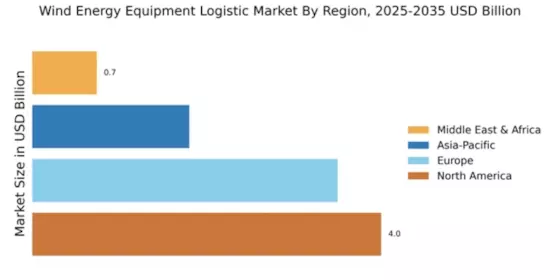
North America is witnessing significant growth in the Wind Energy Equipment Logistic Market, driven by increasing investments in renewable energy and supportive government policies. The market size reached $2.83 billion in December 2025, reflecting a robust demand for wind energy solutions. Regulatory incentives and tax credits are catalyzing the expansion of wind farms, contributing to a favorable environment for logistics services in this sector. The United States stands as a leader in this region, with key players like GE Renewable Energy and Siemens Gamesa driving innovation and efficiency in logistics. The competitive landscape is characterized by a mix of established firms and emerging players, all vying for a share of the growing market. As the demand for wind energy continues to rise, logistics providers are adapting to meet the challenges of transporting large equipment and components across vast distances, ensuring timely project completions.

Europe : Market Share Dominance

Europe has established itself as a powerhouse in the Wind Energy Equipment Logistic Market, boasting a market size of $3.55 billion as of December 2025. The region's growth is fueled by ambitious renewable energy targets and stringent regulations aimed at reducing carbon emissions. Countries like Germany and Denmark are at the forefront, implementing policies that encourage investment in wind energy infrastructure and logistics, thus enhancing market dynamics. The competitive landscape in Europe is marked by the presence of major players such as Vestas Wind Systems and Nordex, who are innovating in logistics solutions to optimize supply chains. The region's commitment to sustainability and technological advancement positions it as a leader in the global market. As Europe continues to expand its wind energy capacity, logistics providers are increasingly focused on efficiency and sustainability in their operations, ensuring they meet the growing demand for renewable energy solutions.

Asia-Pacific : Emerging Market Potential

The Asia-Pacific region is emerging as a significant player in the Wind Energy Equipment Logistic Market, with a market size of $0.93 billion in December 2025. The growth is driven by increasing energy demands and government initiatives promoting renewable energy sources. Countries like China and India are investing heavily in wind energy projects, supported by favorable policies and incentives that encourage logistics development in this sector. China leads the region, with companies like Goldwind and Envision Energy spearheading advancements in wind energy logistics. The competitive landscape is evolving, with both domestic and international players striving to capture market share. As the region continues to expand its wind energy capacity, logistics providers are focusing on enhancing their capabilities to manage the complexities of transporting large wind turbine components, ensuring timely and efficient project execution.

Middle East and Africa : Untapped Renewable Resources

The Middle East and Africa region is gradually recognizing the potential of the Wind Energy Equipment Logistic Market, with a market size of $0.8 billion as of December 2025. The growth is driven by increasing awareness of renewable energy benefits and government initiatives aimed at diversifying energy sources. Countries like South Africa are beginning to invest in wind energy projects, supported by regulatory frameworks that encourage logistics development in this sector. The competitive landscape is still developing, with a mix of local and international players entering the market. Companies are focusing on building logistics capabilities to support the growing demand for wind energy solutions. As the region continues to explore its renewable energy potential, logistics providers are poised to play a crucial role in facilitating the transportation and installation of wind energy equipment, ensuring successful project outcomes.

Key Players and Competitive Insights

The Wind Energy Equipment Logistic Market is currently characterized by a dynamic competitive landscape, driven by the increasing global demand for renewable energy solutions and the urgent need for sustainable practices. Key players such as Siemens Gamesa (ES), GE Renewable Energy (US), and Vestas Wind Systems (DK) are at the forefront, each adopting distinct strategies to enhance their market positioning. Siemens Gamesa (ES) focuses on innovation in turbine technology, aiming to improve efficiency and reduce costs, while GE Renewable Energy (US) emphasizes digital transformation through advanced analytics and IoT integration to optimize logistics and supply chain management. Vestas Wind Systems (DK) is actively pursuing regional expansion, particularly in emerging markets, to capitalize on the growing demand for wind energy.

The business tactics employed by these companies include localizing manufacturing to reduce transportation costs and enhance supply chain resilience. The market structure appears moderately fragmented, with several players competing for market share, yet the collective influence of major companies is significant. Their strategies not only shape individual company trajectories but also contribute to a more robust and competitive market environment.

In November 2025, Siemens Gamesa (ES) announced a strategic partnership with a leading logistics firm to enhance its supply chain capabilities. This collaboration is expected to streamline operations and improve delivery timelines, thereby reinforcing Siemens Gamesa's competitive edge in the market. The partnership underscores the importance of logistics in the overall efficiency of wind energy projects, particularly as demand continues to rise.

In October 2025, GE Renewable Energy (US) unveiled a new digital platform designed to optimize the logistics of wind turbine installations. This platform leverages AI and machine learning to predict potential delays and optimize resource allocation. The introduction of this technology is likely to enhance operational efficiency and reduce costs, positioning GE Renewable Energy as a leader in the integration of digital solutions within the logistics sector.

In September 2025, Vestas Wind Systems (DK) expanded its manufacturing footprint in Asia by opening a new facility in India. This move is strategically significant as it allows Vestas to better serve the rapidly growing Asian market while reducing lead times for equipment delivery. The expansion reflects Vestas's commitment to localizing production and enhancing its supply chain capabilities in response to regional demand.

As of December 2025, the competitive trends in the Wind Energy Equipment Logistic Market are increasingly defined by digitalization, sustainability, and the integration of AI technologies. Strategic alliances among key players are shaping the landscape, fostering innovation and collaboration. The shift from price-based competition to a focus on technological advancement and supply chain reliability is evident, suggesting that future competitive differentiation will hinge on the ability to innovate and adapt to changing market dynamics.

Key Companies in the Wind Energy Equipment Logistic Market market include

Industry Developments

Recent developments in the Global Energy Logistic Market have shown a dynamic landscape, particularly with the surge in demand for efficient energy transportation and logistics solutions. Key players such as C.H. Robinson and DHL Supply Chain have been expanding their service offerings to address the rising complexities associated with energy logistics. Current affairs indicate a growing emphasis on sustainability within the supply chain operations of CEVA Logistics and Geodis, aligning with global trends toward greener energy solutions. Recent mergers and acquisitions have also shaped the market, as companies like Kuehne + Nagel and DB Schenker strategically acquire or merge with smaller firms to enhance their operational capabilities and market presence. Meanwhile, firms like Maersk Logistics and DP World continue to innovate in their logistics services, integrating technology to optimize efficiency. Growth in market valuation among these companies reflects an increased interest in energy logistics, driven by global energy transitions and demands for renewable energy sources, thereby pushing traditional logistics models to adapt and evolve in response to market needs. The efforts of GAC Group, XPO Logistics, and others are indicative of a broader commitment to reshaping energy logistics in a rapidly changing global environment.

Energy Logistic Market Report Scope

Future Outlook

Wind Energy Equipment Logistic Market Future Outlook

The Wind Energy Equipment Logistic Market is projected to grow at a 6.2% CAGR from 2024 to 2035, driven by technological advancements, increasing demand for renewable energy, and enhanced logistics efficiency.

New opportunities lie in:

  • Development of automated logistics management software for real-time tracking.
  • Expansion of specialized transport services for oversized wind turbine components.
  • Investment in green logistics solutions to reduce carbon footprint in supply chains.

By 2035, the market is expected to be robust, driven by innovation and sustainability initiatives.

Market Segmentation

Wind Energy Equipment Logistic Market End User Outlook

  • Energy Companies
  • Construction Firms
  • Government Agencies
  • Logistics Providers

Wind Energy Equipment Logistic Market Application Outlook

  • Transportation
  • Storage
  • Installation
  • Maintenance
  • Decommissioning

Wind Energy Equipment Logistic Market Service Type Outlook

  • Transportation Services
  • Installation Services
  • Maintenance Services
  • Consultation Services

Wind Energy Equipment Logistic Market Equipment Type Outlook

  • Wind Turbine Components
  • Logistics Vehicles
  • Handling Equipment
  • Storage Solutions

Report Scope

MARKET SIZE 20247.11(USD Billion)
MARKET SIZE 20257.55(USD Billion)
MARKET SIZE 203512.97(USD Billion)
COMPOUND ANNUAL GROWTH RATE (CAGR)6.2% (2024 - 2035)
REPORT COVERAGERevenue Forecast, Competitive Landscape, Growth Factors, and Trends
BASE YEAR2024
Market Forecast Period2025 - 2035
Historical Data2019 - 2024
Market Forecast UnitsUSD Billion
Key Companies ProfiledSiemens Gamesa (ES), GE Renewable Energy (US), Vestas Wind Systems (DK), Nordex (DE), MHI Vestas Offshore Wind (DK), Senvion (DE), Goldwind (CN), Envision Energy (CN), Suzlon Energy (IN), Acciona Energy (ES)
Segments CoveredApplication, Equipment Type, Service Type, End User
Key Market OpportunitiesIntegration of advanced logistics technologies enhances efficiency in the Wind Energy Equipment Logistic Market.
Key Market DynamicsRising demand for efficient logistics solutions drives innovation and competition in the wind energy equipment sector.
Countries CoveredNorth America, Europe, APAC, South America, MEA

Leave a Comment

FAQs

What is the market size of the Wind Energy Equipment Logistic Market in 2023?

In 2023, the Wind Energy Equipment Logistic Market size is estimated to be around USD 7.65 billion.

What is the expected market size of the Wind Energy Equipment Logistic Market in 2032?

The Wind Energy Equipment Logistic Market is projected to reach USD 17.43 billion by 2032, growing at a CAGR of 8.70%.

What are the key market segments of the Wind Energy Equipment Logistic Market?

The key market segments include transportation, storage, and installation.

Which regions are expected to have the highest growth in the Wind Energy Equipment Logistic Market?

North America is expected to have the highest growth in the Wind Energy Equipment Logistic Market.

Who are the key players in the Wind Energy Equipment Logistic Market?

The key players in the Wind Energy Equipment Logistic Market include DSV, CEVA Logistics, and Kuehne+Nagel.

What are the key drivers of the Wind Energy Equipment Logistic Market?

The key drivers of the Wind Energy Equipment Logistic Market include the growth of the wind energy industry and the need for efficient logistics solutions.

What are the key challenges faced by the Wind Energy Equipment Logistic Market?

The key challenges faced by the Wind Energy Equipment Logistic Market include the high cost of transportation and the lack of infrastructure in remote areas.

What are the key opportunities for the Wind Energy Equipment Logistic Market?

The key opportunities for the Wind Energy Equipment Logistic Market include the development of new technologies and the expansion of the wind energy industry in emerging markets.

What is the impact of government regulations on the Wind Energy Equipment Logistic Market?

Government regulations play a significant role in the Wind Energy Equipment Logistic Market, as they can impact the cost and efficiency of logistics operations.

What are the key trends in the Wind Energy Equipment Logistic Market?

The key trends in the Wind Energy Equipment Logistic Market include the use of digital technologies and the development of sustainable logistics solutions.

What is the expected market size of the Global Energy Logistic Market by 2024?

The Global Energy Logistic Market is expected to be valued at 17.06 USD Billion in 2024.

What will be the market size of the Global Energy Logistic Market in 2035?

By 2035, the Global Energy Logistic Market is projected to reach a valuation of 30.0 USD Billion.

What is the expected CAGR for the Global Energy Logistic Market from 2025 to 2035?

The expected CAGR for the Global Energy Logistic Market from 2025 to 2035 is 5.27%.

Which region is projected to have the largest market size in the Global Energy Logistic Market by 2035?

North America is projected to have the largest market size, valued at 12.01 USD Billion in 2035.

What will be the market size of the Transportation segment within the Global Energy Logistic Market by 2035?

The Transportation segment is expected to be valued at 12.5 USD Billion in 2035.

Who are the major players in the Global Energy Logistic Market?

Major players in the Global Energy Logistic Market include C.H. Robinson, DHL Supply Chain, CEVA Logistics, and others.

What is the expected market size for the Warehousing segment by 2035?

The Warehousing segment of the Global Energy Logistic Market is expected to reach 9.0 USD Billion by 2035.

What is the anticipated market growth rate for the APAC region within the Global Energy Logistic Market?

The APAC region is anticipated to grow to a market size of 6.4 USD Billion by 2035.

How much is the Distribution segment projected to be valued at in 2035?

The Distribution segment is projected to be valued at 8.5 USD Billion in 2035.

What challenges does the Global Energy Logistic Market face amidst current global developments?

The Global Energy Logistic Market faces challenges related to logistics efficiency and regulatory compliance due to evolving global circumstances.

Download Free Sample

Kindly complete the form below to receive a free sample of this Report

Compare Licence

×
Features License Type
Single User Multiuser License Enterprise User
Price $4,950 $5,950 $7,250
Maximum User Access Limit 1 User Upto 10 Users Unrestricted Access Throughout the Organization
Free Customization
Direct Access to Analyst
Deliverable Format
Platform Access
Discount on Next Purchase 10% 15% 15%
Printable Versions