×
Request Free Sample ×

Kindly complete the form below to receive a free sample of this Report

* Please use a valid business email

Leading companies partner with us for data-driven Insights

clients tt-cursor
Hero Background

Wine Scotch And Whiskey Barrel Market

ID: MRFR/FnB/23044-HCR
128 Pages
Varsha More
October 2025

Wine Scotch And Whiskey Barrel Market Research Report By Material (Oak, Walnut, Ash, Maple), By Type (Wine Barrel, Scotch Barrel, Whiskey Barrel), By Capacity (50-100 liters, 101-200 liters, Over 200 liters), By Toast Level (Light, Medium, Heavy), By Char Level (Level 1, Level 2, Level 3) and By Regional (North America, Europe, South America, Asia-Pacific, Middle East and Africa) - Forecast to 2035.

Share:
Download PDF ×

We do not share your information with anyone. However, we may send you emails based on your report interest from time to time. You may contact us at any time to opt-out.

Wine Scotch And Whiskey Barrel Market Infographic
Purchase Options

Wine Scotch And Whiskey Barrel Market Summary

As per MRFR analysis, the Wine Scotch and Whiskey Barrel Market Size was estimated at 1.962 USD Billion in 2024. The Wine Scotch And Whiskey Barrel industry is projected to grow from 2.03 in 2025 to 2.862 by 2035, exhibiting a compound annual growth rate (CAGR) of 3.49 during the forecast period 2025 - 2035.

Key Market Trends & Highlights

The Wine Scotch and Whiskey Barrel Market is experiencing a dynamic shift towards sustainability and innovation.

  • Sustainability in barrel production is becoming a pivotal trend, particularly in North America, where environmental concerns are paramount.
  • Innovation in barrel aging techniques is gaining traction, enhancing flavor profiles and attracting premium spirit consumers.
  • The globalization of flavor profiles is evident, with Asian markets increasingly embracing diverse barrel types, including oak and maple.
  • Key market drivers include the global demand for premium spirits and the cultural influence on barrel usage, particularly in the whiskey segment.

Market Size & Forecast

2024 Market Size 1.962 (USD Billion)
2035 Market Size 2.862 (USD Billion)
CAGR (2025 - 2035) 3.49%

Major Players

Brown-Forman (US), Pernod Ricard (FR), Diageo (GB), Chivas Brothers (GB), Suntory Holdings (JP), Edrington Group (GB), William Grant & Sons (GB), Cognac Ferrand (FR)

Wine Scotch And Whiskey Barrel Market Trends

The Wine Scotch And Whiskey Barrel Market is currently experiencing a dynamic evolution, driven by a confluence of factors that shape consumer preferences and production methodologies. The increasing appreciation for artisanal and craft beverages has led to a heightened demand for barrels that impart unique flavors and characteristics to spirits. This trend is further fueled by a growing interest in sustainability, prompting producers to seek eco-friendly options and innovative aging techniques. As a result, the market is witnessing a diversification of barrel types, including those made from various wood species, which enhances the complexity of the final product. Moreover, the globalization of the beverage industry has facilitated the exchange of ideas and practices across regions, leading to a richer tapestry of offerings in the Wine Scotch And Whiskey Barrel Market. Distilleries and wineries are increasingly experimenting with barrel finishes, utilizing previously used barrels from different spirits to create distinctive flavor profiles. This experimentation not only caters to adventurous consumers but also encourages a culture of exploration within the industry. As the market continues to evolve, it appears poised for further growth, driven by innovation and a commitment to quality that resonates with discerning consumers.

Sustainability in Barrel Production

The Wine Scotch And Whiskey Barrel Market is witnessing a shift towards sustainable practices in barrel production. Producers are increasingly focusing on sourcing wood from responsibly managed forests and utilizing eco-friendly manufacturing processes. This trend reflects a broader consumer demand for environmentally conscious products, as buyers seek to align their purchasing decisions with their values.

Innovation in Barrel Aging Techniques

Innovation is a key driver in the Wine Scotch And Whiskey Barrel Market, with distilleries exploring novel aging techniques. This includes the use of different wood types and previously used barrels to create unique flavor profiles. Such experimentation not only enhances the complexity of spirits but also attracts consumers eager for new tasting experiences.

Globalization of Flavor Profiles

The globalization of the beverage industry is influencing the Wine Scotch And Whiskey Barrel Market, as producers adopt diverse flavor profiles from various regions. This trend encourages cross-cultural exchanges, leading to the creation of unique blends that appeal to a wider audience. As a result, consumers are increasingly exposed to a variety of styles and tastes.

Wine Scotch And Whiskey Barrel Market Drivers

Global Demand for Premium Spirits

The Wine Scotch And Whiskey Barrel Market is experiencing a surge in demand for premium spirits, which is directly impacting barrel production. As consumers increasingly seek high-quality, artisanal products, distilleries are investing in superior barrels to enhance the aging process. Market analysis indicates that the premium spirits segment is projected to grow at a compound annual growth rate of over 5% in the coming years. This trend is prompting producers to focus on sourcing high-quality wood and employing meticulous aging techniques, thereby driving the demand for specialized barrels. Consequently, the Wine Scotch And Whiskey Barrel Market is likely to benefit from this growing preference for premium offerings, as producers strive to meet consumer expectations.

Cultural Influence on Barrel Usage

Cultural factors significantly shape the Wine Scotch And Whiskey Barrel Market, as different regions have unique traditions regarding barrel usage. For instance, the Scotch whisky industry has a long-standing tradition of using oak barrels, which imparts distinct flavors. Similarly, wine regions often have specific preferences for barrel types that align with local varietals. This cultural diversity not only influences production methods but also affects consumer preferences, creating a rich tapestry of offerings in the market. As global travel and communication increase, consumers are becoming more aware of these cultural nuances, potentially driving demand for region-specific products. Thus, cultural influences are likely to remain a key driver in the Wine Scotch And Whiskey Barrel Market.

Sustainability in Barrel Production

The Wine Scotch And Whiskey Barrel Market is increasingly influenced by sustainability practices in barrel production. As consumers become more environmentally conscious, distilleries and wineries are adopting eco-friendly methods for sourcing wood and manufacturing barrels. This shift not only addresses environmental concerns but also enhances brand reputation. For instance, the use of reclaimed wood and sustainable forestry practices is gaining traction, potentially leading to a more robust market. Reports indicate that sustainable barrels may command a premium price, reflecting consumer willingness to pay for environmentally responsible products. Consequently, this trend could drive growth in the Wine Scotch And Whiskey Barrel Market, as producers align with consumer values and regulatory standards.

Innovation in Barrel Aging Techniques

Innovation plays a pivotal role in the Wine Scotch And Whiskey Barrel Market, particularly in aging techniques. Distillers and winemakers are experimenting with various wood types, toasting levels, and barrel sizes to create unique flavor profiles. This experimentation not only enhances the sensory experience but also attracts a diverse consumer base. Recent data suggests that products aged in innovative barrels can achieve higher market prices, indicating a potential for increased profitability. Furthermore, the introduction of technology in monitoring aging processes may lead to more consistent quality, thereby appealing to both traditional and modern consumers. As a result, innovation in barrel aging techniques is likely to be a significant driver of growth in the Wine Scotch And Whiskey Barrel Market.

Regulatory Standards and Quality Control

Regulatory standards play a crucial role in the Wine Scotch And Whiskey Barrel Market, as they ensure quality and safety in barrel production. Governments and industry bodies impose regulations that dictate the types of wood used, treatment processes, and labeling requirements. Compliance with these standards is essential for producers aiming to maintain market access and consumer trust. Recent trends indicate that stricter regulations may lead to increased production costs, but they also enhance product quality, which can justify higher prices. As the market evolves, adherence to regulatory standards will likely become a competitive advantage for producers in the Wine Scotch And Whiskey Barrel Market, influencing their operational strategies and market positioning.

Market Segment Insights

By Material: Oak (Largest) vs. Maple (Fastest-Growing)

In the Wine Scotch And Whiskey Barrel Market, the material segment showcases a diverse range of options, primarily dominated by Oak, which holds the largest market share. The traditional use of Oak barrels in aging spirits continues to reinforce its leading position as it imparts distinctive flavors and mellows the spirit character over time. Following Oak, Walnut, Ash, and Maple also contribute to the market, albeit to a lesser extent, with Maple emerging as a notable contender due to its unique flavor profile and growing consumer acceptance.

Oak (Dominant) vs. Maple (Emerging)

Oak, known for its robust characteristics, remains the dominant force in the Wine Scotch And Whiskey Barrel Market, coveted for its ability to enhance flavor complexity and aroma during aging. Its natural properties make it ideal for a variety of spirits, supporting a rich tradition in winemaking and whiskey production. In contrast, Maple is emerging as a popular choice among distillers seeking innovative barrels that offer a sweeter and lighter flavor profile. As consumer interest in craft distilling and unique flavor experiences grows, Maple is quickly gaining traction, signaling a shift in preferences and production techniques within the market.

By Type: Wine Barrel (Largest) vs. Whiskey Barrel (Fastest-Growing)

In the Wine Scotch and Whiskey Barrel Market, the distribution of market share among the segment values reveals that wine barrels hold the largest portion, largely attributed to the global popularity of wine production and aging processes. This segment benefits from the longstanding tradition of using wooden barrels, which enhance the flavor profiles and aromas of the wine, making it a preferred method among winemakers. Meanwhile, whiskey barrels are witnessing rapid growth due to the increasing demand for craft whiskey and innovative aging techniques, which are driving their adoption in various markets.

Wine Barrel (Dominant) vs. Whiskey Barrel (Emerging)

Wine barrels have established themselves as a dominant force in the market, revered for their ability to impart distinct flavors to wine during the aging process. Made from high-quality oak, these barrels not only enhance the taste but also add complexity to the wine's profile, making them essential for premium wineries. On the other hand, whiskey barrels are emerging as a hot trend, especially with the rise of craft distilleries that experiment with aging spirits in barrels previously used for various liquors. This innovative approach is creating a surge in the whiskey barrel market, appealing to a new generation of consumers seeking unique, diverse liquor experiences.

By Capacity: 101-200 liters (Largest) vs. Over 200 liters (Fastest-Growing)

In the Wine Scotch and Whiskey Barrel Market, the capacity segment showcases a diverse distribution among three key ranges: 50-100 liters, 101-200 liters, and Over 200 liters. The 101-200 liters category dominates, holding a significant share due to an increasing preference among distilleries for barrels that balance capacity and aging characteristics. Meanwhile, the Over 200 liters segment is gaining traction, appealing to larger producers seeking efficiency and scalability.

Capacity: 101-200 liters (Dominant) vs. Over 200 liters (Emerging)

The 101-200 liters barrel segment stands out as the dominant choice for wineries and distilleries, favored for its versatility in aging wines and spirits. These barrels provide an optimal size for balancing surface area to volume ratios, essential for flavor development. Conversely, the Over 200 liters segment is rapidly emerging, characterized by its ability to accommodate bulk aging processes, which are increasingly vital for large-scale production. This segment's growth is fueled by the demand for larger storage solutions that maintain quality while enhancing operational efficiency.

By Toast Level: Medium (Largest) vs. Heavy (Fastest-Growing)

In the Wine Scotch And Whiskey Barrel Market, the 'Toast Level' segment is segmented into three primary categories: Light, Medium, and Heavy. The Medium toast segment represents the largest share due to its balanced flavor profile that appeals to a broad range of consumers and producers. Meanwhile, the Heavy toast category is rapidly gaining traction, attracting interest for its robust flavors and complex aromas, particularly among artisanal and craft distillers, which are increasingly popular in today's market.

Medium (Dominant) vs. Heavy (Emerging)

The Medium toast segment holds a dominant position in the Wine Scotch And Whiskey Barrel Market, known for imparting smooth and rich flavors to the spirits aged in these barrels. Producers favor Medium toasting as it allows for versatile applications across various types of wines and whiskies, ensuring a fine balance that enhances the drink's character. Conversely, the Heavy toast segment is emerging as a strong competitor, appealing to niche markets that seek deeper flavors and unique profiles that arise from extended caramelization of the wood sugars. As consumer interest in more intense and complex spirits continues to grow, the Heavy toast segment is poised for significant growth, driven by craft distillation trends.

By Char Level: Level 2 (Largest) vs. Level 3 (Fastest-Growing)

In the Wine Scotch And Whiskey Barrel Market, the char level segment sees significant distribution among its various values, primarily dominated by Level 2, which holds the largest market share. Level 2 barrels, known for their balanced flavor extraction, cater to a wide array of consumer preferences, making them the go-to choice for many distilleries. Conversely, Level 1 and Level 3 are in smaller niches, with Level 3 gaining traction for its unique flavor profile that caters to specialty products.

Level 2 (Dominant) vs. Level 3 (Emerging)

Level 2 barrels occupy a significant position in the market due to their ideal toasting process, which enhances flavor complexity while retaining smoothness. This dominance is fueled by their extensive use in aging premium wines and spirits. Meanwhile, Level 3 barrels, while emerging, are quickly gaining attention for their robust flavor contributions and are increasingly favored by craft distillers and innovative brands. Their distinctive taste notes attract a growing segment of consumers seeking unique drinking experiences, propelling their market adoption as producers experiment with varied char levels.

Get more detailed insights about Wine Scotch And Whiskey Barrel Market

Regional Insights

North America : Market Leader in Spirits

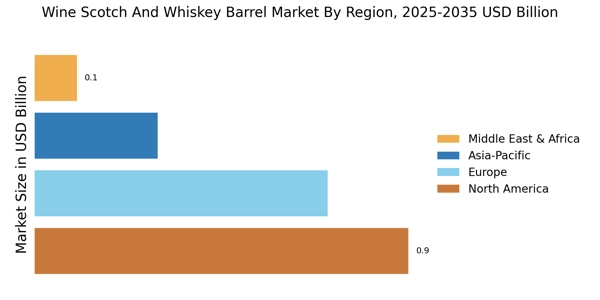
North America is the largest market for wine, scotch, and whiskey barrels, holding approximately 45% of the global market share. The region's growth is driven by increasing consumer demand for premium spirits, coupled with a rise in craft distilleries. Regulatory support for local production and aging processes further enhances market dynamics. The U.S. leads this market, followed closely by Canada, which contributes around 15% to the overall share. The competitive landscape in North America is characterized by the presence of major players such as Brown-Forman and Diageo, which dominate the market with their extensive portfolios. The craft distilling movement has also gained momentum, leading to a surge in small-scale producers. This diversification fosters innovation and competition, making the region a vibrant hub for whiskey and wine barrel production.

Europe : Heritage and Craftsmanship

Europe is a significant player in the wine, scotch, and whiskey barrel market, accounting for approximately 35% of the global share. The region's growth is fueled by a rich heritage of distilling and aging practices, particularly in countries like Scotland and France. Regulatory frameworks, such as the EU's geographical indications, protect traditional methods and enhance product authenticity, driving consumer interest and demand. Leading countries in Europe include the United Kingdom, France, and Germany, with the UK being the largest contributor to the market. Key players like Pernod Ricard and Chivas Brothers are well-established, while smaller craft distilleries are emerging, adding diversity to the market. The competitive landscape is robust, with a focus on quality and heritage, appealing to both local and international consumers.

Asia-Pacific : Emerging Market Potential

Asia-Pacific is rapidly emerging as a key market for wine, scotch, and whiskey barrels, holding about 15% of the global market share. The region's growth is driven by increasing disposable incomes, changing consumer preferences towards premium spirits, and a growing interest in whiskey culture. Countries like Japan and China are leading this trend, supported by favorable regulatory environments that encourage local production and importation of quality barrels. Japan stands out as a significant player, with brands like Suntory Holdings gaining international acclaim. The competitive landscape is evolving, with both established brands and new entrants vying for market share. The presence of key players such as Edrington Group and William Grant & Sons further enhances the region's market dynamics, fostering innovation and quality in barrel production.

Middle East and Africa : Untapped Market Opportunities

The Middle East and Africa region is an emerging market for wine, scotch, and whiskey barrels, currently holding about 5% of the global market share. The growth potential is significant, driven by increasing urbanization, a young population, and a rising interest in premium alcoholic beverages. Regulatory changes in several countries are also facilitating market entry and expansion for international brands, creating a favorable environment for growth. Leading countries in this region include South Africa and the United Arab Emirates, where the demand for quality spirits is on the rise. The competitive landscape is still developing, with a mix of local and international players. As the market matures, the presence of key brands and innovative local distilleries is expected to increase, further driving growth in the wine and whiskey barrel market.

Wine Scotch And Whiskey Barrel Market Regional Image

Key Players and Competitive Insights

Major players in the Wine Scotch and Whiskey Barrel Market industry are constantly innovating and developing new products to meet the changing demands of consumers. Leading Wine Scotch And Whiskey Barrel Market players are investing heavily in research and development to create new and improved products that offer superior quality and taste. The Wine Scotch And Whiskey Barrel Market industry is also seeing a growing trend towards consolidation as larger players acquire smaller companies to expand their market share. 

This consolidation is likely to continue in the future as larger players seek to gain economies of scale and increase their market power.The Wine Scotch And Whiskey Barrel Market Competitive Landscape is characterized by a few dominant players and a large number of smaller players. The dominant players in the market have a strong brand presence and a wide distribution network. They also have the financial resources to invest in research and development and to acquire smaller companies. 

The smaller players in the market are typically more focused on specific niches and have a more limited distribution network. They are also more likely to be price-sensitive and to compete on the basis of price.A leading company in the Wine Scotch And Whiskey Barrel Market industry is Brown-Forman Corporation. Brown-Forman Corporation is a  beverage company that produces and markets a wide range of alcoholic beverages, including Jack Daniel's Tennessee Whiskey, Finlandia Vodka, and Woodford Reserve Bourbon.

The company has a strong presence in the Wine Scotch And Whiskey Barrel Market and is known for its high-quality products and innovative marketing campaigns. Brown-Forman Corporation is also a major player in the  spirits market and has a significant market share in several key markets.

Key Companies in the Wine Scotch And Whiskey Barrel Market market include

Industry Developments

The  Wine Scotch And Whiskey Barrel Market is projected to reach USD 2.5 billion by 2032, exhibiting a CAGR of 3.49% during the forecast period. Increasing demand for premium and luxury spirits, growing popularity of craft distilleries, and rising consumer preference for aged spirits are driving market growth. Key industry participants are focusing on product innovation, expanding their distribution channels, and entering new markets to cater to evolving consumer demands. Sustainability initiatives and the adoption of eco-friendly practices are also gaining traction in the market.

Future Outlook

Wine Scotch And Whiskey Barrel Market Future Outlook

The Wine Scotch And Whiskey Barrel Market is projected to grow at a 3.49% CAGR from 2024 to 2035, driven by increasing demand for premium spirits and sustainable production practices.

New opportunities lie in:

  • Expansion into eco-friendly barrel production methods
  • Development of smart barrels with integrated monitoring technology
  • Partnerships with craft distilleries for exclusive barrel aging programs

By 2035, the market is expected to be robust, reflecting evolving consumer preferences and innovative production techniques.

Market Segmentation

Wine Scotch And Whiskey Barrel Market Type Outlook

  • Wine Barrel
  • Scotch Barrel
  • Whiskey Barrel

Wine Scotch And Whiskey Barrel Market Capacity Outlook

  • 50-100 liters
  • 101-200 liters
  • Over 200 liters

Wine Scotch And Whiskey Barrel Market Material Outlook

  • Oak
  • Walnut
  • Ash
  • Maple

Wine Scotch And Whiskey Barrel Market Char Level Outlook

  • Level 1
  • Level 2
  • Level 3

Wine Scotch And Whiskey Barrel Market Toast Level Outlook

  • Light
  • Medium
  • Heavy

Report Scope

MARKET SIZE 20241.962(USD Billion)
MARKET SIZE 20252.03(USD Billion)
MARKET SIZE 20352.862(USD Billion)
COMPOUND ANNUAL GROWTH RATE (CAGR)3.49% (2024 - 2035)
REPORT COVERAGERevenue Forecast, Competitive Landscape, Growth Factors, and Trends
BASE YEAR2024
Market Forecast Period2025 - 2035
Historical Data2019 - 2024
Market Forecast UnitsUSD Billion
Key Companies ProfiledMarket analysis in progress
Segments CoveredMarket segmentation analysis in progress
Key Market OpportunitiesGrowing demand for sustainable and innovative barrel aging techniques in the Wine Scotch And Whiskey Barrel Market.
Key Market DynamicsRising consumer preference for premium spirits drives demand for high-quality wine, scotch, and whiskey barrels.
Countries CoveredNorth America, Europe, APAC, South America, MEA

Leave a Comment

FAQs

What is the current valuation of the Wine Scotch and Whiskey Barrel Market?

The market valuation was 1.962 USD Billion in 2024.

Download Free Sample

Kindly complete the form below to receive a free sample of this Report

Compare Licence

×
Features License Type
Single User Multiuser License Enterprise User
Price $4,950 $5,950 $7,250
Maximum User Access Limit 1 User Upto 10 Users Unrestricted Access Throughout the Organization
Free Customization
Direct Access to Analyst
Deliverable Format
Platform Access
Discount on Next Purchase 10% 15% 15%
Printable Versions