Wine Market (2026 - 2035)

Wine Market Size, Share, Industry Trend & Analysis Overview-Research Report By Product Type (Still Wine, Sparkling Wine, Other), By Color (Red Wine, White Wine, Rosé Wine), By End User (Women, Men), By Distribution Channel (Off-Trade, On-Trade), By Geography (North America, Europe, Asia-Pacific, South America, Middle East & Africa) - Forecast to 2035
ID: MRFR/FnB/1124-HCR
150 Pages
Harshita Gorde
Last Updated: July 12, 2026
Wine Market
Market Size
Forecast Period2026-2035
CAGR (2026-2035)3.60%
2025 Market SizeUSD 384.00 Billion
2035 Market SizeUSD 546.90 Billion
Key Players
E. & J. Gallo Winery
Constellation Brands
The Wine Group
Treasury Wine Estates
Pernod Ricard
Concha y Toro
Opportunities
  • Low-Alcohol and Dealcoholized Wine Formats
  • Premiumization in Emerging Markets
  • Data-Driven DTC and Subscription Models

Wine Market Summary

The global Wine Market reached an estimated USD 384.00 billion in 2025 and is projected to grow from USD 397.80 billion in 2026 to USD 546.90 billion by 2035, registering a CAGR of 3.60% during the forecast period. This trajectory reflects a clear shift in how consumers engage with wine — value growth now outpaces volume growth as buyers gravitate toward premium labels, estate-bottled selections, and region-specific appellations. Policy support from the European Commission's Common Agricultural Policy, which allocated over EUR 1.1 billion annually to vineyard restructuring and promotion programs through 2027, continues to anchor production quality across legacy wine production regions [1].

A quiet transformation is reshaping the Wine Market from the vineyard floor to the retail shelf. Legacy distribution networks built around brick-and-mortar retail are giving way to direct-to-consumer (DTC) e-commerce platforms and subscription models. The USDA estimates that online wine sales across major consuming nations surpassed USD 28 billion in 2024, roughly double pre-pandemic levels [5]. Precision viticulture — leveraging drone imagery, IoT soil sensors, and AI-driven harvest timing — now influences roughly 18% of global hectarage under vine, reducing yield volatility and labor costs [13].

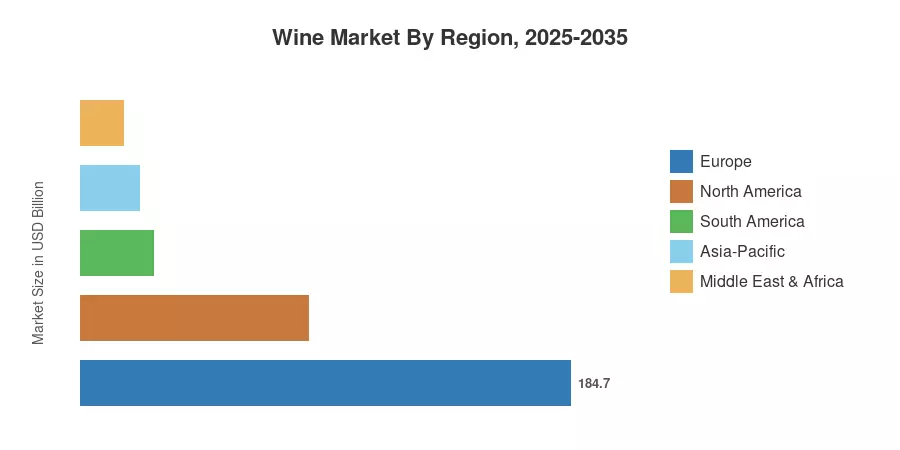
Europe commands roughly 48.1% of the Wine Market by value, anchored by France, Italy, and Spain — three nations that together account for nearly half of global production volume [3]. Asia-Pacific is the fastest-growing region, advancing at a 5.8% CAGR as urbanization and rising disposable incomes in China and India reshape consumption habits. North America holds the second-largest share, driven by the United States' position as the world's top wine-consuming country by value. The decade ahead will hinge on how producers balance premiumization ambitions against climate-induced supply constraints and shifting generational preferences.


Key Report Takeaways

• By Product Type

  • Still wine accounted for 76.2% of the total Wine Market value in 2025, sustained by everyday table wine consumption and growing interest in single-vineyard bottlings.
  • Sparkling wine is projected to expand at a 4.3% CAGR through 2035, fueled by year-round consumption patterns beyond traditional celebrations.

• By Color

  • Red wine captured 51.6% of the Wine Market in 2025, supported by strong demand in Southern Europe and established New World appellations.
  • Rosé wine is forecast to grow at a 4.4% CAGR, reflecting lifestyle-driven demand among younger demographics.

• By Region

  • Europe held a 48.1% share of the Wine Market in 2025, leveraging protected designations of origin and centuries-old production infrastructure.
  • Asia-Pacific is set to register the fastest growth through 2035 at a 5.8% CAGR, with China, India, and ASEAN markets leading adoption.


Market Size and Forecast (2021–2035)

Market Research Future derives historical Wine Market estimates from customs trade data, producer revenue filings, and OIV harvest statistics. Forecast projections integrate proprietary demand modeling with macroeconomic overlays, adjusting for population growth, disposable income trends, and excise-tax trajectories across 45 key consuming nations [1][2].
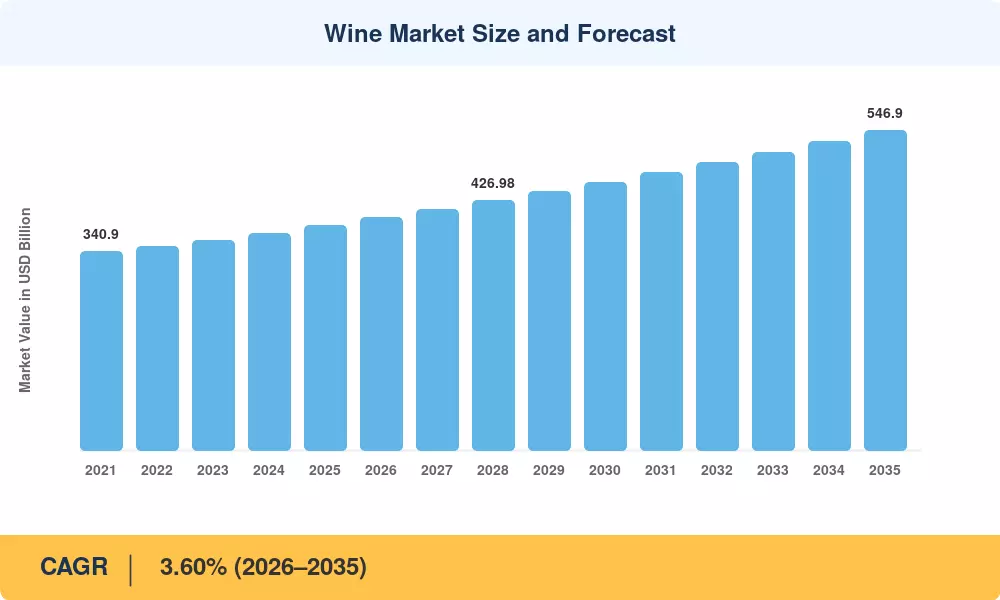
Wine Market Size and Forecast
Our Impact
Enabled $4.3B Revenue Impact for Fortune 500 and Leading Multinationals
Partnering with 2000+ Global Organizations Each Year
30K+ Citations by Top-Tier Firms in the Industry

Driver Impact Analysis

Driver ~% Impact on CAGR Geographic Relevance Impact Timeline
Premiumization and trade-up behavior ~20% Global Short-term
E-commerce and DTC channel growth ~18% North America, Europe Medium-term
Rising middle-class adoption in the Asia-Pacific ~15% Asia-Pacific Long-term
Wine tourism and experiential marketing ~12% Europe, South America Medium-term
Health-conscious moderation and low-alcohol formats ~10% Global Short-term
Sustainability certifications and ESG compliance ~8% Europe, North America Long-term
Ready-to-drink wine-based beverages ~7% North America Medium-term


Premiumization and Trade-Up Behavior

While buying fewer bottles, consumers in developed wine market economies are spending more per bottle. According to scan data, bottles priced above USD 15 increased 9% by value in the US alone in 2024, while volumes below USD 8 decreased 4% [15]. Premiumization is currently the most significant revenue driver in the wine market because of this structural change, which enables producers and retailers to safeguard margins even when aggregate volume flattens.


E-Commerce and Direct-to-Consumer Expansion

Online wine sales represented roughly 12% of off-trade value in major Western markets by end-2024, up from under 5% in 2019 [5]. Platforms such as Vivino, Wine.com, and producer-owned DTC storefronts give wineries access to higher-margin channels while capturing first-party consumer data. The EU's digital single market regulations have also simplified cross-border e-commerce for Wine Market participants, removing friction from intra-EU shipments [17].

Rising Middle-Class Adoption in Asia-Pacific

China's imported wine tariff reductions and India's expanding hospitality sector are opening new demand corridors. China's tariff removal on Australian wine imports in early 2024 triggered a 35% year-on-year rebound in Australian shipments to the Chinese Wine Market within six months [19]. Meanwhile, India's wine consumption grew at approximately 10% annually between 2021 and 2024, albeit from a small base, supported by domestic producers in Maharashtra and Karnataka [4].


Restraints Impact Analysis

The restraint estimates below represent directional drag on forward growth. They do not net directly against driver percentages and are assessed independently within Market Research Future's scenario framework [14].

Restraint ~% Negative Impact on CAGR Geographic Relevance Impact Timeline
Climate change and vineyard yield volatility ~-15% Global Long-term
Rising input costs (glass, energy, labor) ~-12% Global Short-term
Restrictive alcohol advertising regulations ~-10% Europe, Asia-Pacific Medium-term
Competition from craft beer and spirits ~-8% North America, Europe Medium-term
Currency fluctuations and trade tariffs ~-5% Global Short-term


Climate Change and Yield Volatility

The 2023 vintage saw France's Bordeaux region lose an estimated 15% of potential output due to mildew pressure exacerbated by unseasonal rainfall, while heat waves cut yields in parts of Spain and Southern Italy by up to 20% [7]. Climate modeling by the FAO projects that traditional Wine Market growing zones in Southern Europe may shift northward by 200–300 km over the next two decades, forcing capital-intensive replanting and varietal experimentation [7].

Rising Input Costs

Between 2021 and 2023, glass bottle prices increased by 25–30% due to a jump in energy and soda ash prices in Europe [10]. Despite stabilizing through 2024, prices are still about 15% higher than baselines from 2019. Wine market margins for producers that rely on manual harvesting are still being compressed by labour shortages during harvest seasons, which are most severe in California, Australia, and Southern France.


Wine Market Opportunities

Low-Alcohol and Dealcoholized Wine Formats

Dealcoholized wine sales grew more than 30% in volume terms across Western Europe in 2024, indicating significant runway for producers who invest in advanced spinning-cone and vacuum-distillation technology [14]. This segment enables Wine Market participants to reach health-conscious consumers and markets with restrictive alcohol policies.

Premiumization in Emerging Markets

India's domestic wine industry — concentrated in Nashik, Maharashtra — produced roughly 25 million liters in 2024, yet per-capita consumption remains below 0.02 liters [4]. As disposable incomes grow and hospitality infrastructure expands, producers who establish brand equity early in these nascent Wine Market corridors stand to benefit disproportionately.

Data-Driven DTC and Subscription Models

Over USD 3 billion is currently generated annually worldwide by wine subscription services and algorithm-driven recommendation websites [15]. Compared to traditional retail, Wine Market participants can lower customer acquisition costs by 20–35% and customize offerings according to the first-party data these platforms produce, such as purchase frequency, taste profiles, and price sensitivity.


Sustainable Viticulture and Carbon-Neutral Certifications

Over 11% of global vineyard area carried some form of organic or biodynamic wine certification by 2024, and brands with verified sustainability claims commanded price premiums averaging 18% in EU retail [13]. Regulatory tailwinds, including the EU Green Deal's Farm-to-Fork targets, will continue rewarding Wine Market producers that invest in regenerative practices.

Wine Tourism and Cellar-Door Revenue Diversification

Global wine tourism revenue exceeded USD 10 billion in 2024, with regions such as Napa Valley, Tuscany, and Mendoza experiencing record visitor counts [17]. For smaller estates, cellar-door sales can represent 40–60% of total revenue, significantly boosting Wine Market margins versus wholesale distribution.


Wine Market Future Outlook

Climate Adaptation and Precision Viticulture

Over the next ten years, AI-driven irrigation scheduling and satellite-guided canopy management have the potential to completely transform vineyard operations. According to OIV estimations, the use of precision viticulture might directly improve the production stability of the wine market by reducing water consumption by 25% and improving yield predictability by 15% throughout Mediterranean climate zones [1][7].


Digital Commerce and Platform Economics

By 2030, online channels are projected to capture 20–25% of the global off-trade Wine Market value, up from roughly 12% in 2024. Platform-driven models — combining subscription boxes, virtual tastings, and AI sommeliers — will reshape how mid-tier producers access consumers, eroding the traditional distributor gatekeeping model [5][15].

Sustainability and Regenerative Winemaking

The Wine Market faces mounting pressure from ESG-conscious investors and regulatory mandates such as the EU Corporate Sustainability Reporting Directive. Producers that adopt carbon-neutral certifications and water-positive viticulture stand to unlock both price premiums and preferential access to institutional procurement channels [13][17].

Premiumization and Experiential Consumption

Premiumization is not merely a pricing strategy — it is a structural realignment of the Wine Market around storytelling, provenance, and sensory experience. Millennials and Gen-Z consumers increasingly favor fewer, higher-quality bottles purchased through curated channels, a trend that will compress the sub-USD 8 segment while expanding the USD 15-plus tier through 2035 [14][15].


Wine Market Segmentation

By Product Type

Segment Key Metric Primary Demand Driver
Still Wine 76.2% share (2025) Every day and premium table consumption
Sparkling Wine 4.3% CAGR (2026–2035) Year-round celebratory and casual occasions
Other (Fortified, Dessert) USD 30.50 Billion (2025) Niche connoisseur and cocktail-ingredient demand


Still wine remains the backbone of the Wine Market, spanning everyday table wines through ultra-premium single-vineyard bottlings. Growth in this segment is driven almost entirely by price appreciation rather than volume expansion, as consumers trade up to bottles in the USD 12–25 range. Sparkling wine, once confined to celebrations, has become an everyday aperitif in key markets such as the UK, where Prosecco imports now exceed Champagne in volume. This behavioral shift positions sparkling as the fastest-growing product category within the Wine Market through 2035.

By Color

Segment Key Metric Primary Demand Driver
Red Wine 51.6% share (2025) Established food-pairing culture and aging appeal
White Wine USD 124.80 Billion (2025) Refreshment-driven demand, Sauvignon Blanc and Chardonnay
Rosé Wine 4.4% CAGR (2026–2035) Lifestyle branding, summer consumption, Instagram appeal


Red wine commands the largest color share within the Wine Market, supported by deeply rooted consumption patterns in France, Italy, Argentina, and the United States. However, rosé is rapidly closing the gap in growth terms, particularly across younger demographics in the US and Northern Europe who associate it with casual outdoor dining and social-media-friendly aesthetics.

By End User

Segment Key Metric Primary Demand Driver
Women 55.9% share (2025) Preference for lighter styles, rosé, and sparkling
Men 4.8% CAGR (2026–2035) Growing interest in premium reds and collectible wines


Women represent the majority of Wine Market consumers by volume, particularly in North America and Northern Europe, where lighter-bodied whites and rosés align with prevailing taste preferences. Men, while a smaller share of the consumer base, are driving faster growth through higher average spend per bottle, especially in the collector and fine-wine investment segments.

By Distribution Channel

Segment Key Metric Primary Demand Driver
Off-Trade 63.8% share (2025) Supermarket, specialist retail, and online channels
On-Trade 4.0% CAGR (2026–2035) Restaurant, hotel, and bar recovery post-pandemic


Off-trade channels dominate the Wine Market due to the convenience and price advantages of supermarket and e-commerce purchasing. However, on-trade — encompassing restaurants, bars, and hotels — is rebounding strongly from pandemic-era closures and is expected to recapture share as experiential dining grows in importance.


Regional Market Share Analysis

Region Key Metric Primary Investment Themes
Europe 48.1% share (2025) Appellation protection, vineyard modernization
North America USD 86.00 Billion (2025) Premium DTC, health-oriented formats
Asia-Pacific 5.8% CAGR (2026–2035) Urban middle-class adoption, import expansion
South America USD 27.65 Billion (2025) Export diversification, Malbec/Carménère premiumization
Middle East & Africa 4.2% CAGR (2026–2035) Tourism-driven demand, South African production
Total USD 384.00 Billion (2025)

The Wine Market's geographic footprint reflects deep historical roots in European production centers alongside rapidly growing consumer bases in Asia-Pacific and the Americas.


North America

Country Key Metric Key Driver
United States 78.4% of regional share Largest consuming nation by value
Canada 3.8% CAGR Ice wine specialty and premium imports
Mexico USD 3.10 Billion (2025) Expanding middle-class wine culture


The United States drives the North American Wine Market, with California alone producing over 80% of domestic output. Direct-to-consumer shipments reached USD 4.2 billion in 2024, and tasting-room visits recovered to pre-pandemic levels [5][15].

Europe

Country Key Metric Key Driver
France 24.3% of regional share Bordeaux, Burgundy, and Champagne appellations
Italy 22.1% of regional share Prosecco-driven sparkling growth
Spain USD 18.50 Billion (2025) Bulk and premium export volumes
Germany 3.5% CAGR Riesling premiumization
United Kingdom USD 12.40 Billion (2025) Largest import-only Wine Market
Nordic Countries 3.2% CAGR State-monopoly channel innovation
Russia USD 6.80 Billion (2025) Domestic production resurgence
Rest of Europe 3.1% CAGR Portugal, Greece, and Eastern Europe's growth


Europe's Wine Market benefits from centuries of established production, protected appellations, and deep cultural affinity. The EU's wine reform program committed EUR 1.1 billion annually through 2027 for vine grubbing-up, restructuring, and promotional campaigns in third-country markets [17].

Asia-Pacific

Country Key Metric Key Driver
China 32.5% of regional share Import recovery post-tariff removal
Japan 5.2% CAGR Premium sake-to-wine crossover
India 6.4% CAGR Domestic production and hospitality growth
South Korea USD 3.20 Billion (2025) K-culture lifestyle adoption
ASEAN 5.9% CAGR Tourism and expatriate consumption
Rest of Asia-Pacific 4.8% CAGR Australia and New Zealand are export hubs


Asia-Pacific represents the fastest-expanding frontier for the Wine Market. China's reversal of anti-dumping duties on Australian wine in March 2024 reignited bilateral trade flows, while India's domestic producers in Nashik and Bengaluru are scaling output to meet urban demand [19][4].

South America

Country Key Metric Key Driver
Argentina 44.2% of regional share Malbec's global export dominance
Brazil 4.0% CAGR Sparkling wine consumption has surged
Rest of South America USD 4.80 Billion (2025) Chile and Uruguay's niche exports


Argentina and Chile anchor the South American Wine Market, together accounting for over 80% of the continent's export volume. Argentina's Malbec has become one of the most recognized varietal brands globally, and Mendoza attracted 3.8 million wine tourists in 2024 [17].

Middle East & Africa

Country Key Metric Key Driver
South Africa 52.8% of regional share Cape Winelands production heritage
UAE 5.6% CAGR Luxury hospitality channel demand
Saudi Arabia 2.1% CAGR Limited, non-alcoholic wine niche
Egypt USD 0.45 Billion (2025) Small domestic production base
Rest of MEA 3.8% CAGR Tourism-led demand pockets


South Africa dominates the MEA Wine Market with well-established production regions in Stellenbosch, Franschhoek, and Paarl. The country's wine exports reached approximately 450 million liters in 2024, with the UK, Germany, and the Netherlands as primary destinations [18].


Wine Market By Region, 2025-2035

Competitive Benchmarking

The Wine Market remains highly fragmented, with an estimated HHI below 400 and the top five companies collectively holding approximately 16–22% of global revenue. Thousands of family estates, cooperatives, and boutique wineries coexist alongside multinational beverage corporations, creating a competitive environment where brand heritage, terroir authenticity, and distribution reach all serve as differentiation levers.

Company Est. Revenue Share Range Key Offerings for Wine Market Strategic Positioning
E. & J. Gallo Winery ~4–7% Barefoot, Apothic, premium estate labels Vertically integrated, scale leader in the US
Constellation Brands ~3–5% Kim Crawford, Meiomi, Robert Mondavi Premium portfolio focus, DTC expansion
The Wine Group ~2–4% Franzia, Cupcake, Chloe Value and mid-tier volume leadership
Treasury Wine Estates ~2–4% Penfolds, 19 Crimes, Wolf Blass Global premium brands, luxury tier growth
Pernod Ricard ~2–3% Jacob's Creek, Campo Viejo, Brancott Estate Multi-beverage platform, global distribution
Concha y Toro ~1–3% Casillero del Diablo, Don Melchor, Trivento South American export dominance
Castel Group ~1–3% Baron de Lestac, Roche Mazet French mass-market and African distribution
Accolade Wines ~1–2% Hardys, Grant Burge, St Hallett Australian heritage, UK retail footprint
Diageo ~1–2% Sterling Vineyards, wine-adjacent spirits Cross-category premiumization
Viña San Pedro Tarapacá ~1–2% 1865, Altaïr, Tarapacá Chilean premium export strategy


Recent News & Developments


  • China Ministry of Commerce (March 2024): Formally removed anti-dumping and countervailing duties on Australian wine imports, reopening the world's fifth-largest import Wine Market corridor [19].


  • European Commission (September 2024): Approved a EUR 120 million supplementary support package for vineyard restructuring and promotional campaigns under the reformed Common Agricultural Policy [17].
  • E. & J. Gallo Winery (January 2025): Deployed an AI-powered precision viticulture platform across 12,000 acres of Sonoma and San Joaquin vineyards to optimize irrigation and pest management [13].
  • Concha y Toro (April 2025): Inaugurated a new sustainability-certified production facility in Chile's Maule Valley, designed to reduce carbon emissions per bottle by 30% [16].
  • Pernod Ricard (August 2024): Expanded its digital Wine Market sales platform across five Southeast Asian countries, targeting urban millennial consumers through localized content partnerships [14].


Wine Market Report Scope

Parameter Detail
Market Scope Global Wine Market by Product Type, Color, End User, Distribution Channel, Geography
Study Period 2021–2035
CAGR (Forecast Window) 3.60% (2026–2035)
Base Year Market Size USD 384.00 Billion (2025)
Forecast Endpoint USD 546.90 Billion (2035)
Fastest Growing Segment Asia-Pacific (by region); Sparkling Wine (by product type)
Companies Profiled 10+, including E. & J. Gallo, Constellation Brands, Treasury Wine Estates, Pernod Ricard
Valuation Currency USD Billion


FAQs

What cork alternatives are gaining traction in the Wine Market?
Screw caps now seal over 30% of global bottles, especially in Australia and New Zealand. Synthetic closures and glass stoppers also serve mid-range segments where cork taint risk outweighs tradition [9].
How do tariff disputes reshape the Wine Market?
Tariff swings redirect trade flows within months — China's three-year Australian wine duties shifted import volumes to Chile and France. Producers increasingly diversify export destinations to hedge policy risk [19].
What role does blockchain play in the Wine Market?
Blockchain-based provenance tracking is used by premium estates to certify authenticity from vineyard to consumer. Adoption remains limited to high-value bottles where counterfeiting risk justifies the cost [14].
How does generational preference affect the Wine Market?
Gen-Z consumers favor lighter, lower-alcohol options and discovery-driven purchasing via apps. This pushes producers toward smaller-format packaging and social-media-first branding strategies [15].
What investment risks exist in the fine Wine Market?
Fine wine returns depend on storage integrity, provenance documentation, and auction liquidity. Climate volatility and shifting critic influence can depreciate collections unpredictably [10].
How do private-label wines affect the Wine Market?
Private-label wines capture roughly 18% of European off-trade volume, pressuring branded producers on shelf space. Retailers use own-label ranges to offer value while protecting category margins [9].
What packaging innovations are emerging in the Wine Market?
Bag-in-box, aluminum cans, and flat PET bottles are expanding beyond entry-level tiers. These formats reduce shipping weight by up to 40% and appeal to outdoor and single-serve occasions [20].    
Author
Author
Author Profile
Harshita Gorde LinkedIn
Research Analyst
Harshita Post graduate MBA in Business Administration from Welingkar Institute, Mumbai and 5 years of experience in the field of product market research. As a Research Analyst, I have cross-domain experience in packaging, and industrial Automation & Equipment. I am currently looking after the research process of packaging, logistics & transportation, and industrial automation & equipment at Market Research Future Reports. My responsibilities at the organization involve handling syndicate and custom reports as well as responding to client inquiries, and organize, co-ordinate with a group of 5 to 6 persons to manage all workflows.
Download Free Sample

Kindly complete the form below to receive a free sample of this Report

Download PDF ×

We do not share your information with anyone. However, we may send you emails based on your report interest from time to time. You may contact us at any time to opt-out.
















