Download Free Sample
Kindly complete the form below to receive a free sample of this Report
Women’s Leather Luxury Footwear Market Size, Share, Industry Trend & Analysis Research Report By Footwear Type (Flats, Heels, Boots, Sandals), By Material (Full Grain Leather, Top Grain Leather, Patent Leather, Suede), By Sales Channel (Online Retail, Offline Retail, Luxury Department Stores), By Consumer Age Group (Teenagers, Young Adults, Middle Aged, Senior Citizens) andBy Regional (North America, Europe, South America, Asia Pacific, Middle East and Africa)- Forecast to 2035
As per Market Research Future analysis, the Women's Leather Luxury Footwear Market was estimated at 20.52 USD Billion in 2024. The market is projected to grow from 21.16 USD Billion in 2025 to 28.69 USD Billion by 2035, exhibiting a compound annual growth rate (CAGR) of 3.09% during the forecast period 2025 - 2035
The Women's Leather Luxury Footwear Market is experiencing a dynamic shift towards sustainability and digital engagement.
| 2024 Market Size | 20.52 (USD Billion) |
| 2035 Market Size | 28.69 (USD Billion) |
| CAGR (2025 - 2035) | 3.09% |
The Women's Leather Luxury Footwear Market is currently experiencing a dynamic evolution, characterized by shifting consumer preferences and an increasing emphasis on sustainability. As more individuals become aware of environmental issues, there is a noticeable trend towards eco-friendly materials and ethical production practices. This shift appears to be influencing purchasing decisions, with consumers gravitating towards brands that prioritize sustainability alongside luxury. Furthermore, the market is witnessing a rise in online shopping, as digital platforms provide greater accessibility and convenience for consumers seeking high-end footwear. This trend suggests that brands must adapt their strategies to enhance their online presence and engage with a tech-savvy clientele. In addition to sustainability and digitalization, the Women's Leather Luxury Footwear Market is also seeing a growing demand for customization and personalization. Consumers are increasingly seeking unique products that reflect their individual styles and preferences. This desire for distinctiveness may lead brands to offer more bespoke options, allowing customers to tailor their footwear choices. Overall, the market landscape is shifting, and brands that can effectively respond to these emerging trends are likely to thrive in this competitive environment.
The emphasis on eco-friendly materials and ethical production practices is reshaping consumer preferences in the Women's Leather Luxury Footwear Market. Brands that prioritize sustainability are likely to attract environmentally conscious buyers.
The rise of online shopping is transforming how consumers purchase luxury footwear. Digital platforms offer convenience and accessibility, compelling brands to enhance their online presence to engage with a broader audience.
There is an increasing desire for personalized footwear options among consumers. This trend suggests that brands may need to offer bespoke services to cater to individual styles and preferences.
The increasing disposable income among consumers appears to be a pivotal driver for the Women's leather Luxury footwear Market. As individuals experience enhanced financial freedom, they are more inclined to invest in high-quality, luxury footwear. This trend is particularly evident in emerging markets, where a burgeoning middle class is seeking premium products. Reports indicate that the luxury footwear segment has witnessed a growth rate of approximately 5% annually, suggesting a robust demand for women's leather luxury footwear. Furthermore, the willingness to spend on luxury items is often associated with lifestyle aspirations, which further propels the market forward. As consumers prioritize quality and craftsmanship, the Women's Leather Luxury Footwear Market is likely to benefit from this upward trend in disposable income.
Fashion trends play a crucial role in shaping consumer preferences within the Women's Leather Luxury Footwear Market. The cyclical nature of fashion, characterized by seasonal collections and designer collaborations, drives demand for luxury footwear. Notably, the rise of social media influencers and fashion bloggers has amplified the visibility of luxury brands, leading to increased consumer interest. Data suggests that the luxury footwear market has expanded by approximately 6% in recent years, largely due to the influence of fashion trends. As styles evolve, consumers are more likely to seek out unique and stylish leather footwear that aligns with current trends. This dynamic interplay between fashion and consumer behavior indicates that the Women's Leather Luxury Footwear Market will continue to thrive as long as it adapts to the ever-changing landscape of fashion.
The expansion of e-commerce platforms has revolutionized the shopping experience for consumers in the Women's Leather Luxury Footwear Market. With the convenience of online shopping, consumers can easily access a wide range of luxury footwear options from the comfort of their homes. Data indicates that online sales in the luxury footwear segment have increased by approximately 20% over the past year, highlighting a significant shift in consumer purchasing behavior. This trend is further supported by advancements in technology, such as virtual fitting rooms and augmented reality, which enhance the online shopping experience. As e-commerce continues to grow, the Women's Leather Luxury Footwear Market is poised to benefit from increased accessibility and a broader customer base, potentially leading to higher sales and brand loyalty.
Sustainability and ethical production practices are becoming increasingly important to consumers in the Women's Leather Luxury Footwear Market. As awareness of environmental issues rises, consumers are more inclined to support brands that prioritize sustainable sourcing and production methods. Reports suggest that approximately 60% of consumers consider sustainability when making purchasing decisions, indicating a significant shift in consumer values. Brands that adopt eco-friendly practices, such as using vegetable-tanned leather or reducing carbon footprints, are likely to resonate with this conscientious consumer base. This growing emphasis on sustainability may drive innovation within the Women's Leather Luxury Footwear Market, as companies strive to meet the demands of environmentally aware consumers. Consequently, the market may witness a transformation as brands align their offerings with the principles of sustainability.
There is a discernible shift towards valuing quality and craftsmanship in the Women's Leather Luxury Footwear Market. Consumers are increasingly discerning, seeking products that not only offer aesthetic appeal but also durability and comfort. This trend is particularly pronounced among millennials and Gen Z, who prioritize sustainable and ethically produced goods. Reports indicate that approximately 70% of consumers are willing to pay a premium for high-quality leather footwear, reflecting a growing appreciation for artisanal craftsmanship. As brands emphasize their commitment to quality, the Women's Leather Luxury Footwear Market is likely to see a surge in demand for products that embody these values. This focus on quality over quantity may redefine purchasing behaviors, steering consumers towards luxury footwear that promises longevity and style.
In the Women’s Leather Luxury Footwear Market, the segment distribution shows that flats hold the largest market share, attributed to their versatility and comfort. Consumers increasingly prefer flats for casual and formal events alike, leading to a strong foothold in retail. Heels, on the other hand, have emerged as the fastest-growing segment, driven by fashion trends and a rising demand for statement footwear that enhances women's outfits for special occasions.
Flats (Dominant) vs. Heels (Emerging)
Flats are characterized by their flat soles and comfort, making them a preferred choice for daily wear among women. This segment is dominant due to the increasing shift towards practicality without compromising on style. Meanwhile, heels, which have seen emerging popularity, cater to the high-end fashion sector, appealing to consumers looking for elegance and sophistication. The distinct attributes of each segment highlight their unique market positions, with flats focusing on practicality and accessibility, while heels target luxury and premium branding in women's fashion.
In the Women's Leather Luxury Footwear Market, the material segment showcases a diverse distribution of shares among its values. Full Grain Leather stands out as the largest segment, revered for its durability and natural aesthetics, capturing a significant portion of the market. Following closely are Top Grain Leather and Patent Leather, both appreciated for their unique textures and finishes. Suede, while less traditional, is rapidly gaining traction, particularly among younger consumers seeking a softer, stylish alternative.
Full Grain Leather (Dominant) vs. Suede (Emerging)
Full Grain Leather remains the dominant choice in the Women's Leather Luxury Footwear Market due to its unparalleled quality and long-lasting characteristics. This material is unprocessed, allowing it to retain the original grain and providing a luxurious feel and robust endurance. Conversely, Suede is establishing itself as an emerging trend, popular for its soft texture and stylish appeal. Its growing adoption can be attributed to evolving fashion preferences, particularly among millennials and Gen Z shoppers who favor versatility and comfort. As brands innovatively incorporate suede into their collections, its position is expected to strengthen, reflecting a shift in consumer tastes towards more casual yet luxe options.
In the Women's Leather Luxury Footwear Market, the sales distribution illustrates a predominant trend towards online retail, which captures a significant share of consumer purchases. This channel has transformed the shopping experience by offering convenience and a wide array of options, making it the preferred choice for many luxury footwear buyers. Conversely, offline retail and luxury department stores remain essential, with their compelling in-store experiences and personalized customer service, influencing consumer preferences.
Online Retail: Dominant vs. Luxury Department Stores: Emerging
The online retail segment is characterized by its extensive reach and ability to offer diverse products to a global audience. Enhanced digital marketing strategies and user-friendly platforms contribute to its leading position in the market. In contrast, luxury department stores are emerging strongly as they combine high-end brands with a sophisticated shopping experience. These stores provide exclusivity and the chance for customers to physically interact with products. As consumers increasingly seek personalized experiences, luxury department stores are capitalizing on this trend, driving their rapid growth in the market.
In the Women's Leather Luxury Footwear Market, the distribution of market share among consumer age groups reveals that Teenagers represent the largest segment, as they increasingly seek trendy and high-quality footwear. This demographic is drawn to unique styles and brand prestige, making them a substantial force in the luxury segment. On the other hand, Young Adults are emerging with the fastest-growing presence, showing a shift towards conscious consumerism and brand loyalty in their footwear choices, fostering a new generation of luxury shoppers.
Growth trends highlight a compelling narrative, particularly as Young Adults are triggered by fashion influences and social media, propelling their segment into rapid expansion. The Teenagers' segment thrives on the vibrant demand for fashionable and expressive footwear, but Young Adults are likely to take the lead, driven by their growing disposable income and an ever-increasing inclination toward sustainability and ethical production in luxury fashion. This shift indicates a dynamic evolution within consumer preferences in this market.
Teenagers (Dominant) vs. Senior Citizens (Emerging)
Teenagers have established themselves as the dominant age group within the Women's Leather Luxury Footwear Market due to their affinity for trendy and fashionable footwear that reflects their personal identity. This demographic prioritizes statement pieces and brand messages that resonate with their lifestyle, making them highly relevant to luxury brands. In contrast, Senior Citizens represent an emerging segment, increasingly seeking stylish yet comfortable options. This age group has traditionally been underrepresented but is now gaining traction as they pursue quality over quantity in their purchases, focusing on the longevity and craftsmanship of luxury footwear. As brands begin to cater to their unique needs, this segment could significantly alter market dynamics, showcasing the importance of inclusivity in luxury fashion.
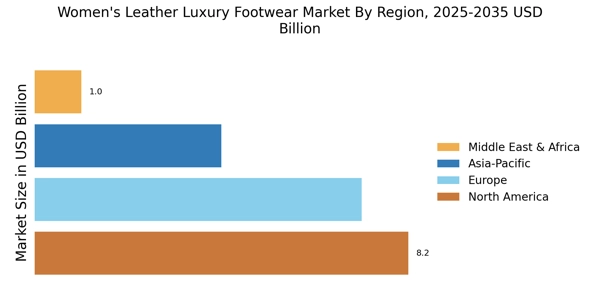
The Women’s Leather Luxury Footwear Market exhibits a diverse regional landscape with varying valuations and growth trajectories. In 2023, North America leads with a significant market value of 7.68 USD Billion, reflecting its majority holding in the segment due to strong consumer spending and brand loyalty. Europe follows closely with a valuation of 5.67 USD Billion, showcasing a vibrant fashion industry that increasingly embraces sustainable luxury.
The APAC region, valued at 4.13 USD Billion, is gaining traction driven by rising disposable incomes and evolving fashion preferences among the younger demographic.South America accounts for 1.67 USD Billion, indicating potential for expansion as luxury fashion continues to penetrate emerging markets. Meanwhile, the MEA region, while smaller at 0.16 USD Billion, presents unique opportunities for growth as luxury consumption rises in affluent markets. This varied regional segmentation highlights the dynamic nature of the Women’s Leather Luxury Footwear Market, offering ample opportunities for brands to target specific consumer bases while navigating the regional trends.
The Women’s Leather Luxury Footwear Market is a vibrant and dynamically evolving sector characterized by a unique blend of premium materials, artisanal craftsmanship, and contemporary design trends. This market not only offers an array of high-end products appealing to discerning consumers but also faces fierce competition as luxury brands vie for market share. The competitive landscape is marked by several established players, each striving to differentiate their offerings through innovative designs, marketing strategies, and brand positioning.
With the increasing demand for luxury footwear fueled by rising disposable incomes and changing consumer lifestyles, brands are also leveraging digital platforms to enhance their reach and foster direct engagement with their customers. Sustainability has emerged as a critical consideration, prompting brands to adopt eco-friendly practices that resonate with conscientious consumers, thereby shaping the competitive dynamics within this market.
LVMH stands as a formidable stronghold in the Women’s Leather Luxury Footwear Market. The luxury conglomerate benefits from its robust brand portfolio and an unparalleled reputation for excellence, quality, and exclusivity. LVMH's strong presence in the leather luxury footwear domain is amplified by its commitment to craftsmanship and innovation, which positions the brand as a preferred choice among affluent consumers. The company's ability to blend traditional techniques with modern aesthetics enables it to create distinct and desirable footwear that appeals to a broad audience.
Furthermore, LVMH's extensive distribution network and strategic alliances enhance its market reach, while its emphasis on research and development ensures that it remains at the forefront of industry trends. This strong positioning is underpinned by the brand's dedication to sustainability, as LVMH actively incorporates eco-friendly practices into its production processes, strengthening its appeal among environmentally conscious consumers.
Dolce and Gabbana is another prominent player in the Women’s Leather Luxury Footwear Market, recognized for its distinctive Italian flair and bold design philosophy. The brand's footwear collections are synonymous with luxury, combining rich materials with intricate detailing and vibrant aesthetics that resonate with a daring consumer base. Dolce and Gabbana effectively captivates its target audience through captivating marketing campaigns, fostering a sense of exclusivity and desirability around its products.
The brand's commitment to craftsmanship is evident in its meticulous attention to detail and the incorporation of traditional artisanal methods, ensuring that every piece reflects the heritage and sophistication of Italian luxury. Furthermore, Dolce and Gabbana's ability to consistently launch innovative collections and collaborate with influential designers enhances its visibility and appeal in the competitive landscape. The brand's focus on storytelling and branding allows it to create a loyal consumer base deeply connected to its cultural narrative and luxury attributes.

The Women’s Leather Luxury Footwear Market has seen significant recent developments, particularly with brands like LVMH and Gucci expanding their product lines and enhancing their digital presence to cater to a growing e-commerce consumer base. Dolce & Gabbana and Prada continue to innovate, focusing on eco-friendly practices in their manufacturing processes, which cater to the rising demand for sustainable luxury goods. Companies such as Michael Kors and Jimmy Choo are investing heavily in marketing strategies to attract millennials and Generation Z consumers, leveraging social media platforms to enhance brand visibility.
Additionally, Salvatore Ferragamo is benefiting from a noticeable increase in market valuation due to a recent surge in demand for high-end footwear. Recent mergers and acquisitions in this sector remain limited; however, notable partnerships and collaborations indicate a strategic approach to growth and diversification among luxury brands like Kering and Christian Louboutin. Overall, the market is adapting to changing consumer preferences, leading to a dynamic business environment that encourages innovation and sustainability while navigating the impacts of global economic shifts.
The Women's Leather Luxury Footwear Market is projected to grow at a 3.09% CAGR from 2025 to 2035, driven by increasing consumer demand for premium products and sustainable practices.
New opportunities lie in:
By 2035, the market is expected to solidify its position as a leader in luxury footwear.
| MARKET SIZE 2024 | 20.52(USD Billion) |
| MARKET SIZE 2025 | 21.16(USD Billion) |
| MARKET SIZE 2035 | 28.69(USD Billion) |
| COMPOUND ANNUAL GROWTH RATE (CAGR) | 3.09% (2025 - 2035) |
| REPORT COVERAGE | Revenue Forecast, Competitive Landscape, Growth Factors, and Trends |
| BASE YEAR | 2024 |
| Market Forecast Period | 2025 - 2035 |
| Historical Data | 2019 - 2024 |
| Market Forecast Units | USD Billion |
| Key Companies Profiled | LVMH (FR), Kering (FR), Prada (IT), Chanel (FR), Salvatore Ferragamo (IT), Gucci (IT), Tod's (IT), Bally (CH), Fendi (IT) |
| Segments Covered | Footwear Type, Material, Sales Channel, Consumer Age Group, Regional |
| Key Market Opportunities | Growing demand for sustainable materials in the Women's Leather Luxury Footwear Market presents significant innovation opportunities. |
| Key Market Dynamics | Shifting consumer preferences towards sustainable materials drive innovation in the Women's Leather Luxury Footwear Market. |
| Countries Covered | North America, Europe, APAC, South America, MEA |
The market valuation reached 20.52 USD Billion in 2024.
The market is expected to grow to 28.69 USD Billion by 2035.
The expected CAGR is 3.09% from 2025 to 2035.
Heels and Boots segments are notable, with valuations of 6.2 and 5.0 USD Billion in 2024, respectively.
Suede and Full Grain Leather are prominent, with valuations of 8.02 and 5.0 USD Billion in 2024.
Offline Retail and Luxury Department Stores led the market, with valuations of 8.0 and 7.52 USD Billion in 2024.
Middle Aged consumers contributed significantly, with a valuation of 8.2 USD Billion in 2024.
Key players include LVMH, Kering, Prada, and Gucci, among others.
The Flats segment is projected to grow from 4.1 USD Billion in 2024 to 5.5 USD Billion by 2035.
Young Adults and Middle Aged groups show strong potential, with valuations of 6.15 and 8.2 USD Billion in 2024.



Kindly complete the form below to receive a free sample of this Report

“This is really good guys. Excellent work on a tight deadline. I will continue to use you going forward and recommend you to others. Nice job”


“Thanks. It’s been a pleasure working with you, please use me as reference with any other Intel employees.”


“Thanks for sending the report it gives us a good global view of the Betaïne market.”


“Thank you, this will be very helpful for OQS.”


“We found the report very insightful! we found your research firm very helpful. I'm sending this email to secure our future business.”


“I am very pleased with how market segments have been defined in a relevant way for my purposes (such as "Portable Freezers & refrigerators" and "last-mile"). In general the report is well structured. Thanks very much for your efforts.”


“I have been reading the first document or the study, ,the Global HVAC and FP market report 2021 till 2026. Must say, good info! I have not gone in depth at all parts, but got a good indication of the data inside!”


“We got the report in time, we really thank you for your support in this process. I also thank to all of your team as they did a great job.”


“The Automotive 48V ECU Components Procurement Intelligence Study” was a complex project, but the Market Research Future (MRFR) team handled it with quality, agility, and customer-centricity. They delivered all requested data on time and within the agreed scope. The team, including Shubhendra Anand and Rahul Gotadki, was always readily available to clarify questions and swiftly implement necessary adjustments, driving the project to a successful conclusion within a very demanding timeframe.
I would also like to specifically commend Akshay Agarwal for his responsiveness and support at every stage—from our initial inquiry on May 6th through to final delivery on June 18th. His dedication made the entire process seamless.”



