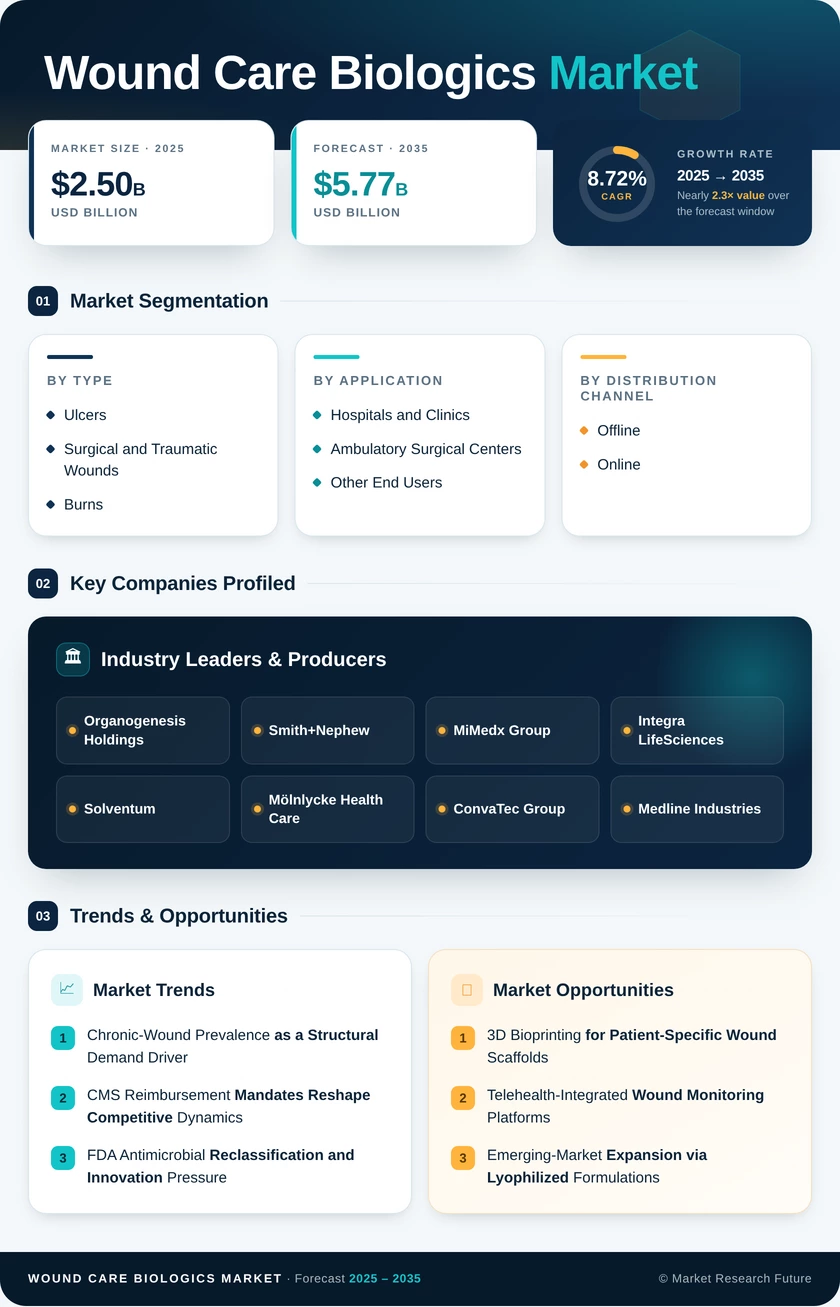
Segmentation Quick Reference
| Dimension | Sub-Segments | Dominant Segment | Fastest Growing Segment |
| By Product | Biological Skin Substitutes, Topical Agents | Biological Skin Substitutes | Topical Agents |
| By Wound Type | Ulcers, Surgical and Traumatic Wounds, Burns | Ulcers | Burns |
| By End User | Hospitals and Clinics, Ambulatory Surgical Centers, Other End Users | Hospitals and Clinics | Ambulatory Surgical Centers |
| By Distribution Channel | Offline, Online | Offline | Online |
| By Geography | North America, Europe, Asia-Pacific, South America, Middle East & Africa | North America | Asia-Pacific |
Market Segmentation Overview
By Product
| Sub-Segment | Key Trend |
| Biological Skin Substitutes | Acellular dermal matrices lead; xenografts gaining share through expanded burn and ulcer indications |
| Topical Agents | Growth-factor therapies and bioactive collagen dressings expanding in outpatient wound-care settings |
Biological skin substitutes remain the revenue backbone, driven by deep clinical-evidence bases for acellular dermal matrices in chronic-ulcer management. Topical agents are gaining momentum as ambulatory surgical centers seek easier-to-apply biologic options that reduce procedure time and storage complexity.
By Wound Type
| Sub-Segment | Key Trend |
| Ulcers | Diabetic foot ulcers and venous leg ulcers sustain the largest demand pool globally |
| Surgical and Traumatic Wounds | Rising surgical volumes and military trauma-care programs drive biologic adoption |
| Burns | Specialized burn centers increasingly replace conventional grafting with xenograft and allograft products |
Ulcers dominate the wound-type segmentation, reflecting the global burden of diabetes and vascular disease. Burns represent the fastest-growing category as biologic dressings demonstrate improved cosmetic outcomes and reduced scarring in burn-center protocols.
By End User
| Sub-Segment | Key Trend |
| Hospitals and Clinics | Inpatient wound-care programs and operating-room infrastructure anchor demand |
| Ambulatory Surgical Centers | Reimbursement parity legislation and outpatient procedure growth accelerate ASC adoption |
| Other End Users | Home health agencies and long-term care facilities expanding biologic wound-care programs |
Hospitals and clinics capture the majority of revenue due to surgical infrastructure and specialist staffing. Ambulatory surgical centers represent the fastest-growing channel, supported by regulatory changes enabling more outpatient wound-care procedures.
By Distribution Channel
| Sub-Segment | Key Trend |
| Offline | Direct manufacturer-to-hospital sales and group purchasing organizations dominate procurement |
| Online | E-procurement platforms accelerating adoption among ASCs and smaller clinics |
Offline distribution controls the majority of revenue through established GPO contracts and direct sales relationships. Online platforms are the fastest-growing channel as digital procurement tools simplify ordering for smaller facilities.
By Geography
| Sub-Segment | Key Trend |
| North America | CMS LCD mandates, DoD biologics procurement, and mature ASC networks anchor global leadership |
| Europe | Aging demographics and diverse regulatory pathways sustain second-largest regional share |