Author

Sakshi Gupta

Zipper Market Size, Share, Industry Trend & Analysis Research Report Information By Product Type (Close-End {Conventional Zipper, and Invisible Zipper}, and Open-End), By Material Type (Metal, Coil, Plastic, and Others), By Function (Standard, and Multifunctional {Reflective Zipper, Water Repellent, Sustainable, and Heat Resistant}), By End Use (Apparel, Sporting Goods, Bags, Luggage, Camping Gear, and Others) And By Region (North America, Europe, Asia-Pacific, And Rest Of The World) – Forecast Till 2035
As per MRFR analysis, the Zipper Market Size was estimated at 17.39 USD Billion in 2024. The Zipper industry is projected to grow from 18.74 USD Billion in 2025 to 39.59 USD Billion by 2035, exhibiting a compound annual growth rate (CAGR) of 7.76% during the forecast period 2025 - 2035. North America holds the largest share of the global Zipper Market at approximately 28%, driven by robust demand from the apparel, footwear, and automotive sectors, a strong manufacturing base, and the presence of leading zipper brands such as YKK, Talon International, and Coats Group. The United States is the leading country within North America, capturing approximately 22% of the global Zipper Market share, supported by a large fashion and sportswear industry, significant demand for high-performance zippers in outdoor and workwear applications, and strong retail and export channels. Apparel dominates the Zipper Market as the largest application segment, accounting for approximately 42% of the global market share in 2025, driven by the high volume of global clothing production incorporating zippers as functional and decorative elements across casual, formal, and sportswear categories.
The Zipper Market is experiencing a dynamic shift towards sustainability and technological advancements.
| 2024 Market Size | 17.39 (USD Billion) |
| 2035 Market Size | 39.59 (USD Billion) |
| CAGR (2025 - 2035) | 7.76% |
YKK (JP), Coats Group (GB), Riri (CH), SBS Zipper (KR), Talon International (US), KCC Zipper (KR), YBS Zipper (CN), Zipper Stop (US), DMC (GB)
Our Impact
Enabled $4.3B Revenue Impact for Fortune 500 and Leading Multinationals
Partnering with 2000+ Global Organizations Each Year
30K+ Citations by Top-Tier Firms in the Industry
The Zipper Market is currently experiencing a dynamic evolution, driven by various factors that influence consumer preferences and manufacturing processes. The demand for zippers is expanding across multiple sectors, including fashion, automotive, and outdoor equipment. This growth is likely attributed to the increasing emphasis on durability and functionality in product design. Manufacturers are adapting to these trends by innovating materials and designs, which may enhance the overall user experience. Furthermore, sustainability appears to be a growing concern, prompting companies to explore eco-friendly alternatives in zipper production. In addition to sustainability, technological advancements are reshaping the Zipper Market landscape. Automation and smart manufacturing techniques are being integrated into production lines, potentially improving efficiency and reducing costs. This shift may also lead to the development of customized zipper solutions tailored to specific consumer needs. As the market continues to evolve, it seems that collaboration between manufacturers and designers will play a crucial role in meeting the diverse demands of consumers, ensuring that the Zipper Market remains competitive and relevant in the years to come.
The Zipper Market is witnessing a notable shift towards sustainable practices. Manufacturers are increasingly focusing on eco-friendly materials and production methods, which may appeal to environmentally conscious consumers. This trend suggests a potential transformation in how zippers are produced, with an emphasis on reducing waste and utilizing recyclable components.
Advancements in technology are significantly impacting the Zipper Market. Automation and smart manufacturing processes are being adopted, which could enhance production efficiency and reduce operational costs. This trend indicates a move towards more innovative and customized zipper solutions, catering to specific market demands.
The intersection of fashion and functionality is becoming increasingly prominent in the Zipper Market. As consumers seek products that combine aesthetic appeal with practical use, manufacturers are responding by designing zippers that not only serve their purpose but also enhance the overall look of garments and accessories. This trend highlights the importance of design in product development.
The Global Zipper Industry is poised for substantial growth, with projections indicating a market value of 17.4 USD Billion in 2024 and an anticipated increase to 39.6 USD Billion by 2035. This growth trajectory suggests a compound annual growth rate of 7.77% from 2025 to 2035, reflecting the industry's resilience and adaptability. Factors contributing to this growth include rising consumer demand for functional and fashionable products, technological advancements in manufacturing, and the increasing emphasis on sustainability. As the market evolves, stakeholders are likely to capitalize on emerging trends to enhance their competitive positioning.
The Global Zipper Industry is significantly influenced by the expansion of the fashion sector, which increasingly incorporates zippers in diverse clothing lines. As fashion trends evolve, designers are utilizing zippers not only for practicality but also as aesthetic elements. This dual functionality enhances the appeal of garments, thereby driving demand for zippers. With the fashion industry projected to grow substantially, the Global Zipper Market is expected to benefit from this momentum. By 2035, the market could reach 39.6 USD Billion, indicating a robust correlation between fashion trends and zipper utilization.
The Global Zipper Industry experiences a notable surge in demand for functional apparel, which incorporates zippers as essential components. This trend is particularly evident in sectors such as outdoor and sportswear, where durability and ease of use are paramount. As consumers increasingly prioritize performance-oriented clothing, manufacturers are adapting their designs to include high-quality zippers. This shift is projected to contribute to the market's growth, with the Global Zipper Market expected to reach 17.4 USD Billion in 2024. The emphasis on functionality in apparel is likely to drive innovation in zipper technology, further enhancing the industry's prospects.
The Global Zipper Industry benefits from diverse applications across various sectors, including fashion, automotive, and home textiles. Zippers serve critical functions in these industries, providing both utility and design elements. For instance, in the automotive sector, zippers are utilized in upholstery and interior design, while in home textiles, they are essential for bedding and curtains. This versatility ensures a steady demand for zippers, as manufacturers seek to incorporate them into a wide range of products. The broad applicability of zippers is likely to sustain market growth, as industries continue to explore innovative uses for this essential fastening solution.
Sustainability trends are increasingly impacting the Global Zipper Industry, as consumers and manufacturers alike prioritize eco-friendly practices. The shift towards sustainable materials, such as recycled plastics and organic fabrics, is prompting zipper manufacturers to innovate and adapt their production methods. This focus on sustainability not only meets consumer demand but also aligns with global environmental goals. As companies invest in sustainable practices, the Global Zipper Market is likely to see a positive response, with growth driven by eco-conscious consumers. This trend may also enhance brand loyalty and market share for companies that prioritize sustainability.
Technological advancements in zipper manufacturing are reshaping the Global Zipper Industry. Innovations such as automated production processes and the introduction of new materials are enhancing the quality and efficiency of zipper production. These advancements allow manufacturers to produce zippers that are not only more durable but also lighter and more versatile. As a result, the market is likely to witness increased adoption of high-performance zippers across various applications, including automotive and aerospace. This trend may contribute to a compound annual growth rate of 7.77% from 2025 to 2035, reflecting the industry's adaptability to technological changes.
The zipper market demonstrates a diverse application landscape, with the apparel segment commanding the largest share, driven by the high volume of clothing production globally. Additionally, footwear and bags also contribute significantly, reflecting their essential role in every consumer’s wardrobe. Conversely, home textiles represent a rapidly expanding sector, capturing increasing attention due to the growing trend of interior design and customization. The growth trends in the zipper market are heavily influenced by the evolving fashion industry and consumer preferences. Apparel remains a dominant force, while home textiles emerge as a burgeoning segment spurred by homeowners’ desire for stylish and functional designs. The automotive application is also on the rise, supported by advancements in technology and materials, enhancing product durability and usability.
Apparel (Dominant) vs. Home Textiles (Emerging)
The apparel segment in the zipper market is characterized by its vast and varied usage, providing critical functionality and design to clothing items. As fashion trends evolve, zippers have become integral to garments, allowing for greater innovation in styles and designs. On the other hand, the home textiles segment is emerging with significant momentum, driven by consumer desires for aesthetic and practical applications in home decor products. This segment is seeing a range of products, from decorative cushions to functional window treatments, that utilize zippers for both enhanced utility and visual appeal. The combined attributes of both segments highlight the versatility of zippers in adapting to consumer needs across various applications.
The Zipper Market is significantly shaped by material types, with metal zippers currently holding the largest market share. Recognized for their durability and strength, metal zippers are widely utilized in high-end apparel and luxury items. On the other hand, plastic zippers are gaining traction, favored for their lightweight and rust-resistant properties, particularly in outdoor and casual wear. This distribution reveals a traditional preference for metal zippers among manufacturers, while the versatility of plastic zippers opens new avenues for growth in various applications. As the market evolves, the growth of the plastic zipper segment is propelled by increasing demand for lightweight and cost-effective solutions. Additionally, innovations in plastic materials have led to improved performance and design flexibility, encouraging manufacturers to adopt plastic over metal. The surge in activewear and casual fashion trends has further enhanced the appeal of plastic zippers, positioning them as a key player in the shifting landscape of the zipper market.
Metal (Dominant) vs. Plastic (Emerging)
Metal zippers are synonymous with durability, longevity, and strength, making them a dominant choice for high-quality products such as jackets, leather goods, and bags. Their traditional appeal lies in their ability to withstand stress and wear, whereas plastic zippers are rapidly emerging in the market due to their lightweight and rust-resistant characteristics. While metal zippers hold their ground in luxury apparel, plastic zippers are latching onto trends in fast fashion and activewear, driven by consumer preferences for convenience and diversity. As manufacturers integrate advanced technologies into plastic zipper production, the gap between metal and plastic zippers is narrowing, giving rise to a competitive environment where both materials serve distinct yet overlapping market segments.
The Zipper Market exhibits a diverse array of end uses, with the fashion industry dominating the market share significantly. Fashion is not just about clothing but extends to accessories and different apparel, contributing substantially to the overall demand for zippers. On the other hand, medical applications are swiftly gaining traction; while currently smaller in share, they represent an expanding segment fueled by the rise in healthcare products requiring specialized and durable zippers, such as medical bags and equipment.
Fashion Industry: Dominant vs. Medical Applications: Emerging
The Fashion Industry is the cornerstone of the Zipper Market, characterized by a wide variety of styles, colors, and functionalities that cater to diverse consumer preferences. Fashion zippers must not only be functional but also serve as design elements, which enhances their marketability. Conversely, Medical Applications represent an emerging segment driven by an increasing demand for sterile, durable, and reliable zippers in medical products. This sector is evolving rapidly, with innovations focusing on materials and designs that ensure hygiene and safety, positioning medical zippers as crucial components in modern healthcare.
The zipper market exhibits diverse preferences, with the coil zipper holding the largest share, favored for its versatility and functionality across various applications, including apparel and accessories. Meanwhile, metal zippers retain their appeal in high-end fashion and heavy-duty applications but do not match the coil zipper's widespread usage. Plastic zippers, on the other hand, are popular due to their lightweight and cost-effective benefits, especially in outdoor gear. Invisible zippers, while a smaller segment currently, are carving out a niche in fashion due to their sleek appearance and demand for seamless garment designs. Current growth trends suggest a favorable trajectory for the zipper market driven by innovative designs and materials. The rising demand for eco-friendly zippers, particularly in the plastic and invisible categories, is expected to propel these segments further. Additionally, the ongoing evolution in fashion trends and functionality requirements means that coil zippers will continue to cater to traditional needs while emerging segments like invisible zippers will meet modern aesthetic preferences, presenting tailored opportunities in the overall market.
Coil Zipper (Dominant) vs. Invisible Zipper (Emerging)
Coil zippers remain the dominant choice in the zipper market, known for their adaptability and ease of manufacturing, making them suitable for a wide array of products from clothing to luggage. This type of zipper is typically made of polyester, offering flexibility and resilience. In contrast, invisible zippers, although emerging, are gaining traction due to their ability to provide a seamless look in garments, appealing to fashion designers seeking sleek designs. Their growing popularity is fueled by innovations in fastening technology and consumer preference for aesthetic versatility. As sustainability becomes increasingly important, both segment values are exploring eco-friendly materials, setting the stage for competitive differentiation and collaborative development in the years to come.
Get more detailed insights about Zipper Market Request Free Sample
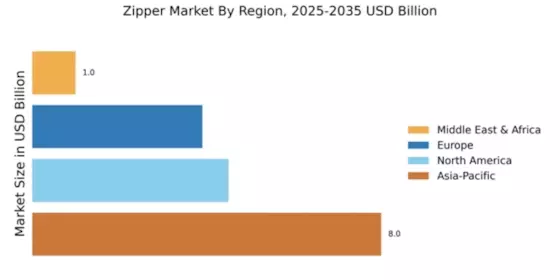
The North American zipper market is projected to reach $4.5 billion by December 2025, driven by increasing demand in the apparel and automotive sectors. Regulatory support for sustainable manufacturing practices is also a key growth driver, as consumers increasingly prefer eco-friendly products. The region's focus on innovation and technology in zipper design further enhances market potential, catering to diverse consumer needs and preferences. Leading countries in this region include the United States and Canada, where major players like Talon International and Zipper Stop are headquartered. The competitive landscape is characterized by a mix of established brands and emerging companies, all striving to capture market share. The presence of key players such as YKK and Coats Group ensures a robust supply chain, contributing to the overall growth of the market.
The European zipper market is expected to reach $3.9 billion by December 2025, fueled by a growing emphasis on sustainability and eco-friendly materials. Regulatory frameworks across the EU promote the use of recycled materials, which is becoming a significant demand trend. This shift towards sustainable practices is not only meeting consumer expectations but also aligning with governmental policies aimed at reducing environmental impact. Key players in Europe include Coats Group and Riri, with strong market presence in countries like Germany, France, and Italy. The competitive landscape is marked by innovation in product offerings, with companies investing in R&D to develop high-quality, sustainable zippers. The region's diverse market dynamics and regulatory support create a favorable environment for growth, attracting both established and new entrants.
Asia-Pacific is the largest zipper market, projected to reach $8.0 billion by December 2025. The region's growth is driven by rapid industrialization, increasing disposable incomes, and a booming fashion industry. Countries like China and India are witnessing a surge in demand for zippers, particularly in the apparel and automotive sectors. Regulatory initiatives aimed at enhancing manufacturing standards are also contributing to market growth, ensuring quality and safety in production. China stands out as a manufacturing hub, hosting key players like YBS Zipper and KCC Zipper. The competitive landscape is intense, with numerous local and international brands vying for market share. The presence of established companies such as YKK and SBS Zipper further strengthens the market, fostering innovation and competitive pricing strategies. This dynamic environment positions Asia-Pacific as a leader in The Zipper.
The Middle East and Africa zipper market is projected to reach $0.99 billion by December 2025, with growth driven by increasing urbanization and a rising middle class. Demand for zippers in the fashion and automotive sectors is gradually increasing, supported by regional economic development initiatives. However, the market is still in its nascent stages, with significant potential for expansion as local manufacturing capabilities improve and consumer preferences evolve. Countries like South Africa and the UAE are leading the way in market development, with a growing number of local manufacturers entering the space. The competitive landscape is characterized by a mix of international brands and emerging local players. As the market matures, the presence of key players and investment in infrastructure will be crucial for capturing market share and driving growth in the region.
The Zipper Market is currently characterized by a dynamic competitive landscape, driven by innovation, sustainability, and regional expansion. Key players such as YKK (Japan), Coats Group (GB), and Riri (Switzerland) are at the forefront, each adopting distinct strategies to enhance their market positioning. YKK (Japan), known for its commitment to quality and innovation, continues to invest heavily in R&D, focusing on eco-friendly materials and production processes. Coats Group (GB) emphasizes digital transformation, leveraging technology to optimize its supply chain and improve customer engagement. Meanwhile, Riri (Switzerland) is expanding its luxury segment, targeting high-end fashion brands with bespoke zipper solutions, thereby enhancing its competitive edge in niche markets.The business tactics employed by these companies reflect a trend towards localizing manufacturing and optimizing supply chains to enhance efficiency and responsiveness. The market structure appears moderately fragmented, with a mix of established players and emerging companies vying for market share. This fragmentation allows for diverse offerings, yet the collective influence of major players like YKK (Japan) and Coats Group (GB) shapes the competitive dynamics significantly, as they set benchmarks for quality and innovation.In November YKK (Japan) announced the launch of its new line of biodegradable zippers, a strategic move aimed at addressing the growing demand for sustainable products in the fashion industry. This initiative not only reinforces YKK's commitment to environmental responsibility but also positions the company as a leader in sustainable innovation within the zipper market. Similarly, in October 2025, Coats Group (GB) unveiled its advanced digital platform designed to streamline order processing and enhance customer interaction. This digital transformation is likely to improve operational efficiency and customer satisfaction, further solidifying Coats Group's competitive position.In September Riri (Switzerland) entered into a strategic partnership with a prominent luxury fashion brand, enabling the development of exclusive zipper designs tailored to high-end garments. This collaboration underscores Riri's focus on the luxury segment and its ability to cater to the specific needs of premium brands, thereby enhancing its market presence. Such strategic actions reflect a broader trend where companies are increasingly aligning their offerings with consumer preferences and market demands.As of December the Zipper Market is witnessing significant trends such as digitalization, sustainability, and the integration of AI technologies. These trends are reshaping competitive strategies, with companies increasingly forming strategic alliances to enhance their capabilities and market reach. The shift from price-based competition to a focus on innovation, technology, and supply chain reliability is evident, suggesting that future competitive differentiation will hinge on the ability to adapt to these evolving market dynamics. Companies that prioritize sustainable practices and technological advancements are likely to emerge as leaders in this competitive landscape.


June 2019: YKK Group has announced the launch of click-Trak, a zipper that makes opening and closing operations easier by replacing the insert pin with a snap button that you press together when closing the zipper. The open parts automatically spin and engage when overlaid and can be easily closed by pushing them together like a button.
April 12, 2024:
YKK has used Low-Carbon Aluminum in its zippers with the objective of lowering greenhouse gas emissions, in line with its YKK Sustainability Vision 2050.
The Zipper Market is projected to grow at a 7.76% CAGR from 2025 to 2035, driven by innovations in materials, increasing demand in fashion, and sustainable practices.
New opportunities lie in:
By 2035, the Zipper Market is expected to achieve robust growth, driven by innovation and strategic partnerships.
| MARKET SIZE 2024 | 17.39(USD Billion) |
| MARKET SIZE 2025 | 18.74(USD Billion) |
| MARKET SIZE 2035 | 39.59(USD Billion) |
| COMPOUND ANNUAL GROWTH RATE (CAGR) | 7.76% (2025 - 2035) |
| REPORT COVERAGE | Revenue Forecast, Competitive Landscape, Growth Factors, and Trends |
| BASE YEAR | 2024 |
| Market Forecast Period | 2025 - 2035 |
| Historical Data | 2019 - 2024 |
| Market Forecast Units | USD Billion |
| Key Companies Profiled | YKK (JP), Coats Group (GB), Riri (CH), SBS Zipper (KR), Talon International (US), KCC Zipper (KR), YBS Zipper (CN), Zipper Stop (US), DMC (GB) |
| Segments Covered | Application, Material Type, End Use, Zipper Type |
| Key Market Opportunities | Integration of sustainable materials in Zipper Market production processes enhances eco-friendly consumer appeal. |
| Key Market Dynamics | Rising demand for sustainable materials drives innovation and competition in the zipper market. |
| Countries Covered | North America, Europe, APAC, South America, MEA |
The Zipper Market was valued at 17.39 USD Billion in 2024.
The Zipper Market is projected to reach 39.59 USD Billion by 2035.
The expected CAGR for the Zipper Market during 2025 - 2035 is 7.76%.
In 2024, the Apparel segment had the highest valuation at 6.95 USD Billion.
The Footwear segment is projected to reach 6.8 USD Billion by 2035.
Plastic is expected to dominate the Zipper Market, projected to reach 11.0 USD Billion by 2035.
The Fashion Industry segment is projected to reach 11.0 USD Billion by 2035.


The secondary research process involved comprehensive analysis of regulatory databases, industry publications, trade statistics, and authoritative manufacturing organizations. Key sources included the US Consumer Product Safety Commission (CPSC), European Committee for Standardization (CEN/TC 248) for textile standards, ASTM International (ASTM D2061) for zipper testing standards, International Organization for Standardization (ISO 10717) for slide fasteners, US International Trade Commission (USITC), Eurostat for EU manufacturing data, US Census Bureau (Quarterly Survey of Plant Capacity Utilization), China National Light Industry Council (CNLIC), Japan Textile Evaluation Technology Council (JTECT), World Trade Organization (WTO) trade statistics, International Textile Manufacturers Federation (ITMF), Bureau of Indian Standards (BIS), Korean Agency for Technology and Standards (KATS), and national textile association reports from key manufacturing markets. These sources were used to collect production statistics, regulatory compliance data, material innovation studies, import/export trends, and competitive landscape analysis for metal zippers, coil zippers, plastic zippers, and specialty fastening technologies.
During the primary research process, both supply-side and demand-side stakeholders were interviewed to gather qualitative and quantitative views. Supply-side sources included CEOs, VPs of Manufacturing, heads of R&D, and supply chain executives from zipper manufacturers and component suppliers. Demand-side sources included chiefs of procurement from clothing labels, outdoor gear designers, car interior specialists, and sourcing managers from fashion houses, bag makers, and industrial textile firms. Primary research confirmed the timetables for sustainability initiatives, validated market segmentation, and gathered information on how materials are replaced, how prices change, and how to make supply chains more resilient.
Primary Respondent Breakdown:
By Designation: C-level Primaries (28%), Director Level (32%), Others (40%)
By Region: North America (32%), Europe (30%), Asia-Pacific (28%), Rest of World (10%)
Global market valuation was derived through production volume analysis and revenue mapping across the value chain. The methodology included:
Identification of 50+ key manufacturers across North America, Europe, Asia-Pacific, and Latin America
Product mapping across metal, coil, plastic, and specialty zipper categories by function (standard, water-repellent, reflective, sustainable, heat-resistant)
Analysis of reported and modeled annual revenues specific to zipper and fastening system portfolios
Coverage of manufacturers representing 75-80% of global market share in 2024
Extrapolation using bottom-up (production volume × ASP by country/segment) and top-down (manufacturer revenue validation) approaches to derive segment-specific valuations, incorporating raw material price indices for metals, polymers, and textile substrates
Kindly complete the form below to receive a free sample of this Report

“This is really good guys. Excellent work on a tight deadline. I will continue to use you going forward and recommend you to others. Nice job”


“Thanks. It’s been a pleasure working with you, please use me as reference with any other Intel employees.”


“Thanks for sending the report it gives us a good global view of the Betaïne market.”


“Thank you, this will be very helpful for OQS.”


“We found the report very insightful! we found your research firm very helpful. I'm sending this email to secure our future business.”


“I am very pleased with how market segments have been defined in a relevant way for my purposes (such as "Portable Freezers & refrigerators" and "last-mile"). In general the report is well structured. Thanks very much for your efforts.”


“I have been reading the first document or the study, ,the Global HVAC and FP market report 2021 till 2026. Must say, good info! I have not gone in depth at all parts, but got a good indication of the data inside!”


“We got the report in time, we really thank you for your support in this process. I also thank to all of your team as they did a great job.”


“The Automotive 48V ECU Components Procurement Intelligence Study” was a complex project, but the Market Research Future (MRFR) team handled it with quality, agility, and customer-centricity. They delivered all requested data on time and within the agreed scope. The team, including Shubhendra Anand and Rahul Gotadki, was always readily available to clarify questions and swiftly implement necessary adjustments, driving the project to a successful conclusion within a very demanding timeframe.
I would also like to specifically commend Akshay Agarwal for his responsiveness and support at every stage—from our initial inquiry on May 6th through to final delivery on June 18th. His dedication made the entire process seamless.”



