3D Machine Vision Market

3D 机器视觉市场研究报告信息按组件(硬件和软件)、按产品(基于智能相机和基于 PC)、按应用(测量和质量保证与检测)、按垂直领域(汽车、半导体、消费电子产品、医疗保健、食品和包装及其他)和按地区(北美、欧洲、亚太地区和世界其他地区)- 到 2030 年的市场预测。
ID: MRFR/ICT/1009-CR
128 Pages
Ankit Gupta
Last Updated: July 10, 2026
3D Machine Vision Market
Market Size
Forecast Period2025 - 2035
CAGR (2025 - 2035)9.12%
2024 Market Size$ 2.31 Billion
2025 Market Size$ 2.52 Billion
2035 Market Size$ 6.04 Billion
Key Players
Cognex Corporation
Keyence Corporation
Basler AG
Teledyne Technologies Incorporated
Omron Corporation
SICK AG
Opportunities
  • Rising Demand for Automation
  • Growing Applications in Robotics
  • Advancements in Imaging Technology

3D机器视觉市场 摘要

根据市场研究未来分析,2024 年 3D 机器视觉市场规模预计为 2.313 亿美元。3D 机器视觉行业预计将从 2025 年的 25.24 亿美元增长到 2035 年的 60.42 亿美元,在 2025 - 2035 年预测期间复合年增长率 (CAGR) 为 9.12%

主要市场趋势和亮点

在技​​术进步和各行业自动化程度提高的推动下,3D 机器视觉市场正在经历强劲增长。

  • 该市场正在见证制造业的采用不断增加,特别是在北美,它仍然是最大的市场。
  • 与人工智能的集成越来越普遍,增强了 3D 机器视觉系统的功能。
  • 医疗保健应用的扩张引人注目,尤其是在增长最快的市场亚太地区。
  • 对自动化的需求不断增长和成像技术的进步是推动市场增长的关键驱动力。

市场规模与预测

2024 年市场规模 2.313 (USD Billion)
2035年市场规模 6.042 (USD Billion)
CAGR (2025 - 2035) 9.12%
2024 年最大的区域市场份额 北美

主要参与者

康耐视公司(美国)、基恩士公司(日本)、巴斯勒股份公司(德国)、Teledyne Technologies Incorporated(美国)、Omron Corporation(日本)、西克公司(德国)、National Instruments Corporation(美国)、Sony Corporation(日本)、MVTec Software GmbH(德国)

Our Impact
Enabled $4.3B Revenue Impact for Fortune 500 and Leading Multinationals
Partnering with 2000+ Global Organizations Each Year
30K+ Citations by Top-Tier Firms in the Industry

市场细分洞察

按组件:硬件(最大)与软件(增长最快)

在 3D 机器视觉市场中,由于先进成像技术和复杂传感器设备的广泛采用,硬件部分占据了最大的市场份额。该部分包括相机、照明和处理单元,它们协同工作以提供高质量的 3D 成像。与此同时,软件领域虽然目前的市场份额较小,但在自动化和智能制造解决方案需求不断增长的推动下,正在迅速取得进展。软件领域正在迅速兴起,这得益于对先进 3D 机器视觉软件和智能 3D 视觉软件解决方案的需求,这些解决方案能够实现实时分析和预测性检查。

组成部分:硬件(主导)与软件(新兴)

硬件领域在 3D 机器视觉市场中仍然占据主导地位,其特点是其在汽车、电子和制药等不同行业中的广泛应用和成熟地位。立体相机和专用照明系统等硬件组件对于实现机器视觉任务的高精度至关重要。另一方面,被标记为新兴的软件领域在创新的推动下正在经历显着增长。人工智能和机器学习。先进的软件解决方案,包括图像识别和数据分析算法,对于优化生产流程变得至关重要,凸显了软件功能与硬件系统集成的转变,以增强整体机器视觉性能。

按产品:基于智能相机(最大)与基于 PC(增长最快)

在3D机器视觉市场中,市场份额的分布凸显了对基于智能相机的解决方案的明显偏好,这些解决方案因其紧凑的设计和集成的功能而占据主导地位。这些系统在需要快速设置和灵活性的应用中特别受到青睐,可实现实时处理并减少对大量外部硬件的需求。相比之下,基于 PC 的系统虽然目前不太流行,但随着软件功能和处理能力的进步而迅速兴起,使其对复杂的成像任务具有吸引力。

产品类型:基于智能相机(主导)与基于 PC(新兴)

基于智能相机的 3D 机器视觉系统的特点是其一体化解决方案,将图像传感器、处理单元和通信接口组合到一个单元中。这种集成不仅简化了设置和维护,还增强了便携性,使其成为以下行业应用的理想选择制造业和机器人技术。相反,基于 PC 的系统虽然目前所占份额较小,但被认为是增长最快的部分。它们提供更高的处理能力和灵活性,使其成为复杂和资源密集型任务的理想选择。随着对高级自动化和数据分析需求的增加,它们与高端软件和分析工具集成的能力使它们能够在未来增长。基于智能相机的解决方案因其紧凑的设计而在市场上占据主导地位,而基于 PC 的 3D 视觉系统和 3D 机器视觉系统则在复杂的工业应用中越来越受欢迎。

按应用:质量保证和检验(最大)与测量(增长最快)

在 3D 机器视觉市场中,“应用”部分主要以质量保证和检测为主,展示了其在各种工业流程中的广泛应用。该细分市场因其在确保产品质量和运营效率方面发挥的关键作用而受到高度重视。测量应用虽然市场份额较小,但在提高测量精度和可靠性的技术进步的推动下,正在迅速获得关注。随着制造商越来越多地采用这些技术,他们正在重塑竞争格局和整体市场方向。 3D 机器视觉市场的增长趋势揭示了质量保证和检测流程自动化的强烈倾向,从而为制造商提供了效率提升。此外,测量应用受益于制造和汽车等行业需求的增加,这些行业的精度至关重要。 Innovations such as artificial intelligence and机器学习与 3D 视觉系统的集成是重要的驱动因素,可以增强分析能力和稳健的决策流程。随着公司努力实现更好的质量控制,对先进 3D 机器视觉解决方案的需求将显着增长,这标志着这两个应用领域的前景光明。

质量保证和检验(主导)与测量(新兴)

质量保证和检测是 3D 机器视觉市场的主导应用,主要是因为它在维持高产品标准和最大限度地减少制造过程中的缺陷方面发挥着至关重要的作用。该应用程序包含一系列功能,包括实时监控和自动缺陷检测,对于寻求优化生产效率的行业来说是不可或缺的。相反,测量应用被认为是新兴的,很大程度上是因为它在确保各种产品的尺寸精度方面越来越重要。随着行业发展到采用更复杂的设计和规格,测量应用正在取得重大进步。随着增强扫描技术和实时数据分析等创新,对精确测量解决方案的需求正在推动其增长,使其成为进一步投资和开发的有吸引力的领域。

按行业分类:汽车(最大)与医疗保健(增长最快)

3D机器视觉市场受到各个垂直行业的显着影响,其中汽车行业占据最大份额。这种主导地位归因于汽车装配和制造中自动化和先进质量控制流程的广泛采用。半导体行业也占据着关键地位,利用 3D 机器视觉进行检查和分类应用。检查和测量过程中对 3D 视觉自动化的需求不断增长,正在扩大 3D 工业视觉解决方案在制造工厂中的采用。其他值得注意的细分市场包括消费电子产品、医疗保健以及食品和包装,每个细分市场都通过专门的应用和要求为整体市场的增长做出了贡献。

汽车:质量控制(主导)与医疗保健:手术援助(新兴)

汽车领域继续在 3D 机器视觉市场中处于领先地位,这主要是由对高效质量控制系统的需求推动的。汽车制造商利用 3D 视觉系统检查零件并确保装配过程中的精度,从而提高整体生产效率。相比之下,医疗保健行业正在成为重要的贡献者,特别是在手术辅助和诊断领域,其中精确成像至关重要。 3D 视觉技术的创新使外科医生能够以前所未有的细节可视化解剖结构,有助于复杂的手术并改善患者的治疗效果。随着这两个领域的发展,它们独特的需求正在推动 3D 机器视觉技术的进步。

获取关于3D机器视觉市场的更多详细见解

主要参与者和竞争洞察

领先的市场参与者正在大力投资研发以扩大其产品线,这将有助于 3D 机器视觉市场进一步增长。市场参与者还开展各种战略活动,以扩大其全球足迹,重要的市场发展包括新产品发布、合同协议、并购、增加投资以及与其他组织的合作。为了在竞争更加激烈和不断发展的市场环境中发展和生存,3D 机器视觉行业必须提供具有成本效益的产品。

本地制造以最大限度地降低运营成本是制造商在全球 3D 机器视觉行业中使用的关键业务策略之一,以使客户受益并扩大市场份额。近年来,3D 机器视觉行业提供了一些最显着的医疗优势。 3D 机器视觉市场的主要参与者,包括通用磨坊公司、安利、康尼格拉品牌公司、嘉吉公司、雅培实验室、卡夫食品集团公司等,都试图通过投资研发业务来增加市场需求。

康耐视公司是一家美国制造商机器视觉自动化制造中用于检查和识别零件、检测缺陷、验证产品装配和引导装配机器人的系统、软件和传感器。康耐视总部位于美国马萨诸塞州纳蒂克,在 20 多个国家设有办事处。

7 月,康耐视推出了“VisionPro”,这是一款用于工业机器视觉的新视觉软件系列,使客户能够在同一应用中将深度学习和传统视觉工具结合起来。
欧姆龙的主要业务是制造和销售自动化元件、设备和系统。它以消费和医疗市场上的数字温度计、血压计和雾化器等医疗设备而闻名。欧姆龙于 2007 年开发出世界上第一台电子检票机,被命名为 IEEE Milestone,并且是最早的制造商之一自动柜员机(ATM)配备磁条阅读器。

3 月,欧姆龙推出了用于机械臂的 FH-SMD 系列 3D 视觉传感器,可实现节省空间的组装、检查和拾放应用。

3D机器视觉市场市场的主要公司包括

行业发展

  • 2024 年第二季度:康耐视推出用于高速检测的 In-Sight L38 3D 视觉系统康耐视公司宣布推出 In-Sight L38 3D 视觉系统,专为制造环境中的高速、高精度检测而设计。该新产品旨在改善电子和汽车生产线的缺陷检测和测量。
  • 2024 年第二季度:SICK AG 推出 TriSpector1000 3D视觉传感器适用于食品和包装行业SICK AG 推出了 TriSpector1000,这是一款专为食品和包装应用中的质量控制而定制的新型 3D 视觉传感器。该传感器可实现实时 3D 检测,以确保产品完整性并减少浪费。
  • 2024 年第二季度:Keyence 在德国开设新的研发机构,以推进 3D 机器视觉市场技术Keyence Corporation 在德国慕尼黑开设了一个新的研发中心,专注于加速工业自动化和机器人领域 3D 机器视觉系统的创新。
  • 2024 年第三季度:3D 视觉初创公司 Scantinel 筹集 2500 万美元 B 轮融资以扩展工业应用Scantinel Photonics 是一家 3D 机器视觉解决方案开发商,获得了 2500 万美元的 B 轮融资,以扩大其在物流、制造和自主机器人领域的技术。
  • 2024 年第三季度:Basler AG 宣布与 NVIDIA 就人工智能驱动的 3D 视觉系统建立战略合作伙伴关系Basler AG 与 NVIDIA 建立战略合作伙伴关系,将先进的 AI 功能集成到其 3D 机器视觉相机中,旨在增强工业环境中的实时对象识别和缺陷检测。
  • 2024 年第三季度:欧姆龙推出适用于高精度装配线的 FH-SMD 3D 视觉传感器欧姆龙公司发布了 FH-SMD 3D 视觉传感器,旨在提高自动化装配线的精度和速度,特别是在电子和汽车制造领域。
  • 2024 年第四季度:Teledyne DALSA 赢得向汽车 OEM 供应 3D 机器视觉市场系统的重要合同Teledyne DALSA 获得了一份价值数百万美元的合同,为全球领先的汽车原始设备制造商 (OEM) 提供用于质量检测的 3D 机器视觉系统。
  • 2024 年第四季度:Isra Vision 收购 3D 视觉初创公司 RoboSpect,收购金额未公开阿特拉斯·科普柯子公司 Isra Vision 收购了专门从事自动化焊接检测 3D 机器视觉的初创公司 RoboSpect,以加强其在工业自动化领域的产品组合。
  • 2025 年第一季度:Zivid 任命新首席执行官,推动 3D 机器视觉市场的全球扩张挪威 3D 视觉技术公司 Zivid 宣布任命新首席执行官,领导其国际增长战略并加速物流和制造市场的产品开发。
  • 2025 年第一季度:LMI Technologies 推出 Gocator 2600 系列 3D 智能传感器LMI Technologies 推出了 Gocator 2600 系列,这是一款全新的高分辨率 3D 智能传感器系列,专为电子、汽车和包装行业的严苛检测任务而设计。
  • 2025 年第二季度:Photoneo 获得 4000 万美元资金以扩展 3D 视觉机器人平台3D 机器视觉和机器人解决方案提供商 Photoneo 在新一轮融资中筹集了 4000 万美元,以加速其 3D 视觉平台在物流和电子商务自动化领域的部署。
  • 2025 年第二季度:康耐视收购 3D 视觉软件公司 OptoGenius 以增强人工智能能力康耐视公司收购了 AI 驱动的 3D 视觉软件开发商 OptoGenius,以加强其在先进机器视觉领域的产品组合并扩展其智能制造产品。

报告范围

FAQs

What is the projected market valuation of the 3D Machine Vision Market by 2035?

The projected market valuation for the 3D Machine Vision Market by 2035 is 6.042 USD Billion.

What was the market valuation of the 3D Machine Vision Market in 2024?

The overall market valuation of the 3D Machine Vision Market in 2024 was 2.313 USD Billion.

What is the expected CAGR for the 3D Machine Vision Market during the forecast period 2025 - 2035?

The expected CAGR for the 3D Machine Vision Market during the forecast period 2025 - 2035 is 9.12%.

Which companies are considered key players in the 3D Machine Vision Market?

Key players in the 3D Machine Vision Market include Cognex Corporation, Keyence Corporation, Basler AG, and Teledyne Technologies Incorporated.

What are the main components of the 3D Machine Vision Market?

The main components of the 3D Machine Vision Market are hardware and software, with hardware valued at 3.8 USD Billion and software at 2.242 USD Billion by 2035.

How does the market for smart camera-based products compare to PC-based products in 2025?

In 2025, the market for smart camera-based products is projected to reach 3.1 USD Billion, while PC-based products are expected to reach 2.942 USD Billion.

What applications are driving growth in the 3D Machine Vision Market?
The applications driving growth in the 3D Machine Vision Market include measurement and quality assurance & inspection, with respective valuations of 3.8 USD Billion and 2.242 USD Billion by 2035.
Which verticals are most prominent in the 3D Machine Vision Market?

Prominent verticals in the 3D Machine Vision Market include automotive, semiconductor, and consumer electronics, with automotive projected to reach 1.8 USD Billion by 2035.

What is the expected growth trajectory for the healthcare sector within the 3D Machine Vision Market?

The healthcare sector within the 3D Machine Vision Market is expected to grow to 0.8 USD Billion by 2035.

How does the 3D Machine Vision Market's growth compare across different verticals?

The 3D Machine Vision Market's growth varies across verticals, with 'Others' projected to reach 1.642 USD Billion, indicating diverse applications and demand.

作者
Author
Author Profile
Ankit Gupta LinkedIn
Team Lead - Research
Ankit Gupta is a seasoned market intelligence and strategic research professional with over six plus years of experience in the ICT and Semiconductor industries. With academic roots in Telecom, Marketing, and Electronics, he blends technical insight with business strategy. Ankit has led 200+ projects, including work for Fortune 500 clients like Microsoft and Rio Tinto, covering market sizing, tech forecasting, and go-to-market strategies. Known for bridging engineering and enterprise decision-making, his insights support growth, innovation, and investment planning across diverse technology markets.
发表评论

Research Approach


Secondary Research

The secondary research process involved comprehensive analysis of technical standards databases, automation industry publications, manufacturing sector reports, and authoritative industrial technology organizations. Key sources included the International Organization for Standardization (ISO) standards for machine vision and optical measurement (ISO 10218 for robotic safety interfacing with vision systems), National Institute of Standards and Technology (NIST) Manufacturing Extension Partnership databases, International Federation of Robotics (IFR) World Robotics annual statistics, Association for Advancing Automation (A3/AIA) vision industry databases, European Machine Vision Association (EMVA) technical standards and market data, Japan Industrial Imaging Association (JIIA) industry reports, VDMA (German Engineering Federation) Optical Storage Technology sessions, IEEE Robotics and Automation Society publications on computer vision, SPIE (International Society for Optics and Photonics) proceedings on 3D imaging technologies, EU Eurostat Industrial Production databases for automation equipment, U.S. Bureau of Labor Statistics for manufacturing automation trends, National Electrical Manufacturers Association (NEMA) industrial control standards, and semiconductor industry association reports from SIA (Semiconductor Industry Association) and SEMI. These sources were used to collect installation statistics, standardization compliance data, industrial adoption trends, manufacturing automation benchmarks, and technology landscape analysis for structured light scanners, laser triangulation systems, time-of-flight cameras, and stereo vision technologies.


Primary Research

In the main research process, people from both the supply side and the demand side were interviewed to get both qualitative and quantitative information. Supply-side sources included CEOs, CTOs of Imaging Technology, VPs of Engineering, heads of R&D for 3D vision systems, and regional commercial directors from machine vision camera manufacturers, smart sensor OEMs, and industrial software providers. Plant directors, automation engineering managers, quality control directors, robotic system integrators, and manufacturing IT leads from automotive assembly plants, semiconductor fabrication facilities, electronics contract manufacturers, pharmaceutical packaging lines, and logistics distribution centers were all sources of demand. Primary research confirmed product development roadmaps for depth-sensing technologies, gathered information on integration problems, pricing trends for vision-guided robotics, and barriers to implementing Industry 4.0. It also confirmed market segmentation across hardware components and software platforms.

Primary Respondent Breakdown:

By Designation: C-level Primaries (30%), Director Level (35%), Others (35%)

By Region: North America (30%), Europe (25%), Asia-Pacific (40%), Rest of World (5%)
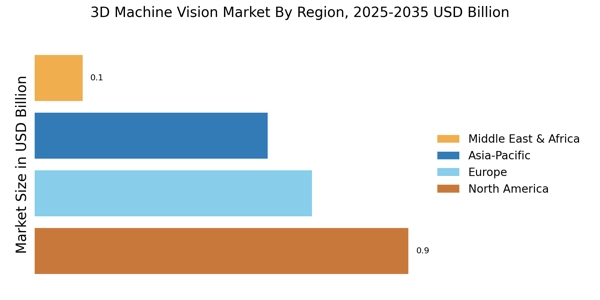
 

Market Size Estimation

Global market valuation was derived through hardware shipment analysis and software licensing revenue mapping. The methodology included:

Identification of 40+ key manufacturers across North America, Europe, Asia-Pacific, and Latin America specializing in 3D cameras, vision processors, and imaging software

Product mapping across structured light, laser triangulation, time-of-flight (ToF), stereo vision, and photometric stereo technologies

Analysis of reported and modeled annual revenues specific to 3D machine vision hardware components (cameras, sensors, lighting, processors) and analytical software suites

Coverage of manufacturers representing 75-80% of global market share in 2024

Extrapolation using bottom-up (unit shipments × average selling price by end-use industry and country) and top-down (manufacturer revenue triangulation against industrial automation spending) approaches to derive segment-specific valuations for quality inspection, robotic guidance, and dimensional measurement applications

下载免费样本

请填写以下表格以获取本报告的免费样本

Download PDF ×

We do not share your information with anyone. However, we may send you emails based on your report interest from time to time. You may contact us at any time to opt-out.