Building Information Modelling Market

建筑信息模型市场研究报告按组件(BIM 软件和 BIM 服务)、项目生命周期(施工前、施工和运营)、部署模型(本地和云端)、最终用户(政府、建筑师、工程、承包商、设施经理、维护技术人员、学术界和业主)和地区(北美、欧洲、亚太地区、中东和非洲以及南美洲)提供的信息 - 预测到 2030 年
ID: MRFR/ICT/1512-CR
110 Pages
Apoorva Priyadarshi, Shubham Munde
Last Updated: June 29, 2026
Building Information Modelling Market
Market Size
Forecast Period2025 - 2035
CAGR (2025 - 2035)14.32%
2024 Market Size$ 10.1 Billion
2025 Market Size$ 11.55 Billion
2035 Market Size$ 44.02 Billion
Key Players
Autodesk
Bentley Systems
Trimble
Nemetschek
Graphisoft
RIB Software
Opportunities
  • Growing Emphasis on Sustainability
  • Increased Focus on Cost Efficiency
  • Regulatory Compliance and Standards

Building Information Modelling Market 摘要

根据市场研究未来分析,建筑信息模型市场规模预计到 2024 年为 101 亿美元。建筑信息模型行业预计将从 2025 年的 11.55 亿美元增长到 2035 年的 440.2 亿美元,在 2025 年至 2035 年的预测期内复合年增长率 (CAGR) 为 14.32%

主要市场趋势和亮点

在技​​术进步和可持续发展举措的推动下,建筑信息模型市场有望实现大幅增长。

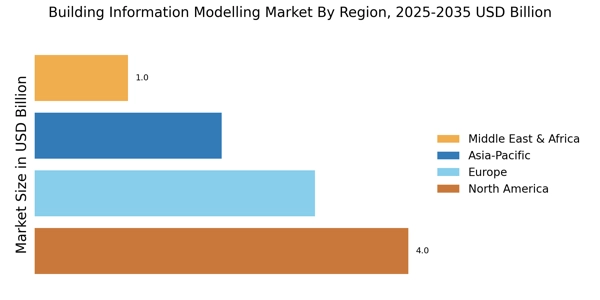
  • 先进技术的集成正在改变建筑信息模型市场格局,特别是在北美。
  • 可持续性和绿色建筑实践日益成为 BIM 战略的核心,尤其是在亚太地区。
  • 协作和实时数据共享正在提高项目效率,BIM 软件引领市场。
  • 对基础设施开发的需求不断增长以及对可持续性的日益重视是推动 BIM 服务领域发展的关键驱动力。

市场规模与预测

2024 年市场规模 10.1 (USD Billion)
2035年市场规模 44.02 (USD Billion)
CAGR (2025 - 2035) 14.32%
2024 年最大的区域市场份额 北美

主要参与者

Autodesk(美国)、Bentley 软件公司(美国)、天宝(我们),涅梅切克(德国)、Graphisoft (HU)、RIB Software (德国)、AVEVA (英国)、达索系统 (法国)、西门子 (德国)

Our Impact
Enabled $4.3B Revenue Impact for Fortune 500 and Leading Multinationals
Partnering with 2000+ Global Organizations Each Year
30K+ Citations by Top-Tier Firms in the Industry

市场细分洞察

按组件:BIM 软件(最大)与 BIM 服务(增长最快)

建筑信息模型(BIM)市场显示BIM软件明显领先,占据最大的市场份额。其主导地位主要是由于越来越多地采用软件解决方案来增强项目管理和建筑项目效率。另一方面,由于对补充软件使用的专业服务的需求日益增长,BIM 服务迅速在行业中获得关注。随着公司寻求优化 BIM 的使用,与实施、培训和咨询相关的服务变得同样重要。

BIM 软件(主导)与 BIM 服务(新兴)

BIM 软件处于建筑信息模型市场的前沿,提供了促进建筑项目设计、可视化和分析的重要工具。其强大的功能支持各个项目阶段,使其成为建筑师、工程师和承包商不可或缺的一部分。相反,BIM 服务虽然目前是一个新兴领域,但正变得越来越重要。它们包含一系列产品,包括培训、支持和定制,使组织能够最大化其软件投资。随着行业的发展,这两个组成部分之间的协同作用变得至关重要,使公司能够充分发挥 BIM 技术的潜力。

按项目生命周期:施工前(最大)与施工(增长最快)

在建筑信息模型 (BIM) 市场中,项目生命周期部分表现出不同的份额和动态,其中施工前是最大的贡献者。此阶段的利益相关者利用 BIM 来增强规划、可视化和协作,从而显着影响项目成果。相反,随着组织越来越多地采用 BIM 技术来简化运营并降低成本,施工阶段已成为增长最快的部分。这种增长是由实时数据集成和改进项目协调的需求推动的。随着市场的发展,施工前阶段由于其在初始项目评估和设计效率中的关键作用而继续占据主导地位。然而,数字化施工技术的不断加快以及对项目执行敏捷性的重视正在推动施工阶段的快速扩张。借助自动化和数据管理的进步,公司逐渐认识到 BIM 在提高施工过程中的生产力和灵活性方面的价值。

建设前:主导 vs. 建设:新兴

BIM 市场的施工前阶段的特点是其在项目开发中的基础作用,建筑师和工程师利用先进的建模技术来优化设计并简化工作流程。该部分强调通过可视化工具和数据共享进行利益相关者协作,确保在实际施工开始之前进行全面规划。另一方面,施工阶段被认为是 BIM 领域的新兴力量,见证了支持实时项目跟踪和管理的技术的大量采用。向异地施工和模块化设计的转变需要强大的 BIM 应用程序来增强现场沟通和项目执行。这两个部分都很关键,但它们具有不同的功能,从而形成协同关系,从而提高整体项目效率。

按部署模型:本地(最大)与云端(增长最快)

建筑信息模型市场展示了多样化的部署模型格局,主要分为本地和云解决方案。目前,本地部署在市场份额方面处于领先地位,满足了需要高安全性和定制解决方案的组织的需求。其份额反映了老牌企业对内部数据管理的传统偏好,特别是在保密性和数据控制至关重要的行业。另一方面,在年轻公司在运营中拥抱灵活性和可扩展性的推动下,云解决方案正在获得关注并开始占据重要的市场份额。随着行业的发展,由于建筑和建筑领域的快速数字化转型,云部署成为增长最快的部分。主要增长动力包括对支持实时数据访问、增强移动性以及降低与云基础设施相关的运营成本的协作工具的需求不断增长。此外,云技术的不断进步正在简化软件集成,使云解决方案不仅具有吸引力,而且对于那些希望在 BIM 领域保持领先地位的公司来说也是一种竞争必需品。

部署模型:本地部署(主导)与云端(新兴)

本地部署仍然是建筑信息模型市场的主导力量,代表了建筑公司在本地服务器上托管 BIM 软件的传统方法。这种模式吸引了优先考虑数据安全和监管合规性的老牌公司。本地解决方案为用户提供根据特定企业需求量身定制的定制服务,从而营造一个维护遗留系统的环境。相反,云部署正在成为一种强大的替代方案,主要吸引初创公司和有远见的公司。它具有显着的优势,包括降低 IT 成本、可扩展性和增强协作。云解决方案的可访问性允许团队在不同地点同时工作,促进国际协作和项目管理,同时最大限度地减少延迟。

按最终用户:建筑师(最大)与承包商(增长最快)

建筑信息模型 (BIM) 市场的特点是客户多元化,建筑师因其在设计和规划中不可或缺的作用而占据最大的市场份额。紧随其后的是承包商,他们利用 BIM 技术来提高项目效率和协作,从而实现快速增长。政府和设施经理等部门也做出了重大贡献,但仍然被这些关键参与者所掩盖。最终用户的多样性展示了 BIM 在整个施工生命周期中的广泛适用性。随着行业的发展,施工复杂性的增加、对可持续性的推动以及高效项目管理的必要性推动了对 BIM 解决方案的需求。承包商尤其受益于移动 BIM 应用程序的进步,这些应用程序可以在工作现场进行实时协作。学术机构在培训下一代 BIM 专业人员、进一步推动整个行业的采用方面发挥着至关重要的作用。人工智能和物联网等创新技术的整合预计将在未来几年推动增长并重塑市场格局。

建筑师(主导)与承包商(新兴)

建筑师在建筑信息模型 (BIM) 市场中举足轻重,凭借其设计和战略规划方面的专业知识成为主导力量。他们对 BIM 工具的熟悉使他们能够创建详细的可视化并有效地向利益相关者传达想法。该细分市场的特点是高度重视创造力和创新,使建筑师能够在竞争激烈的市场中保持领先地位。相比之下,承包商代表了一个新兴的细分市场,越来越多地利用 BIM 来简化运营、降低成本并增强项目交付。他们专注于将 BIM 集成到施工流程中,以促进更好的协调和管理,使他们成为项目中的重要参与者。随着承包商不断采用和适应这些技术,他们有望塑造 BIM 领域的未来趋势。

获取关于Building Information Modelling Market的更多详细见解

Building Information Modelling Market市场的主要公司包括

报告范围

FAQs

What is the current valuation of the Building Information Modelling Market?

As of 2024, the market valuation stands at 10.1 USD Billion.

What is the projected market size for the Building Information Modelling Market by 2035?

The market is expected to reach a valuation of 44.02 USD Billion by 2035.

What is the expected CAGR for the Building Information Modelling Market during the forecast period?

The market is anticipated to grow at a CAGR of 14.32% from 2025 to 2035.

Which companies are considered key players in the Building Information Modelling Market?

Key players include Autodesk, Bentley Systems, Trimble, Nemetschek, and others.

What are the main components of the Building Information Modelling Market?

The primary components are BIM Software, valued at 6.06 USD Billion, and BIM Services, valued at 4.04 USD Billion.

How does the market perform across different project lifecycle stages?
In the project lifecycle, Construction is valued at 4.0 USD Billion, while Operation and Pre-construction are valued at 3.6 USD Billion and 2.5 USD Billion, respectively.
What are the deployment models utilized in the Building Information Modelling Market?
The market features On-premise deployment valued at 4.04 USD Billion and On-cloud deployment valued at 6.06 USD Billion.
Which end users are driving demand in the Building Information Modelling Market?
End users include Architects, valued at 2.0 USD Billion, and Engineers, valued at 2.5 USD Billion, among others.
What is the projected growth for BIM Services by 2035?
BIM Services are expected to grow to 17.62 USD Billion by 2035.
How does the market's growth potential compare across different segments?
The market's growth potential varies, with BIM Software projected to reach 26.4 USD Billion and BIM Services reaching 17.62 USD Billion by 2035.
作者
Author
Author Profile
Apoorva Priyadarshi LinkedIn
Research Analyst
With 4+ years of experience in Market Intelligence and Strategic Research, Apoorv specializes in ICT, Semiconductor, and BFSI markets. Combining strong analytical capabilities with a deep understanding of technology-driven industries, he focuses on delivering data-driven insights that support strategic decision-making. With a background in technology and business research, Apoorv has contributed to numerous global market studies, competitive landscape analyses, and opportunity assessments across sectors such as semiconductors, digital banking, cybersecurity, and telecommunications.
Co-Author
Co-Author Profile
Shubham Munde LinkedIn
Team Lead - Research
Shubham brings over 7 years of expertise in Market Intelligence and Strategic Consulting, with a strong focus on the Automotive, Aerospace, and Defense sectors. Backed by a solid foundation in semiconductors, electronics, and software, he has successfully delivered high-impact syndicated and custom research on a global scale. His core strengths include market sizing, forecasting, competitive intelligence, consumer insights, and supply chain mapping. Widely recognized for developing scalable growth strategies, Shubham empowers clients to navigate complex markets and achieve a lasting competitive edge. Trusted by start-ups and Fortune 500 companies alike, he consistently converts challenges into strategic opportunities that drive sustainable growth.
发表评论

Research Approach

Research Methodology on Building Information Modelling Market

Introduction

The present research aims to analyze the potential of the Building Information Modeling (BIM) market as projected in the report published by Market Research Future, entitled “Building Information Modelling Market ” (MRFR). The BIM market is expected to grow at a substantial rate owing to the increasing adoption of technological advancements in the construction sector. The report focuses on regional and global market growth along with market performance, drivers, and opportunities. The report also highlights various dynamics of the industry such as market outlook, opportunities, and constraints associated with this domain.

The research methodology applied in this report consists of primary research and secondary research. The primary research includes industry talks with BIM experts, developers of BIM technology, and building design software developers, while the secondary research includes examining published papers, books, and magazines, analysis of their contents, industry databases, press releases, and other syndicated data sources. This is supplemented with inputs from key industry players, reference material such as Bloomberg Businessweek, product launches, trade data, and price structure.

Objectives of the Study

The objectives of this study are as follows:

  • To study the current market trends, statistics and market performance of the BIM market
  • To analyze the aspects affecting the market growth, opportunities, and constraints associated with the BIM domain
  • To provide an insight into the regional and global BIM market growth
  • To analyze the market potential, business opportunities and trends for the BIM market
  • To define and forecast the global BIM market based on technology, application, and region

Scope of the Study

This research report covers the following market segments:

  • Technology: Cloud BIM, Mobile BIM, RESTful BIM, Open BIM
  • Application: Infrastructure, Asset, Buildings, Facility Management
  • Region: North America, Europe, Asia-Pacific, Latin America, and Middle East & Africa

Research Methodology

Secondary Research

 Secondary research includes the identification of data sources, the collection of the data, and the analysis of the data gathered. It is used to define the unique characteristics of the BIM market by mapping out the parameters available within the research framework while also developing a broad understanding of past market trends and developments.

The secondary sources include Bloomberg BusinessWeek, Search Engine databases, press releases, articles, and relevant reference materials such as white papers, company reports, industry reports, and news articles. Additionally, these are supplemented with inputs from leading businesses and industry experts related to the BIM market via interviews and surveys.

The collected data is then categorized into its respective segments and then analyzed using various methods such as Porter’s Five Forces Model, SWOT Analysis, and PESTEL analysis to estimate the potential of the BIM market in the future.

Primary Research

Primary research includes data gathered through direct communication and surveys of selected key personnel. It is used to validate the data collected from secondary research and to develop an in-depth understanding of the BIM market.

The primary data is collected through face-to-face interviews with key personnel from various stakeholders in the BIM market. These include BIM developers, suppliers, distributors, traders, vendors, and manufacturers. It is also gathered from a panel of domain experts from other areas such as academia, government and business.

Data Collection

The collected data is then categorized into its respective segments and then analyzed using various methods such as Porter’s Five Forces Model, SWOT Analysis, and PESTEL analysis to estimate the potential of the BIM market in the future. This data is then used to develop the necessary insights into the competitive landscape of the BIM market.

Data Validation

After the data is collected, it is then validated by conducting a series of three-point checks such as accuracy check, errors check, outliers check, trends check, and missing values check. This is done to ensure the accuracy as well as the completeness of the data.

Data Analysis

Once the data is validated, it is then analyzed and processed to develop an understanding of the BIM market landscape and its potential. The collected data is analyzed using various analytical and statistical tools such as Porter’s Five Forces Model, SWOT Analysis, and PESTEL Analysis.

Continuous Feedback

 Continuous feedback from the stakeholders helps in improving the accuracy and approaches used for analyzing the BIM market. This ensures that the insights produced are up-to-date and applicable to the BIM market.

Conclusion

The research methodology applied in this report helps to analyze the potential of the BIM market for the future, along with various dynamics of the industry such as market size, market growth, technology, applications, opportunities, and constraints associated with the domain. The data is collected from both primary and secondary research sources and validated through a series of measures to ensure accuracy, completeness, and correctness. This is further supplemented by continuous feedback from the stakeholders, which helps in improving the accuracy of the analysis and the insights produced.

下载免费样本

请填写以下表格以获取本报告的免费样本

Download PDF ×

We do not share your information with anyone. However, we may send you emails based on your report interest from time to time. You may contact us at any time to opt-out.