Request Free Sample ×

Kindly complete the form below to receive a free sample of this Report

* Please use a valid business email

Leading companies partner with us for data-driven Insights

clients tt-cursor
Hero Background

Power Tools Market

ID: MRFR/Equip/2429-CR
147 Pages
Sakshi Gupta
Last Updated: May 23, 2026
电动工具市场研究报告信息按机器类型(钻孔工具、切割/锯切工具、紧固工具、破碎工具等)按操作模式(电动、液压、气动、其他)、按移动性(固定式和便携式)、按应用(住宅、商业和工业)以及按地区(北美、欧洲、亚太地区和世界其他地区)划分 - 预测到 2032 年
Download PDF ×

We do not share your information with anyone. However, we may send you emails based on your report interest from time to time. You may contact us at any time to opt-out.

Power Tools Market 摘要

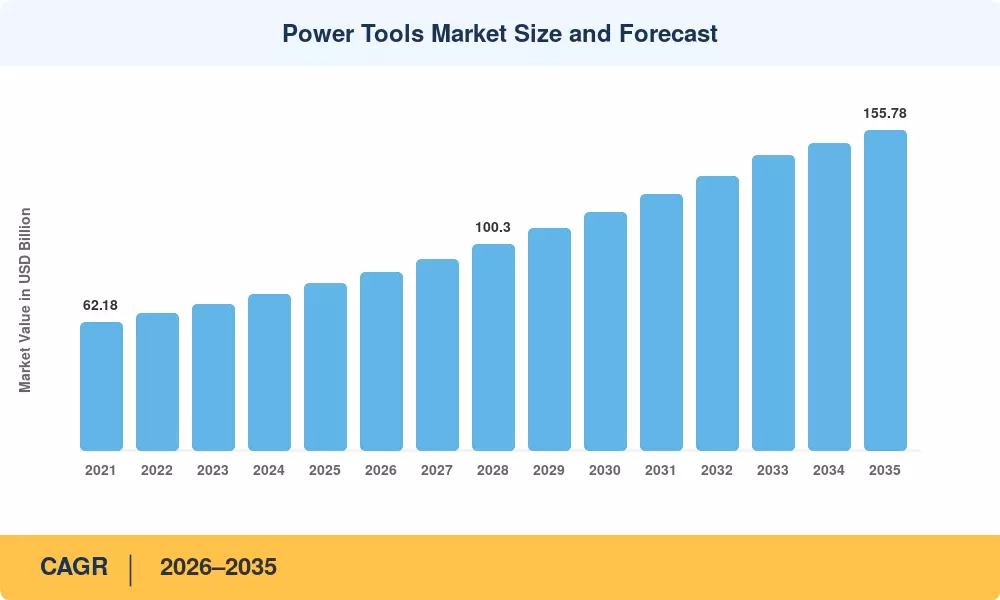
根据 MRFR 分析,2024 年电动工具市场规模预计为 421.903 亿美元。电动工具行业预计将从 2025 年的 448.3227 亿美元增长到 2035 年的 822.9464 亿美元,在 2025 年至 2035 年的预测期内复合年增长率 (CAGR) 为 6.26%。

主要市场趋势和亮点

电动工具市场正在经历向创新和可持续发展的动态转变。

  • 智能技术的融合正在重塑电动工具市场,提升用户体验和效率。
  • 可持续发展和环保产品越来越受欢迎,反映出消费者对环保工具的偏好日益增长。
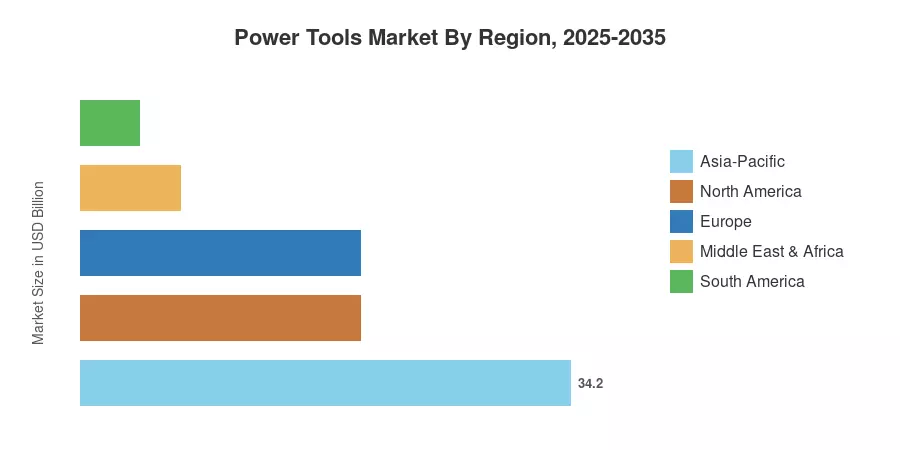
  • 北美仍然是最大的市场,而亚太地区正在成为电动工具增长最快的地区。
  • 技术进步和建筑活动的增加是推动市场增长的关键驱动力,特别是在建筑领域。

市场规模与预测

2024 年市场规模 42190.3 (USD Million)
2035年市场规模 82294.64 (USD Million)
CAGR (2025 - 2035) 6.26%
2024 年最大的区域市场份额 北美

主要参与者

博世(德国)、DeWalt (美国)、Makita (日本)、Hilti (LI)、Milwaukee (美国)、Black & Decker (美国)、Ryobi (日本)、Festool (德国)、麦太保(德国)

Our Impact
Enabled $4.3B Revenue Impact for Fortune 500 and Leading Multinationals
Partnering with 2000+ Global Organizations Each Year
30K+ Citations by Top-Tier Firms in the Industry

主要参与者和竞争洞察

电动工具市场目前的特点是在创新、技术进步和对可持续性日益重视的推动下,竞争格局充满活力。博世(德国)、得伟(美国)和喜利得(爱尔兰)等主要参与者正在通过产品多元化和区域扩张相结合的方式进行战略定位。博世(DE)专注于将智能技术集成到其工具中,增强用户体验和运营效率。
 
DeWalt(美国)强调稳健的营销策略以及与专业承包商的合作伙伴关系,从而巩固其在北美市场的地位。另一方面,喜利得 (LI) 正在大力投资数字化转型,旨在通过先进的软件解决方案简化运营并提高客户参与度。总的来说,这些战略有助于营造一个越来越以创新和以客户为中心的解决方案为中心的竞争环境。电动工具市场的关键业务策略包括本地化制造和优化供应链,以提高对市场需求的响应能力。市场结构显得较为分散,几个主要参与者发挥着相当大的影响力。这种分散化使得利基市场参与者能够蓬勃发展,而大公司则利用规模经济来保持有竞争力的价格。这些关键参与者的集体影响力塑造了市场动态,因为他们不断适应不断变化的消费者偏好和技术进步。
 
2025 年 11 月,博世(德国)宣布推出具有先进人工智能功能的新系列无绳电动工具。这一战略举措意义重大,因为它使博世处于智能工具领域的前沿,吸引了精通技术的消费者和寻求增强功能的专业人士。人工智能的集成不仅提高了工具性能,还提供了预测性维护功能,有可能减少用户的停机时间。
 
2025年10月,得伟(美国)扩大了产品线,推出了一系列由回收材料制成的环保电动工具。这一举措符合消费者对可持续产品日益增长的需求,并体现了得伟对环境责任的承诺。通过优先考虑可持续发展,得伟不仅在竞争激烈的市场中脱颖而出,而且还吸引了更广泛关注生态影响的受众。
 
2025 年 9 月,喜利得 (LI) 与一家领先的软件公司建立了战略合作伙伴关系,以增强其数字产品。此次合作旨在开发一个集成工具管理和项目规划的综合平台,从而简化建筑专业人员的工作流程。此次合作的战略重要性在于喜利得能够为客户提供附加值,巩固其作为建筑行业数字化转型领导者的地位。
 
截至 2025 年 12 月,电动工具市场当前的竞争趋势越来越多地由数字化、可持续性和人工智能技术的集成来定义。战略联盟在塑造格局方面发挥着至关重要的作用,使公司能够利用互补优势并增强其市场产品。展望未来,差异化竞争可能会从传统的基于价格的竞争演变为注重创新、技术进步和供应链可靠性。这一转变强调了适应性和前瞻性战略对于保持竞争优势的重要性。

Power Tools Market市场的主要公司包括

报告范围

FAQs

What is the current valuation of the Power Tools Market as of 2024?

The Power Tools Market was valued at approximately 42190.3 USD Million in 2024.

What is the projected market valuation for the Power Tools Market in 2035?

The market is expected to reach a valuation of around 82294.64 USD Million by 2035.

What is the expected CAGR for the Power Tools Market during the forecast period 2025 - 2035?

The anticipated CAGR for the Power Tools Market during the 2025 - 2035 period is 6.26%.

Which segments are included in the Power Tools Market by application?

The market segments by application include Construction, Woodworking, Metalworking, Automotive, and Maintenance.

What are the projected valuations for the Construction segment in 2035?

The Construction segment is projected to reach a valuation of approximately 21000.0 USD Million by 2035.

Which power sources are utilized in the Power Tools Market?

The market categorizes power sources into Electric, Pneumatic, Hydraulic, Internal Combustion Engine, and Manual.

What is the expected growth for the Electric power source segment by 2035?

The Electric power source segment is likely to grow to around 34000.0 USD Million by 2035.

What types of tools are included in the Power Tools Market?

The market encompasses various tool types, including Drills, Saws, Grinders, Sanders, and Fastening Tools.

What is the projected valuation for the Industrial end-use segment in 2035?

The Industrial end-use segment is expected to reach a valuation of approximately 30.0 USD Billion by 2035.

How are the distribution channels structured in the Power Tools Market?

Distribution channels in the market include Online, Retail, Wholesale, Direct Sales, and Distributors.
作者
Author
Author Profile
Sakshi Gupta LinkedIn
Team Lead - Research
Currently a Team Lead in consumer goods, FMCG, and F&B, she translates rigorous research into decisive strategy. She develops GTM roadmaps, pricing architectures, and competitive benchmarks for companies across Europe, the US, and APAC. She synthesize insights, align cross-functional teams, and drive execution from brief to measurable outcomes. She leads end-to-end engagements with crisp analysis, compelling storytelling, and a strong command of Power BI, Tableau, SQL, and advanced research platforms.
发表评论

Research Approach


Secondary Research

The secondary research process involved comprehensive analysis of regulatory databases, industry trade publications, manufacturing statistics, equipment safety standards, and authoritative industrial organizations. Key sources included the US Occupational Safety and Health Administration (OSHA), Consumer Product Safety Commission (CPSC), US Department of Commerce Bureau of Industry and Security, National Institute of Standards and Technology (NIST), European Committee for Standardization (CEN) regarding machinery directive standards (EN 60745 series), International Organization for Standardization (ISO) specifically ISO 11148 for hand-held power tools, Power Tool Institute (PTI), Cordless Power Tool Association, National Electrical Manufacturers Association (NEMA), US Census Bureau (construction spending and manufacturing production data), Eurostat (industrial production indices), United Nations Industrial Development Organization (UNIDO), World Trade Organization (WTO) trade flow databases, Ministry of Economy Trade and Industry (METI) Japan, China National Light Industry Council, Bureau of Indian Standards (BIS) and Construction Industry Institute (CII). These sources were used to collect industrial production statistics, safety compliance data, standardization frameworks, import/export volumes, raw material pricing trends, and channel distribution analysis for corded, cordless, pneumatic, and gas-powered tool technologies.


Primary Research

To gather both qualitative and quantitative insights, supply-side and demand-side stakeholders were interviewed during the primary research phase. CEOs, VPs of Manufacturing Operations, R&D directors, product category managers, and channel sales directors from manufacturers of power tools, OEM component suppliers, and battery technology providers were examples of supply-side sources. Demand-side sources included fleet managers from equipment rental firms, professional contractors, home improvement retail buyers, facility maintenance managers from manufacturing plants, and procurement directors from building and infrastructure companies. Primary study acquired information on pricing elasticity, battery platform ecosystem tactics, and aftermarket service dynamics, as well as validated segment-wise volume forecasts and cordless technology adoption timetables.

Primary Respondent Breakdown:

By Designation: C-level Primaries (30%), Director/VP Level (32%), Others (38%)

By Region: North America (32%), Europe (30%), Asia-Pacific (28%), Rest of World (10%)


Market Size Estimation

Global market valuation was derived through production volume analysis and channel revenue mapping. The methodology included:

Identification of 50+ key manufacturers across North America, Europe, Asia-Pacific, Latin America, and Middle East & Africa

Product mapping across drilling tools, cutting/sawing tools, fastening tools, breaker tools, and specialty categories including battery pack specifications and voltage platforms

Analysis of reported and modeled annual revenues specific to power tool portfolios, including professional-grade and consumer-grade segments

Coverage of manufacturers representing 75-80% of global market share in 2024

Extrapolation using bottom-up (unit shipments × average selling price by country/region and distribution channel) and top-down (manufacturer revenue validation across business segments) approaches to derive mobility-specific (stationary vs. portable) and application-specific (industrial vs. residential) valuations

下载免费样本

请填写以下表格以获取本报告的免费样本