Waterproofing Membrane Market (2026 - 2035)
Informationen zum Marktforschungsbericht für Abdichtungsmembranen nach Produkttyp (aufgetragene kalte Flüssigkeit, aufgetragene heiße Flüssigkeit, vollständig verklebte Folie und lose verlegte Folie), nach Endverbrauchssektor (Wohngebäude, Gewerbe, Industrie und Institutionen sowie Infrastruktur) – Prognose bis 2035
ID: MRFR/CnM/7034-HCR
111 Pages
Last Updated: August 24, 2026
Waterproofing Membrane Market
Market Size
Forecast Period2026-2035
CAGR (2026-2035)5.96%
2025 Market SizeUSD 27.38 Billion
2035 Market SizeUSD 46.12 Billion
Key Players
Sika AG
BASF SE
GAF
Carlisle Companies
GCP Applied Technologies
Soprema Group
Trends
- Public Infrastructure Spending Surge
- Building-Envelope Energy Code Tightening
- VOC Regulation and Green-Chemistry Mandates
Opportunities
- Spray-Applied Robotic Installation
- Green-Label and EPD-Certified Products
- Emerging-Market Urbanization in Africa and Southeast Asia
Regionale Einblicke
Nordamerika: Marktführer im Bereich Abdichtung
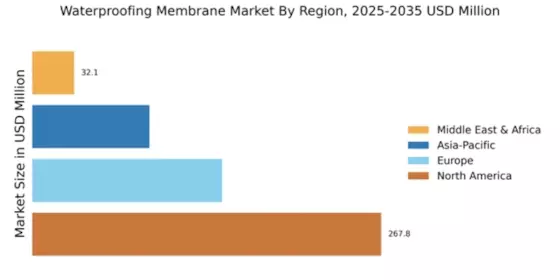
Nordamerika ist bereit, seine Führungsposition auf dem Markt für Abdichtungsmembranen zu behaupten und im Jahr 2024 einen bedeutenden Anteil von 267,84 Millionen zu halten. Das Wachstum der Region wird durch zunehmende Bauaktivitäten, strenge Bauvorschriften und eine steigende Nachfrage nach nachhaltigen Baulösungen vorangetrieben. Die regulatorische Unterstützung für energieeffiziente Gebäude treibt die Marktexpansion weiter voran, da die Interessengruppen bestrebt sind, Umweltstandards einzuhalten und die Haltbarkeit von Baumaterialien zu verbessern. Als Hauptmarkt stechen die Vereinigten Staaten hervor, wobei wichtige Akteure wie Sika AG, GAF Materials Corporation und Firestone Building Products an der Spitze stehen. Die Wettbewerbslandschaft ist geprägt von Innovation und strategischen Partnerschaften, da Unternehmen in Forschung und Entwicklung investieren, um fortschrittliche Abdichtungslösungen zu entwickeln. Dieser Fokus auf Technologie und Qualität positioniert Nordamerika als Drehscheibe für hochmoderne Abdichtungsprodukte und gewährleistet ein kontinuierliches Marktwachstum.
Europa: Dynamik der Schwellenländer
Der europäische Markt für Abdichtungsbahnen verzeichnet ein robustes Wachstum mit einer Marktgröße von 145,7 Millionen im Jahr 2024. Die Region profitiert von der zunehmenden Urbanisierung, einem Fokus auf Infrastrukturentwicklung und strengen Vorschriften zur Verbesserung der Gebäudesicherheit und Nachhaltigkeit. Das Engagement der Europäischen Union für Initiativen zum umweltfreundlichen Bauen und Energieeffizienzstandards wirkt als Katalysator für die Marktexpansion und steigert die Nachfrage nach leistungsstarken Abdichtungslösungen. Führende Länder wie Deutschland, Frankreich und Großbritannien stehen an der Spitze dieses Wachstums, wobei große Player wie BASF SE und Mapei S.p.A. aktiv am Markt teilnehmen. Die Wettbewerbslandschaft ist geprägt von Innovation und einer starken Betonung umweltfreundlicher Produkte. Da sich Unternehmen an regulatorische Änderungen und Verbraucherpräferenzen anpassen, wird der europäische Markt erhebliche Fortschritte bei den Abdichtungstechnologien erleben.
Asien-Pazifik: Schnelles Wachstumspotenzial
Der Markt für Abdichtungsbahnen im asiatisch-pazifischen Raum befindet sich auf Wachstumskurs und wird im Jahr 2024 eine Marktgröße von 90,0 Millionen erreichen. Dieses Wachstum wird durch die rasche Urbanisierung, zunehmende Bautätigkeiten und ein wachsendes Bewusstsein für die Bedeutung der Abdichtung im Bauwesen vorangetriebenLanglebigkeit. Die Regierungen in der Region setzen Vorschriften zur Verbesserung der Baustandards um, was die Nachfrage nach wirksamen Abdichtungslösungen in verschiedenen Sektoren, einschließlich Wohn- und Gewerbebau, weiter steigert. Länder wie China, Indien und Japan sind führend und verfügen über eine Wettbewerbslandschaft mit sowohl lokalen als auch internationalen Akteuren. Unternehmen wie Henry Company und Noxudol bauen ihre Präsenz aus und konzentrieren sich auf innovative Produkte, die auf regionale Bedürfnisse zugeschnitten sind. Während sich der Markt weiterentwickelt, wird die Betonung von Qualität und Nachhaltigkeit die Zukunft der Abdichtungslösungen im asiatisch-pazifischen Raum prägen.
Naher Osten und Afrika: Chancen für neue Märkte
Der Markt für Abdichtungsbahnen im Nahen Osten und in Afrika entwickelt sich allmählich und wird im Jahr 2024 eine Marktgröße von 32,13 Millionen erreichen. Das Wachstum der Region wird durch zunehmende Infrastrukturprojekte, Urbanisierung und ein wachsendes Bewusstsein für den Bedarf an effektiven Abdichtungslösungen im Bauwesen vorangetrieben. Regierungen investieren in Großprojekte, was den Abdichtungsherstellern die Möglichkeit bietet, der steigenden Nachfrage nach langlebigen und effizienten Baumaterialien gerecht zu werden. Länder wie die Vereinigten Arabischen Emirate und Südafrika sind wichtige Akteure auf diesem Markt und verfügen über eine Wettbewerbslandschaft, die sowohl lokale als auch internationale Unternehmen umfasst. Während sich die Region weiter entwickelt, werden die Präsenz wichtiger Akteure und ihr Fokus auf innovative Lösungen entscheidend für die Gestaltung der Zukunft des Marktes für Abdichtungsbahnen im Nahen Osten und in Afrika sein.
Zu den wichtigsten Unternehmen im Waterproofing Membrane Market-Markt gehören
Zukunftsaussichten
Waterproofing Membrane Market Zukunftsaussichten
Berichtsumfang
Markt-Highlights
FAQs
How do specifiers compare cold liquid applied membranes versus fully adhered sheet systems for commercial rooftops in the Waterproofing Membrane Market?
Cold liquid applied products suit complex geometries and seamless coverage but require trained applicators and weather-sensitive cure windows. Fully adhered sheets offer faster installation in large flat areas and superior wind-uplift resistance [18].
What procurement strategies can general contractors use to hedge against bitumen price volatility in the Waterproofing Membrane Market?
Contractors increasingly lock in bitumen-linked supply agreements 6–12 months ahead or shift specifications to polymer-based alternatives that decouple material cost from crude-oil swings. Dual-sourcing across regions further mitigates supply disruption [12].
Which emerging application segment is gaining the most traction within the Waterproofing Membrane Market?
Below-slab waterproofing for battery-storage facilities and EV-charging depots is expanding rapidly, driven by fire-code requirements mandating chemical-resistant moisture barriers beneath lithium-ion battery arrays [10].
How are green-building certifications reshaping product-selection criteria across the Waterproofing Membrane Market?
LEED v4.1 and BREEAM now award credits for low-VOC, EPD-certified membranes, making environmental documentation a prerequisite for specification shortlists in institutional projects [3].
What role does applicator training play in competitive differentiation within the Waterproofing Membrane Market?
Manufacturers offering certified installer programs report 20–30% lower warranty claims, turning training investment into a measurable quality advantage that influences architect and consultant specifications [6].
How is modular construction affecting membrane format preferences in the Waterproofing Membrane Market?
Factory-controlled environments favor spray-applied liquid films that can be robotically deposited with consistent mil thickness, reducing field-labor dependence and enabling tighter quality tolerances [18].
What regulatory changes should investors monitor when evaluating growth prospects in the Waterproofing Membrane Market?
California's pending 25 g/L VOC cap and the EU's 2028 NZEB enforcement deadline are the two highest-impact regulatory triggers, as both will force product reformulation and drive premium-product adoption [4][8].
Autor
Author

Chitranshi Jaiswal

Research Approach
Research Methodology on Waterproofing Membrane Market
Introduction
The waterproofing membrane is a thin layer of waterproof material that is applied on the surface of buildings and structures to perform waterproofing. This waterproofing solution is suitable for surfaces like walls, floors, roofs, bathrooms, etc., and provides an impermeable barrier against water seepage or water leakage. Global Waterproofing Membrane Market is expected to grow at a steady compound annual growth rate between 2023 and 2030.
Objective
The objective of this research is to assess the market demand for waterproofing membranes with a particular focus on the market attributes, end user segment, product types and several geographic locations.
Research Approach
The research will focus on the data collected over a period of 3 months from several primary and secondary sources. Primary sources include direct industry experts, architects, and industrial experts. Secondary sources include the market data and growth analysis from Market Research Future (MRFR) database, detailed product catalogues and technical data from the Waterproofing Membrane Manufactures (WMMs), and various other online materials related to the Waterproofing Membrane Market such as journals, white papers, magazines, official websites, reports, trade shows, online databases, case studies, and other online sources.
Data Collection
The data collected from both primary and secondary sources will be analyzed differently to get information on market size, share, trends, growth patterns, and end-user segments. The primary data collected from the direct stakeholders will be analyzed through interviews on a one-on-one basis and from their opinions provided in an online survey. The survey will include questions related to market size, product types, segmentation, and geographic locations. The data collected through the online survey will then be synthesized with secondary sources of data to derive accurate market estimates.
The secondary data collected from the MRFR database, product catalogues from the WMMs, and other sources as mentioned before will be studied and analyzed separately to get better insights into the market size, growth pattern, segmentation, and end-user segments. The data will be tabulated and categorized, and then using market research analytic tools, the statistics will be formulated and calculated.
Conclusion
This research methodology aims to provide a comprehensive review of the Waterproofing Membrane Market. The research will be conducted by combining the data from primary and secondary sources and providing a thorough analysis of the Waterproofing Membrane Market. The research findings derived from this research can be used to make informed decisions regarding the future of the waterproofing membrane market.
Kostenloses Muster herunterladen
Bitte füllen Sie das folgende Formular aus, um ein kostenloses Muster dieses Berichts zu erhalten
Customer Stories

“This is really good guys. Excellent work on a tight deadline. I will continue to use you going forward and recommend you to others. Nice job”

Noah Malgeri
Co-Founder

“Thanks. It’s been a pleasure working with you, please use me as reference with any other Intel employees.”

Joseph Aguayo
Sales Operations & Pricing Manager

“Thanks for sending the report it gives us a good global view of the Betaïne market.”

Peter Groot koerkamp
Account and Business Manager

“Thank you, this will be very helpful for OQS.”

La Terria Dodd
Program Support Specialist

“We found the report very insightful! we found your research firm very helpful. I'm sending this email to secure our future business.”

Younghwan Choi
Senior Retail Manager

“I am very pleased with how market segments have been defined in a relevant way for my purposes (such as "Portable Freezers & refrigerators" and "last-mile"). In general the report is well structured. Thanks very much for your efforts.”

Mark Irwin
Management Consultant

“I have been reading the first document or the study, ,the Global HVAC and FP market report 2021 till 2026. Must say, good info! I have not gone in depth at all parts, but got a good indication of the data inside!”

Rob Kooiker
Group Product Manager HVAC & Fire Protection GMA

“We got the report in time, we really thank you for your support in this process. I also thank to all of your team as they did a great job.”

Akif Moroglu
Strategy & Business Development Director

“The Automotive 48V ECU Components Procurement Intelligence Study” was a complex project, but the Market Research Future (MRFR) team handled it with quality, agility, and customer-centricity. They delivered all requested data on time and within the agreed scope. The team, including Shubhendra Anand and Rahul Gotadki, was always readily available to clarify questions and swiftly implement necessary adjustments, driving the project to a successful conclusion within a very demanding timeframe.
I would also like to specifically commend Akshay Agarwal for his responsiveness and support at every stage—from our initial inquiry on May 6th through to final delivery on June 18th. His dedication made the entire process seamless.”

Guilherme Gomes Martins
Product Management Director

Fallstudie
Aerospace & Defense
.webp?v=1787579635)
