Waterproofing Membrane Market (2026 - 2035)

Waterproofing Membrane Market Size, Share & Industry Analysis Research Report Information by Material (Modified Bitumen, PVC, TPO, EPDM, HDPE, LDPE), by Type (Liquid-applied Membranes, Sheet Based Membranes), by Application (Roofing and Walls, Water and Waste Management, Building Structures, Tunnel Liners, Bridges & Highways), And by Region (North America, Europe, Asia-Pacific, Latin America, Middle east & South Africa) - Forecast Till 2035
ID: MRFR/CnM/7034-HCR
111 Pages
Chitranshi Jaiswal
Last Updated: July 12, 2026
Waterproofing Membrane Market
Market Size
Forecast Period2026-2035
CAGR (2026-2035)5.96%
2025 Market SizeUSD 27.38 Billion
2035 Market SizeUSD 46.12 Billion
Key Players
Sika AG
BASF SE
GAF
Carlisle Companies
GCP Applied Technologies
Soprema Group
Opportunities
  • Spray-Applied Robotic Installation
  • Green-Label and EPD-Certified Products
  • Emerging-Market Urbanization in Africa and Southeast Asia

Waterproofing Membrane Market Summary

The Waterproofing Membrane Market reached an estimated USD 27.38 Billion in 2025 and is projected to climb from USD 28.91 Billion in 2026 to USD 46.12 Billion by 2035, reflecting a CAGR of 5.96% across the forecast window. This expansion is anchored in accelerating public infrastructure investment — governments worldwide committed over USD 1.2 trillion to transport and flood-mitigation projects between 2023 and 2025 — and in tightening building-envelope energy codes that now fold moisture barrier membranes into whole-building carbon performance calculations[2].

Technology is driving a generational shift within the Waterproofing Membrane Market. Legacy solvent-borne bituminous waterproofing systems are giving way to self-healing nano-composite sheets and 100%-solids liquid waterproofing systems that cure without volatile organic compound (VOC) off-gassing. The U.S. EPA's 50 g/L VOC ceiling and California's proposed 25 g/L threshold are forcing formulators to reformulate around water-based and reactive chemistries, pushing construction waterproofing solutions toward higher-performance, lower-emission profiles [3][4]. Data-center and pharmaceutical-cleanroom specifiers now treat waterproof coating materials as engineered performance components rather than commodity line items.

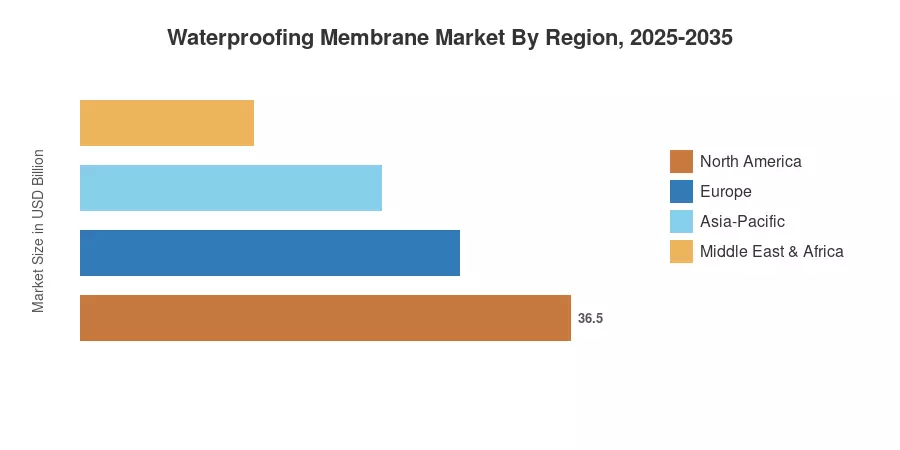
Asia-Pacific commands the largest share of the Waterproofing Membrane Market at roughly 38.9% of 2025 revenue, propelled by China's sponge-city mandates and India's urban-housing pipeline. South America is the fastest-growing region with a projected CAGR of 6.42% through 2035, driven by Brazilian metro and dam construction. Europe holds the second-largest share at approximately 24.5%, where EU renovation-wave directives continue to mandate foundation waterproofing upgrades across aging building stock

Key Report Takeaways

• By Product Type

  • Cold liquid applied products captured the leading position in the Waterproofing Membrane Market in 2025, accounting for approximately 36.6% of global revenue, driven by fast-cure formulations suited to roofing waterproof membranes and retrofit projects
  • Fully adhered sheet membranes are forecast to register the highest segment CAGR of 7.98% through 2035, as polymer waterproof membranes gain traction in high-wind roofing protection systems
  • Hot liquid applied systems remain a critical niche for below-grade foundation waterproofing, particularly in infrastructure tunneling applications

• By End-Use Sector

  • The residential sector led the Waterproofing Membrane Market with a 31.8% share in 2025, fueled by moisture barrier membranes adoption in suburban housing across North America and Asia-Pacific
  • Infrastructure end-use is expected to expand at a CAGR of 6.64% through 2035 as metro, dam, and flood-control projects scale globally

• By Geography

  • Asia-Pacific held the dominant revenue share of the Waterproofing Membrane Market in 2025, reflecting heavy urbanization spending in China and India
  • South America is projected to be the fastest-growing region through 2035, advancing at a 6.42% CAGR as Brazilian and Argentine building waterproof materials demand accelerates

Market Size and Forecast (2021–2035)

MRFR's proprietary estimation framework triangulates primary interviews with manufacturers, distributors, and contractors against secondary trade data, customs records, and public procurement databases. Historical values (2021–2024) are validated against audited company filings; forecast values (2026–2035) apply a compound growth trajectory calibrated to macro construction spending, regulatory phase-in schedules, and raw-material cost indices.
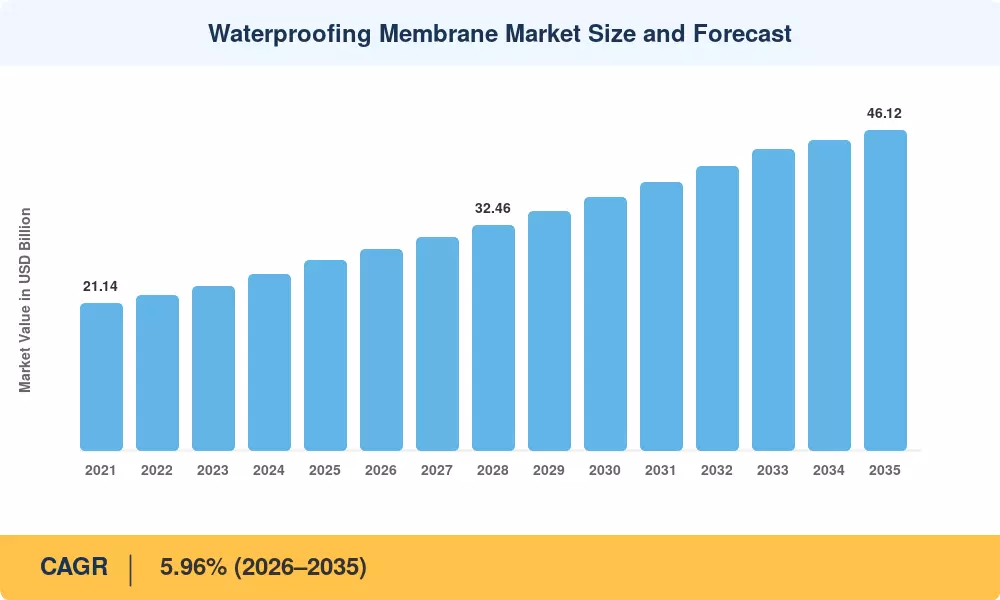
Waterproofing Membrane Market Size and Forecast
Our Impact
Enabled $4.3B Revenue Impact for Fortune 500 and Leading Multinationals
Partnering with 2000+ Global Organizations Each Year
30K+ Citations by Top-Tier Firms in the Industry

Driver Impact Analysis

**Driver** **~% Impact on CAGR** **Geographic Relevance** **Impact Timeline** **Ref**
Public infrastructure spending surge +1.4% Global Short-term (≤2 yr) [2]
Building-envelope energy code tightening +1.1% North America, Europe Medium-term (2–4 yr) [3]
VOC regulation and green-chemistry mandates +0.9% North America, Europe Medium-term (2–4 yr) [4]
Urbanization and residential housing pipelines +0.8% Asia-Pacific, South America Long-term (≥4 yr) [5]
Modular/off-site construction growth +0.6% North America, Europe Medium-term (2–4 yr) [6]
Self-healing and nano-composite membrane R&D +0.5% Global Long-term (≥4 yr) [11]
Data-center and cleanroom construction boom +0.4% North America, Asia-Pacific Short-term (≤2 yr) [10]


Public Infrastructure Spending Surge

Government capital programs are the single largest catalyst for the Waterproofing Membrane Market. The U.S. Infrastructure Investment and Jobs Act earmarked over USD 550 Billion for roads, bridges, and tunnels through 2030, with foundation waterproofing specified in nearly every below-grade transit structure [2]. India's Bharatmala Pariyojana highway program and China's 14th Five-Year Plan metro expansions collectively represent another USD 380 Billion in waterproofing-intensive contracts, creating sustained demand for bituminous waterproofing and polymer waterproof membranes across tunneling, dam, and flood-barrier applications.

Building-Envelope Energy Code Tightening

Updated energy codes in the United States (ASHRAE 90.1-2022) and Europe (EPBD recast) now treat moisture control as integral to thermal performance, effectively elevating roofing waterproof membranes and moisture barrier membranes from optional add-ons to mandatory building-envelope components [3]. Compliance deadlines between 2025 and 2028 will force retrofit of millions of commercial rooftops, driving demand for liquid waterproofing systems that integrate seamlessly with continuous insulation assemblies.

VOC Regulation and Green-Chemistry Mandates

The EPA's 50 g/L VOC ceiling for architectural coatings, coupled with California's proposed 25 g/L cap, is accelerating the phase-out of solvent-borne waterproof coating materials across North America [4]. Formulators are pivoting toward water-based reactive chemistries and 100%-solids liquid films, which command price premiums of 15–25% over legacy systems. This regulatory push is expanding addressable revenue for the Waterproofing Membrane Market while rewarding suppliers that have invested early in low-emission construction waterproofing solutions.

Data-Center and Cleanroom Construction Boom

Global data-center capital expenditure exceeded USD 340 Billion in 2024, with hyperscale operators specifying zero-tolerance moisture ingress standards that demand high-performance building waterproof materials [10]. Pharmaceutical cleanrooms impose similarly stringent requirements, creating a premium tier within the Waterproofing Membrane Market where downtime-risk calculus overrides first-cost sensitivity.

Restraints Impact Analysis

**Restraint** **~% Impact on CAGR** **Geographic Relevance** **Impact Timeline** **Ref**
Raw-material price volatility (bitumen, polymers) –0.7% Global Short-term (≤2 yr) [12]
Skilled-labor shortages in application trades –0.5% North America, Europe Medium-term (2–4 yr) [6]
Fragmented building codes across jurisdictions –0.4% Asia-Pacific, MEA Long-term (≥4 yr) [13]
Competition from alternative waterproofing methods –0.3% Global Medium-term (2–4 yr) [14]
Extended project approval timelines –0.2% Europe, South America Short-term (≤2 yr) [15]


Raw-Material Price Volatility

Bitumen — the backbone of bituminous waterproofing products — is a petroleum refinery residual whose price tracks crude oil benchmarks with a 60–90 day lag. Between 2022 and 2024, bitumen spot prices swung by as much as 38%, compressing margins for manufacturers of roofing waterproof membranes and forcing quarterly re-pricing that disrupts contractor procurement cycles [12]. Polymer resin feedstocks (SBS, APP, TPO) face similar volatility, exposing the Waterproofing Membrane Market to input-cost shocks that can delay project starts.

Skilled-Labor Shortages

Proper installation of liquid waterproofing systems and fully adhered sheet membranes demands certified applicators, yet the U.S. construction sector reported over 400,000 unfilled craft positions in 2024, according to the Bureau of Labor Statistics [6]. Europe faces a comparable gap, with Germany's ZDB trade association estimating a 15% shortfall in qualified roofing and waterproofing contractors. Labor scarcity raises installed costs and can compromise moisture barrier membranes performance if application protocols are not followed precisely.

Fragmented Building Codes

Inconsistent waterproofing specifications across Asian and Middle Eastern jurisdictions create compliance complexity for multinational suppliers of construction waterproofing solutions. A manufacturer exporting polymer waterproof membranes to five ASEAN nations may face five distinct test standards, thickness minimums, and fire-rating requirements — each adding certification cost and time-to-market delays [13].

Waterproofing Membrane Market Opportunities

Spray-Applied Robotic Installation

Labor scarcity is accelerating adoption of robotic spray-application systems that can coat 500 m² per hour — roughly four times manual rates. Modular-construction factories are ideal early adopters, creating a new channel for liquid waterproofing systems that bypasses traditional on-site constraints Manufacturers investing in automated application platforms could capture premium positioning within the Waterproofing Membrane Market.

Green-Label and EPD-Certified Products

Environmental Product Declarations (EPDs) and green-label certifications (e.g., LEED v4.1, BREEAM) are becoming procurement prerequisites for institutional buyers. Suppliers of low-VOC waterproof coating materials and bio-based polymer waterproof membranes that hold third-party EPDs can access specification pipelines closed to conventional products

Emerging-Market Urbanization in Africa and Southeast Asia

Sub-Saharan Africa's urban population is projected to double by 2050 (UN Habitat), yet formal waterproofing penetration remains below 30% of new residential starts [16]. Southeast Asian nations face similar gaps. Early market entrants offering affordable bituminous waterproofing and simplified roofing protection systems stand to establish durable distribution networks across the fastest-growing construction corridors in the Waterproofing Membrane Market

Digital Inspection and Warranty-as-a-Service

Drone-based infrared thermography and AI-powered leak detection are enabling manufacturers to offer predictive-maintenance warranties on roofing waterproof membranes. This data-monetization model converts one-time product sales into recurring service revenue, improving customer retention and lifetime value within the Waterproofing Membrane Market

Cool-Roof and Reflective Membrane Integration

Energy utilities in sun-belt regions are incentivizing reflective roofing protection systems that reduce cooling loads by 15–25%. Hybrid membranes combining waterproofing with high solar-reflectance coatings tap both the moisture barrier membranes and energy-efficiency value chains, expanding addressable spend per square meter

Waterproofing Membrane Market Future Outlook

AI-Enabled Quality Assurance and Predictive Maintenance

Machine-learning algorithms trained on infrared and acoustic sensor data are beginning to identify sub-surface moisture intrusion within 24 hours of membrane failure onset. By 2030, AI-driven inspection could reduce warranty claim costs by 30–40% for manufacturers of roofing waterproof membranes, shifting competitive differentiation toward digital service capabilities within the Waterproofing Membrane Market [10].

Circular-Economy Membrane Recycling

The European Chemicals Agency (ECHA) is evaluating end-of-life recycling mandates for polymer waterproof membranes under the revised Waste Framework Directive. Closed-loop recycling of TPO and PVC roofing sheets — which currently constitute over 2 million tonnes of annual construction waste — could create a secondary raw-material stream that lowers production costs for building waterproof materials by 10–15% [8][14].

Bio-Based and Carbon-Negative Chemistries

Research consortia in Germany and Japan are developing lignin-based bituminous waterproofing binders and bio-epoxy liquid waterproofing systems with net-negative embodied carbon. If commercialized by 2029–2030, these formulations could capture 8–12% of the premium construction waterproofing solutions segment, offering specifiers a pathway to meet 2035 whole-building carbon targets [11][17].

Integrated Building-Envelope Systems

The convergence of insulation, air barriers, and moisture barrier membranes into single-ply integrated assemblies is reshaping procurement. Manufacturers that can deliver factory-laminated roofing protection systems combining waterproofing, thermal resistance, and vapor control in one product will capture share from multi-layer field-assembled systems, compressing installation time by up to 40% and reducing the Waterproofing Membrane Market's exposure to labor-scarcity headwinds [6][18].

Waterproofing Membrane Market Segmentation

By Product Type

**Segment** **Key Metric** **Primary Demand Driver**
Cold Liquid Applied 36.6% share (2025) Fast-cure roofing retrofits, VOC-compliant formulations [4]
Hot Liquid Applied USD 4.93 Billion (2025) Below-grade foundation waterproofing, tunnel linings [2]
Fully Adhered Sheet 7.98% CAGR (2026–2035) High-wind roofing zones, commercial single-ply systems [13]
Loose-Laid Sheet USD 3.84 Billion (2025) Ballasted roofing, temporary moisture protection [14]


Cold liquid applied products dominate the Waterproofing Membrane Market because they can be spray- or roller-applied to complex geometries without seams, making them the preferred choice for roofing waterproof membranes on irregular substrates. The segment's growth is reinforced by reformulation toward water-based and reactive chemistries that meet tightening VOC limits, positioning liquid waterproofing systems as the default specification in environmentally regulated jurisdictions.

Fully adhered sheet membranes are the fastest-growing product type in the Waterproofing Membrane Market, benefiting from polymer waterproof membranes innovations in TPO and PVC formulations that deliver superior puncture resistance and dimensional stability. These construction waterproofing solutions are increasingly specified in hurricane-prone coastal markets where mechanical fastening of loose-laid sheets risks wind uplift failure.

By End-Use Sector

**Segment** **Key Metric** **Primary Demand Driver**
Residential 31.8% share (2025) Affordable-housing mandates, bathroom/kitchen wet-area protection [5]
Commercial USD 6.43 Billion (2025) Office, retail, and hospitality renovation cycles [3]
Industrial & Institutional 5.78% CAGR (2026–2035) Data centers, cleanrooms, manufacturing facilities [10]
Infrastructure 6.64% CAGR (2026–2035) Metro tunnels, dams, flood-control barriers [2]


Residential end-use leads the Waterproofing Membrane Market as urbanization in Asia-Pacific and affordable-housing programs in India, Brazil, and sub-Saharan Africa generate high-volume demand for building waterproof materials in foundations, basements, and wet areas. The sector's price sensitivity favors bituminous waterproofing and cold-applied liquid waterproofing systems that minimize installed cost per square meter.

Infrastructure is the fastest-growing end-use sector in the Waterproofing Membrane Market, driven by metro-rail expansions and flood-control investments that require high-performance waterproof coating materials capable of withstanding hydrostatic pressure, chemical exposure, and decades-long service life. Specification complexity in this sector favors manufacturers with established technical-support networks and proven roofing protection systems track records.

Regional Market Share Analysis

**Region** **Key Metric (2025)** **Primary Investment Themes**
Asia-Pacific 38.9% revenue share Sponge-city programs, metro construction, residential housing [5]
Europe USD 6.71 Billion Renovation-wave directives, NZEB compliance [8]
North America 5.82% CAGR (2026–2035) VOC regulation, data-center expansion, IRA spending [4]
South America 6.42% CAGR (2026–2035) Metro transit, dam projects, affordable housing [9]
Middle East & Africa USD 2.19 Billion Mega-projects, desalination plants, urban expansion [7]
**Total** **USD 27.38 Billion**

The Waterproofing Membrane Market exhibits significant geographic variation shaped by climate, regulatory maturity, and construction-cycle timing. Asia-Pacific leads in absolute revenue, while South America posts the strongest growth trajectory through 2035.


North America

**Country** **Key Metric** **Key Driver**
US 78.4% of regional revenue IRA infrastructure allocation, VOC compliance upgrades [4]
Canada 5.61% CAGR (2026–2035) Climate-resilient building codes, flood-plain construction [15]
Mexico USD 0.52 Billion (2025) Nearshoring-driven industrial construction [12]


The U.S. dominates North American demand for construction waterproofing solutions, underpinned by USD 110 Billion in federal highway and bridge funding that specifies below-grade foundation waterproofing. Canada's updated National Building Code (2025 edition) mandates continuous moisture barrier membranes on all occupied below-grade spaces in climate zones 5–8, while Mexico's nearshoring manufacturing boom is generating new industrial roofing waterproof membranes demand along the northern border corridor.

Europe

**Country** **Key Metric** **Key Driver**
Germany 22.1% of regional revenue Energiewende renovation mandates [8]
UK 5.73% CAGR (2026–2035) Post-Grenfell building-safety regulations [13]
France USD 1.04 Billion (2025) Grand Paris Express metro waterproofing contracts [9]
Italy 12.8% of regional revenue Superbonus 110% renovation incentive legacy [3]
Spain 5.48% CAGR (2026–2035) Coastal flood-resilience infrastructure [7]
Nordic Countries USD 0.51 Billion (2025) Green-roof and cool-roof municipal mandates [8]
Russia 7.2% of regional revenue Domestic production substitution policies [14]
Rest of Europe 5.31% CAGR (2026–2035) EU cohesion-fund construction spending [15]


Europe's Waterproofing Membrane Market benefits from the EU's Energy Performance of Buildings Directive recast, which requires near-zero-energy building (NZEB) compliance for all new construction by 2028 and mandates deep renovation of the worst-performing 15% of commercial buildings by 2030. These policies translate directly into demand for liquid waterproofing systems and polymer waterproof membranes in both new-build and retrofit applications, with Germany and France leading procurement volumes.

Asia-Pacific

**Country** **Key Metric** **Key Driver**
China 42.3% of regional revenue Sponge-city program, metro expansion [5]
India 6.89% CAGR (2026–2035) PMAY-U housing, smart-city mission [16]
Japan USD 1.82 Billion (2025) Seismic retrofit mandates, aging infrastructure renewal [13]
South Korea 8.7% of regional revenue Green New Deal construction targets [8]
ASEAN 6.51% CAGR (2026–2035) Flood-resilient urban planning, FDI-driven industrial parks [7]
Rest of Asia-Pacific USD 0.78 Billion (2025) Emerging urbanization in Central and West Asia [16]


Asia-Pacific's commanding position in the Waterproofing Membrane Market traces to China's sponge-city program, which has invested over USD 28 Billion since 2015 in urban flood management requiring extensive below-grade and plaza-deck bituminous waterproofing. India's Pradhan Mantri Awas Yojana – Urban (PMAY-U) targets construction of 20 million affordable housing units, each requiring building waterproof materials for foundations and wet areas, while Japan's post-earthquake retrofit standards mandate upgraded roofing protection systems across commercial portfolios.

South America

**Country** **Key Metric** **Key Driver**
Brazil 62.5% of regional revenue São Paulo and Rio de Janeiro metro expansions [9]
Argentina 6.18% CAGR (2026–2035) Residential construction recovery, Vaca Muerta infrastructure [12]
Rest of South America USD 0.34 Billion (2025) Dam and hydropower waterproofing projects [7]


South America is the fastest-growing region in the Waterproofing Membrane Market, propelled by Brazil's multi-billion-dollar metro transit expansions in São Paulo (Line 6) and Rio de Janeiro (Line 4 extension), which specify fully adhered polymer waterproof membranes for tunnel and station construction. Argentina's economic stabilization is reviving stalled residential projects that require foundation waterproofing and roofing waterproof membranes, adding incremental volume across the Southern Cone.

Middle East & Africa

**Country** **Key Metric** **Key Driver**
Saudi Arabia 34.8% of regional revenue NEOM, Jeddah Tower, Red Sea tourism mega-projects [7]
UAE 5.94% CAGR (2026–2035) Expo legacy development, high-rise construction [7]
South Africa USD 0.31 Billion (2025) Municipal infrastructure upgrades, social housing [16]
Egypt 5.67% CAGR (2026–2035) New Administrative Capital construction [15]
Rest of MEA 18.4% of regional revenue Sub-Saharan urbanization, industrial zones [16]


The Middle East & Africa segment of the Waterproofing Membrane Market is characterized by extreme-climate construction that demands high-performance moisture barrier membranes capable of withstanding sustained temperatures above 50 °C. Saudi Arabia's Vision 2030 mega-projects alone represent an estimated USD 1.5 trillion in total construction value, with waterproof coating materials specified across underground transit, desalination-plant foundations, and coastal hospitality developments.

Waterproofing Membrane Market By Region, 2025-2035

Competitive Benchmarking

The Waterproofing Membrane Market exhibits medium concentration, with an estimated HHI below 1,000 and the top five players collectively holding approximately 28–35% of global revenue. The landscape is characterized by a mix of diversified building-materials conglomerates and specialized membrane manufacturers competing on formulation technology, geographic reach, and applicator training networks.

**Company** **Est. Revenue Share Range** **Key Offerings** **Strategic Positioning**
Sika AG ~6–9% Liquid-applied waterproofing, polymer waterproof membranes, admixtures Global breadth, strong infrastructure focus
BASF SE ~5–8% Bituminous waterproofing, construction chemicals, spray-applied systems R&D leadership, integrated portfolio
GAF (Standard Industries) ~4–7% Roofing waterproof membranes, TPO/PVC sheet systems North America market leader in commercial roofing
Carlisle Companies ~4–6% Single-ply roofing protection systems, liquid waterproofing systems Vertical integration, contractor loyalty programs
GCP Applied Technologies (Saint-Gobain) ~3–5% Foundation waterproofing, waterproof coating materials, self-adhered membranes Below-grade specialization, global distribution
Soprema Group ~3–5% Bituminous waterproofing, green-roof systems, moisture barrier membranes European market leader, sustainability certifications
Pidilite Industries ~2–4% Liquid waterproofing systems, construction chemicals, retail coatings India market leader, strong retail distribution
Fosroc International ~2–4% Construction waterproofing solutions, admixtures, grouts MEA and Asia-Pacific infrastructure specialist
Tremco (RPM International) ~2–3% Roofing waterproof membranes, sealants, building waterproof materials Integrated roofing and envelope solutions
Mapei S.p.A. ~2–3% Liquid waterproofing systems, adhesives, waterproof coating materials Technology-driven, broad distribution


Recent News & Developments

  • Sika AG (September 2024): Acquired a regional waterproofing manufacturer in Southeast Asia, expanding spray-applied construction waterproofing solutions capacity across ASEAN markets. The deal added two production facilities and approximately 12,000 tonnes of annual membrane output.
  • BASF SE (June 2024): Launched a bio-based liquid waterproofing system with 40% renewable content, targeting LEED v4.1 and BREEAM-certified projects in Europe and North America [11].
  • GAF / Standard Industries (March 2025): Opened a USD 180 Million TPO membrane manufacturing plant in Texas, doubling North American production capacity for polymer waterproof membranes [12].
  • California Air Resources Board (CARB) (January 2025): Published a proposed 25 g/L VOC limit for architectural waterproof coating materials, with a compliance deadline of January 2027, accelerating reformulation timelines across the Waterproofing Membrane Market [4].
  • Soprema Group (November 2024): Introduced a fully recyclable PVC roofing membrane with a closed-loop take-back program, positioning the company as a circular-economy leader in roofing protection systems [14].
  • Pidilite Industries (August 2024): Expanded its Dr. Fixit liquid waterproofing systems line with a rapid-cure formula designed for India's monsoon-season construction window, reducing cure time from 72 to 24 hours [5].
  • Carlisle Companies (February 2025): Partnered with a drone-inspection startup to offer AI-powered roofing waterproof membranes condition assessments integrated with extended warranty packages [10].

Waterproofing Membrane Market Report Scope

**Parameter** **Detail**
Market Scope Global Waterproofing Membrane Market covering product types, end-use sectors, and regional analysis
Study Period 2021–2035
Historical Period 2021–2024
Base Year 2025
Forecast Period 2026–2035
CAGR 5.96% (2026–2035)
Market Size (2025) USD 27.38 Billion
Market Size (2035) USD 46.12 Billion
Fastest Growing Segment Fully Adhered Sheet (by product type); Infrastructure (by end-use)
Companies Profiled Sika AG, BASF SE, GAF, Carlisle Companies, GCP Applied Technologies, Soprema, Pidilite, Fosroc, Tremco, Mapei
Valuation Currency USD Billion


FAQs

How do specifiers compare cold liquid applied membranes versus fully adhered sheet systems for commercial rooftops in the Waterproofing Membrane Market?
Cold liquid applied products suit complex geometries and seamless coverage but require trained applicators and weather-sensitive cure windows. Fully adhered sheets offer faster installation in large flat areas and superior wind-uplift resistance [18].
What procurement strategies can general contractors use to hedge against bitumen price volatility in the Waterproofing Membrane Market?
Contractors increasingly lock in bitumen-linked supply agreements 6–12 months ahead or shift specifications to polymer-based alternatives that decouple material cost from crude-oil swings. Dual-sourcing across regions further mitigates supply disruption [12].
Which emerging application segment is gaining the most traction within the Waterproofing Membrane Market?
Below-slab waterproofing for battery-storage facilities and EV-charging depots is expanding rapidly, driven by fire-code requirements mandating chemical-resistant moisture barriers beneath lithium-ion battery arrays [10].
How are green-building certifications reshaping product-selection criteria across the Waterproofing Membrane Market?
LEED v4.1 and BREEAM now award credits for low-VOC, EPD-certified membranes, making environmental documentation a prerequisite for specification shortlists in institutional projects [3].
What role does applicator training play in competitive differentiation within the Waterproofing Membrane Market?
Manufacturers offering certified installer programs report 20–30% lower warranty claims, turning training investment into a measurable quality advantage that influences architect and consultant specifications [6].
How is modular construction affecting membrane format preferences in the Waterproofing Membrane Market?
Factory-controlled environments favor spray-applied liquid films that can be robotically deposited with consistent mil thickness, reducing field-labor dependence and enabling tighter quality tolerances [18].
What regulatory changes should investors monitor when evaluating growth prospects in the Waterproofing Membrane Market?
California's pending 25 g/L VOC cap and the EU's 2028 NZEB enforcement deadline are the two highest-impact regulatory triggers, as both will force product reformulation and drive premium-product adoption [4][8].
Author
Author
Author Profile
Chitranshi Jaiswal LinkedIn
Team Lead - Research
Chitranshi is a Team Leader in the Chemicals & Materials (CnM) and Energy & Power (EnP) domains, with 6+ years of experience in market research. She leads and mentors teams to deliver cross-domain projects that equip clients with actionable insights and growth strategies. She is skilled in market estimation, forecasting, competitive benchmarking, and both primary & secondary research, enabling her to turn complex data into decision-ready insights. An engineer and MBA professional, she combines technical expertise with strategic acumen to solve dynamic market challenges. Chitranshi has successfully managed projects that support market entry, investment planning, and competitive positioning, while building strong client relationships. Certified in Advanced Excel & Power BI she leverages data-driven approaches to ensure accuracy, clarity, and impactful outcomes.

Research Approach

Research Methodology on Waterproofing Membrane Market

Introduction

The waterproofing membrane is a thin layer of waterproof material that is applied on the surface of buildings and structures to perform waterproofing. This waterproofing solution is suitable for surfaces like walls, floors, roofs, bathrooms, etc., and provides an impermeable barrier against water seepage or water leakage. Global Waterproofing Membrane Market is expected to grow at a steady compound annual growth rate between 2023 and 2030.

Objective

The objective of this research is to assess the market demand for waterproofing membranes with a particular focus on the market attributes, end user segment, product types and several geographic locations.

Research Approach

The research will focus on the data collected over a period of 3 months from several primary and secondary sources. Primary sources include direct industry experts, architects, and industrial experts. Secondary sources include the market data and growth analysis from Market Research Future (MRFR) database, detailed product catalogues and technical data from the Waterproofing Membrane Manufactures (WMMs), and various other online materials related to the Waterproofing Membrane Market such as journals, white papers, magazines, official websites, reports, trade shows, online databases, case studies, and other online sources.

Data Collection

The data collected from both primary and secondary sources will be analyzed differently to get information on market size, share, trends, growth patterns, and end-user segments. The primary data collected from the direct stakeholders will be analyzed through interviews on a one-on-one basis and from their opinions provided in an online survey. The survey will include questions related to market size, product types, segmentation, and geographic locations. The data collected through the online survey will then be synthesized with secondary sources of data to derive accurate market estimates.

The secondary data collected from the MRFR database, product catalogues from the WMMs, and other sources as mentioned before will be studied and analyzed separately to get better insights into the market size, growth pattern, segmentation, and end-user segments. The data will be tabulated and categorized, and then using market research analytic tools, the statistics will be formulated and calculated.

Conclusion

This research methodology aims to provide a comprehensive review of the Waterproofing Membrane Market. The research will be conducted by combining the data from primary and secondary sources and providing a thorough analysis of the Waterproofing Membrane Market. The research findings derived from this research can be used to make informed decisions regarding the future of the waterproofing membrane market.

Download Free Sample

Kindly complete the form below to receive a free sample of this Report

Download PDF ×

We do not share your information with anyone. However, we may send you emails based on your report interest from time to time. You may contact us at any time to opt-out.