Industrial Internet Of Things Market

Tamaño del mercado de IoT industrial, participación e informe de investigación: Por componente (hardware, solución y servicio), por implementación (en la nube, en las instalaciones), por conectividad (cableada e inalámbrica), por usuario final (TI y telecomunicaciones, manufactura, atención médica, comercio minorista, petróleo y gas, automotriz y otros) - Pronóstico 2034
ID: MRFR/ICT/1593-CR
100 Pages
Apoorva Priyadarshi, Shubham Munde
Last Updated: July 29, 2026
Industrial Internet Of Things Market
Market Size
Forecast Period2025 - 2035
CAGR (2025 - 2035)8.16%
2024 Market Size$ 196.4 Billion
2025 Market Size$ 212.43 Billion
2035 Market Size$ 465.45 Billion
Key Players
Siemens
General Electric
Honeywell
Cisco
Rockwell Automation
Schneider Electric
Opportunities
  • Rising Demand for Automation
  • Advancements in Sensor Technology
  • Integration of Advanced Analytics

Industrial Internet Of Things Market Resumen

Según el análisis de Market Research Future, se estimó que el tamaño del mercado de IoT industrial era de 196.4 mil millones de USD en 2024. Se proyecta que la industria de IoT industrial crecerá de 212.43 mil millones de USD en 2025 a 465.45 mil millones de USD para 2035, exhibiendo una tasa de crecimiento anual compuesta (CAGR) del 8.16% durante el período de pronóstico 2025 - 2035

Tendencias clave del mercado y aspectos destacados

El mercado de IoT industrial está preparado para un crecimiento sustancial impulsado por avances tecnológicos y una creciente demanda de automatización.

  • América del Norte sigue siendo el mercado más grande para IoT industrial, mostrando una inversión robusta en tecnologías de automatización.
  • Asia-Pacífico está emergiendo como la región de más rápido crecimiento, impulsada por la rápida industrialización y las iniciativas de transformación digital.
  • La tecnología Wi-Fi continúa dominando el mercado, mientras que BLE está ganando terreno como el segmento de más rápido crecimiento debido a su eficiencia energética.
  • La creciente demanda de automatización y los avances en la tecnología de sensores son los principales impulsores que propulsan el mercado hacia adelante.

Tamaño del mercado y previsión

2024 Market Size 196.4 (USD Billion)
2035 Market Size 465.45 (USD Billion)
CAGR (2025 - 2035) 8.16%

Principales jugadores

Siemens (DE), General Electric (US), Honeywell (US), Cisco (US), Rockwell Automation (US), Schneider Electric (FR), ABB (CH), IBM (US), Microsoft (US)

Industrial Internet Of Things Market Treiber

Rising Demand for Automation

The Industrial IoT Market is experiencing a notable surge in demand for automation across various sectors. This trend is driven by the need for enhanced operational efficiency and reduced labor costs. Industries such as manufacturing and logistics are increasingly adopting IoT solutions to streamline processes and minimize human error. According to recent data, the automation segment within the Industrial IoT Market is projected to grow at a compound annual growth rate of approximately 25% over the next five years. This growth is indicative of a broader shift towards smart factories and automated supply chains, where real-time data analytics and machine-to-machine communication play pivotal roles in decision-making and operational optimization.

Advancements in Sensor Technology

Advancements in sensor technology are significantly influencing the Industrial IoT Market. The proliferation of low-cost, high-performance sensors enables industries to collect vast amounts of data in real-time, facilitating better monitoring and control of processes. These sensors are integral to applications such as predictive maintenance, where they help in identifying potential equipment failures before they occur. The market for sensors in the Industrial IoT Market is expected to reach USD 30 billion by 2026, reflecting the growing reliance on data-driven insights. As industries continue to invest in smart technologies, the integration of advanced sensors will likely enhance operational capabilities and drive further innovation.

Integration of Advanced Analytics

The integration of advanced analytics into the Industrial IoT Market is transforming how organizations interpret and utilize data. By leveraging big data analytics, companies can gain deeper insights into operational performance, customer behavior, and market trends. This capability allows for more informed decision-making and strategic planning. The analytics segment within the Industrial IoT Market is anticipated to witness substantial growth, with projections indicating a market size of USD 15 billion by 2025. As industries increasingly recognize the value of data-driven strategies, the demand for sophisticated analytics tools and platforms is likely to escalate, further propelling the evolution of the Industrial IoT landscape.

Growing Focus on Supply Chain Optimization

The Industrial IoT Market is witnessing a growing focus on supply chain optimization, driven by the need for greater visibility and efficiency. IoT technologies enable real-time tracking of goods and assets, allowing companies to respond swiftly to disruptions and enhance inventory management. This trend is particularly relevant in sectors such as retail and manufacturing, where supply chain agility is critical. Recent studies indicate that companies implementing IoT solutions for supply chain management can achieve cost reductions of up to 30%. As organizations strive to create more resilient supply chains, the adoption of IoT technologies is expected to accelerate, further shaping the future of the Industrial IoT Market.

Emphasis on Sustainability and Energy Efficiency

The Industrial IoT Market is increasingly aligning with sustainability goals, as organizations seek to reduce their carbon footprints and enhance energy efficiency. IoT solutions facilitate real-time monitoring of energy consumption, enabling companies to identify inefficiencies and implement corrective measures. This focus on sustainability is not only driven by regulatory pressures but also by consumer demand for environmentally responsible practices. The market for energy management solutions within the Industrial IoT Market is projected to grow significantly, with estimates suggesting a value of USD 20 billion by 2025. This trend indicates a shift towards greener operations, where IoT technologies play a crucial role in achieving sustainability objectives.

Perspectivas del segmento de mercado

By Connectivity: Wi-Fi (Largest) vs. BLE (Fastest-Growing)

In the Industrial IoT market, the connectivity segment showcases a diverse array of technologies with Wi-Fi leading the pack as the largest segment. It holds a significant market share due to its widespread adoption in industrial applications, such as monitoring and control systems. Following Wi-Fi are technologies like ZWave and RF, which also contribute notably, but they have not yet reached the same scale of deployment and user acceptance as Wi-Fi. Other technologies, while present, account for a smaller portion of the overall market share, marking them as less dominant players in this space. As the industry evolves, growth trends indicate a rise in the adoption of BLE (Bluetooth Low Energy) technologies, particularly in asset tracking and smart manufacturing scenarios. The demand for low-power, efficient connectivity solutions is propelling BLE into the spotlight, exhibiting rapid growth rates. Additionally, the introduction of innovative applications in the Industrial IoT space, such as smart sensors and devices, is driving competition among connectivity technologies. Emergence of Li-Fi solutions further signifies a trend toward enhanced data transmission capabilities, aiming to meet the increasing data needs of modern industrial setups.

Connectivity: Wi-Fi (Dominant) vs. BLE (Emerging)

Wi-Fi remains the dominant choice for industrial connectivity, providing robust and high-speed data transfer essentials for various applications, from real-time monitoring to data analytics. Its ability to cover wide areas and integrate seamlessly with existing infrastructure makes it a preferred option for many organizations seeking scalability and flexibility. In contrast, BLE is emerging as a pivotal technology tailored for applications where power efficiency and low data rates are primary concerns. It is particularly suited for short-range communication, making it ideal for interconnected devices in smart factories. BLE's rapid growth stems from its capability to enhance automation by connecting numerous devices while maintaining power requirements, thereby carving out a significant niche within the Industrial IoT landscape.

By Deployment: Cloud (Largest) vs. On-Premises (Fastest-Growing)

In the Industrial IoT Market, the deployment segment is characterized by a clear division between cloud-based and on-premises solutions. Cloud deployment has emerged as the largest segment due to its scalability, cost-effectiveness, and ease of access. Many industries favor cloud solutions for their flexibility in handling large datasets and analysis in real-time, contributing to its dominant position. In contrast, on-premises deployment is gaining traction as organizations that prioritize data security and control opt for this more traditional solution. The trend towards on-premises solutions is fueled by increasing concerns over data privacy and security, prompting industries to invest in localized infrastructure. This has led to a significant growth momentum for on-premises solutions, appealing especially to sectors like manufacturing and critical infrastructure. Organizations are increasingly adopting hybrid models, combining advantages from both deployment types to leverage their respective benefits, while also enhancing system reliability and operational efficiency.

Deployment: Cloud (Dominant) vs. On-Premises (Emerging)

Cloud deployment in the Industrial IoT Market is considered a dominant force due to its ability to offer scalable solutions that cater to a myriad of industrial needs. With its inherent advantage of facilitating remote access and data storage capabilities, it enables organizations to optimize operations without heavy upfront investments in hardware. On the other hand, on-premises deployment is an emerging choice, particularly among firms that prioritize stringent control over their data and systems. This segment is characterized by tailored solutions that suit specific operational requirements, offering organizations the peace of mind that comes with managing data within their own infrastructure. As a result, on-premises systems are increasingly being viewed as integral in sectors requiring high security, making them a compelling alternative to cloud solutions.

By Components: Services (Largest) vs. Hardware (Fastest-Growing)

The Industrial IoT market is characterized by a diverse component distribution, with services leading in market share compared to hardware and software. Services encompass consulting and support, contributing significantly to overall revenue due to their critical role in deployment and maintenance. In contrast, hardware and software segments are vital, albeit to a lesser extent, reflecting the market's increasing reliance on integrated solutions and real-time data management for efficient industrial operations. Growth trends indicate that while services are proliferating due to ongoing digital transformation initiatives, hardware stands out as the fastest-growing segment. The expansion is fueled by advancements in sensor technology and edge computing. As industries seek enhanced connectivity and automation, demand for innovative hardware solutions is surging, highlighting the necessity for robust infrastructure to support IoT applications.

Services: Consulting (Dominant) vs. Hardware: Edge Devices (Emerging)

In the realm of Industrial IoT, consulting services represent a dominant value, providing essential support in strategy formulation, technology integration, and optimization. Consulting firms help manufacturers navigate the complexities of digital transformation, enabling a seamless transition to IoT-based operations. Conversely, edge devices as an emerging hardware segment are experiencing rapid growth due to their essential role in processing data closer to the source. This mitigates latency issues and enhances response times, thereby driving operational efficiencies. As companies increasingly prioritize real-time analytics, the market for edge devices is expected to witness significant innovation, making them imperative for the next phase of industrial automation.

By Organization Size: Large (Largest) vs. Small (Fastest-Growing)

The Industrial IoT market exhibits a diverse distribution across organization sizes, with large organizations commanding the highest market share due to their extensive resources and robust infrastructures. These enterprises leverage advanced IoT technology to optimize their operations and maintain a competitive edge, reflecting a significant share in the market. Conversely, small organizations, while currently representing a smaller portion of the market, are rapidly increasing their presence, driven by the ease of access to IoT solutions and the growing demand for efficiency in operations. The growth trends in the Industrial IoT sector indicate a notable rise in adoption among small-sized organizations. Historically underserved, this segment is now experiencing a surge in technological advancements allowing them to innovate and automate processes effectively. Key drivers include heightened awareness of IoT benefits, affordability of solutions, and increased customization options tailored to their unique operational needs, positioning them for significant growth in the coming years.

Large (Dominant) vs. Small (Emerging)

Large organizations in the Industrial IoT market position themselves as dominant players due to their ability to invest in large-scale IoT deployments and partnerships with leading technology providers. They typically operate with complex, integrated systems that enhance efficiency and drive innovation across their massive operations. Their established market presence allows them to leverage extensive data analytics to optimize performance further. In contrast, small organizations are emerging as crucial players within this segment, benefitting from simplified and cost-effective IoT solutions. These companies are able to implement IoT technologies that enhance operational processes without the heavy infrastructure burdens faced by larger firms, demonstrating agility and speed in adopting new technologies. As they continue to explore IoT applications, small organizations are likely to contribute significantly to the overall market growth.

By Vertical: Healthcare (Largest) vs. BFSI (Fastest-Growing)

In the Industrial IoT market, the vertical segment shows a diversified range of applications, with Healthcare capturing the largest share. It leverages IoT technology for patient monitoring, equipment tracking, and enhanced healthcare services, making it a preferred choice among industries seeking operational efficiency. Following closely, the BFSI sector is rapidly growing, utilizing IoT for security, risk management, and customer service enhancements, showcasing significant investment in smart banking solutions.

Healthcare (Dominant) vs. BFSI (Emerging)

The Healthcare sector stands as a dominant player in the Industrial IoT landscape, characterized by robust integration of IoT devices that improve patient care and streamline operations. This vertical focuses on advanced technologies such as wearables and telehealth services, fostering a patient-centric approach. In contrast, the BFSI segment, while emerging, is experiencing rapid expansion as banks and financial institutions adopt IoT solutions for real-time data analytics and cyber security measures. This growing emphasis on digital transformation positions BFSI as a crucial contender in the market.

Obtenga información más detallada sobre Industrial Internet Of Things Market

Perspectivas regionales

América del Norte: Centro de Innovación y Liderazgo

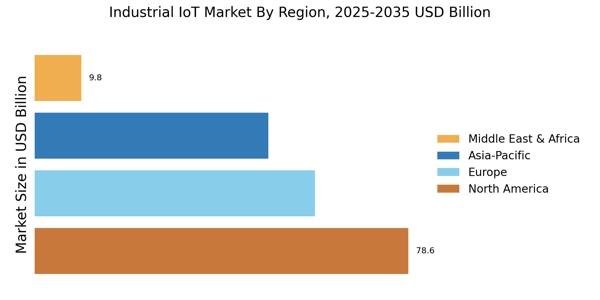
América del Norte es el mercado más grande para IoT industrial, con aproximadamente el 40% de la participación global. El crecimiento de la región está impulsado por rápidos avances tecnológicos, una mayor adopción de fabricación inteligente y iniciativas gubernamentales de apoyo. Los marcos regulatorios que promueven la transformación digital y la ciberseguridad también son catalizadores significativos para la expansión del mercado. EE. UU. lidera este mercado, seguido de cerca por Canadá, que contribuye con alrededor del 10% a la participación total. El paisaje competitivo en América del Norte es robusto, con actores clave como Siemens, General Electric y Honeywell. Estas empresas están a la vanguardia de la innovación, proporcionando soluciones de vanguardia que mejoran la eficiencia operativa. La presencia de grandes empresas tecnológicas como Cisco e IBM fortalece aún más el mercado, fomentando un ecosistema colaborativo que impulsa el crecimiento y desarrollo en el sector de IoT industrial.

Europa: Potencia Industrial Emergente

Europa está presenciando un crecimiento significativo en el mercado de IoT industrial, representando aproximadamente el 30% de la participación global. La expansión de la región está impulsada por regulaciones estrictas destinadas a mejorar la eficiencia industrial y la sostenibilidad. Países como Alemania y Francia están liderando la carga, con Alemania contribuyendo sola con alrededor del 15% al mercado. Las iniciativas de la Unión Europea para promover la digitalización en la fabricación son fundamentales para impulsar la demanda de soluciones de IoT. Alemania, el mercado más grande de Europa, alberga a actores clave como Siemens y Schneider Electric, que son fundamentales en el avance de las tecnologías de IoT. Francia y el Reino Unido también desempeñan roles cruciales, con un número creciente de startups y empresas establecidas enfocándose en innovaciones de IoT. El paisaje competitivo se caracteriza por la colaboración entre empresas de fabricación tradicionales y empresas tecnológicas, mejorando las capacidades de la región en el espacio de IoT industrial.

Asia-Pacífico: Mercado de Rápido Crecimiento

Asia-Pacífico está emergiendo como un jugador significativo en el mercado de IoT industrial, con alrededor del 25% de la participación global. El crecimiento de la región está impulsado por la creciente automatización industrial, iniciativas gubernamentales que promueven ciudades inteligentes y una demanda creciente de análisis de datos en tiempo real. China y Japón son los mercados más grandes, con China representando sola aproximadamente el 15% de la participación total del mercado, reflejando su rápida industrialización y avances tecnológicos. El paisaje competitivo en Asia-Pacífico es diverso, con empresas establecidas y startups innovadoras. Actores clave como ABB y Rockwell Automation están expandiendo su presencia, mientras que las empresas locales también están avanzando en soluciones de IoT. El enfoque de la región en mejorar la eficiencia de fabricación y la sostenibilidad está impulsando la adopción de tecnologías de IoT industrial, convirtiéndola en un mercado vibrante para el crecimiento futuro.

Medio Oriente y África: Potencial de Mercado Emergente

La región de Medio Oriente y África está emergiendo gradualmente en el mercado de IoT industrial, con aproximadamente el 5% de la participación global. El crecimiento está impulsado principalmente por el aumento de inversiones en infraestructura y un impulso hacia la transformación digital en diversas industrias. Países como los EAU y Sudáfrica están liderando esta tendencia, con los EAU contribuyendo con aproximadamente el 3% a la participación del mercado, apoyados por iniciativas gubernamentales destinadas a mejorar la adopción tecnológica. El paisaje competitivo en esta región está evolucionando, con una mezcla de actores locales e internacionales que ingresan al mercado. Las empresas se están enfocando en desarrollar soluciones de IoT adaptadas a las necesidades únicas de industrias como la de petróleo y gas, fabricación y logística. La presencia de actores clave, junto con un número creciente de startups, está fomentando la innovación y impulsando la adopción de tecnologías de IoT industrial en la región.

Industrial Internet Of Things Market Regional Image

Jugadores clave y perspectivas competitivas

El mercado de IoT industrial se caracteriza actualmente por un paisaje competitivo dinámico, impulsado por rápidos avances tecnológicos y una creciente demanda de automatización en diversos sectores. Los actores clave como Siemens (DE), General Electric (US) y Honeywell (US) se están posicionando estratégicamente a través de la innovación y asociaciones. Siemens (DE) se centra en la transformación digital y la infraestructura inteligente, mientras que General Electric (US) enfatiza su estrategia industrial digital, integrando IoT con su extensa cartera industrial. Honeywell (US) está mejorando sus capacidades de tecnología operativa, lo que indica un cambio colectivo hacia soluciones integradas que mejoran la eficiencia y reducen los costos operativos.

La estructura del mercado parece moderadamente fragmentada, con una mezcla de actores establecidos y nuevas startups. Las empresas están adoptando diversas tácticas comerciales, como la localización de la fabricación y la optimización de las cadenas de suministro, para mejorar su ventaja competitiva. Esta fragmentación permite ofertas diversas, sin embargo, la influencia de los actores principales sigue siendo sustancial, ya que establecen estándares de la industria y fomentan la innovación a través de inversiones significativas en I&D.

En agosto de 2025, Siemens (DE) anunció una asociación estratégica con un proveedor líder de servicios en la nube para mejorar las capacidades de su plataforma IoT. Esta colaboración tiene como objetivo aprovechar la computación en la nube para mejorar el análisis de datos y las aplicaciones de aprendizaje automático dentro de entornos industriales. La importancia estratégica de este movimiento radica en el compromiso de Siemens de proporcionar soluciones escalables y flexibles que satisfagan las necesidades cambiantes de sus clientes, reforzando así su posición en el mercado.

En septiembre de 2025, General Electric (US) presentó un nuevo conjunto de herramientas de mantenimiento predictivo impulsadas por IA diseñadas para el sector manufacturero. Esta iniciativa refleja el enfoque de GE en aprovechar la inteligencia artificial para optimizar el rendimiento del equipo y reducir el tiempo de inactividad. La introducción de estas herramientas probablemente mejorará la satisfacción y lealtad del cliente, ya que las empresas buscan cada vez más soluciones que minimicen las interrupciones operativas.

En julio de 2025, Honeywell (US) lanzó un nuevo marco de ciberseguridad adaptado para aplicaciones de IoT industrial. Este marco tiene como objetivo proteger la infraestructura crítica de las amenazas cibernéticas, que se han convertido en una preocupación creciente en la era digital. Al priorizar la ciberseguridad, Honeywell no solo aborda una necesidad urgente del mercado, sino que también se posiciona como líder en la protección de operaciones industriales, mejorando así su diferenciación competitiva.

A partir de octubre de 2025, las tendencias más prominentes que están dando forma al paisaje competitivo incluyen la digitalización, la sostenibilidad y la integración de la inteligencia artificial. Las alianzas estratégicas se están convirtiendo cada vez más en una piedra angular de la estrategia competitiva, permitiendo a las empresas agrupar recursos y experiencia. Mirando hacia el futuro, parece que la diferenciación competitiva evolucionará de la competencia tradicional basada en precios a un enfoque en la innovación, el avance tecnológico y la fiabilidad de la cadena de suministro. Este cambio sugiere que las empresas que prioricen estos elementos probablemente emergerán como líderes en el mercado de IoT industrial.

Las empresas clave en el mercado Industrial Internet Of Things Market incluyen

Desarrollos de la industria

  • Q2 2024: Siemens lanza el Sistema de Gestión de Edge Industrial para IIoT Siemens anunció el lanzamiento de su nuevo Sistema de Gestión de Edge Industrial, que permite a los fabricantes gestionar dispositivos y aplicaciones de IIoT a gran escala, mejorando el procesamiento de datos en tiempo real y la eficiencia operativa.
  • Q2 2024: Rockwell Automation adquiere Clearpath Robotics para expandir capacidades de IIoT Rockwell Automation completó la adquisición de Clearpath Robotics, con el objetivo de integrar robots móviles autónomos avanzados en su cartera de IoT industrial para entornos de fabricación más inteligentes.
  • Q2 2024: ABB y Microsoft anuncian asociación estratégica para soluciones IIoT impulsadas por IA ABB y Microsoft establecieron una asociación estratégica para co-desarrollar soluciones de IoT industrial impulsadas por IA, enfocándose en mantenimiento predictivo y optimización de energía para clientes de fabricación.
  • Q2 2024: Honeywell presenta nueva planta habilitada para IIoT en Texas Honeywell abrió una nueva instalación de fabricación en Texas equipada con sensores avanzados de IIoT y plataformas de análisis, diseñada para mostrar operaciones de fábricas inteligentes de próxima generación.
  • Q2 2024: La startup de IoT industrial Tulip recauda $50M en Serie C para escalar la plataforma Tulip, un proveedor de software de fabricación de IIoT, aseguró $50 millones en financiamiento de Serie C para acelerar el desarrollo de productos y expandir su base de clientes global.
  • Q3 2024: Schneider Electric lanza EcoStruxure Automation Expert 2024 para IIoT Schneider Electric lanzó la última versión de su plataforma EcoStruxure Automation Expert, que presenta una integración mejorada de IIoT y capacidades de computación en el borde para automatización industrial.
  • Q3 2024: Bosch se asocia con AWS para ofrecer análisis de IIoT basados en la nube Bosch anunció una asociación con Amazon Web Services para ofrecer servicios de análisis basados en la nube y aprendizaje automático para implementaciones de IoT industrial, dirigidos a los sectores de fabricación y logística.
  • Q3 2024: Emerson nombra nuevo Director Digital para liderar la estrategia de IIoT Emerson nombró a un nuevo Director Digital para liderar su estrategia de IoT industrial, enfocándose en expandir las transformaciones digitales en sus operaciones globales.
  • Q4 2024: GE Vernova gana contrato de $100M para modernización de red habilitada para IIoT GE Vernova aseguró un contrato de $100 millones para implementar soluciones habilitadas para IIoT para la modernización de la red, incluyendo sensores inteligentes y análisis predictivos para clientes de servicios públicos.
  • Q4 2024: Siemens y SAP anuncian plataforma conjunta IIoT para fabricación Siemens y SAP lanzaron una plataforma conjunta de IIoT diseñada para integrar datos de planta con sistemas de planificación de recursos empresariales, permitiendo flujos de trabajo digitales sin problemas para los fabricantes.
  • Q1 2025: Hitachi abre nuevo centro de I&D de IIoT en Japón Hitachi inauguró un nuevo centro de investigación y desarrollo centrado en tecnologías de IoT industrial, con el objetivo de acelerar la innovación en fabricación inteligente e infraestructura conectada.
  • Q1 2025: La startup de IoT industrial Element Analytics recauda $30M en Serie B Element Analytics, especializada en integración de datos y análisis de IIoT, recaudó $30 millones en financiamiento de Serie B para expandir su oferta de productos y crecer su equipo de ingeniería.

Perspectivas futuras

Industrial Internet Of Things Market Perspectivas futuras

Se proyecta que el mercado de IoT industrial crecerá a un CAGR del 8.16% desde 2024 hasta 2035, impulsado por avances en conectividad, automatización y análisis de datos.

Para 2035, se espera que el mercado de IoT industrial sea robusto, impulsado por la innovación y las inversiones estratégicas.

Segmentación de mercado

Industrial Internet Of Things Market Vertical Outlook

  • Public Sector
  • Healthcare
  • BFSI
  • Government

Industrial Internet Of Things Market Components Outlook

  • Services
  • Software
  • Hardware

Industrial Internet Of Things Market Deployment Outlook

  • Cloud
  • On-Premises

Industrial Internet Of Things Market Connectivity Outlook

  • Wi-Fi
  • ZWave
  • RF
  • Li-Fi
  • LAN
  • BLE
  • Others

Industrial Internet Of Things Market Organization Size Outlook

  • Small
  • Medium
  • Large

Alcance del informe

FAQs

What is the projected market valuation of the Industrial IoT Market by 2035?

The Industrial IoT Market is projected to reach a valuation of 465.45 USD Billion by 2035.

What was the market valuation of the Industrial IoT Market in 2024?

In 2024, the Industrial IoT Market was valued at 196.4 USD Billion.

What is the expected CAGR for the Industrial IoT Market during the forecast period 2025 - 2035?

The expected CAGR for the Industrial IoT Market during the forecast period 2025 - 2035 is 8.16%.

Which companies are considered key players in the Industrial IoT Market?

Key players in the Industrial IoT Market include Siemens, General Electric, Honeywell, Cisco, Rockwell Automation, Schneider Electric, ABB, IBM, and Microsoft.

What are the projected valuations for the connectivity segment in the Industrial IoT Market?

The connectivity segment is projected to range from 76.4 to 170.45 USD Billion.

How does the deployment segment of the Industrial IoT Market compare between cloud and on-premises solutions?

The deployment segment indicates cloud solutions may reach 186.12 USD Billion, while on-premises solutions could reach 279.33 USD Billion.

What is the expected performance of the components segment in the Industrial IoT Market?

The components segment is projected to have valuations ranging from 78.56 to 186.24 USD Billion for both software and hardware.

What are the projected valuations for the organization size segment in the Industrial IoT Market?

The organization size segment is expected to range from 39.28 to 233.7 USD Billion, depending on the size classification.

Which verticals are expected to drive growth in the Industrial IoT Market?

The verticals expected to drive growth include healthcare, BFSI, government, and the public sector, with valuations ranging from 30.0 to 175.45 USD Billion.

What does the future hold for the Industrial IoT Market in terms of growth and innovation?

The Industrial IoT Market appears poised for substantial growth, driven by technological advancements and increasing adoption across various sectors.

Autor
Author
Author Profile
Apoorva Priyadarshi LinkedIn
Research Analyst
With 4+ years of experience in Market Intelligence and Strategic Research, Apoorv specializes in ICT, Semiconductor, and BFSI markets. Combining strong analytical capabilities with a deep understanding of technology-driven industries, he focuses on delivering data-driven insights that support strategic decision-making. With a background in technology and business research, Apoorv has contributed to numerous global market studies, competitive landscape analyses, and opportunity assessments across sectors such as semiconductors, digital banking, cybersecurity, and telecommunications.
Co-Author
Co-Author Profile
Shubham Munde LinkedIn
Team Lead - Research
Shubham brings over 7 years of expertise in Market Intelligence and Strategic Consulting, with a strong focus on the Automotive, Aerospace, and Defense sectors. Backed by a solid foundation in semiconductors, electronics, and software, he has successfully delivered high-impact syndicated and custom research on a global scale. His core strengths include market sizing, forecasting, competitive intelligence, consumer insights, and supply chain mapping. Widely recognized for developing scalable growth strategies, Shubham empowers clients to navigate complex markets and achieve a lasting competitive edge. Trusted by start-ups and Fortune 500 companies alike, he consistently converts challenges into strategic opportunities that drive sustainable growth.

Research Approach

Secondary Research

The secondary research process involved comprehensive analysis of industrial standards databases, government technology initiatives, peer-reviewed engineering journals, IoT industry publications, and authoritative manufacturing organizations. Key sources included the National Institute of Standards and Technology (NIST) Smart Manufacturing Systems, International Electrotechnical Commission (IEC) Industrial IoT Standards, Institute of Electrical and Electronics Engineers (IEEE) IoT Technical Community, International Society of Automation (ISA) Automation Standards, US Department of Energy Industrial Efficiency Programs, European Commission Digital Industry initiatives, Germany's Federal Ministry for Economic Affairs and Climate Action (Industry 4.0 programs), China Ministry of Industry and Information Technology (MIIT) Smart Manufacturing policies, US Bureau of Economic Analysis Manufacturing Data, International Data Corporation (IDC) Industrial IoT Trackers, GSMA Intelligence Industrial Connectivity Reports, Industrial Internet Consortium (IIC) White Papers, Platform Industrie 4.0 Germany, Manufacturing USA Institutes, US Census Bureau Annual Survey of Manufactures, Eurostat Digital Economy and Society Statistics, Japan Ministry of Economy Trade and Industry (METI) Connected Industries Initiative, and national digital transformation reports from key industrial markets. These sources were used to collect industrial automation adoption statistics, regulatory compliance frameworks, cybersecurity standards, manufacturing output trends, connectivity infrastructure deployments, and competitive landscape analysis for IoT platforms, industrial sensors, edge computing devices, and predictive analytics solutions.

Primary Research

Qualitative and quantitative insights were obtained by interviewing supply-side and demand-side stakeholders during the primary research process. The supply-side sources comprised CEOs, CTOs, VPs of IoT Product Development, heads of Industrial Automation, and commercial directors from IIoT platform providers, industrial communication vendors, sensor manufacturers, edge computing hardware companies, and cloud service providers that served industrial sectors. Demand-side sources consist of Chief Digital Officers, VP of Manufacturing Operations, Plant Directors, OT/IT Managers, and procurement representatives from discrete and process manufacturing enterprises, oil and gas operators, automotive OEMs, healthcare device manufacturers, and utility companies. The primary research validated market segmentation across hardware, software, and services layers, confirmed Industry 4.0 implementation timelines, and gathered insights on IoT adoption barriers, cybersecurity investment priorities, cloud vs. edge deployment preferences, and ROI metrics for predictive maintenance implementations.

Primary Respondent Breakdown:

By Designation: C-level Primaries (28%), Director Level (35%), Others (37%)

By Region: North America (40%), Europe (30%), Asia-Pacific (22%), Rest of World (8%)

Market Size Estimation

Global market valuation was derived through revenue mapping and industrial connectivity deployment analysis. The methodology included:

Identification of 55+ key IIoT ecosystem participants across platform providers, industrial automation vendors, cloud hyperscalers, and connectivity specialists spanning North America, Europe, Asia-Pacific, and Latin America

Product mapping across IoT platforms, industrial gateways, sensors & actuators, edge computing hardware, predictive maintenance software, and managed connectivity services

Analysis of reported and modeled annual revenues specific to industrial IoT portfolios, including automation software licenses, hardware shipments, and recurring cloud subscriptions

Coverage of manufacturers and service providers representing 75-80% of global market share in 2024

Extrapolation using bottom-up (device shipments × ASP by component category and vertical) and top-down (vendor revenue validation across platform, hardware, and services segments) approaches to derive segment-specific valuations, including separate estimations for cloud vs. on-premise deployments and wireless vs. wired connectivity technologies

Descargar muestra gratis

Complete el formulario a continuación para recibir una muestra gratuita de este informe

Download PDF ×

We do not share your information with anyone. However, we may send you emails based on your report interest from time to time. You may contact us at any time to opt-out.