Event Management Software Market (2026 - 2035)

이벤트 관리 소프트웨어 시장 조사 보고서 – 2032년까지의 글로벌 예측
ID: MRFR/ICT/0890-CR
110 Pages
Apoorva Priyadarshi, Shubham Munde
Last Updated: July 20, 2026
Event Management Software Market
Market Size
Forecast Period2026-2035
CAGR (2026-2035)10.62%
2025 Market SizeUSD 14.18 Billion
2035 Market SizeUSD 35.29 Billion
Key Players
Cvent
Eventbrite
Bizzabo
Hopin
Aventri
Splash
Opportunities
  • AI-Powered Revenue Attribution Platforms
  • Emerging-Market MICE Infrastructure Buildout
  • Drone-as-a-Service and Event Data Monetization

이벤트 관리 소프트웨어 시장 요약

시장 조사 미래 분석에 따르면 이벤트 관리 소프트웨어 시장 규모는 2024년 82억 달러로 추산되었습니다. 이벤트 관리 소프트웨어 산업은 2025년 93억 2500만 달러에서 2035년까지 337억 3300만 달러로 성장할 것으로 예상되며, 2025~2035년 예측 기간 동안 13.72%의 연평균 성장률(CAGR)을 보일 것으로 예상됩니다.

주요 시장 동향 및 하이라이트

이벤트 관리 소프트웨어 시장은 기술 발전과 진화하는 사용자 기대에 힘입어 강력한 성장을 경험하고 있습니다.

  • 시장에서는 특히 여전히 가장 큰 시장인 북미 지역에서 사용자 경험에 대한 관심이 높아지고 있습니다.
  • 특히 가장 빠르게 성장하는 시장으로 인식되는 아시아 태평양 지역에서는 첨단 기술의 통합이 보편화되고 있습니다.
  • 기업 고객과 이벤트 주최자 모두의 다양한 요구를 충족하는 하이브리드 이벤트 솔루션이 증가하고 있습니다.
  • 주요 시장 동인으로는 가상 이벤트에 대한 수요 증가와 이벤트 기술에 대한 투자 증가 등이 있으며, 이는 업계의 미래를 형성하고 있습니다.

시장 규모 및 예측

2024년 시장규모 8.2 (USD Billion)
2035년 시장규모 33.73 (USD Billion)
CAGR (2025 - 2035) 13.72%
2024년 지역 시장 점유율 최대 북아메리카

주요 기업

씨벤트(미국), 이벤트브라이트(미국),비자보(미국), Aventri (미국), Whova (미국), Social Tables (미국), EventMobi (CA), Some (미국), Meetup (미국)

지역 통찰력

북미: 혁신의 시장 리더

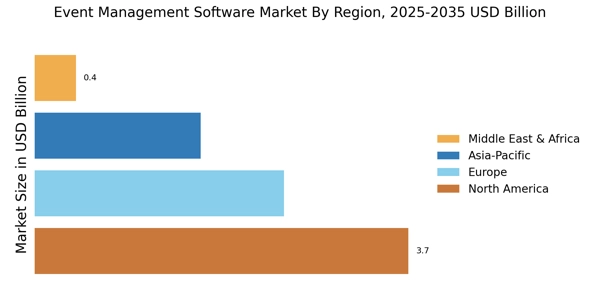
북미는 이벤트 관리 소프트웨어의 가장 큰 시장으로 전 세계 시장 점유율의 약 45%를 차지합니다. 이 지역의 성장은 가상 및 하이브리드 이벤트의 급증과 함께 이벤트 계획 및 관리를 위한 디지털 솔루션의 채택이 증가함에 따라 주도됩니다. 이벤트 부문의 기술 채택에 대한 규제 지원은 이러한 성장을 더욱 촉진하여 혁신의 허브로 만듭니다. 미국은 이 시장의 선두 국가이며 씨벤트(Cvent),이벤트브라이트, 그리고 Bizzabo는 여기에 본사를 두고 있습니다. 캐나다도 EventMobi와 같은 회사가 관심을 끌면서 크게 기여하고 있습니다. 경쟁 환경은 기존 기업과 신흥 스타트업이 혼합되어 빠르게 변화하는 환경에서 시장 점유율을 놓고 경쟁하는 것이 특징입니다.

유럽: 잠재력이 있는 신흥 시장

유럽은 이벤트 관리 소프트웨어 시장에서 전 세계 점유율의 약 30%를 차지하는 강력한 성장 궤적을 목격하고 있습니다. 기업 이벤트 및 컨퍼런스의 수가 증가하고 이벤트 기획에서 지속 가능성에 대한 강조가 높아지면서 이 지역의 수요가 더욱 커지고 있습니다. 이벤트 부문의 디지털 전환을 촉진하는 규제 프레임워크도 중요한 성장 동인입니다. 이 지역의 주요 국가로는 영국, 독일, 프랑스가 있으며, 이들 국가의 기업에서는 고급 이벤트 관리 솔루션을 점점 더 많이 채택하고 있습니다. 경쟁 환경에는 사용자 경험을 향상하고 혁신적인 기술을 통합하는 데 중점을 둔 현지 및 국제 플레이어가 모두 포함됩니다. Eventbrite 및 Bizzabo와 같은 주요 업체의 존재는 시장을 더욱 강화합니다.

아시아 태평양: 급속한 성장과 채택

아시아 태평양 지역은 글로벌 시장 점유율의 약 20%를 차지하며 이벤트 관리 소프트웨어 시장에서 중요한 플레이어로 빠르게 부상하고 있습니다. 이 지역의 성장은 도시화 증가, 가처분 소득 증가, 기업 행사 및 전시회에 대한 관심 증가에 의해 주도됩니다. 관광 및 비즈니스 이벤트 홍보를 목표로 하는 규제 계획도 시장 확대에 기여하고 있습니다. 중국, 인도, 호주와 같은 국가에서는 급증하는 신생 기업과 기존 기업이 시장에 진입하면서 이러한 추세를 주도하고 있습니다. 경쟁 환경은 다양하며 국내 플레이어가 국제 거대 기업을 상대로 우위를 점하고 있습니다. Whova 및 Some과 같은 주요 업체의 존재는 이벤트 관리 솔루션의 혁신과 성장을 위한 지역의 잠재력을 강조합니다.

중동 및 아프리카: 아직 개척되지 않은 시장 기회

중동 및 아프리카 지역은 이벤트 관리 소프트웨어 시장에서 점차적으로 부상하고 있으며 현재 전 세계 점유율의 약 5%를 차지하고 있습니다. 성장은 주로 인프라에 대한 투자 증가와 비즈니스 관광 증가에 의해 주도됩니다. 국제 행사 개최를 위한 규제 지원은 시장 성장을 위한 촉매제이기도 하며, 현지 요구에 맞는 소프트웨어 솔루션을 위한 기회를 창출합니다. UAE 및 남아프리카공화국과 같은 국가가 선두에 있으며 점점 더 많은 행사와 컨퍼런스가 개최되고 있습니다. 경쟁 구도는 여전히 발전하고 있으며, 국내 및 해외 플레이어 모두 시장 입지를 놓고 경쟁하고 있습니다. 새로운 회사의 진입과 기존 회사의 확장은 이 지역의 이벤트 관리 솔루션에 대한 유망한 미래를 나타냅니다.

이벤트 관리 소프트웨어 시장 Regional Image

이벤트 관리 소프트웨어 시장 시장의 주요 기업은 다음과 같습니다

보고서 범위

FAQs

How do procurement teams evaluate build-versus-buy decisions for event technology?
Most enterprises find that buying a commercial event planning platform delivers ROI 3–5x faster than building in-house, primarily because commercial tools include pre-built integrations with CRM and marketing stacks [21]. Build options only make sense for organizations running 500+ proprietary events annually with unique workflow requirements.
What role does API extensibility play in selecting conference management tools?
API-first platforms allow organizers to connect event data with BI dashboards, HR systems, and finance tools without custom middleware [7]. Buyers should prioritize vendors offering RESTful APIs with documented webhook support and pre-built connectors for Salesforce, HubSpot, and Marketo.
How are event ticketing solutions adapting to dynamic pricing models?
Leading event ticketing solutions now offer algorithmic pricing that adjusts ticket costs based on demand signals, time-to-event, and historical conversion rates [8]. Dynamic pricing can lift revenue per event by 12–18% compared to fixed-tier models.
What cybersecurity certifications should buyers require from Event Management Software Market vendors?
Minimum requirements include SOC 2 Type II, ISO 27001, and GDPR compliance attestations [15]. For government or healthcare events, FedRAMP authorization or HIPAA-compliant hosting adds a critical layer of audit readiness.
How does the Event Management Software Market address accessibility compliance for hybrid events?
Vendors are embedding WCAG 2.1 AA-compliant interfaces, automated captioning in 30+ languages, and screen-reader-optimized attendee portals [16]. The European Accessibility Act makes these features regulatory requirements for EU-hosted events starting June 2025.
What integration challenges arise when deploying virtual event management alongside existing martech stacks?
The primary friction points are data-schema mismatches between event platforms and CRM systems, SSO configuration across identity providers, and real-time data-sync latency [14]. Pilot deployments of 60–90 days with a dedicated integration team reduce go-live risk significantly.
How are online event registration software platforms handling multi-currency and multi-language requirements for global events?
Top-tier platforms support 25+ currencies with real-time FX conversion and localized registration flows in 40+ languages [1]. Buyers running events across three or more regions should verify that the vendor offers in-country payment-gateway partnerships and locale-specific tax-ID collection.    
저자
Author
Author Profile
Apoorva Priyadarshi LinkedIn
Research Analyst
With 4+ years of experience in Market Intelligence and Strategic Research, Apoorv specializes in ICT, Semiconductor, and BFSI markets. Combining strong analytical capabilities with a deep understanding of technology-driven industries, he focuses on delivering data-driven insights that support strategic decision-making. With a background in technology and business research, Apoorv has contributed to numerous global market studies, competitive landscape analyses, and opportunity assessments across sectors such as semiconductors, digital banking, cybersecurity, and telecommunications.
Co-Author
Co-Author Profile
Shubham Munde LinkedIn
Team Lead - Research
Shubham brings over 7 years of expertise in Market Intelligence and Strategic Consulting, with a strong focus on the Automotive, Aerospace, and Defense sectors. Backed by a solid foundation in semiconductors, electronics, and software, he has successfully delivered high-impact syndicated and custom research on a global scale. His core strengths include market sizing, forecasting, competitive intelligence, consumer insights, and supply chain mapping. Widely recognized for developing scalable growth strategies, Shubham empowers clients to navigate complex markets and achieve a lasting competitive edge. Trusted by start-ups and Fortune 500 companies alike, he consistently converts challenges into strategic opportunities that drive sustainable growth.

Research Approach


Secondary Research

The secondary research process involved comprehensive analysis of industry databases, technology publications, government IT reports, and authoritative software industry organizations. Key sources included the US Bureau of Labor Statistics (BLS), International Data Corporation (IDC), Gartner Research, National Institute of Standards and Technology (NIST), European Commission's Digital Economy and Society Index (DESI), Software & Information Industry Association (SIIA), TechUK, National Association of Broadcasters (NAB), International Congress and Convention Association (ICCA), Events Industry Council (EIC), Meeting Professionals International (MPI), World Tourism Organization (UNWTO), International Monetary Fund (IMF) World Economic Outlook, US Census Bureau Business Patterns, EU Eurostat Digital Economy Statistics, and national IT ministry reports from key markets.

Digital adoption metrics, event industry statistics, cloud infrastructure data, corporate event spending trends, regulatory frameworks for data privacy (GDPR, CCPA), and competitive landscape analysis for event management platforms, virtual event solutions, and hybrid event technologies were all gathered from these sources.


Primary Research

In order to gather both qualitative and quantitative insights, supply-side and demand-side stakeholders were interviewed during the primary research process. CEOs, CTOs, VPs of Product Development, Chief Revenue Officers, and heads of Partnerships from SaaS technology firms, virtual event platform providers, and event management software suppliers were examples of supply-side sources. Chief marketing officers, corporate events directors, global meeting planners, IT directors from Fortune 1000 companies, procurement leaders from expert conference organizers, and venue technology managers from hotels and convention centers were among the demand-side sources. Primary research obtained information on procurement decision-making procedures, pricing models, and security compliance criteria; verified product roadmaps and AI integration timetables; and validated market segmentation across software vs. services, deployment models, and application verticals.

Primary Respondent Breakdown:

By Designation: C-level Primaries (40%), Director Level (32%), Others (28%)

By Region: North America (42%), Europe (25%), Asia-Pacific (23%), Rest of World (10%)


Market Size Estimation

Enterprise adoption analysis and revenue mapping were used to determine the global market valuation. The methodology comprised:

Finding more than fifty major software suppliers and service providers in North America, Europe, Asia-Pacific, and Latin America

Solution mapping between venue management software, virtual event platforms, registration and ticketing systems, analytics and engagement tools, and event management software

Examination of stated and projected yearly income for event technology portfolios

coverage of suppliers accounting for 75–80% of the world market in 2024

Extrapolation of segment-specific valuations across corporate, government, education, and third-party event organizer verticals utilizing top-down (vendor revenue validation) and bottom-up (number of events × average software spend by organization size) methods

무료 샘플 다운로드

이 보고서의 무료 샘플을 받으려면 아래 양식을 작성하십시오

Download PDF ×

We do not share your information with anyone. However, we may send you emails based on your report interest from time to time. You may contact us at any time to opt-out.