Industrial Internet Of Things Market

산업 IoT 시장 규모, 점유율 및 연구 보고서: 구성 요소별(하드웨어, 솔루션 및 서비스), 배포별(클라우드, 온프레미스), 연결성별(유선 및 무선), 최종 사용자별(IT 및 통신, 제조, 의료, 소매, 석유 및 가스, 자동차 및 기타) - 2034년 전망
ID: MRFR/ICT/1593-CR
100 Pages
Apoorva Priyadarshi, Shubham Munde
Last Updated: July 29, 2026
Industrial Internet Of Things Market
Market Size
Forecast Period2025 - 2035
CAGR (2025 - 2035)8.16%
2024 Market Size$ 196.4 Billion
2025 Market Size$ 212.43 Billion
2035 Market Size$ 465.45 Billion
Key Players
Siemens
General Electric
Honeywell
Cisco
Rockwell Automation
Schneider Electric
Opportunities
  • Rising Demand for Automation
  • Advancements in Sensor Technology
  • Integration of Advanced Analytics

Industrial Internet Of Things Market 요약

시장 조사 미래 분석에 따르면, 산업 IoT 시장 규모는 2024년에 196.4억 달러로 추정되었습니다. 산업 IoT 산업은 2025년 212.43억 달러에서 2035년까지 465.45억 달러로 성장할 것으로 예상되며, 2025 - 2035년 예측 기간 동안 연평균 성장률(CAGR)은 8.16%에 이를 것으로 보입니다.

주요 시장 동향 및 하이라이트

산업 IoT 시장은 기술 발전과 자동화에 대한 수요 증가로 인해 상당한 성장을 할 준비가 되어 있습니다.

  • 북미는 산업 IoT의 가장 큰 시장으로 남아 있으며, 자동화 기술에 대한 강력한 투자를 보여줍니다.
  • 아시아 태평양 지역은 빠른 산업화와 디지털 전환 이니셔티브에 힘입어 가장 빠르게 성장하는 지역으로 부상하고 있습니다.
  • Wi-Fi 기술은 여전히 시장을 지배하고 있으며, BLE는 에너지 효율성 덕분에 가장 빠르게 성장하는 세그먼트로 주목받고 있습니다.
  • 자동화에 대한 수요 증가와 센서 기술의 발전이 시장을 앞으로 나아가게 하는 주요 동력입니다.

시장 규모 및 예측

2024 Market Size 196.4 (USD Billion)
2035 Market Size 465.45 (USD Billion)
CAGR (2025 - 2035) 8.16%

주요 기업

지멘스 (DE), 제너럴 일렉트릭 (US), 하니웰 (US), 시스코 (US), 록웰 오토메이션 (US), 슈나이더 일렉트릭 (FR), ABB (CH), IBM (US), 마이크로소프트 (US)

Industrial Internet Of Things Market Treiber

Rising Demand for Automation

The Industrial IoT Market is experiencing a notable surge in demand for automation across various sectors. This trend is driven by the need for enhanced operational efficiency and reduced labor costs. Industries such as manufacturing and logistics are increasingly adopting IoT solutions to streamline processes and minimize human error. According to recent data, the automation segment within the Industrial IoT Market is projected to grow at a compound annual growth rate of approximately 25% over the next five years. This growth is indicative of a broader shift towards smart factories and automated supply chains, where real-time data analytics and machine-to-machine communication play pivotal roles in decision-making and operational optimization.

Advancements in Sensor Technology

Advancements in sensor technology are significantly influencing the Industrial IoT Market. The proliferation of low-cost, high-performance sensors enables industries to collect vast amounts of data in real-time, facilitating better monitoring and control of processes. These sensors are integral to applications such as predictive maintenance, where they help in identifying potential equipment failures before they occur. The market for sensors in the Industrial IoT Market is expected to reach USD 30 billion by 2026, reflecting the growing reliance on data-driven insights. As industries continue to invest in smart technologies, the integration of advanced sensors will likely enhance operational capabilities and drive further innovation.

Integration of Advanced Analytics

The integration of advanced analytics into the Industrial IoT Market is transforming how organizations interpret and utilize data. By leveraging big data analytics, companies can gain deeper insights into operational performance, customer behavior, and market trends. This capability allows for more informed decision-making and strategic planning. The analytics segment within the Industrial IoT Market is anticipated to witness substantial growth, with projections indicating a market size of USD 15 billion by 2025. As industries increasingly recognize the value of data-driven strategies, the demand for sophisticated analytics tools and platforms is likely to escalate, further propelling the evolution of the Industrial IoT landscape.

Growing Focus on Supply Chain Optimization

The Industrial IoT Market is witnessing a growing focus on supply chain optimization, driven by the need for greater visibility and efficiency. IoT technologies enable real-time tracking of goods and assets, allowing companies to respond swiftly to disruptions and enhance inventory management. This trend is particularly relevant in sectors such as retail and manufacturing, where supply chain agility is critical. Recent studies indicate that companies implementing IoT solutions for supply chain management can achieve cost reductions of up to 30%. As organizations strive to create more resilient supply chains, the adoption of IoT technologies is expected to accelerate, further shaping the future of the Industrial IoT Market.

Emphasis on Sustainability and Energy Efficiency

The Industrial IoT Market is increasingly aligning with sustainability goals, as organizations seek to reduce their carbon footprints and enhance energy efficiency. IoT solutions facilitate real-time monitoring of energy consumption, enabling companies to identify inefficiencies and implement corrective measures. This focus on sustainability is not only driven by regulatory pressures but also by consumer demand for environmentally responsible practices. The market for energy management solutions within the Industrial IoT Market is projected to grow significantly, with estimates suggesting a value of USD 20 billion by 2025. This trend indicates a shift towards greener operations, where IoT technologies play a crucial role in achieving sustainability objectives.
시장 세그먼트 통찰력

By Connectivity: Wi-Fi (Largest) vs. BLE (Fastest-Growing)

In the Industrial IoT market, the connectivity segment showcases a diverse array of technologies with Wi-Fi leading the pack as the largest segment. It holds a significant market share due to its widespread adoption in industrial applications, such as monitoring and control systems. Following Wi-Fi are technologies like ZWave and RF, which also contribute notably, but they have not yet reached the same scale of deployment and user acceptance as Wi-Fi. Other technologies, while present, account for a smaller portion of the overall market share, marking them as less dominant players in this space. As the industry evolves, growth trends indicate a rise in the adoption of BLE (Bluetooth Low Energy) technologies, particularly in asset tracking and smart manufacturing scenarios. The demand for low-power, efficient connectivity solutions is propelling BLE into the spotlight, exhibiting rapid growth rates. Additionally, the introduction of innovative applications in the Industrial IoT space, such as smart sensors and devices, is driving competition among connectivity technologies. Emergence of Li-Fi solutions further signifies a trend toward enhanced data transmission capabilities, aiming to meet the increasing data needs of modern industrial setups.

Connectivity: Wi-Fi (Dominant) vs. BLE (Emerging)

Wi-Fi remains the dominant choice for industrial connectivity, providing robust and high-speed data transfer essentials for various applications, from real-time monitoring to data analytics. Its ability to cover wide areas and integrate seamlessly with existing infrastructure makes it a preferred option for many organizations seeking scalability and flexibility. In contrast, BLE is emerging as a pivotal technology tailored for applications where power efficiency and low data rates are primary concerns. It is particularly suited for short-range communication, making it ideal for interconnected devices in smart factories. BLE's rapid growth stems from its capability to enhance automation by connecting numerous devices while maintaining power requirements, thereby carving out a significant niche within the Industrial IoT landscape.

By Deployment: Cloud (Largest) vs. On-Premises (Fastest-Growing)

In the Industrial IoT Market, the deployment segment is characterized by a clear division between cloud-based and on-premises solutions. Cloud deployment has emerged as the largest segment due to its scalability, cost-effectiveness, and ease of access. Many industries favor cloud solutions for their flexibility in handling large datasets and analysis in real-time, contributing to its dominant position. In contrast, on-premises deployment is gaining traction as organizations that prioritize data security and control opt for this more traditional solution. The trend towards on-premises solutions is fueled by increasing concerns over data privacy and security, prompting industries to invest in localized infrastructure. This has led to a significant growth momentum for on-premises solutions, appealing especially to sectors like manufacturing and critical infrastructure. Organizations are increasingly adopting hybrid models, combining advantages from both deployment types to leverage their respective benefits, while also enhancing system reliability and operational efficiency.

Deployment: Cloud (Dominant) vs. On-Premises (Emerging)

Cloud deployment in the Industrial IoT Market is considered a dominant force due to its ability to offer scalable solutions that cater to a myriad of industrial needs. With its inherent advantage of facilitating remote access and data storage capabilities, it enables organizations to optimize operations without heavy upfront investments in hardware. On the other hand, on-premises deployment is an emerging choice, particularly among firms that prioritize stringent control over their data and systems. This segment is characterized by tailored solutions that suit specific operational requirements, offering organizations the peace of mind that comes with managing data within their own infrastructure. As a result, on-premises systems are increasingly being viewed as integral in sectors requiring high security, making them a compelling alternative to cloud solutions.

By Components: Services (Largest) vs. Hardware (Fastest-Growing)

The Industrial IoT market is characterized by a diverse component distribution, with services leading in market share compared to hardware and software. Services encompass consulting and support, contributing significantly to overall revenue due to their critical role in deployment and maintenance. In contrast, hardware and software segments are vital, albeit to a lesser extent, reflecting the market's increasing reliance on integrated solutions and real-time data management for efficient industrial operations. Growth trends indicate that while services are proliferating due to ongoing digital transformation initiatives, hardware stands out as the fastest-growing segment. The expansion is fueled by advancements in sensor technology and edge computing. As industries seek enhanced connectivity and automation, demand for innovative hardware solutions is surging, highlighting the necessity for robust infrastructure to support IoT applications.

Services: Consulting (Dominant) vs. Hardware: Edge Devices (Emerging)

In the realm of Industrial IoT, consulting services represent a dominant value, providing essential support in strategy formulation, technology integration, and optimization. Consulting firms help manufacturers navigate the complexities of digital transformation, enabling a seamless transition to IoT-based operations. Conversely, edge devices as an emerging hardware segment are experiencing rapid growth due to their essential role in processing data closer to the source. This mitigates latency issues and enhances response times, thereby driving operational efficiencies. As companies increasingly prioritize real-time analytics, the market for edge devices is expected to witness significant innovation, making them imperative for the next phase of industrial automation.

By Organization Size: Large (Largest) vs. Small (Fastest-Growing)

The Industrial IoT market exhibits a diverse distribution across organization sizes, with large organizations commanding the highest market share due to their extensive resources and robust infrastructures. These enterprises leverage advanced IoT technology to optimize their operations and maintain a competitive edge, reflecting a significant share in the market. Conversely, small organizations, while currently representing a smaller portion of the market, are rapidly increasing their presence, driven by the ease of access to IoT solutions and the growing demand for efficiency in operations. The growth trends in the Industrial IoT sector indicate a notable rise in adoption among small-sized organizations. Historically underserved, this segment is now experiencing a surge in technological advancements allowing them to innovate and automate processes effectively. Key drivers include heightened awareness of IoT benefits, affordability of solutions, and increased customization options tailored to their unique operational needs, positioning them for significant growth in the coming years.

Large (Dominant) vs. Small (Emerging)

Large organizations in the Industrial IoT market position themselves as dominant players due to their ability to invest in large-scale IoT deployments and partnerships with leading technology providers. They typically operate with complex, integrated systems that enhance efficiency and drive innovation across their massive operations. Their established market presence allows them to leverage extensive data analytics to optimize performance further. In contrast, small organizations are emerging as crucial players within this segment, benefitting from simplified and cost-effective IoT solutions. These companies are able to implement IoT technologies that enhance operational processes without the heavy infrastructure burdens faced by larger firms, demonstrating agility and speed in adopting new technologies. As they continue to explore IoT applications, small organizations are likely to contribute significantly to the overall market growth.

By Vertical: Healthcare (Largest) vs. BFSI (Fastest-Growing)

In the Industrial IoT market, the vertical segment shows a diversified range of applications, with Healthcare capturing the largest share. It leverages IoT technology for patient monitoring, equipment tracking, and enhanced healthcare services, making it a preferred choice among industries seeking operational efficiency. Following closely, the BFSI sector is rapidly growing, utilizing IoT for security, risk management, and customer service enhancements, showcasing significant investment in smart banking solutions.

Healthcare (Dominant) vs. BFSI (Emerging)

The Healthcare sector stands as a dominant player in the Industrial IoT landscape, characterized by robust integration of IoT devices that improve patient care and streamline operations. This vertical focuses on advanced technologies such as wearables and telehealth services, fostering a patient-centric approach. In contrast, the BFSI segment, while emerging, is experiencing rapid expansion as banks and financial institutions adopt IoT solutions for real-time data analytics and cyber security measures. This growing emphasis on digital transformation positions BFSI as a crucial contender in the market.

Industrial Internet Of Things Market에 대한 더 자세한 통찰력 얻기

지역 통찰력

북미 : 혁신 및 리더십 허브

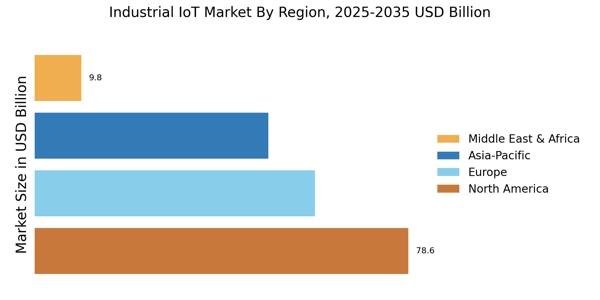
북미는 산업 IoT의 가장 큰 시장으로, 전 세계 시장의 약 40%를 차지하고 있습니다. 이 지역의 성장은 빠른 기술 발전, 스마트 제조의 증가하는 채택, 그리고 지원적인 정부 이니셔티브에 의해 주도되고 있습니다. 디지털 전환 및 사이버 보안을 촉진하는 규제 프레임워크도 시장 확장의 중요한 촉매제입니다. 미국이 이 시장을 선도하고 있으며, 캐나다가 뒤를 이어 전체 시장의 약 10%를 기여하고 있습니다.

북미의 경쟁 환경은 강력하며, 지멘스, 제너럴 일렉트릭, 하니웰과 같은 주요 기업들이 있습니다. 이들 기업은 혁신의 최전선에 있으며, 운영 효율성을 향상시키는 최첨단 솔루션을 제공합니다. 시스코와 IBM과 같은 주요 기술 기업의 존재는 시장을 더욱 강화하여 산업 IoT 분야의 성장과 발전을 촉진하는 협력 생태계를 조성하고 있습니다.

유럽 : 신흥 산업 강국

유럽은 산업 IoT 시장에서 상당한 성장을 목격하고 있으며, 전 세계 시장의 약 30%를 차지하고 있습니다. 이 지역의 확장은 산업 효율성과 지속 가능성을 향상시키기 위한 엄격한 규제에 의해 촉진되고 있습니다. 독일과 프랑스와 같은 국가들이 선두에 있으며, 독일만으로도 시장의 약 15%를 기여하고 있습니다. 제조업에서 디지털화를 촉진하기 위한 유럽 연합의 이니셔티브는 IoT 솔루션에 대한 수요를 주도하는 데 중요한 역할을 하고 있습니다.

유럽에서 가장 큰 시장인 독일은 지멘스와 슈나이더 일렉트릭과 같은 주요 기업들이 IoT 기술을 발전시키는 데 중요한 역할을 하고 있습니다. 프랑스와 영국도 중요한 역할을 하며, IoT 혁신에 집중하는 스타트업과 기존 기업들이 증가하고 있습니다. 경쟁 환경은 전통적인 제조 기업과 기술 기업 간의 협력으로 특징지어지며, 이 지역의 산업 IoT 분야의 역량을 강화하고 있습니다.

아시아 태평양 : 빠르게 성장하는 시장

아시아 태평양은 산업 IoT 시장에서 중요한 플레이어로 부상하고 있으며, 전 세계 시장의 약 25%를 차지하고 있습니다. 이 지역의 성장은 산업 자동화 증가, 스마트 시티를 촉진하는 정부 이니셔티브, 그리고 실시간 데이터 분석에 대한 수요 증가에 의해 주도되고 있습니다. 중국과 일본이 가장 큰 시장이며, 중국은 전체 시장 점유율의 약 15%를 차지하고 있어 급속한 산업화와 기술 발전을 반영하고 있습니다.

아시아 태평양의 경쟁 환경은 다양하며, 기존 기업과 혁신적인 스타트업이 혼합되어 있습니다. ABB와 록웰 오토메이션과 같은 주요 기업들이 존재감을 확장하고 있으며, 현지 기업들도 IoT 솔루션에서 진전을 이루고 있습니다. 제조 효율성과 지속 가능성을 향상시키려는 이 지역의 집중은 산업 IoT 기술의 채택을 촉진하고 있으며, 미래 성장에 대한 활기찬 시장을 만들고 있습니다.

중동 및 아프리카 : 신흥 시장 잠재력

중동 및 아프리카 지역은 산업 IoT 시장에서 점차 부상하고 있으며, 전 세계 시장의 약 5%를 차지하고 있습니다. 성장은 주로 인프라에 대한 투자 증가와 다양한 산업에서 디지털 전환을 추진하는 데 의해 주도되고 있습니다. UAE와 남아프리카 공화국과 같은 국가들이 이 추세를 선도하고 있으며, UAE는 시장 점유율의 약 3%를 기여하고 있으며, 기술 채택을 향상시키기 위한 정부 이니셔티브에 의해 지원받고 있습니다.

이 지역의 경쟁 환경은 진화하고 있으며, 현지 및 국제 기업들이 시장에 진입하고 있습니다. 기업들은 석유 및 가스, 제조, 물류와 같은 산업의 고유한 요구에 맞춘 IoT 솔루션 개발에 집중하고 있습니다. 주요 기업들의 존재와 함께 증가하는 스타트업들은 혁신을 촉진하고 이 지역에서 산업 IoT 기술의 채택을 이끌고 있습니다.

Industrial Internet Of Things Market Regional Image

주요 기업 및 경쟁 통찰력

산업 IoT 시장은 현재 빠른 기술 발전과 다양한 분야에서 자동화에 대한 수요 증가에 의해 주도되는 역동적인 경쟁 환경을 특징으로 하고 있습니다. 지멘스 (DE), 제너럴 일렉트릭 (US), 하니웰 (US)과 같은 주요 기업들은 혁신과 파트너십을 통해 전략적으로 자신을 포지셔닝하고 있습니다. 지멘스 (DE)는 디지털 전환 및 스마트 인프라에 집중하고 있으며, 제너럴 일렉트릭 (US)은 IoT를 광범위한 산업 포트폴리오와 통합하는 디지털 산업 전략을 강조하고 있습니다. 하니웰 (US)은 운영 기술 능력을 강화하고 있으며, 이는 효율성을 높이고 운영 비용을 줄이는 통합 솔루션으로의 집단적 전환을 나타냅니다.

시장 구조는 중간 정도로 분산되어 있으며, 기존 기업과 신생 스타트업이 혼합되어 있습니다. 기업들은 경쟁 우위를 높이기 위해 제조 현지화 및 공급망 최적화와 같은 다양한 비즈니스 전술을 채택하고 있습니다. 이러한 분산은 다양한 제품을 가능하게 하지만, 주요 기업의 영향력은 여전히 상당하여, 이들이 산업 표준을 설정하고 상당한 연구 개발 투자로 혁신을 주도하고 있습니다.

2025년 8월, 지멘스 (DE)는 IoT 플랫폼 기능을 향상시키기 위해 주요 클라우드 서비스 제공업체와 전략적 파트너십을 발표했습니다. 이 협력은 클라우드 컴퓨팅을 활용하여 산업 환경 내 데이터 분석 및 머신 러닝 응용 프로그램을 개선하는 것을 목표로 하고 있습니다. 이 움직임의 전략적 중요성은 지멘스가 고객의 변화하는 요구를 충족하는 확장 가능하고 유연한 솔루션을 제공하겠다는 약속에 있습니다.

2025년 9월, 제너럴 일렉트릭 (US)은 제조 부문을 위해 설계된 AI 기반 예측 유지보수 도구의 새로운 제품군을 공개했습니다. 이 이니셔티브는 장비 성능을 최적화하고 다운타임을 줄이기 위해 인공지능을 활용하는 제너럴 일렉트릭의 초점을 반영합니다. 이러한 도구의 도입은 고객 만족도와 충성도를 높일 가능성이 있으며, 기업들이 운영 중단을 최소화하는 솔루션을 점점 더 많이 찾고 있습니다.

2025년 7월, 하니웰 (US)은 산업 IoT 응용 프로그램을 위해 맞춤화된 새로운 사이버 보안 프레임워크를 출시했습니다. 이 프레임워크는 디지털 시대에 점점 더 우려되는 사이버 위협으로부터 중요한 인프라를 보호하는 것을 목표로 하고 있습니다. 사이버 보안을 우선시함으로써 하니웰은 시급한 시장 요구를 해결할 뿐만 아니라 산업 운영을 보호하는 리더로 자리매김하여 경쟁 차별화를 강화하고 있습니다.

2025년 10월 현재, 경쟁 환경을 형성하는 가장 두드러진 트렌드는 디지털화, 지속 가능성 및 인공지능의 통합입니다. 전략적 제휴는 점점 더 경쟁 전략의 초석이 되고 있으며, 기업들이 자원과 전문성을 결합할 수 있게 하고 있습니다. 앞으로 경쟁 차별화는 전통적인 가격 기반 경쟁에서 혁신, 기술 발전 및 공급망 신뢰성에 초점을 맞춘 방향으로 발전할 것으로 보입니다. 이러한 변화는 이러한 요소를 우선시하는 기업들이 산업 IoT 시장에서 리더로 부상할 가능성이 높다는 것을 시사합니다.

Industrial Internet Of Things Market 시장의 주요 기업은 다음과 같습니다

산업 발전

  • 2024년 2분기: 지멘스, IIoT를 위한 산업 엣지 관리 시스템 출시 지멘스는 IIoT 장치 및 응용 프로그램을 대규모로 관리할 수 있는 새로운 산업 엣지 관리 시스템을 출시하여 실시간 데이터 처리 및 운영 효율성을 향상시킵니다.
  • 2024년 2분기: 록웰 오토메이션, IIoT 기능 확장을 위해 클리어패스 로보틱스 인수 록웰 오토메이션은 산업 IoT 포트폴리오에 고급 자율 이동 로봇을 통합하기 위해 클리어패스 로보틱스를 인수했습니다.
  • 2024년 2분기: ABB와 마이크로소프트, AI 기반 IIoT 솔루션을 위한 전략적 파트너십 발표 ABB와 마이크로소프트는 제조 고객을 위한 예측 유지보수 및 에너지 최적화에 중점을 두고 AI 기반 산업 IoT 솔루션을 공동 개발하기 위해 전략적 파트너십을 체결했습니다.
  • 2024년 2분기: 하니웰, 텍사스에 새로운 IIoT 지원 공장 공개 하니웰은 차세대 스마트 공장 운영을 선보이기 위해 고급 IIoT 센서 및 분석 플랫폼이 장착된 새로운 제조 시설을 텍사스에 개설했습니다.
  • 2024년 2분기: 산업 IoT 스타트업 튤립, 플랫폼 확장을 위해 5000만 달러 시리즈 C 자금 조달 IIoT 제조 소프트웨어 제공업체인 튤립은 제품 개발을 가속화하고 글로벌 고객 기반을 확장하기 위해 5000만 달러의 시리즈 C 자금을 확보했습니다.
  • 2024년 3분기: 슈나이더 일렉트릭, IIoT를 위한 EcoStruxure Automation Expert 2024 출시 슈나이더 일렉트릭은 산업 자동화를 위한 IIoT 통합 및 엣지 컴퓨팅 기능이 향상된 EcoStruxure Automation Expert 플랫폼의 최신 버전을 출시했습니다.
  • 2024년 3분기: 보쉬, 클라우드 기반 IIoT 분석 제공을 위해 AWS와 파트너십 체결 보쉬는 산업 IoT 배포를 위한 클라우드 기반 분석 및 머신 러닝 서비스를 제공하기 위해 아마존 웹 서비스와 파트너십을 발표했습니다.
  • 2024년 3분기: 에머슨, IIoT 전략을 이끌 새로운 최고 디지털 책임자 임명 에머슨은 산업 IoT 전략을 이끌기 위해 새로운 최고 디지털 책임자를 임명하고, 글로벌 운영 전반에 걸쳐 디지털 전환 이니셔티브를 확장하는 데 집중하고 있습니다.
  • 2024년 4분기: GE 버노바, IIoT 지원 그리드 현대화를 위한 1억 달러 계약 체결 GE 버노바는 유틸리티 고객을 위한 스마트 센서 및 예측 분석을 포함한 IIoT 지원 솔루션을 배포하기 위해 1억 달러 계약을 체결했습니다.
  • 2024년 4분기: 지멘스와 SAP, 제조를 위한 공동 IIoT 플랫폼 발표 지멘스와 SAP는 제조업체를 위한 원활한 디지털 워크플로우를 가능하게 하는 상점 데이터와 기업 자원 계획 시스템을 통합하도록 설계된 공동 IIoT 플랫폼을 출시했습니다.
  • 2025년 1분기: 히타치, 일본에 새로운 IIoT 연구개발 센터 개설 히타치는 스마트 제조 및 연결된 인프라에서 혁신을 가속화하기 위해 산업 IoT 기술에 중점을 둔 새로운 연구개발 센터를 개설했습니다.
  • 2025년 1분기: 산업 IoT 스타트업 엘리먼트 애널리틱스, 3000만 달러 시리즈 B 자금 조달 IIoT 데이터 통합 및 분석을 전문으로 하는 엘리먼트 애널리틱스는 제품 제공을 확장하고 엔지니어링 팀을 성장시키기 위해 3000만 달러의 시리즈 B 자금을 확보했습니다.

향후 전망

Industrial Internet Of Things Market 향후 전망

산업 IoT 시장은 2024년부터 2035년까지 8.16%의 CAGR로 성장할 것으로 예상되며, 연결성, 자동화 및 데이터 분석의 발전에 의해 추진됩니다.

2035년까지 산업 IoT 시장은 혁신과 전략적 투자에 의해 강력할 것으로 예상됩니다.

시장 세분화

Industrial Internet Of Things Market Vertical Outlook

  • Public Sector
  • Healthcare
  • BFSI
  • Government

Industrial Internet Of Things Market Components Outlook

  • Services
  • Software
  • Hardware

Industrial Internet Of Things Market Deployment Outlook

  • Cloud
  • On-Premises

Industrial Internet Of Things Market Connectivity Outlook

  • Wi-Fi
  • ZWave
  • RF
  • Li-Fi
  • LAN
  • BLE
  • Others

Industrial Internet Of Things Market Organization Size Outlook

  • Small
  • Medium
  • Large

보고서 범위

FAQs

What is the projected market valuation of the Industrial IoT Market by 2035?

The Industrial IoT Market is projected to reach a valuation of 465.45 USD Billion by 2035.

What was the market valuation of the Industrial IoT Market in 2024?

In 2024, the Industrial IoT Market was valued at 196.4 USD Billion.

What is the expected CAGR for the Industrial IoT Market during the forecast period 2025 - 2035?

The expected CAGR for the Industrial IoT Market during the forecast period 2025 - 2035 is 8.16%.

Which companies are considered key players in the Industrial IoT Market?

Key players in the Industrial IoT Market include Siemens, General Electric, Honeywell, Cisco, Rockwell Automation, Schneider Electric, ABB, IBM, and Microsoft.

What are the projected valuations for the connectivity segment in the Industrial IoT Market?

The connectivity segment is projected to range from 76.4 to 170.45 USD Billion.

How does the deployment segment of the Industrial IoT Market compare between cloud and on-premises solutions?

The deployment segment indicates cloud solutions may reach 186.12 USD Billion, while on-premises solutions could reach 279.33 USD Billion.

What is the expected performance of the components segment in the Industrial IoT Market?

The components segment is projected to have valuations ranging from 78.56 to 186.24 USD Billion for both software and hardware.

What are the projected valuations for the organization size segment in the Industrial IoT Market?

The organization size segment is expected to range from 39.28 to 233.7 USD Billion, depending on the size classification.

Which verticals are expected to drive growth in the Industrial IoT Market?

The verticals expected to drive growth include healthcare, BFSI, government, and the public sector, with valuations ranging from 30.0 to 175.45 USD Billion.

What does the future hold for the Industrial IoT Market in terms of growth and innovation?

The Industrial IoT Market appears poised for substantial growth, driven by technological advancements and increasing adoption across various sectors.

저자
Author
Author Profile
Apoorva Priyadarshi LinkedIn
Research Analyst
With 4+ years of experience in Market Intelligence and Strategic Research, Apoorv specializes in ICT, Semiconductor, and BFSI markets. Combining strong analytical capabilities with a deep understanding of technology-driven industries, he focuses on delivering data-driven insights that support strategic decision-making. With a background in technology and business research, Apoorv has contributed to numerous global market studies, competitive landscape analyses, and opportunity assessments across sectors such as semiconductors, digital banking, cybersecurity, and telecommunications.
Co-Author
Co-Author Profile
Shubham Munde LinkedIn
Team Lead - Research
Shubham brings over 7 years of expertise in Market Intelligence and Strategic Consulting, with a strong focus on the Automotive, Aerospace, and Defense sectors. Backed by a solid foundation in semiconductors, electronics, and software, he has successfully delivered high-impact syndicated and custom research on a global scale. His core strengths include market sizing, forecasting, competitive intelligence, consumer insights, and supply chain mapping. Widely recognized for developing scalable growth strategies, Shubham empowers clients to navigate complex markets and achieve a lasting competitive edge. Trusted by start-ups and Fortune 500 companies alike, he consistently converts challenges into strategic opportunities that drive sustainable growth.

Research Approach

Secondary Research

The secondary research process involved comprehensive analysis of industrial standards databases, government technology initiatives, peer-reviewed engineering journals, IoT industry publications, and authoritative manufacturing organizations. Key sources included the National Institute of Standards and Technology (NIST) Smart Manufacturing Systems, International Electrotechnical Commission (IEC) Industrial IoT Standards, Institute of Electrical and Electronics Engineers (IEEE) IoT Technical Community, International Society of Automation (ISA) Automation Standards, US Department of Energy Industrial Efficiency Programs, European Commission Digital Industry initiatives, Germany's Federal Ministry for Economic Affairs and Climate Action (Industry 4.0 programs), China Ministry of Industry and Information Technology (MIIT) Smart Manufacturing policies, US Bureau of Economic Analysis Manufacturing Data, International Data Corporation (IDC) Industrial IoT Trackers, GSMA Intelligence Industrial Connectivity Reports, Industrial Internet Consortium (IIC) White Papers, Platform Industrie 4.0 Germany, Manufacturing USA Institutes, US Census Bureau Annual Survey of Manufactures, Eurostat Digital Economy and Society Statistics, Japan Ministry of Economy Trade and Industry (METI) Connected Industries Initiative, and national digital transformation reports from key industrial markets. These sources were used to collect industrial automation adoption statistics, regulatory compliance frameworks, cybersecurity standards, manufacturing output trends, connectivity infrastructure deployments, and competitive landscape analysis for IoT platforms, industrial sensors, edge computing devices, and predictive analytics solutions.

Primary Research

Qualitative and quantitative insights were obtained by interviewing supply-side and demand-side stakeholders during the primary research process. The supply-side sources comprised CEOs, CTOs, VPs of IoT Product Development, heads of Industrial Automation, and commercial directors from IIoT platform providers, industrial communication vendors, sensor manufacturers, edge computing hardware companies, and cloud service providers that served industrial sectors. Demand-side sources consist of Chief Digital Officers, VP of Manufacturing Operations, Plant Directors, OT/IT Managers, and procurement representatives from discrete and process manufacturing enterprises, oil and gas operators, automotive OEMs, healthcare device manufacturers, and utility companies. The primary research validated market segmentation across hardware, software, and services layers, confirmed Industry 4.0 implementation timelines, and gathered insights on IoT adoption barriers, cybersecurity investment priorities, cloud vs. edge deployment preferences, and ROI metrics for predictive maintenance implementations.

Primary Respondent Breakdown:

By Designation: C-level Primaries (28%), Director Level (35%), Others (37%)

By Region: North America (40%), Europe (30%), Asia-Pacific (22%), Rest of World (8%)

Market Size Estimation

Global market valuation was derived through revenue mapping and industrial connectivity deployment analysis. The methodology included:

Identification of 55+ key IIoT ecosystem participants across platform providers, industrial automation vendors, cloud hyperscalers, and connectivity specialists spanning North America, Europe, Asia-Pacific, and Latin America

Product mapping across IoT platforms, industrial gateways, sensors & actuators, edge computing hardware, predictive maintenance software, and managed connectivity services

Analysis of reported and modeled annual revenues specific to industrial IoT portfolios, including automation software licenses, hardware shipments, and recurring cloud subscriptions

Coverage of manufacturers and service providers representing 75-80% of global market share in 2024

Extrapolation using bottom-up (device shipments × ASP by component category and vertical) and top-down (vendor revenue validation across platform, hardware, and services segments) approaches to derive segment-specific valuations, including separate estimations for cloud vs. on-premise deployments and wireless vs. wired connectivity technologies

무료 샘플 다운로드

이 보고서의 무료 샘플을 받으려면 아래 양식을 작성하십시오

Download PDF ×

We do not share your information with anyone. However, we may send you emails based on your report interest from time to time. You may contact us at any time to opt-out.