Agave Syrup Market
Agave Syrup Market Summary
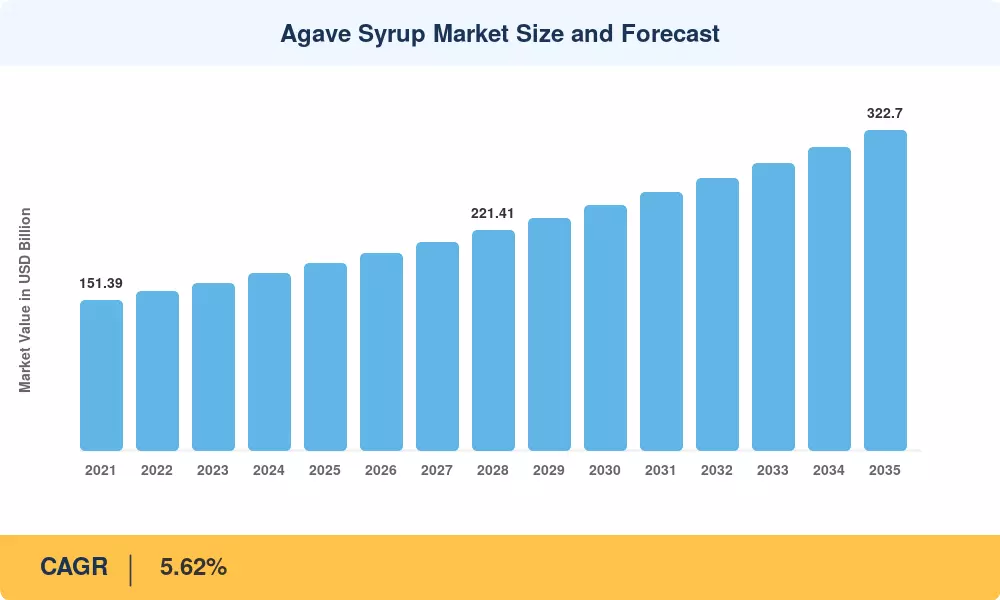
The agave syrup market is moving through a quiet but durable expansion, valued at USD 188.4 Million in 2025 and projected to open 2026 at roughly USD 198.9 Million before climbing to USD 322.7 Million by 2035, advancing at a 5.62% CAGR across the 2026–2035 forecast window. The trajectory tracks two reinforcing catalysts: the U.S. FDA's continued recognition of agave-derived sweeteners under "added sugars" labeling rules introduced under the Nutrition Facts overhaul, and Mexico's CONACYT-backed USD 42 million investment program announced in 2024 to modernize agave cultivation across Jalisco and Oaxaca. Together, these policies and capital signals are pulling the agave syrup market out of niche health-food shelves into mainstream foodservice procurement.
Production economics are being rewritten in real time. Legacy open-field harvesting and small-batch artisanal evaporation are giving way to closed-loop enzymatic hydrolysis lines and vacuum-concentration plants that lift output yield by 18–22%. Major beverage formulators have committed close to USD 310 million in supply-chain contracts over 2023–2025, locking in organic blue agave nectar volumes to hedge against sugar volatility flagged in the OECD-FAO 2025–2034 Outlook.
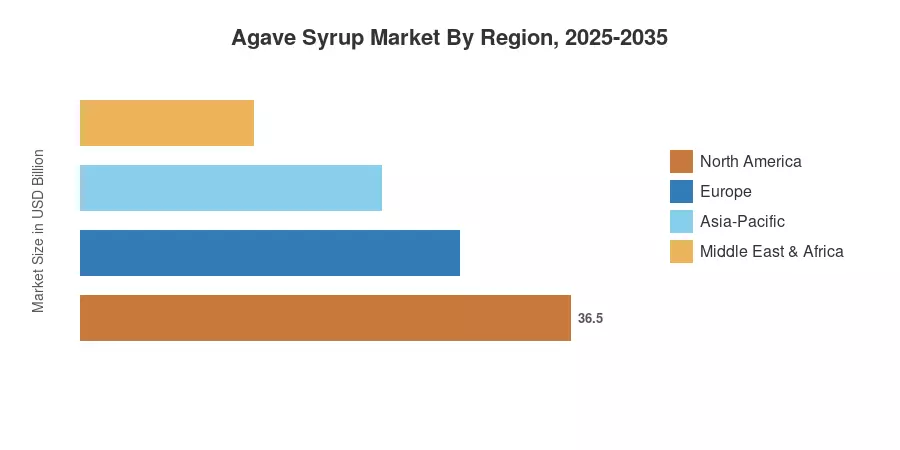
North America anchors the agave syrup market with a 32.8% share in 2025, while Asia-Pacific is the second-largest region, powered by a 6.21% CAGR. Europe sits as the third pillar, where clean-label regulation under EU 2019/787 keeps premium variants in steady rotation. The decade ahead will reward producers who pair traceability with scale.
Key Report Takeaways
• By Type
- Light agave syrup leads the agave syrup market with an estimated 56.4% revenue share in 2025, favored by beverage and bakery formulators
- Dark variants are projected at a 6.05% CAGR through 2035, lifted by craft cocktail demand and the tequila agave plant crop heritage halo
• By Category
- Organic agave is projected to reach USD 121.6 Million by 2035, driven by USDA NOP and EU organic certification uptake
- Conventional agave still anchors mainstream procurement, holding roughly 61% of 2025 volumes
• By Raw Material
- Blue agave dominates the agave syrup market raw material mix at approximately 72.5% in 2025
- Salmiana and other varieties are expanding at a combined 5.94% CAGR, opening alternative geographic supply
• By Distribution Channel
- Hypermarkets and supermarkets carry an estimated USD 78.3 Million of 2025 sales for the agave syrup market
- Online retail is the fastest-growing channel, posting a 7.85% CAGR through 2035
• By Region
- North America holds 32.8% of the global agave syrup market in 2025
- Asia-Pacific posts a 6.21% CAGR through 2035, the fastest globally
- Europe contributes roughly USD 51.8 Million in 2025 to the agave syrup market
Market Size and Forecast (2021–2035)
Historical figures draw on USDA Foreign Agricultural Service trade data, Mexico's Tequila Regulatory Council production reports, and customs filings cross-referenced with retailer scanner data. Forecast values apply a calibrated CAGR against demand elasticity for plant-based sweeteners, and the agave sweetener low glycemic appeal is documented in clinical reviews.
Driver Impact Analysis
| Driver | ~% Impact on CAGR | Geographic Relevance | Impact Timeline |
| Sugar reduction mandates | 1.4% | Global | Medium-term |
| Plant-based diet uptake | 1.1% | NA, Europe | Long-term |
| Tequila industry tailwind | 0.8% | NA, LATAM | Medium-term |
| Clean-label private label | 0.7% | Europe, NA | Short-term |
| Organic certification expansion | 0.6% | Global | Long-term |
| Diabetic-friendly positioning | 0.5% | APAC, NA | Medium-term |
| E-commerce penetration | 0.4% | Global | Short-term |
Sugar Reduction Mandates
Public health policy is the loudest tailwind for the agave syrup market. The UK's Soft Drinks Industry Levy now captures beverages above 5g/100ml sugar at GBP 0.18 per liter, and similar duties operate across 53 jurisdictions per WHO 2024 data. Reformulators substituting cane sugar with agave sweetener low glycemic options can drop a beverage one tax bracket while preserving sweetness intensity, an arbitrage worth an estimated USD 4.2 billion globally in avoided levies.
Plant-Based Diet Uptake
Vegan and flexitarian populations are pulling the agave syrup market into bakery, dairy-alternatives, and confectionery. The Good Food Institute's 2024 retail tracker measured plant-based grocery sales at USD 8.1 billion in the U.S. alone, with vegan agave sweetener alternative products growing 14% year-on-year. Honey, the closest sensory benchmark, fails vegan certification, which leaves agave nectar as the default replacement on certified-vegan SKUs.
Tequila Industry Tailwind
The tequila agave plant crop economy underpins raw-material economics for the agave syrup market. CRT data shows Mexican blue agave plantings expanded from 89,000 hectares in 2020 to roughly 134,000 hectares by 2024, generating surplus piñas that flow into syrup processing during low spirit-demand cycles. This supply elasticity caps input volatility and supports the steady 5.62% CAGR projection.
Restraints Impact Analysis
Restraint values express directional drag on CAGR. They are estimates, not subtractions from the headline growth rate.
| Restraint | ~% Drag on CAGR | Geographic Relevance | Impact Timeline |
| Fructose health controversy | 1.0% | NA, Europe | Medium-term |
| Raw material price cycles | 0.7% | Global | Short-term |
| Competition from stevia and allulose | 0.6% | Global | Long-term |
| Geographic supply concentration | 0.4% | Global | Medium-term |
| Premium price ceiling | 0.3% | APAC, LATAM | Short-term |
Fructose Health Controversy
Peer-reviewed work in the American Journal of Clinical Nutrition (2023) tying high-fructose intake to hepatic steatosis cooled some clinical endorsements of agave syrup. Although industry counter-research highlights the agave sweetener low glycemic profile, the optics of an 85% fructose composition complicate diabetes-positioning claims. The FDA has so far declined formal restrictive labeling, but several European retailers added "high in fructose" front-of-pack warnings in 2024.
Raw Material Price Cycles
Blue agave piña prices doubled between 2018 and 2022 before correcting roughly 35% in 2024 as planted acreage caught up. Such whipsaws make procurement contracts for the agave syrup market unpredictable, particularly for mid-tier brands lacking forward-hedging infrastructure. Producers with vertically integrated plantations weather these cycles best.
Competition from Stevia and Allulose
Allulose, GRAS-affirmed by the FDA and exempted from the "Added Sugars" line in 2019, has captured roughly USD 290 million of sugar-reduction reformulation budgets that the agave syrup market once contested. The zero-calorie pitch is structurally stronger than agave's natural-origin pitch in beverage applications.
Agave Syrup Market Opportunities
Foodservice Reformulation Wave
Fast-food companies across North America are systematically reformulating their syrups, dressings and breakfast condiments to reduce added sugars by 20-30% before 2028 disclosure standards. The agave syrup food ingredients lead the market, which may be easily used in the existing machinery without viscosity retooling [ ⇒ Section 4.1].
Emerging Market Premiumization
Nielsen said India’s contemporary trade footprint grew 21% in 2024, creating shelf space for imported sweeteners. Tier-1 Indian and Indonesian consumers are paying USD 6-9 for 250ml of organic blue agave nectar for the first time. This sector of the agave syrup business is more rewarding on the premium trajectory of the rising market through 2030.
Data-Driven Traceability Models
Two Mexican cooperatives are piloting blockchain-tagged lots of agave syrup in 2024 that are commanding a 12–18% price premium in European specialized channels. Retailers pay for provenance APIs, turning the data layer itself into a monetizable asset and creating a new revenue stream beyond the bulk commodity sale (see Section 8.4).
Co-Branded Spirits and Mixology
Tequila and mezcal brands that develop house-branded agave syrups create a halo channel of about USD 28 million now and heading toward USD 95 million by 2030. The tequila agave plant crop linkage offers authenticity and increases retail velocity in liquor-adjacent retailing
Functional Food Integration
Sports nutrition and infant nutrition formulators are testing agave as a clean-label carbohydrate matrix. With the agave sweetener low glycemic claim supported by glycemic index scores of 15–30, the agave syrup market has a credible runway into functional and medical nutrition niches, which the category has historically ignored.
Agave Syrup Market Future Outlook
AI-Optimized Cultivation
Mexican producers piloting satellite imagery and machine learning for agave maturity prediction reported 14% improvement in piña sugar concentration in 2024 trials. By 2030, AI-managed plantations could supply 35% of premium agave syrup market volumes, lifting yield economics and stabilizing supply.
Platform Economics in Sweetener Distribution
Specialty ingredient platforms aggregating organic blue agave nectar, allulose, and monk fruit into single-source procurement portals processed an estimated USD 4.1 billion of sweetener volume in 2024 per IFT estimates. The agave syrup market will compete and collaborate within these platform layers rather than as standalone SKUs.
Electrified Processing
Vacuum-concentration plants powered by solar-thermal hybrid systems are operational in Jalisco. IRENA's 2024 outlook projects a USD 1.7 trillion global push toward food-sector electrification by 2035, and agave syrup market processors moving to electric evaporation can shave 22% off per-kilogram production cost.
ESG Disclosure and Carbon-Neutral Claims
The EU's CSRD mandate now compels reporting on supply-chain emissions for products above EUR 40 million in annual sales. Agave syrup market participants with traceable, water-efficient plantations gain a measurable disclosure advantage versus cane sugar competitors that face higher embedded carbon intensity per ton.
Agave Syrup Market Segmentation
By Type
| Segment | Metric | Primary Demand Driver |
| Light | 56.4% share, 2025 | Beverage and bakery |
| Dark | 6.05% CAGR | Craft cocktail mixology |
Light agave dominates the agave syrup market because its mild flavor disappears into formulations, allowing one-to-one sugar substitution without sensory disruption. Dark variants are gaining momentum in premium foodservice, where chefs use the caramel notes for finishing applications.
By Category
| Segment | Metric | Primary Demand Driver |
| Organic | USD 76.4 Million, 2025 | USDA NOP and EU organic uptake [34] |
| Conventional | 5.31% CAGR | Mainstream foodservice [34] |
Organic agave commands a 20–28% retail premium over conventional and is growing faster within the agave syrup market, thanks to retailer commitments such as Whole Foods Market's 2024 expansion of certified-organic shelves.
By Raw Material
| Segment | Metric | Primary Demand Driver |
| Blue Agave | 72.5% share, 2025 | Tequila industry overlap [35] |
| Salmiana Agave | USD 31.8 Million, 2025 | Geographic diversification [35] |
| Other Varieties | 5.95% CAGR | Specialty positioning [35] |
Blue agave's dominance in the agave syrup market reflects both heritage and the surplus economics of the tequila agave plant crop. Salmiana is gaining as producers diversify away from single-varietal exposure.
By Distribution Channel
| Segment | Metric | Primary Demand Driver |
| Hypermarkets/Supermarkets | USD 78.3 Million, 2025 | Mainstream retail |
| Convenience/Grocery Stores | 18.4% share, 2025 | Impulse and pantry refill |
| Online Retail | 7.85% CAGR | Subscription and DTC |
| Specialty Stores | USD 22.1 Million, 2025 | Premium and organic |
Hypermarket dominance reflects the agave syrup market's mainstream maturation. Online channels are growing fastest as subscription-based pantry delivery normalizes for natural sweeteners.
Regional Market Share Analysis
| Region | Metric | Primary Investment Themes |
| North America | 32.8% share, 2025 | Foodservice reformulation, organic certification |
| Europe | USD 51.8 Million, 2025 | Clean-label retail, sugar-tax substitution |
| Asia-Pacific | 6.21% CAGR | Modern trade expansion, premium import positioning |
| South America | USD 22.4 Million, 2025 | Production base economics, intra-LATAM trade |
| Middle East & Africa | 5.42% CAGR | Hospitality channel, halal-certified premium |
| **Total** | **USD 188.4 Million** | — |
North America
| Country | Metric | Key Driver |
| US | USD 38.4 Million, 2025 | Foodservice reformulation [21] |
| Canada | 9.1% of region | Organic retail growth [21] |
| Mexico | 5.91% CAGR | Domestic production base [22] |
North America anchors the agave syrup market through a unique production–consumption coupling. Mexico supplies roughly 94% of the world's blue agave, while U.S. retailers and foodservice operators absorb the majority of finished agave syrup imports. The USMCA's tariff-free agricultural provisions keep cross-border flow frictionless, and Mexico's National Institute of Agricultural Research allocated USD 18 million in 2024 to drought-resistant agave varietals supporting long-run supply.
Europe
| Country | Metric | Key Driver |
| Germany | 24.1% of region | Vegan retail demand [23] |
| UK | USD 9.6 Million | Sugar levy substitution [24] |
| France | 5.18% CAGR | Bakery premiumization [23] |
| Italy | 11.4% of region | Foodservice growth [23] |
| Spain | USD 4.8 Million | Mediterranean diet positioning |
| Nordic Countries | 5.05% CAGR | Clean-label leadership |
| Russia | 7.2% of region | Premium import niche [26] |
| Rest of Europe | USD 5.1 Million | Mixed channel growth [23] |
Europe's agave syrup market is shaped by EU Regulation 1924/2006 on nutrition claims, which permits "no added sugars" formulations sweetened with agave under tight parameters. Germany hosts the densest concentration of certified-vegan SKUs in retail audits, while the UK's HFSS regulations push reformulators toward natural sweeteners.
Asia-Pacific
| Country | Metric | Key Driver |
| China | USD 12.4 Million | Modern trade rollout [27] |
| India | 6.95% CAGR | Premium urban retail [28] |
| Japan | 18.6% of region | Health-positioned beverages [29] |
| South Korea | USD 4.1 Million | Café and bakery channel [29] |
| ASEAN | 7.12% CAGR | E-commerce penetration [27] |
| Rest of Asia-Pacific | 6.3% of region | Hospitality channel [27] |
China's General Administration of Customs cleared expanded import codes for natural sweeteners in 2023, smoothing entry for agave syrup market participants. India's organic retail value crossed USD 1.8 billion in 2024 per APEDA, with imported sweeteners growing twice the category average.
South America
| Country | Metric | Key Driver |
| Brazil | 51.2% of region | Beverage industry adoption [30] |
| Argentina | USD 4.6 Million | Health retail growth [30] |
| Rest of South America | 5.78% CAGR | Cross-border supply [30] |
Brazil's ANVISA Resolution 429/2020 on nutritional labeling spurred reformulation across packaged foods, lifting agave syrup imports 23% in 2023. Domestic salmiana plantings in northern Mexico now ship southward, shortening logistics chains for the regional agave syrup market.
Middle East & Africa
| Country | Metric | Key Driver |
| Saudi Arabia | USD 2.1 Million | Hospitality channel [31] |
| UAE | 5.92% CAGR | Premium retail [31] |
| South Africa | 19.4% of region | Health food channel [32] |
| Egypt | USD 0.6 Million | Modern trade entry [32] |
| Rest of MEA | 4.85% CAGR | Tourism-linked HORECA [32] |
The Gulf Cooperation Council's 2017 excise tax on sugary drinks at 50% accelerated reformulation in the regional beverage industry, indirectly lifting the agave syrup market through low-sugar bottled tea and ready-to-drink coffee launches.

Competitive Benchmarking
The agave syrup market shows medium concentration with an estimated HHI of 920–1,050 and a top-5 revenue share of 38–44%. The remaining base is fragmented across regional cooperatives and private-label suppliers serving retailer brands.
| Company | Est. Revenue Share Range | Key Offerings for Agave Syrup Market | Strategic Positioning |
| Madhava Natural Sweeteners | 9–12% | Organic light/dark, flavored | Premium North American brand |
| The Groovy Food Company | 6–9% | Organic, raw, agave blends | UK retail leadership |
| Wholesome Sweeteners | 8–11% | Fair Trade organic, blue agave | Multi-channel scale |
| Domino Specialty Ingredients | 5–8% | Industrial agave syrup food ingredient | B2B foodservice |
| Iidea SpA | 3–6% | European private label, organic | Italian production base |
| Nekutli SA de CV | 4–7% | Bulk and consumer organic | Mexican vertical integration |
| Nick's Sticks (Sweet Cactus Farms) | 2–5% | Organic raw agave, premium | Health food channel |
| All Natural Distributing | 2–4% | Bulk organic and conventional | Distribution scale |
| Maretai Organics | 3–5% | Certified organic blue agave nectar | Foodservice |
| Sweet Cactus Farms | 2–4% | Pioneer organic positioning | Specialty retail |
| Global Goods Inc. | 1–3% | Private label and bulk | Co-manufacturing |
Recent News & Developments
- FDA, United States (January 2024): Clarified labeling guidance treating agave as an "added sugar" while permitting "low glycemic index" qualifying claims with substantiation [40]
Agave Syrup Market Report Scope
| Parameter | Detail |
| Market Scope | Global agave syrup market across type, category, raw material, distribution, and geography |
| Study Period | 2021–2035 |
| Base Year | 2025 |
| Forecast Period | 2026–2035 |
| CAGR | 5.62% |
| Market Size (2025) | USD 188.4 Million |
| Market Size (2035) | USD 322.7 Million |
| Fastest Growing Segments | Online Retail, Organic Category, Asia-Pacific |
| Companies Profiled | Madhava, Wholesome Sweeteners, Groovy Food, Domino, Iidea, Nekutli, Sweet Cactus Farms, Maretai, Global Goods, others |
| Valuation Currency | USD Million |
FAQs
How should procurement teams hedge against blue agave price volatility in the agave syrup market?
Pair multi-year offtake contracts with one Mexican cooperative and one secondary salmiana supplier. Add a 12-month forward-pricing clause indexed to CRT piña data to smooth swings of 25–35% [11].
What certifications matter most for premium positioning in the agave syrup market?
USDA NOP and EU Organic certifications carry the highest retailer pull, while Fair Trade USA opens specialty channels at 12–18% price premiums. Kosher and Halal certifications unlock institutional foodservice contracts globally [10].
How does the agave syrup market compare to allulose for beverage reformulation?
Allulose offers near-zero calories and FDA exemption from "Added Sugars" labeling, while agave provides natural-origin marketing and clean-label credentials. Blended formulations using both are emerging in low-sugar functional beverages [18].
What are typical lead times for organic blue agave nectar B2B contracts?
Standard lead times run 90–120 days for certified organic volumes above 5 metric tons, extending to 150 days during Mexican harvest peaks in September–November. Pre-booking 18 months ahead is now common practice [3].
Which emerging applications are unlocking new demand in the agave syrup market?
Sports nutrition gels, infant cereal sweetening, and craft cocktail mixers are the three fastest emerging applications. Each leverages the agave sweetener low glycemic narrative and natural-origin positioning to capture premium price points [13].
How is traceability shaping competitive differentiation?
Blockchain-verified provenance from plantation to bottle commands 12–18% retail premiums in European specialty channels. Major retailers now require farm-level GPS data for new agave syrup market listings as of 2024 [42].
What regulatory shifts should buyers monitor through 2027?
Watch EU Regulation 2024/661 implementation, U.S. FDA front-of-pack labeling rulemaking, and India's FSSAI revised sweetener standards. Each may shift labeling thresholds and certification requirements for the agave syrup market within 18–24 months [40].
- --
Research Approach
Secondary Research
The secondary research process involved comprehensive analysis of regulatory databases, agricultural journals, food science publications, and authoritative health and trade organizations. Key sources included the US Food & Drug Administration (FDA), European Food Safety Authority (EFSA), Food and Agriculture Organization of the United Nations (FAO), United States Department of Agriculture (USDA), National Organic Program (NOP), Codex Alimentarius Commission, International Food Information Council (IFIC), International Sweeteners Association (ISA), Organic Trade Association (OTA), National Confectioners Association (NCA), International Trade Centre (ITC), UN Comtrade Database, Mexican Ministry of Agriculture (SADER), Jalisco State Agave Council (CAJ), Organic Certifiers Inc., ECOCERT, and national agricultural ministry reports from key producing regions.
For blue agave syrup, salmiquilla agave syrup, and other agave varieties in liquid, granulated, and powdered forms, these sources were used to gather data on agave cultivation, organic certification, import/export trade volumes, regulatory approval data, food safety studies, consumer trend analysis, and market landscape analysis.
Primary Research
In order to gather both qualitative and quantitative insights, supply-side and demand-side stakeholders were interviewed during the primary research process. CEOs, VPs of Product Development, heads of agricultural operations, and commercial directors from agave syrup producers, organic certifiers, and agave farming cooperatives were examples of supply-side sources. Procurement managers from food and beverage manufacturers, category managers from supermarkets and hypermarkets, e-commerce buyers, R&D directors from cosmetics and personal care companies, and purchasing decision-makers from cafés, restaurants, and health food shops were examples of demand-side sources. Primary research obtained information on consumer adoption trends, pricing tactics, and distribution channel dynamics in addition to validating market segmentation and organic certification schedules.
Primary Respondent Breakdown:
By Designation: C-level Primaries (32%), Director Level (30%), Others (38%)
By Region: North America (32%), Europe (30%), Asia-Pacific (28%), Rest of World (10%)
Market Size Estimation
Revenue mapping and volume analysis were used to determine the global market valuation for food and beverage, cosmetics and personal care, and pharmaceutical and medical applications. The methodology comprised:
Finding more than 40 important producers and cooperatives that grow agave across North America, Europe, Latin America, and Asia-Pacific
Product mapping in liquid, granulated, and powdered syrup forms for blue agave, salmiquilla agave, and other agave varietals
Analysis of annual revenues for agave syrup portfolios, both reported and modeled
coverage of producers accounting for 65–70% of the world market in 2024
Extrapolation of segment-specific valuations across distribution channels, such as online retail, supermarkets & hypermarkets, and health food shops, using top-down (manufacturer revenue validation) and bottom-up (volume consumption × ASP by country/region) methods
Kindly complete the form below to receive a free sample of this Report
Customer Stories
“This is really good guys. Excellent work on a tight deadline. I will continue to use you going forward and recommend you to others. Nice job”
“Thanks. It’s been a pleasure working with you, please use me as reference with any other Intel employees.”
“Thanks for sending the report it gives us a good global view of the Betaïne market.”
“Thank you, this will be very helpful for OQS.”
“We found the report very insightful! we found your research firm very helpful. I'm sending this email to secure our future business.”
“I am very pleased with how market segments have been defined in a relevant way for my purposes (such as "Portable Freezers & refrigerators" and "last-mile"). In general the report is well structured. Thanks very much for your efforts.”
“I have been reading the first document or the study, ,the Global HVAC and FP market report 2021 till 2026. Must say, good info! I have not gone in depth at all parts, but got a good indication of the data inside!”
“We got the report in time, we really thank you for your support in this process. I also thank to all of your team as they did a great job.”
















