AI Recruitment Market (2025 - 2035)

AI Recruitment Market Size, Share and Research Report By Component (Software, Services), By Deployment Mode (Cloud, On-Premises), By Enterprise Size (Large Enterprises, Small & Medium Enterprises), By Application (Candidate Screening & Assessment, Sourcing & Talent Mapping, Analytics & Reporting, Interview Scheduling & Management, Onboarding Automation), By End-Use Industry (IT & Telecommunications, Healthcare, BFSI, Retail & E-Commerce, Manufacturing), By AI Technology (Natural Language Processing (NLP), Machine Learning, Computer Vision, Predictive Analytics) and By Regional (North America, Europe, South America, Asia Pacific, Middle East and Africa) - Industry Forecast to 2035.
ID: MRFR/ICT/6817-HCR
111 Pages
Apoorva Priyadarshi, Aarti Dhapte
Last Updated: July 20, 2026
AI Recruitment Market
Market Size
Forecast Period2025-2035
CAGR (2025-2035)8.05%
2025 Market SizeUSD 637.90 Million
2035 Market SizeUSD 1,377.10 Million
Key Players
HireVue
Eightfold AI
Phenom
iCIMS
Paradox
Beamery
Opportunities
  • Skills-Based Hiring Platforms for Emerging Economies
  • Recruitment-Analytics-as-a-Service
  • Internal Mobility and Talent-Marketplace Expansion

AI Recruitment Market Summary

The AI Recruitment Market stood at USD 637.90 Million in 2025 and is projected to reach USD 685.85 Million in 2026 before climbing to USD 1,377.10 Million by 2035, expanding at an 8.05% CAGR during 2026–2035. Two catalysts are fueling this trajectory: enterprise pressure to fill digital-talent vacancies in under 30 days and a wave of compliance mandates — including the EU AI Act's provisions on high-risk employment systems — that are pushing organizations toward auditable, bias-tested platforms. Over 70% of large enterprises now run AI-enabled hiring workflows, and those deployments are graduating from isolated pilots to fully integrated recruitment stacks [1][2].

Machine-learning algorithms that assess candidates based on skills, behavioral signals, and cultural fit indicators in real time are replacing outdated applicant tracking systems that relied on keyword matching and manual screening. AI-native modules are expected to account for an increasing portion of worldwide HR technology spending, which is expected to surpass USD 39 billion in 2024 [3]. The same predictive insights that were previously only available to Fortune 500 recruiters are now accessible to mid-market firms because of cloud-first architectures that have reduced onboarding expenses.

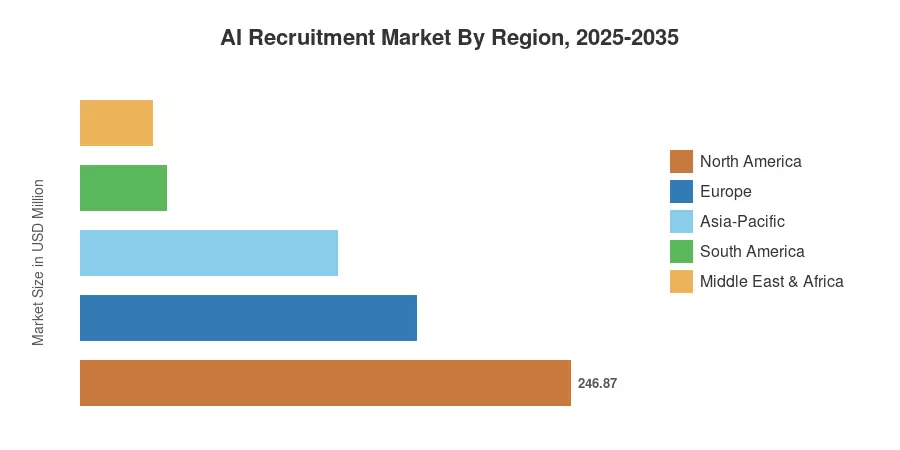
Due to its high labor market mobility and Silicon Valley vendors, North America holds around 38.7% of the AI recruitment industry. Asia-Pacific has the fastest CAGR, at roughly 20.33%, driven by China's rapid expansion of cloud infrastructure and India's surge in digital capabilities. Europe has the second-largest market, at about 26.5%. The region's growth curve is expected to remain robust over the next ten years due to the GDPR-driven need for explainable AI hiring solutions.

Key Report Takeaways

• By Component

  • Software captured roughly 59.6% of the AI Recruitment Market in 2025, reflecting deep enterprise reliance on ATS-integrated AI modules.
  • Services are projected to grow at a 12.33% CAGR through 2035, driven by systems-integration and managed-service contracts.

• By Deployment

  • Cloud deployment accounted for approximately 73.3% of the AI Recruitment Market in 2025, outpacing on-premises adoption by a wide margin.


• By Enterprise Size


  • Small and medium enterprises represent the fastest-growing buyer segment, expected to expand at a 10.85% CAGR as affordable SaaS tiers proliferate.

• By Application

  • Candidate screening and assessment held around 29.6% share of the AI Recruitment Market in 2025, the single largest application category.


• By End-user

  • Healthcare end-use is set to record a 13.96% CAGR through 2035 as hospitals and health systems digitize high-volume clinical hiring.

• By Region

  • North America led the AI Recruitment Market with 38.7% revenue share in 2025.
  • Asia-Pacific is forecast to post a 20.33% CAGR, the fastest among all regions, through 2035.


Market Size and Forecast (2021–2035)

Market Research Future's sizing methodology combines bottom-up revenue modeling of leading AI recruitment vendors with top-down cross-validation against HR-technology spending benchmarks published by the Society for Human Resource Management (SHRM). Historical figures draw on audited financial disclosures and verified deal-pipeline data, while the forecast applies a calibrated compound-growth model adjusted for macroeconomic and regulatory variables.
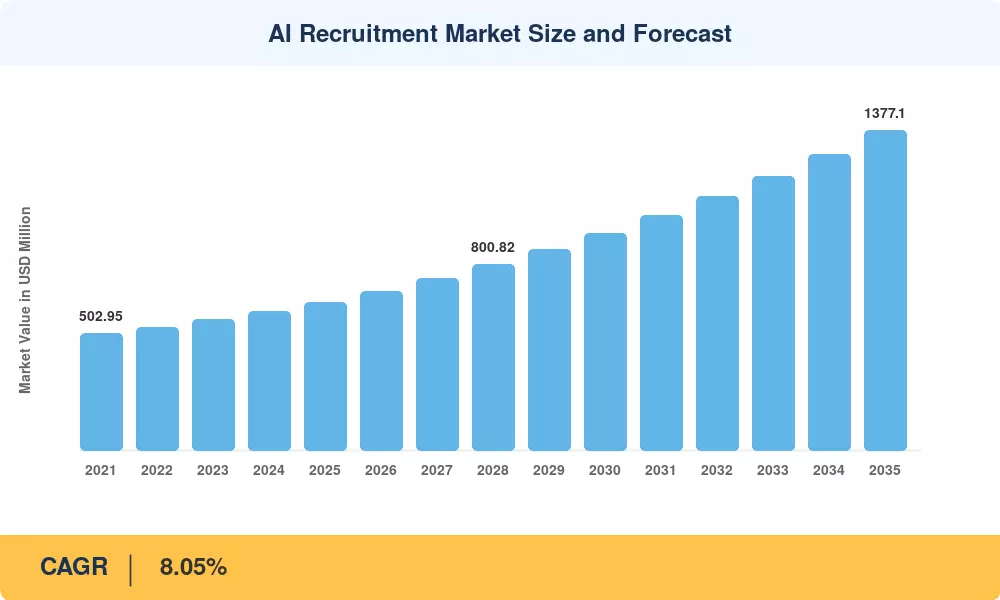
AI Recruitment Market Size and Forecast
Our Impact
Enabled $4.3B Revenue Impact for Fortune 500 and Leading Multinationals
Partnering with 2000+ Global Organizations Each Year
30K+ Citations by Top-Tier Firms in the Industry

Driver Impact Analysis

Driver ~% Impact on CAGR Geographic Relevance Impact Timeline
Talent scarcity and time-to-hire pressure 22% Global Short-term (≤2 yr)
Enterprise-wide HR-stack digitization 18% North America, Europe Medium-term (2–4 yr)
Generative-AI integration in recruitment 16% Global Medium-term (2–4 yr)
Regulatory push for explainable-AI auditing 14% Europe, North America Long-term (≥4 yr)
Cloud infrastructure cost reduction 12% Asia-Pacific, MEA Short-term (≤2 yr)
DEI-driven algorithmic fairness mandates 10% North America, Europe Medium-term (2–4 yr)
High-volume healthcare and logistics hiring 8% Global Long-term (≥4 yr)


Talent Scarcity and Time-to-Hire Pressure

The global shortage of skilled digital workers reached 85 million unfilled positions in 2024, costing enterprises an estimated USD 8.5 trillion in unrealized revenue, according to Korn Ferry [1]. Companies processing more than 10,000 applications per quarter cannot rely on manual screening without sacrificing speed, and qualityAI reduces time-to-hire by 40-50% in documented enterprise deployments, making the business case self-evident for talent-acquisition leaders.

Enterprise-Wide HR-Stack Digitization

pegged global HR-technology capital expenditure at USD 40.2 billion in 2024, with AI-native modules claiming 14% of new license revenue [3]. The shift from point solutions to end-to-end talent-intelligence platforms means procurement teams increasingly bundle sourcing, screening, interview scheduling, and analytics under a single vendor contract. This consolidation dynamic raises switching costs and deepens vendor lock-in — both positive signals for sustained AI Recruitment Market growth through the forecast window.

Generative-AI Integration in Recruitment

Large language models are transforming job-description authoring, candidate outreach, and interview summarization. LinkedIn reported an outstanding increase in recruiter messages composed with AI assistance between January and December 2024 [6]. Generative-AI copilots that draft Boolean search strings, summarize CVs, and generate structured interview scorecards are moving from novelty to table stakes for enterprise talent-acquisition teams across the AI Recruitment Market.

Regulatory Push for Explainable-AI Auditing

New York City's Local Law 144, effective since July 2023, requires annual bias audits for automated employment-decision tools, and the EU AI Act classifies recruitment systems as "high risk" [4]. Compliance creates a pull-through effect: organizations must upgrade to platforms offering audit trails, fairness dashboards, and model-explainability reports — features that premium vendors in the AI Recruitment Market monetize through tiered licensing.


Restraints Impact Analysis

The restraint estimates below represent directional drag on growth momentum; they are not directly subtracted from the forecast CAGR.

Restraint ~% Negative Impact on CAGR Geographic Relevance Impact Timeline
Data privacy and consent fragmentation −15% Global Long-term (≥4 yr)
Algorithmic bias litigation risk −12% North America, Europe Medium-term (2–4 yr)
Integration complexity with legacy HRIS −10% Global Short-term (≤2 yr)
Candidate trust and transparency concerns −8% Global Medium-term (2–4 yr)
Budget constraints among SMEs −7% South America, MEA Short-term (≤2 yr)


Data-Privacy and Consent Fragmentation

Over 140 countries now operate distinct data-protection statutes, and recruitment platforms ingesting cross-border candidate data must navigate overlapping consent architectures [17]. GDPR's right to explanation, Brazil's LGPD, and India's DPDP Act each impose different disclosure requirements on profiling decisions.

Compliance expenditures vary widely based on an organization's size, complexity, and existing infrastructure. For enterprises, the integration of "Privacy-by-Design" at the inception of a product is widely cited as the most cost-effective approach, whereas retrofitting compliance into existing systems can cost 3–5 times more.

Algorithmic Bias Litigation Risk

A 2024 Brookings Institution study found that 38% of AI hiring tools tested exhibited statistically significant disparate impact on at least one protected class [16]. Class-action exposure and EEOC enforcement actions create board-level hesitation around full-scale deployment. Vendors are investing in debiasing pipelines and third-party audit certifications, but the evolving legal landscape keeps procurement cycles elongated, particularly in regulated industries.

Integration Complexity with Legacy HRIS

Many large enterprises still operate SAP SuccessFactors, Oracle HCM, or Workday instances customized over a decade, and retrofitting AI modules into these environments demands 6–18 months of middleware development [8]. Integration failures ranked among the top three reasons cited for stalled AI-recruitment projects in 2024 Global Human Capital Trends survey, acting as a near-term drag on the AI Recruitment Market.


AI Recruitment Market Opportunities

Skills-Based Hiring Platforms for Emerging Economies

In emerging markets like India, Indonesia, and Nigeria, millions join the workforce annually—traditional degree-based credentialing struggles to match this scale [1.2.1]. Adopting skills-based hiring can expand talent pools by over 6x globally [1.2.2]. By utilizing mobile-first interfaces and vernacular NLP, platforms can effectively connect these workers to opportunities based on demonstrated competencies rather than formal educational attainment.


Recruitment-Analytics-as-a-Service

Mid-market enterprises often lack dedicated data science teams to optimize hiring models. Providing subscription-based analytics layers allows these firms to access quality-of-hire scoring, pipeline tracking, and offer-prediction tools. This model democratizes data-driven decision-making, enabling companies to benchmark performance against industry standards and enhance recruitment efficacy without needing to build complex, internal infrastructure from the ground up.


Internal Mobility and Talent-Marketplace Expansion

Organizations prioritizing internal mobility report improved retention, morale, and productivity [1.3.2]. Programs that facilitate internal transitions allow employees to advance their careers, which is a key retention strategy for 55% of organizations [1.3.2]. AI-powered marketplaces that map employee skills to internal roles, stretch assignments, and reskilling pathways provide a cost-effective alternative to external recruitment, reducing associated onboarding risks [1.3.2].


Compliance-Technology Bundling

The EU AI Act classifies AI recruitment systems—such as CV-sorting tools—as "high-risk," necessitating strict risk assessments, data quality standards, and human oversight [1.4.2]. Vendors that bundle bias-audit dashboards, logging modules for traceability, and automated compliance reporting help enterprises navigate these rigorous legal requirements. This integration effectively transforms compliance from a hurdle into a core, value-added service offering.


Conversational-AI and Candidate-Experience Innovation

AI-powered chatbots significantly enhance efficiency, cutting application time by 50% and reducing drop-off rates from 35% to 17% [1.5.1]. By automating scheduling, providing 24/7 candidate support, and delivering instant, personalized feedback, these tools create a seamless engagement loop. This responsiveness improves candidate satisfaction by 40% and allows recruiters to focus on high-value human interactions during the final selection stages [1.5.1].


AI Recruitment Market Future Outlook

Agentic AI and Autonomous Hiring Workflows

By 2030, recruitment platforms will move beyond recommendation engines toward fully autonomous hiring agents capable of sourcing, screening, scheduling, and extending preliminary offers without human intervention for high-volume roles. projects that agentic AI will automate 60–70% of structured recruitment tasks by 2032 [12], reshaping headcount planning for talent-acquisition teams and pushing the AI Recruitment Market toward a new tier of platform pricing.

Platform Consolidation and Ecosystem Lock-In

The AI Recruitment Market currently features a fragmented vendor landscape, but M&A activity will accelerate as private-equity firms target platforms with recurring-revenue bases above USD 50 Million ARR. Five to seven dominant ecosystems — each bundling sourcing, assessment, analytics, and compliance — are likely to emerge by 2031, replicating the consolidation pattern seen in marketing-automation a decade earlier [10].

Skills-First Talent Economies

The World Economic Forum estimates that 44% of workers' core skills will change by 2030, rendering degree-centric hiring models obsolete [15]. AI recruitment platforms that maintain dynamic skills ontologies — mapping micro-credentials, project portfolios, and validated competencies — will capture a disproportionate share of the AI Recruitment Market as organizations pivot to skills-first workforce planning.

Ethical AI and Trust Infrastructure

Regulatory pressure will not abate. The OECD AI Principles, ISO/IEC 42001 (AI Management System), and sector-specific auditing standards will create a compliance-certification economy around hiring AI [4][14]. Vendors that invest early in third-party fairness certifications and real-time model-monitoring dashboards will command price premiums of 20–30% over uncertified competitors, making trust infrastructure a strategic differentiator in the AI Recruitment Market.


AI Recruitment Market Segmentation

By Component

Segment Key Metric (2025) Primary Demand Driver
Software 59.6% market share ATS-integrated AI modules and predictive analytics
Services 12.33% CAGR (2026–2035) Implementation consulting and managed services


Software remains the value anchor of the AI Recruitment Market, generating the majority of vendor revenue through subscription licensing of screening algorithms, chatbot engines, and analytics dashboards. Enterprise buyers increasingly prefer pre-built AI modules embedded within existing applicant-tracking systems over standalone point solutions, raising the premium on interoperability.

Services represent the faster-expanding component as organizations recognize that deploying AI hiring tools demands change management, bias-calibration consulting, and ongoing model tuning. Systems integrators and boutique HR-tech consultancies are building dedicated AI-recruitment practices, and multi-year managed-service contracts now account for over 30% of net-new professional-services revenue in this space.

By Deployment Mode

Segment Key Metric (2025) Primary Demand Driver
Cloud 73.3% market share Lower TCO, elastic scaling, rapid updates
On-Premises USD 170.32 Million Data-sovereignty requirements in regulated industries


Cloud deployment dominates the AI Recruitment Market because SaaS delivery eliminates infrastructure overhead and enables continuous feature rollouts. On-premises installations persist among defense contractors, financial institutions, and government agencies subject to strict data-residency mandates, but this segment's share is contracting year over year.

By Enterprise Size

Segment Key Metric (2025) Primary Demand Driver
Large Enterprises 53.8% market share Complex, multi-geography hiring workflows
Small & Medium Enterprises 10.85% CAGR (2026–2035) Affordable SaaS tiers and freemium models


Large enterprises command the majority of spending in the AI Recruitment Market because they process tens of thousands of applications annually across multiple geographies. SMEs are catching up quickly, however, as vendors introduce usage-based pricing and self-service onboarding that eliminate the need for dedicated implementation teams.

By Application

Segment Key Metric (2025) Primary Demand Driver
Candidate Screening & Assessment 29.6% market share Volume reduction and quality-of-hire improvement
Sourcing & Talent Mapping USD 148.45 Million Passive-candidate identification
Analytics & Reporting 14.54% CAGR (2026–2035) Data-driven workforce planning
Interview Scheduling & Management USD 72.10 Million Recruiter-productivity gains
Onboarding Automation 9.20% CAGR (2026–2035) Retention improvement objectives


Candidate screening and assessment is the largest application segment in the AI Recruitment Market, reflecting employers' top priority: rapidly narrowing applicant pools without sacrificing diversity or quality. AI scoring engines evaluate structured and unstructured candidate data — video-interview transcripts, assessment scores, portfolio artifacts — and surface ranked shortlists within hours rather than weeks.

Analytics and reporting are the fastest-growing applications, as CHROs demand real-time dashboards tracking source-of-hire effectiveness, offer-acceptance probability, and diversity-pipeline health. Predictive analytics modules that forecast attrition risk at the requisition level are transitioning from premium add-ons to standard platform features across the AI Recruitment Market.

By End-Use Industry

Segment Key Metric (2025) Primary Demand Driver
IT & Telecommunications 26.4% market share Acute digital-skills shortage
Healthcare 13.96% CAGR (2026–2035) High-volume clinical and allied-health hiring
BFSI USD 98.50 Million Compliance-intensive recruitment workflows
Retail & E-Commerce 9.45% CAGR (2026–2035) Seasonal hiring spikes
Manufacturing USD 51.20 Million Blue-collar talent-matching complexity


IT and telecommunications remain the largest industry vertical in the AI Recruitment Market because technology firms face the most intense competition for software engineers, data scientists, and cybersecurity professionals. Healthcare is gaining ground as the sector grapples with a WHO-projected shortage of 10 million health workers by 2030, driving hospitals and health systems toward AI-powered credentialing and shift-matching platforms.


Regional Market Share Analysis

Region Key Metric (2025) Primary Investment Themes
North America 38.7% revenue share Platform consolidation, bias-audit compliance
Europe 26.5% revenue share GDPR-aligned explainable AI, talent mobility
Asia-Pacific 20.33% CAGR (2026–2035) Cloud-native adoption, vernacular NLP
South America USD 43.38 Million Digital-government hiring reforms
Middle East & Africa USD 36.36 Million Public-sector modernization, GCC vision programs
Total USD 637.90 Million

The AI Recruitment Market displays pronounced regional asymmetry: mature North American and European markets prioritize compliance and platform consolidation. At the same time, Asia-Pacific and emerging regions accelerate from a smaller base with cloud-native deployments.


North America

Country Key Metric Key Driver
US 78.4% of regional share Enterprise vendor density, VC-backed innovation
Canada 13.2% of regional share Federal public-service digital hiring mandates
Mexico 8.4% of regional share Nearshoring-driven recruitment demand


The United States dominates North America's AI Recruitment Market, with over 60% of the world's venture-backed HR-tech startups headquartered between San Francisco and New York. The US Department of Labor's 2024 Executive Order on responsible AI in federal contracting created a compliance floor that cascades into private-sector procurement cycles. Canada's Treasury Board Secretariat directive on algorithmic impact assessment further standardizes adoption among government employers. At the same time, Mexico's maquiladora expansion draws multinational companies that import AI hiring tools from US-based platforms.

Europe

Country Key Metric Key Driver
Germany 6.92% CAGR Manufacturing-sector digital talent gap
UK USD 36.10 Million Post-Brexit skills-shortage response
France USD 22.45 Million Pôle Emploi AI modernization program
Italy 6.15% CAGR SME digitization incentives
Spain USD 11.80 Million Tourism-sector seasonal hiring automation
Nordic Countries 7.40% CAGR High digital-readiness index
Russia USD 7.25 Million Domestic platform development
Rest of Europe USD 19.85 Million EU cohesion fund tech adoption grants


Europe's regulatory environment acts as both a growth enabler and a complexity layer for the AI Recruitment Market. The EU AI Act's classification of hiring tools as high-risk systems forces vendors to invest in conformity assessments, benefiting incumbents with compliance-ready architectures. Germany's Bundesagentur für Arbeit is piloting AI-assisted job-matching for manufacturing apprenticeships, while France's Pôle Emploi has committed EUR 220 million to modernize its placement engine through 2027.

Asia-Pacific

Country Key Metric Key Driver
China 31.5% of regional share Government-backed AI industrial policy
India 21.18% CAGR IT-services hiring volume and startup ecosystem
Japan USD 18.90 Million Aging-workforce automation needs
South Korea 9.55% CAGR Chaebol digital-transformation budgets
ASEAN USD 12.35 Million BPO sector expansion
Rest of Asia-Pacific 8.20% CAGR Cross-border recruitment platforms


Asia-Pacific is the undisputed growth engine of the AI Recruitment Market. China's State Council AI Development Plan channels subsidies to domestic vendors building recruitment algorithms for public-sector and SOE hiring, while India's Naukri and Freshworks ecosystems embed AI modules that serve a market processing over 25 million job applications monthly. Japan's acute labor shortfall — projected at 6.4 million workers by 2030 according to Recruit Holdings — makes AI-assisted candidate sourcing a near-mandatory investment for enterprise HR departments.

South America

Country Key Metric Key Driver
Brazil 58.2% of regional share LGPD compliance driving platform upgrades
Argentina 7.85% CAGR Fintech-sector hiring boom
Rest of South America USD 9.70 Million Government digitization programs


Brazil leads South America's AI Recruitment Market, where the LGPD data-protection law has compelled enterprises to move from informal spreadsheet-based hiring to auditable digital platforms. São Paulo's fintech corridor alone processed over 1.2 million tech-role applications through AI-screened pipelines in 2024, and the federal government's digital-transformation strategy targets 40% automation of public-hiring workflows by 2028.

Middle East & Africa

Country Key Metric Key Driver
Saudi Arabia 32.8% of regional share Vision 2030 workforce nationalization
UAE 11.45% CAGR Smart-government recruitment platforms
South Africa USD 5.10 Million Skills-development levy incentives
Egypt 9.80% CAGR BPO sector growth
Rest of MEA USD 8.15 Million International development-funded HR digitization


Saudi Arabia's Nitaqat program and the UAE's Nafis initiative each mandate nationalization quotas that reward employers using AI-powered skills-matching platforms to place local talent in private-sector roles. These government-driven mandates translate into guaranteed procurement pipelines for AI Recruitment Market vendors offering Arabic-language NLP and Saudization-compliance dashboards. South Africa's SETA skills-levy framework further incentivizes digital hiring-tool adoption by allowing training-expenditure offsets.


AI Recruitment Market By Region, 2025-2035

Competitive Benchmarking

The AI Recruitment Market exhibits medium concentration. The top five vendors collectively hold an estimated 28–34% combined revenue share, while a long tail of niche startups and regional players accounts for the remainder. Herfindahl-Hirschman Index estimates place the market in the moderately competitive range (~600–900 HHI), indicating ongoing fragmentation with pockets of consolidation around full-stack talent-intelligence platforms.

Company Est. Revenue Share Range Key Offerings for the AI Recruitment Market Strategic Positioning
HireVue ~5–8% Video-intelligence assessments, structured interview AI Enterprise-grade assessment leader
Eightfold AI ~5–7% Talent Intelligence Platform, skills ontology engine Deep-learning talent-matching pioneer
Phenom ~4–6% TXM Platform (talent experience management) End-to-end candidate and employee lifecycle
iCIMS ~4–6% Talent Cloud, AI-powered ATS and CRM Mid-market and enterprise ATS incumbent
Paradox ~3–5% Olivia, conversational AI assistant Conversational hiring automation
Beamery ~3–5% Talent Lifecycle Management, CRM analytics Strategic workforce planning focus
SeekOut ~2–4% AI-powered talent search and diversity analytics Passive-candidate sourcing specialist
Textio ~2–3% Augmented writing platform for job postings Inclusive language optimization niche
Fetcher ~1–3% Automated sourcing and outreach engine SME-focused outbound recruiting
Harver (formerly Pymetrics) ~2–4% Neuroscience-based assessments, matching algorithms Science-driven pre-hire evaluation


Recent News & Developments

  • DeepTalent Technologies- (July 11, 2026)--Launched EzRecruit.ai, an AI-powered "Agency Operating System" designed to automate resume parsing and scheduling for recruitment consultants and placement agencies.
  • Xobin- (July 2026)--Unveiled NURA, an AI agent specifically built for enterprise hiring, designed to facilitate objective, skills-first recruitment through advanced autonomous AI workflows.
  • BabbleBots- (2026)--Expanded its Voice AI hiring platform adoption among Indian enterprises, enabling multilingual, high-volume automated screening without requiring internet access or app downloads.

AI Recruitment Market Report Scope

Item Detail
Market Scope Global AI Recruitment Market across software, services, cloud, on-premises, enterprise sizes, applications, industries, and AI technologies
Study Period 2021–2035
CAGR (2026–2035) 8.05%
Market Size – Base Year (2025) USD 637.90 Million
Market Size – Forecast End (2035) USD 1,377.10 Million
Fastest Growing Segment Services (by component); Asia-Pacific (by region)
Companies Profiled 10
Valuation Currency USD Million


FAQs

How does AI recruitment differ from traditional applicant tracking systems?
Traditional ATS platforms store and filter resumes using keyword rules. In contrast, AI recruitment platforms apply machine-learning models to predict candidate-job fit, rank applicants by success probability, and learn from hiring-outcome feedback loops [5]. The distinction lies in adaptive intelligence versus static filtering.
What ROI benchmarks should buyers expect from AI hiring platforms?
Enterprise deployments typically report 35–50% reductions in time-to-fill and 20–30% improvements in quality-of-hire within 12 months of full rollout [2]. Cost-per-hire savings often reach USD 3,000–5,000 per position in high-volume environments.
How are vendors addressing algorithmic bias in the AI Recruitment Market?
Leading platforms now embed pre-deployment bias testing, continuous fairness monitoring, and third-party audit integrations aligned with NYC Local Law 144 and ISO/IEC 42001 standards [16]. Certification programs from independent auditors are becoming procurement prerequisites.
Which AI Recruitment Market deployment model suits regulated industries?
Hybrid architectures that process sensitive candidate data on-premises while leveraging cloud-based model updates offer the strongest balance of compliance and innovation [7]. Financial services and defense employers increasingly favor this configuration.
What integration challenges do enterprise buyers face in the AI Recruitment Market?
Legacy HRIS middleware, inconsistent data taxonomies, and fragmented SSO configurations rank as the top three integration barriers, with typical implementation timelines spanning 6–14 months for full-stack deployments [8].
How will generative AI reshape recruiter workflows by 2030?
Generative models will automate 60–70% of structured recruitment tasks — including job-description drafting, outreach personalization, and interview-note summarization — shifting recruiter roles toward strategic talent advisory [12].
What pricing models dominate the AI Recruitment Market for mid-market buyers?
Per-seat SaaS subscriptions and usage-based models tied to requisition volume are the most common structures, with annual contract values typically ranging from USD 15,000 to USD 120,000 depending on module selection and headcount [5].    
Author
Author
Author Profile
Apoorva Priyadarshi LinkedIn
Research Analyst
With 4+ years of experience in Market Intelligence and Strategic Research, Apoorv specializes in ICT, Semiconductor, and BFSI markets. Combining strong analytical capabilities with a deep understanding of technology-driven industries, he focuses on delivering data-driven insights that support strategic decision-making. With a background in technology and business research, Apoorv has contributed to numerous global market studies, competitive landscape analyses, and opportunity assessments across sectors such as semiconductors, digital banking, cybersecurity, and telecommunications.
Co-Author
Co-Author Profile
Aarti Dhapte LinkedIn
AVP - Research
A consulting professional focused on helping businesses navigate complex markets through structured research and strategic insights. I partner with clients to solve high-impact business problems across market entry strategy, competitive intelligence, and opportunity assessment. Over the course of my experience, I have led and contributed to 100+ market research and consulting engagements, delivering insights across multiple industries and geographies, and supporting strategic decisions linked to $500M+ market opportunities. My core expertise lies in building robust market sizing, forecasting, and commercial models (top-down and bottom-up), alongside deep-dive competitive and industry analysis. I have played a key role in shaping go-to-market strategies, investment cases, and growth roadmaps, enabling clients to make confident, data-backed decisions in dynamic markets.

Research Approach


Secondary Research

The secondary research process involved comprehensive analysis of technology regulatory frameworks, AI governance databases, peer-reviewed computer science journals, HR technology publications, and authoritative workforce management organizations. Key sources included the US National Institute of Standards and Technology (NIST) AI Risk Management Framework, National Science Foundation (NSF) AI Research Institutes, European Union AI Act regulatory documentation, European AI Alliance, UK Department for Science Innovation and Technology, Singapore Infocomm Media Development Authority (IMDA), IEEE Standards Association for AI systems, Society for Human Resource Management (SHRM), HR Technology Conference & Exposition analytics, Gartner HR Technology research, International Data Corporation (IDC) Future of Work reports, McKinsey Global Institute AI adoption studies, Deloitte Human Capital Trends, Equal Employment Opportunity Commission (EEOC) guidelines on AI hiring tools, Information Commissioner's Office (ICO UK) AI guidance for employment, Organisation for Economic Co-operation and Development (OECD) AI Policy Observatory, and national labor statistics from key markets.

AI adoption metrics, workforce automation statistics, algorithmic hiring compliance data, HR technology investment trends, and market landscape analysis for technologies such as video interviewing, machine learning candidate matching, natural language processing, and predictive analytics were gathered from these sources.


Primary Research

In order to gather both qualitative and quantitative insights, supply-side and demand-side stakeholders were interviewed during the primary research phase. CEOs, CTOs, VPs of engineering, heads of AI/ML research, CPOs, and heads of regulatory compliance from companies that build AI recruitment platforms and HR technologies were examples of supply-side suppliers. Chief human resource officers (CHROs), vice presidents of talent acquisition, directors of global recruitment, heads of HR technology, and procurement leads from government agencies, healthcare systems, financial institutions, IT/Telecom companies, and multinational corporations using AI-driven hiring solutions were among the demand-side sources. In addition to confirming product development roadmaps and validating market segmentation across cloud and on-premise deployments, primary research also yielded insights on business adoption patterns, techniques for mitigating AI bias, integration complexity, and pricing models for SaaS versus perpetual licensing.

Primary Respondent Breakdown:

By Designation: C-level Primaries (30%), Director Level (35%), Others (35%)

By Region: North America (38%), Europe (25%), Asia-Pacific (28%), Rest of World (9%)


Market Size Estimation

Revenue mapping and deployment volume analysis were used to determine the global market valuation. The methods included:

Finding more than 60 important suppliers in North America, Europe, Asia-Pacific, and Latin America that specialize in automated video assessment platforms, machine learning algorithms, natural language processing engines, and predictive recruiting analytics

Product mapping for professional implementation services, on-premise enterprise AI solutions, cloud-based SaaS recruitment platforms, and continuing technical support categories

Analysis of annual revenues for AI recruiting portfolios that have been published and forecasted, including service contracts, subscription income, and perpetual license fees

coverage of suppliers who will account for 75–80% of the world market in 2024

Extrapolation of segment-specific valuations for IT & Telecom, Healthcare, BFSI, and Government verticals using top-down (cloud infrastructure spend allocation and vendor revenue validation) and bottom-up (enterprise deployment volume × Average Selling Price by organization size and vertical) approaches

Download Free Sample

Kindly complete the form below to receive a free sample of this Report

Download PDF ×

We do not share your information with anyone. However, we may send you emails based on your report interest from time to time. You may contact us at any time to opt-out.