×
Request Free Sample ×

Kindly complete the form below to receive a free sample of this Report

* Please use a valid business email

Leading companies partner with us for data-driven Insights

clients tt-cursor
Hero Background

APAC Environmental Monitoring Market

ID: MRFR/ICT/58196-HCR
200 Pages
Aarti Dhapte
October 2025

APAC Environmental Monitoring Market Research Report By Product (Mobile Device, Smart Cards, E-readers), By End-user (Government, Consumer Electronics, Retail, Medical), By Application (Air pollution monitoring, Water pollution monitoring, Noise pollution monitoring, Soil pollution monitoring), and By Regional (China, India, Japan, South Korea, Malaysia, Thailand, Indonesia, Rest of APAC)- Forecast to 2035

Share:
Download PDF ×

We do not share your information with anyone. However, we may send you emails based on your report interest from time to time. You may contact us at any time to opt-out.

APAC Environmental Monitoring Market Infographic
Purchase Options

APAC Environmental Monitoring Market Summary

As per MRFR analysis, the APAC environmental monitoring market Size was estimated at 4585.35 USD Million in 2024. The APAC environmental monitoring market is projected to grow from 4831.58 USD Million in 2025 to 8150.0 USD Million by 2035, exhibiting a compound annual growth rate (CAGR) of 5.37% during the forecast period 2025 - 2035.

Key Market Trends & Highlights

The APAC environmental monitoring market is experiencing robust growth driven by technological advancements and increasing regulatory compliance.

  • China remains the largest market for environmental monitoring, showcasing a strong demand for advanced monitoring technologies.
  • India is emerging as the fastest-growing region, propelled by heightened public awareness and engagement in environmental issues.
  • Technological integration in monitoring systems is becoming increasingly vital, as stakeholders seek efficient data collection and analysis methods.
  • Rising urbanization and industrial growth are key drivers, alongside government funding and support for climate change initiatives.

Market Size & Forecast

2024 Market Size 4585.35 (USD Million)
2035 Market Size 8150.0 (USD Million)
CAGR (2025 - 2035) 5.37%

Major Players

Thermo Fisher Scientific (US), Siemens AG (DE), Honeywell International Inc. (US), Agilent Technologies (US), PerkinElmer Inc. (US), ABB Ltd. (CH), Horiba Ltd. (JP), Teledyne Technologies Inc. (US), Emerson Electric Co. (US)

APAC Environmental Monitoring Market Trends

The environmental monitoring market is currently experiencing notable growth, driven by increasing awareness of environmental issues and the need for sustainable practices. Governments across the APAC region are implementing stricter regulations to monitor air and water quality, which has led to a surge in demand for advanced monitoring technologies. This trend is further supported by the rising incidence of pollution-related health issues, prompting both public and private sectors to invest in comprehensive monitoring solutions. As a result, innovative technologies such as IoT devices and remote sensing are becoming integral to environmental monitoring efforts, enhancing data collection and analysis capabilities. Moreover, the integration of artificial intelligence and machine learning into monitoring systems is transforming how data is processed and utilized. These technologies enable real-time analysis, allowing for quicker responses to environmental changes. The emphasis on sustainability and climate change mitigation is also influencing the market, as organizations seek to align their operations with environmental goals. Consequently, the environmental monitoring market is poised for continued expansion, with a focus on developing more efficient and effective monitoring solutions that cater to the unique challenges faced in the APAC region.

Technological Advancements

The environmental monitoring market is witnessing rapid technological advancements, particularly in sensor technology and data analytics. Innovations such as low-cost sensors and satellite-based monitoring systems are enhancing the ability to collect and analyze environmental data. These advancements facilitate more accurate assessments of air and water quality, enabling stakeholders to make informed decisions.

Regulatory Compliance

Increasing regulatory pressures in the APAC region are driving demand for environmental monitoring solutions. Governments are establishing stricter guidelines for pollution control and environmental protection, compelling industries to adopt comprehensive monitoring systems. This trend underscores the importance of compliance in maintaining operational licenses and avoiding penalties.

Public Awareness and Engagement

There is a growing public awareness regarding environmental issues, which is influencing the environmental monitoring market. Citizens are increasingly demanding transparency and accountability from both governments and corporations. This heightened awareness is prompting organizations to invest in monitoring solutions that not only comply with regulations but also demonstrate their commitment to sustainability.

APAC Environmental Monitoring Market Drivers

Rising Urbanization

The rapid urbanization in APAC countries is a crucial driver for the environmental monitoring market. As cities expand, the demand for effective environmental management systems increases. Urban areas often face challenges such as air and water pollution, waste management, and noise control. The environmental monitoring market is likely to benefit from the need for real-time data to address these issues. For instance, the market for air quality monitoring systems is projected to grow at a CAGR of 10.5% from 2025 to 2030. This growth indicates a heightened focus on urban environmental health, necessitating advanced monitoring solutions to ensure sustainable urban development.

Climate Change Initiatives

The increasing awareness of climate change impacts is propelling the environmental monitoring market in APAC. Governments and organizations are implementing initiatives aimed at reducing carbon footprints and enhancing sustainability. The environmental monitoring market plays a vital role in these efforts by providing data that informs policy decisions and climate action plans. For instance, investments in climate monitoring technologies are projected to increase by 20% over the next five years. This trend suggests a growing recognition of the need for comprehensive environmental data to support climate resilience strategies across the region.

Government Funding and Support

Government initiatives and funding programs aimed at environmental protection are significant drivers of the environmental monitoring market in APAC. Many governments are allocating resources to enhance monitoring capabilities and promote sustainable practices. The environmental monitoring market is benefiting from these investments, which are often directed towards developing infrastructure and technologies for effective environmental management. For instance, funding for environmental monitoring projects is projected to increase by 15% in the next fiscal year. This financial support underscores the commitment of governments to improve environmental quality and compliance, thereby fostering growth in the monitoring sector.

Industrial Growth and Emissions

The industrial sector in APAC is experiencing significant growth, which in turn drives the environmental monitoring market. Industries such as manufacturing, construction, and energy are expanding rapidly, leading to increased emissions and environmental degradation. The environmental monitoring market is responding to this challenge by providing solutions that help industries comply with environmental regulations. For example, the market for emissions monitoring systems is expected to reach $1.5 billion by 2026, reflecting a growing need for technologies that can accurately measure and report emissions. This trend underscores the importance of integrating monitoring systems into industrial operations to mitigate environmental impacts.

Technological Integration in Monitoring

The integration of advanced technologies such as IoT, AI, and big data analytics is transforming the environmental monitoring market in APAC. These technologies enable more efficient data collection, analysis, and reporting, enhancing the capabilities of monitoring systems. The environmental monitoring market is likely to see a surge in demand for smart monitoring solutions that provide real-time insights. For example, the adoption of IoT-based monitoring systems is expected to grow by 30% annually, indicating a shift towards more connected and responsive environmental management practices. This technological evolution is essential for addressing complex environmental challenges.

Market Segment Insights

By Product: Mobile Device (Largest) vs. Smart Card (Fastest-Growing)

In the APAC environmental monitoring market, the distribution among the product segments shows Mobile Devices as the prominent player, holding the largest market share due to their versatility and increasing integration into environmental applications. Smart Cards, while smaller in market presence, are rapidly gaining traction, particularly in specialized monitoring solutions, driven by their compact design and efficiency. The growth trends in this segment are propelled by technological advancements and a shift towards integrated solutions for monitoring environmental conditions. Mobile Devices benefit from widespread adoption across various sectors, while Smart Cards are emerging as solutions for secure data collection and accessibility. This dual growth reflects a broader trend towards digitization and eco-friendly innovation in monitoring technologies.

Mobile Device: Dominant vs. Smart Card: Emerging

Mobile Devices are characterized by their adaptability and multi-functional capabilities, becoming integral tools in environmental monitoring. Their ability to collect, analyze, and transmit data in real-time makes them indispensable in various applications. On the other hand, Smart Cards are positioned as emerging technologies that enhance security and streamline data handling processes. These compact devices are particularly appealing for environmental monitoring due to their durability and ability to integrate with advanced sensors. While Mobile Devices dominate in terms of volume and versatility, Smart Cards present a growing opportunity as industries seek to enhance data integrity and operational efficiency in environmental initiatives.

By End User: Government (Largest) vs. Consumer Electronics (Fastest-Growing)

In the APAC environmental monitoring market, the Government segment holds a significant market share, driven by regulatory requirements and initiatives aimed at environmental protection. This segment's focus on compliance with environmental standards and the implementation of sustainable practices contributes to its dominant position. Meanwhile, the Consumer Electronics segment, though smaller, is rapidly gaining traction due to the increasing demand for smart appliances and devices that monitor environmental conditions. The growth trends indicate a robust expansion for both segments, with the Government segment benefiting from increased funding and policy support for environmental initiatives. On the other hand, the Consumer Electronics segment's growth is propelled by technological advancements, rising consumer awareness, and the integration of environmental monitoring features in various devices, making it the fastest-growing segment in this landscape.

Government: Dominant vs. Consumer Electronics: Emerging

The Government segment in the APAC environmental monitoring market is characterized by a strong emphasis on regulatory compliance and the enforcement of environmental policies. This segment is often backed by significant government funding and initiatives aimed at monitoring air and water quality, climate change, and pollution control. The dominant position of this segment is driven by partnerships with local agencies and the implementation of nationwide monitoring programs. In contrast, the Consumer Electronics segment is emerging rapidly, characterized by innovation and the integration of smart technology in everyday devices. As more consumers seek to understand and improve their environmental impact, devices such as smart thermostats, air quality monitors, and connected home appliances are seeing increased adoption, contributing to the segment's growth.

By Application: Air Pollution Monitoring (Largest) vs. Water Pollution Monitoring (Fastest-Growing)

In the environmental monitoring market, air pollution monitoring holds the largest share, largely driven by increasing urbanization and industrial activities across APAC. Soil pollution monitoring, while critical, captures a smaller share compared to air and water segments, reflecting growing concerns over air quality and its health implications. Conversely, noise pollution monitoring remains a niche but essential segment that is gradually gaining traction as urban development leads to rising noise levels. Growth trends indicate that water pollution monitoring is the fastest-growing segment, propelled by heightened regulatory measures and public awareness regarding water quality. The rise in industrial discharges and agricultural runoff further underscores the need for advanced monitoring solutions. Additionally, increased investments in environmental technology spearhead innovations and respond to emerging challenges, creating opportunities for expansion across these monitoring applications.

Air Pollution Monitoring (Dominant) vs. Water Pollution Monitoring (Emerging)

Air pollution monitoring stands as the dominant segment, bolstered by stringent regulations, the need for compliance, and the growing public demand for cleaner air. Technologies for air monitoring have become increasingly sophisticated, integrating real-time data analytics and IoT capabilities that provide timely insights into pollution levels. On the other hand, water pollution monitoring is an emerging segment that is rapidly gaining attention due to the rising concern over water sources contamination. With the proliferation of industrial activities and urban runoff, the emphasis on water quality has intensified, leading to investments in advanced monitoring systems. Both segments exhibit unique characteristics and needs, underlining the diverse focus within the environmental monitoring landscape.

Get more detailed insights about APAC Environmental Monitoring Market

Regional Insights

China : Rapid Growth Driven by Regulations

Key markets include major cities like Beijing, Shanghai, and Shenzhen, where industrial activities are concentrated. The competitive landscape features significant players such as Thermo Fisher Scientific and Honeywell International Inc., which have established strong local partnerships. The business environment is favorable, with increasing investments in smart city initiatives and environmental sustainability. Applications span various sectors, including manufacturing, agriculture, and public health.

India : Government Initiatives Fuel Growth

Key markets include metropolitan areas such as Delhi, Mumbai, and Bengaluru, where pollution levels are critically high. The competitive landscape is evolving, with local players and international firms like Agilent Technologies and PerkinElmer Inc. vying for market share. The business environment is becoming more conducive to innovation, with a focus on smart technologies and IoT applications in environmental monitoring. Industries such as construction and manufacturing are primary consumers of these technologies.

Japan : Focus on Innovation and Quality

Key markets include Tokyo and Osaka, where industrial activities are concentrated. The competitive landscape features major players like Horiba Ltd. and Teledyne Technologies Inc., known for their innovative solutions. The business environment is characterized by a strong emphasis on R&D and collaboration between public and private sectors. Applications are diverse, spanning air quality, water quality, and industrial emissions monitoring.

South Korea : Focus on Air Quality Monitoring

Key markets include Seoul and Busan, where air quality issues are prevalent. The competitive landscape includes major players like Siemens AG and Emerson Electric Co., which are actively involved in the market. The business environment is supportive of innovation, with a focus on smart city initiatives and public health applications. Industries such as construction and transportation are significant consumers of environmental monitoring solutions.

Malaysia : Sustainable Practices on the Rise

Key markets include Kuala Lumpur and Penang, where industrial activities are concentrated. The competitive landscape features both local and international players, including ABB Ltd. and Honeywell International Inc. The business environment is becoming more favorable for investments in environmental technologies, with applications spanning waste management, air quality, and water monitoring. The focus is on integrating smart technologies into existing systems.

Thailand : Government Policies Support Development

Key markets include Bangkok and Chiang Mai, where pollution levels are a concern. The competitive landscape includes local firms and international players like Thermo Fisher Scientific. The business environment is evolving, with increasing investments in environmental monitoring technologies. Applications are diverse, covering air quality, water quality, and industrial emissions monitoring, with a focus on sustainable practices.

Indonesia : Focus on Urban Pollution Challenges

Key markets include Jakarta and Surabaya, where industrial activities are concentrated. The competitive landscape features both local and international players, including Agilent Technologies and PerkinElmer Inc. The business environment is becoming more conducive to innovation, with a focus on smart technologies and IoT applications in environmental monitoring. Industries such as manufacturing and construction are primary consumers of these technologies.

Rest of APAC : Varied Growth Across Sub-regions

Key markets include countries like Vietnam, Philippines, and Singapore, each with unique environmental challenges. The competitive landscape is diverse, featuring both local and international players. The business environment varies significantly, with some countries fostering innovation while others face regulatory hurdles. Applications span various sectors, including agriculture, manufacturing, and public health, with a focus on sustainable practices.
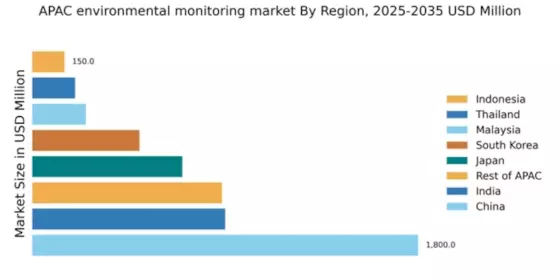

APAC Environmental Monitoring Market Regional Image

Key Players and Competitive Insights

The environmental monitoring market is currently characterized by a dynamic competitive landscape, driven by increasing regulatory pressures and a growing emphasis on sustainability. Key players are actively pursuing strategies that emphasize innovation, regional expansion, and digital transformation. For instance, Thermo Fisher Scientific (US) has positioned itself as a leader in the market by focusing on advanced analytical technologies and expanding its product portfolio to meet diverse environmental monitoring needs. Similarly, Siemens AG (DE) is leveraging its expertise in automation and digitalization to enhance its environmental monitoring solutions, thereby strengthening its competitive edge. These strategies collectively contribute to a market that is moderately fragmented, with significant influence exerted by a few dominant players.

In terms of business tactics, companies are increasingly localizing manufacturing and optimizing supply chains to enhance operational efficiency. This approach not only reduces costs but also allows for quicker response times to market demands. The competitive structure of the market appears to be moderately fragmented, with several key players holding substantial market shares. The collective influence of these companies shapes the market dynamics, as they engage in strategic partnerships and collaborations to enhance their service offerings and technological capabilities.

In September 2025, Honeywell International Inc. (US) announced a strategic partnership with a leading environmental consultancy to develop integrated monitoring solutions aimed at improving air quality management. This collaboration is expected to enhance Honeywell's capabilities in providing real-time data analytics, thereby positioning the company as a frontrunner in the air quality monitoring segment. The strategic importance of this partnership lies in its potential to address growing concerns over air pollution, which is increasingly becoming a focal point for regulatory bodies across the APAC region.

In October 2025, Agilent Technologies (US) launched a new suite of environmental monitoring instruments designed to provide high-precision measurements of pollutants in water and air. This product launch reflects Agilent's commitment to innovation and its focus on meeting the stringent regulatory requirements in the APAC market. The introduction of these advanced instruments is likely to enhance Agilent's market share and reinforce its reputation as a leader in environmental monitoring technologies.

In August 2025, ABB Ltd. (CH) expanded its environmental monitoring solutions by integrating AI capabilities into its existing platforms. This strategic move aims to enhance predictive analytics and improve decision-making processes for clients in various industries. The integration of AI not only positions ABB as a technology leader but also aligns with the broader trend of digital transformation within the environmental monitoring sector, which is increasingly reliant on data-driven insights.

As of November 2025, the competitive trends in the environmental monitoring market are heavily influenced by digitalization, sustainability initiatives, and the integration of AI technologies. Strategic alliances are becoming increasingly important, as companies seek to leverage complementary strengths to enhance their market offerings. Looking ahead, it appears that competitive differentiation will evolve from traditional price-based competition to a focus on innovation, technological advancements, and supply chain reliability. This shift suggests that companies that prioritize these aspects will likely gain a competitive advantage in the rapidly changing market landscape.

Key Companies in the APAC Environmental Monitoring Market market include

Industry Developments

Thermo Fisher Scientific expanded its APAC presence in September 2024 by establishing a new Global Business Services Center in the Philippines to serve its industrial, biotech, and environmental monitoring clients.To highlight continuous innovation in environmental sampling and analysis throughout APAC, Thermo Fisher introduced Omics and Environmental Workflow solutions at ASMS in June 2025. Thermo Fisher improved monitoring capabilities throughout the region in March 2024 by introducing Orbitrap Exploris GC-MS equipment for identifying trace environmental toxins.

With its Smart Infrastructure division, Siemens has been aggressively bolstering APAC infrastructure, aiming to expand its intelligent sensor and environmental automation systems for commercial and industrial customers.With its cutting-edge detection systems being used to satisfy stringent APAC rules on environmental contaminants, PerkinElmer continues to have a significant market share. Hach, a major supplier of environmental and water monitoring systems, keeps growing its business in accordance with the emission and quality control regulations set by the governments of the Asia-Pacific region.

Emerson, one of the top system providers, is also involved in supplying air and water quality monitoring systems to APAC markets. Due to government legislation, digital transformation, and the need for real-time environmental data, there has been a significant rise in investment and technology implementation from January 2023.

Future Outlook

APAC Environmental Monitoring Market Future Outlook

The environmental monitoring market is projected to grow at 5.37% CAGR from 2024 to 2035, driven by regulatory pressures, technological advancements, and increasing environmental awareness.

New opportunities lie in:

  • Development of AI-driven predictive analytics tools for environmental data
  • Expansion of remote sensing technologies for real-time monitoring
  • Integration of IoT solutions for enhanced data collection and management

By 2035, the market is expected to achieve robust growth, driven by innovation and increasing demand.

Market Segmentation

APAC Environmental Monitoring Market Product Outlook

  • Mobile Device
  • Smart Card
  • E-readers

APAC Environmental Monitoring Market End User Outlook

  • Government
  • Consumer Electronics
  • Retail
  • Medical

APAC Environmental Monitoring Market Application Outlook

  • Soil pollution monitoring
  • Air pollution monitoring
  • Water pollution monitoring
  • Noise pollution monitoring

Report Scope

MARKET SIZE 2024 4585.35(USD Million)
MARKET SIZE 2025 4831.58(USD Million)
MARKET SIZE 2035 8150.0(USD Million)
COMPOUND ANNUAL GROWTH RATE (CAGR) 5.37% (2024 - 2035)
REPORT COVERAGE Revenue Forecast, Competitive Landscape, Growth Factors, and Trends
BASE YEAR 2024
Market Forecast Period 2025 - 2035
Historical Data 2019 - 2024
Market Forecast Units USD Million
Key Companies Profiled ["Thermo Fisher Scientific (US)", "Siemens AG (DE)", "Honeywell International Inc. (US)", "Agilent Technologies (US)", "PerkinElmer Inc. (US)", "ABB Ltd. (CH)", "Horiba Ltd. (JP)", "Teledyne Technologies Inc. (US)", "Emerson Electric Co. (US)"]
Segments Covered Product, End User, Application
Key Market Opportunities Integration of advanced sensor technologies enhances real-time data collection in the environmental monitoring market.
Key Market Dynamics Rising regulatory pressures drive innovation and investment in environmental monitoring technologies across the APAC region.
Countries Covered China, India, Japan, South Korea, Malaysia, Thailand, Indonesia, Rest of APAC

Leave a Comment

FAQs

What is the expected market size of the APAC Environmental Monitoring Market in 2024?

The APAC Environmental Monitoring Market is projected to be valued at 4.59 billion USD in 2024.

What is the anticipated market value of the APAC Environmental Monitoring Market by 2035?

By 2035, the APAC Environmental Monitoring Market is expected to reach an estimated value of 8.85 billion USD.

What is the expected compound annual growth rate (CAGR) for the APAC Environmental Monitoring Market from 2025 to 2035?

The market is projected to grow at a CAGR of 6.16% during the forecast period from 2025 to 2035.

Which region is expected to hold the largest market share in the APAC Environmental Monitoring Market in 2024?

China is anticipated to dominate the market with a valuation of approximately 1.683 billion USD in 2024.

What market value is expected for India in the APAC Environmental Monitoring Market in 2024?

India's market value in the APAC Environmental Monitoring Market is projected to be around 0.903 billion USD in 2024.

Who are the key players in the APAC Environmental Monitoring Market?

Major players in the market include Agilent Technologies, Teledyne Technologies, and Thermo Fisher Scientific among others.

What is the projected market size for mobile devices in the APAC Environmental Monitoring Market by 2035?

The market for mobile devices is expected to grow to 2.3 billion USD by 2035.

How much is the smart cards segment valued at in the APAC Environmental Monitoring Market for 2024?

The smart cards segment is valued at approximately 1.5 billion USD in the year 2024.

What is the value of the e-readers segment in the APAC Environmental Monitoring Market for 2024?

In 2024, the e-readers segment is estimated to be valued at around 1.89 billion USD.

What is the expected market growth rate for South Korea in the APAC Environmental Monitoring Market by 2035?

By 2035, the market size for South Korea is projected to reach approximately 1.225 billion USD.

Download Free Sample

Kindly complete the form below to receive a free sample of this Report

Compare Licence

×
Features License Type
Single User Multiuser License Enterprise User
Price $4,950 $5,950 $7,250
Maximum User Access Limit 1 User Upto 10 Users Unrestricted Access Throughout the Organization
Free Customization
Direct Access to Analyst
Deliverable Format
Platform Access
Discount on Next Purchase 10% 15% 15%
Printable Versions