×
Request Free Sample ×

Kindly complete the form below to receive a free sample of this Report

* Please use a valid business email

Leading companies partner with us for data-driven Insights

clients tt-cursor
Hero Background

APAC Route Optimization Software Market

ID: MRFR/ICT/60020-HCR
200 Pages
Aarti Dhapte
October 2025

APAC Route Optimization Software Market Research Report By Deployment Type (Cloud-Based, On-Premise, Hybrid), By End User (Transportation and Logistics, Retail, Healthcare, Government), By Features (Real-Time Tracking, Traffic Analysis, Multi-Stop Routing, Route Analytics, Mobile Compatibility), By Application (Fleet Management, Last-Mile Delivery, Field Service Management) and By Regional (China, India, Japan, South Korea, Malaysia, Thailand, Indonesia, Rest of APAC)- Forecast to 2035

Share:
Download PDF ×

We do not share your information with anyone. However, we may send you emails based on your report interest from time to time. You may contact us at any time to opt-out.

APAC Route Optimization Software Market Infographic
Purchase Options

APAC Route Optimization Software Market Summary

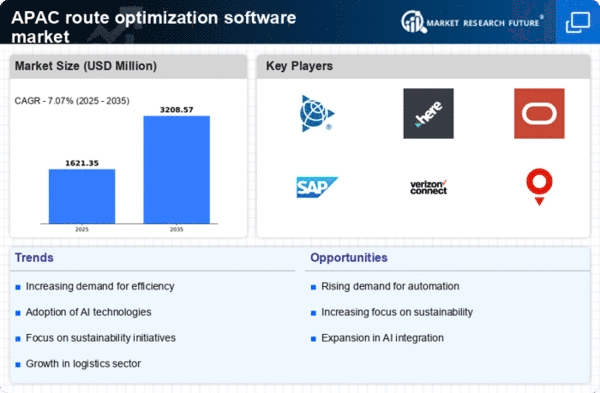
As per MRFR analysis, the APAC route optimization-software market Size was estimated at 1514.29 USD Million in 2024. The APAC route optimization-software market is projected to grow from 1621.35 USD Million in 2025 to 3208.57 USD Million by 2035, exhibiting a compound annual growth rate (CAGR) of 7.07% during the forecast period 2025 - 2035.

Key Market Trends & Highlights

The APAC route optimization-software market is experiencing robust growth driven by technological advancements and increasing demand for efficient logistics solutions.

  • China remains the largest market for route optimization software, reflecting a strong demand for advanced logistics solutions.
  • India is emerging as the fastest-growing region, showcasing a rapid adoption of technology in logistics and transportation.
  • Integration with IoT technologies is becoming a prevalent trend, enhancing real-time data utilization for route optimization.
  • Rising demand for efficient logistics solutions and government initiatives for smart transportation are key drivers propelling market growth.

Market Size & Forecast

2024 Market Size 1514.29 (USD Million)
2035 Market Size 3208.57 (USD Million)
CAGR (2025 - 2035) 7.07%

Major Players

Trimble (US), HERE Technologies (NL), Oracle (US), SAP (DE), Verizon Connect (US), TomTom (NL), Samsara (US), Fleet Complete (CA), MapQuest (US)

APAC Route Optimization Software Market Trends

The route optimization-software market is currently experiencing notable growth, driven by the increasing demand for efficient logistics and transportation solutions across various sectors. In the APAC region, businesses are increasingly recognizing the value of optimizing routes to reduce operational costs and enhance service delivery. This trend is particularly evident in industries such as e-commerce, where timely deliveries are crucial for customer satisfaction. Furthermore, advancements in technology, including artificial intelligence and machine learning, are enabling more sophisticated route planning and real-time adjustments, thereby improving overall efficiency. Moreover, the rise of smart city initiatives in APAC is further propelling the adoption of route optimization software. Governments are investing in infrastructure and technology to streamline urban mobility, which in turn creates a favorable environment for software solutions that can analyze traffic patterns and optimize routes accordingly. As urban populations continue to grow, the need for effective transportation management becomes increasingly critical. Consequently, the route optimization-software market is poised for sustained growth as organizations seek to leverage technology to meet the demands of a rapidly evolving landscape.

Integration with IoT Technologies

The integration of Internet of Things (IoT) technologies into the route optimization-software market is becoming increasingly prevalent. This trend allows for real-time data collection from various sources, such as vehicles and traffic sensors, enabling more accurate route planning. By harnessing IoT capabilities, businesses can enhance their operational efficiency and respond swiftly to changing conditions.

Focus on Sustainability

There is a growing emphasis on sustainability within the route optimization-software market. Companies are increasingly seeking solutions that not only improve efficiency but also reduce their carbon footprint. This trend is driven by regulatory pressures and consumer demand for environmentally friendly practices, prompting software developers to incorporate features that promote greener transportation options.

Customization and Scalability

Customization and scalability are becoming key considerations in the route optimization-software market. As businesses vary in size and operational needs, software solutions that offer tailored features and the ability to scale with growth are in high demand. This flexibility allows organizations to adapt their route planning strategies as their requirements evolve.

APAC Route Optimization Software Market Drivers

Growth of Fleet Management Solutions

The growth of fleet management solutions in APAC is driving the demand for route optimization software. As businesses increasingly rely on fleets for transportation, the need for effective management tools becomes paramount. In 2025, the fleet management market in APAC is expected to reach $10 billion, with a substantial portion allocated to software solutions that enhance operational efficiency. Route optimization software plays a crucial role in this context by providing real-time data analytics and route planning capabilities. This integration not only reduces operational costs but also improves service delivery. Consequently, the route optimization-software market is likely to experience robust growth as fleet management solutions become more prevalent.

Technological Advancements in Data Analytics

Technological advancements in data analytics are reshaping the route optimization-software market in APAC. The ability to analyze vast amounts of data in real-time allows businesses to make informed decisions regarding route planning and resource allocation. In 2025, the data analytics market in APAC is projected to grow by 15%, indicating a strong trend towards data-driven decision-making. This shift is particularly relevant for logistics and transportation companies that rely on precise data to optimize their operations. The route optimization-software market is thus benefiting from these advancements, as companies seek to leverage data analytics to enhance their routing strategies and improve overall efficiency.

Increasing Focus on Cost Reduction Strategies

The increasing focus on cost reduction strategies among businesses in APAC is a significant driver for the route optimization-software market. Companies are under constant pressure to minimize operational expenses while maintaining service quality. In 2025, it is anticipated that businesses will allocate approximately 20% of their logistics budgets to technology solutions aimed at cost reduction. Route optimization software enables organizations to identify the most efficient routes, thereby lowering fuel consumption and labor costs. This emphasis on cost efficiency is likely to propel the growth of the route optimization-software market, as more companies recognize the financial benefits of implementing such solutions.

Government Initiatives for Smart Transportation

Government initiatives aimed at promoting smart transportation systems are significantly influencing the route optimization-software market in APAC. Various governments are investing in digital infrastructure to enhance transportation efficiency. For instance, initiatives to develop smart cities are encouraging the adoption of advanced technologies, including route optimization software. In 2025, it is estimated that government funding for smart transportation projects in APAC will exceed $5 billion. This financial support is likely to accelerate the integration of route optimization solutions into public transportation systems, thereby expanding the market. The route optimization-software market stands to gain from these initiatives, as they align with broader goals of sustainability and efficiency.

Rising Demand for Efficient Logistics Solutions

The increasing demand for efficient logistics solutions in APAC is a primary driver for the route optimization-software market. As e-commerce continues to expand, businesses are seeking ways to streamline their delivery processes. In 2025, the logistics sector in APAC is projected to grow by approximately 10%, necessitating advanced software solutions to manage complex supply chains. Route optimization software enables companies to reduce delivery times and costs, thereby enhancing customer satisfaction. This trend is particularly evident in urban areas where traffic congestion poses significant challenges. The route optimization-software market is thus positioned to benefit from this growing need for efficiency in logistics operations.

Market Segment Insights

By Deployment Type: Cloud-Based (Largest) vs. On-Premise (Fastest-Growing)

In the APAC route optimization-software market, Cloud-Based solutions currently dominate the deployment type segment, capturing the largest share due to their scalability, accessibility, and ease of integration. Businesses increasingly opt for Cloud-Based platforms as they enable real-time data analysis and remote accessibility, making them ideal for logistics and transportation companies seeking efficient route planning. Meanwhile, On-Premise solutions continue to show robust demand, particularly among enterprises with stringent data security needs and integration capabilities.

Deployment Type: Cloud-Based (Dominant) vs. On-Premise (Emerging)

Cloud-Based route optimization solutions are characterized by their flexibility and cost-effectiveness, allowing organizations to easily scale their operations while benefiting from continuous updates and support. This segment addresses varied customer needs, making it particularly appealing to small and medium-sized enterprises. Conversely, On-Premise solutions, while more traditional, are preferred by larger enterprises for their control over data and systems. This segment is experiencing an uptick due to increasing investments in cybersecurity and data integrity concerns, positioning On-Premise as an attractive option for businesses prioritizing security and compliance.

By End User: Transportation and Logistics (Largest) vs. Healthcare (Fastest-Growing)

In the route optimization-software market, the Transportation and Logistics segment retains the largest share, dominating the landscape as it encompasses a wide range of applications that enhance supply chain efficiencies. This sector's substantial investment in technology and the increasing demand for effective logistical solutions contribute significantly to its prominence. Conversely, the Healthcare segment, while smaller in comparison, is rapidly emerging as a vital force in the market, driven by the need for efficient patient transportation and resource allocation within medical facilities. Growth trends indicate that the Transportation and Logistics segment will continue to thrive due to the ongoing digital transformation and evolving consumer expectations. Meanwhile, the Healthcare sector's expansion is fueled by larger investments in health technology and the growing emphasis on patient care efficiency. The intersection of these sectors illustrates a pivotal shift in operational strategies, influencing overall market dynamics.

Transportation and Logistics: Dominant vs. Healthcare: Emerging

The Transportation and Logistics segment is characterized by its extensive integration of advanced technologies that optimize delivery routes, reduce fuel consumption, and enhance overall operational efficiency. This segment stands out for its ability to leverage data analytics and real-time tracking systems, providing stakeholders with crucial insights into their logistics networks. On the other hand, the Healthcare segment represents an emerging market force that focuses on optimizing patient and resource mobility. This segment's evolution is marked by its commitment to integrating route optimization solutions into healthcare systems, allowing for improved emergency response times and efficient transport services, ultimately aiming to enhance patient outcomes and streamline operations.

By Features: Real-Time Tracking (Largest) vs. Traffic Analysis (Fastest-Growing)

In the APAC route optimization-software market, Real-Time Tracking emerges as the largest segment, commanding a significant portion of the market share due to its critical role in enhancing operational efficiency. This feature allows businesses to monitor their fleets in real-time, thereby providing them with the agility needed to respond to dynamic conditions. In contrast, Traffic Analysis has notably become the fastest-growing segment, driven by the increasing integration of AI technologies that enable more accurate traffic forecasting and analysis. The growth trends for these features are influenced by several key factors. As logistics and transportation become increasingly complex, the demand for sophisticated tools that offer detailed insights into routing and traffic patterns is on the rise. Moreover, the continuous advancements in mobile technology have further propelled the adoption of Traffic Analysis as companies seek to enhance their route optimization capabilities and reduce delivery times, thus improving customer satisfaction.

Real-Time Tracking (Dominant) vs. Traffic Analysis (Emerging)

Real-Time Tracking remains the dominant feature in the APAC route optimization-software market due to its integral role in operational management. Companies heavily rely on this feature to gain instantaneous updates on vehicle locations, which streamlines logistics and enhances decision-making processes. Its widespread adoption is fueled by the necessity for transparency and accountability in freight and delivery services. Conversely, Traffic Analysis, while still emerging, is gaining traction as businesses increasingly recognize its ability to provide critical insights into traffic patterns and congestion management. The technology behind Traffic Analysis employs advanced algorithms and data analytics, which are essential for timely route adjustments, making it a vital tool for enhancing efficiency and minimizing operational delays.

By Application: Fleet Management (Largest) vs. Last-Mile Delivery (Fastest-Growing)

In the Application segment of the route optimization-software market, Fleet Management constitutes the largest share, dominating the market due to the increasing need for efficient vehicle scheduling and monitoring in logistics. Last-Mile Delivery is also gaining considerable attention as urbanization accelerates, leading to an increase in demand for effective delivery systems. Field Service Management, while essential, holds a smaller share comparatively. The growth trends within this segment point towards a rapid expansion of Last-Mile Delivery solutions, driven by e-commerce growth and the demand for faster deliveries. Fleet Management continues to be a staple, influenced by technological advancements in telematics and data analytics, which enhance operational efficiency. Field Service Management is also evolving, with businesses realizing the significance of optimizing service deliveries and customer engagements to stay competitive.

Fleet Management (Dominant) vs. Field Service Management (Emerging)

Fleet Management solutions are characterized by their comprehensive capabilities in vehicle tracking, route optimization, and logistics management, making them critical for businesses aiming to enhance efficiency and reduce operational costs. As the dominant player in the Application segment, Fleet Management supports large-scale operations needing reliable data and analytics for better decision-making. On the other hand, Field Service Management is emerging as a significant sector, focusing on optimizing the allocation of resources for field operations, improving service quality, and increasing customer satisfaction. Both segments reflect the need for technological integration to streamline processes, yet Fleet Management leads in overall adoption due to its pervasive necessity in the logistics ecosystem.

Get more detailed insights about APAC Route Optimization Software Market

Regional Insights

China : Unmatched Growth and Innovation

Key markets include major cities like Beijing, Shanghai, and Shenzhen, where logistics and transportation industries thrive. The competitive landscape features significant players like Trimble, HERE Technologies, and Oracle, all vying for market share. Local dynamics are characterized by a strong push for technological innovation and integration of AI in logistics. Industries such as e-commerce, manufacturing, and retail are increasingly adopting route optimization software to enhance operational efficiency and reduce costs.

India : Emerging Market with High Demand

Key markets include metropolitan areas such as Mumbai, Delhi, and Bengaluru, where logistics and transportation networks are expanding. The competitive landscape features players like SAP, Verizon Connect, and local startups. The business environment is dynamic, with increasing investments in technology and infrastructure. Industries such as retail, manufacturing, and food delivery are major adopters of route optimization software, seeking to streamline operations and improve customer satisfaction.

Japan : Focus on Efficiency and Innovation

Key markets include Tokyo, Osaka, and Nagoya, where logistics operations are highly developed. The competitive landscape features major players like Oracle and HERE Technologies, alongside local firms specializing in advanced logistics solutions. The business environment is characterized by a focus on quality and efficiency, with industries such as automotive, electronics, and retail increasingly adopting route optimization software to enhance operational performance and reduce costs.

South Korea : Strong Demand in Urban Areas

Key markets include Seoul, Busan, and Incheon, where logistics and transportation networks are well-established. The competitive landscape features players like Trimble and Samsara, competing with local firms. The business environment is dynamic, with a strong focus on technology adoption and innovation. Industries such as retail, food delivery, and manufacturing are significant users of route optimization software, seeking to improve delivery efficiency and customer satisfaction.

Malaysia : Emerging Market with Potential

Key markets include Kuala Lumpur, Penang, and Johor Bahru, where logistics operations are evolving. The competitive landscape features both international players like TomTom and local firms. The business environment is improving, with increasing investments in technology and infrastructure. Industries such as retail, manufacturing, and logistics are adopting route optimization software to streamline operations and enhance service delivery.

Thailand : Focus on Infrastructure Development

Key markets include Bangkok, Chiang Mai, and Pattaya, where logistics operations are evolving. The competitive landscape features both international players and local firms. The business environment is improving, with increasing investments in technology and infrastructure. Industries such as retail, manufacturing, and logistics are adopting route optimization software to streamline operations and enhance service delivery.

Indonesia : Focus on Urban Logistics Solutions

Key markets include Jakarta, Surabaya, and Bandung, where logistics operations are evolving. The competitive landscape features both international players and local firms. The business environment is improving, with increasing investments in technology and infrastructure. Industries such as retail, manufacturing, and logistics are adopting route optimization software to streamline operations and enhance service delivery.

Rest of APAC : Varied Growth Across Sub-regions

Key markets include major cities in these countries, where logistics operations are evolving. The competitive landscape features both international players and local firms. The business environment varies significantly, with some countries investing heavily in technology and infrastructure while others are still developing. Industries such as retail, manufacturing, and logistics are increasingly adopting route optimization software to enhance operational efficiency and customer satisfaction.


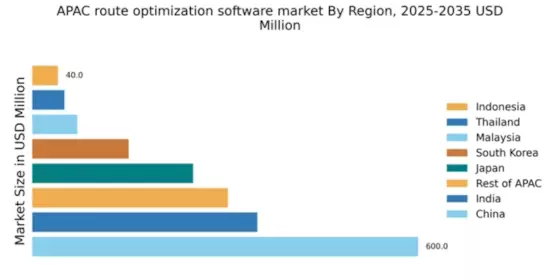
APAC Route Optimization Software Market Regional Image

Key Players and Competitive Insights

The route optimization-software market is currently characterized by a dynamic competitive landscape, driven by technological advancements and increasing demand for efficiency in logistics and transportation. Key players such as Trimble (US), HERE Technologies (NL), and Oracle (US) are strategically positioning themselves through innovation and partnerships. Trimble (US) focuses on integrating advanced analytics and machine learning into its solutions, enhancing route planning capabilities. HERE Technologies (NL) emphasizes its commitment to real-time data integration, which is crucial for optimizing routes in urban environments. Oracle (US) leverages its extensive cloud infrastructure to offer scalable solutions that cater to diverse business needs, thereby shaping a competitive environment that prioritizes technological integration and customer-centric approaches.

The market structure appears moderately fragmented, with numerous players vying for market share. Key business tactics include localizing software solutions to meet regional demands and optimizing supply chains to enhance service delivery. The collective influence of these major companies fosters a competitive atmosphere where innovation and customer service are paramount, allowing them to differentiate themselves in a crowded marketplace.

In October 2025, Trimble (US) announced a strategic partnership with a leading logistics provider to enhance its route optimization capabilities through shared data analytics. This collaboration is expected to improve delivery efficiency by up to 30%, showcasing Trimble's commitment to leveraging partnerships for technological advancement. Such strategic moves not only bolster Trimble's market position but also reflect a broader trend of collaboration within the industry to address complex logistical challenges.

In September 2025, HERE Technologies (NL) launched a new suite of APIs designed to facilitate seamless integration of real-time traffic data into existing route optimization software. This initiative is significant as it allows businesses to adapt to changing traffic conditions dynamically, potentially reducing delivery times by 20%. HERE's focus on real-time data underscores the growing importance of agility in route planning, which is essential for maintaining competitive advantage in the fast-paced logistics sector.

In August 2025, Oracle (US) expanded its cloud-based route optimization solutions by incorporating AI-driven predictive analytics. This enhancement aims to provide businesses with insights into potential disruptions and optimize routes accordingly. The strategic importance of this development lies in Oracle's ability to offer a more proactive approach to route management, which could lead to cost savings of up to 15% for its clients. Such innovations reflect a shift towards data-driven decision-making in the industry, aligning with broader trends in digital transformation.

As of November 2025, the competitive trends in the route optimization-software market are increasingly defined by digitalization, sustainability, and AI integration. Strategic alliances are becoming more prevalent, as companies recognize the value of collaborative innovation in addressing market demands. Looking ahead, competitive differentiation is likely to evolve from traditional price-based competition to a focus on technological innovation, reliability in supply chains, and enhanced customer experiences. This shift indicates a transformative phase in the market, where companies that prioritize innovation and adaptability will likely emerge as leaders.

Key Companies in the APAC Route Optimization Software Market market include

Industry Developments

The APAC Route Optimization Software Market has recently witnessed significant growth driven by technology advancements and increased demand for logistics efficiency. Companies such as Locus.sh and Trimble have been innovating their solutions to enhance delivery and route planning capabilities, leveraging machine learning and artificial intelligence. 

Descartes Systems Group has been expanding its presence in the region, while Telogis has focused on integrating IoT data to improve fleet management. In terms of mergers and acquisitions, notable activity includes Cargomatic's expansions within the APAC market, aiming to bolster its logistics network, and Fleet Complete's acquisition strategies to diversify its software offerings. 

Recent growth trends indicate an increased market valuation, particularly due to the rising e-commerce sector, which has necessitated better route optimization solutions to meet consumer demands efficiently. The overall APAC market for Route Optimization Software is projected to evolve significantly as companies adapt to changing logistics needs amidst heightened competition and technological advancements, especially between 2021 and 2023, reflecting a notable shift in operational tactics within the region's supply chain frameworks.


Future Outlook

APAC Route Optimization Software Market Future Outlook

The route optimization-software market is projected to grow at a 7.07% CAGR from 2024 to 2035, driven by advancements in AI, increased logistics demand, and sustainability initiatives.

New opportunities lie in:

  • Integration of AI-driven predictive analytics for enhanced route planning efficiency.
  • Development of subscription-based models for small to medium-sized enterprises.
  • Expansion into emerging markets with tailored solutions for local logistics challenges.

By 2035, the market is expected to achieve substantial growth, driven by innovation and strategic partnerships.

Market Segmentation

APAC Route Optimization Software Market End User Outlook

  • Transportation and Logistics
  • Retail
  • Healthcare
  • Government

APAC Route Optimization Software Market Features Outlook

  • Real-Time Tracking
  • Traffic Analysis
  • Multi-Stop Routing
  • Route Analytics
  • Mobile Compatibility

APAC Route Optimization Software Market Application Outlook

  • Fleet Management
  • Last-Mile Delivery
  • Field Service Management

APAC Route Optimization Software Market Deployment Type Outlook

  • Cloud-Based
  • On-Premise
  • Hybrid

Report Scope

MARKET SIZE 20241514.29(USD Million)
MARKET SIZE 20251621.35(USD Million)
MARKET SIZE 20353208.57(USD Million)
COMPOUND ANNUAL GROWTH RATE (CAGR)7.07% (2024 - 2035)
REPORT COVERAGERevenue Forecast, Competitive Landscape, Growth Factors, and Trends
BASE YEAR2024
Market Forecast Period2025 - 2035
Historical Data2019 - 2024
Market Forecast UnitsUSD Million
Key Companies Profiled["Trimble (US)", "HERE Technologies (NL)", "Oracle (US)", "SAP (DE)", "Verizon Connect (US)", "TomTom (NL)", "Samsara (US)", "Fleet Complete (CA)", "MapQuest (US)"]
Segments CoveredDeployment Type, End User, Features, Application
Key Market OpportunitiesIntegration of artificial intelligence enhances efficiency in the route optimization-software market.
Key Market DynamicsRising demand for efficient logistics drives innovation in route optimization software across the APAC region.
Countries CoveredChina, India, Japan, South Korea, Malaysia, Thailand, Indonesia, Rest of APAC

Leave a Comment

FAQs

What is the expected market size of the APAC Route Optimization Software Market in 2024?

The APAC Route Optimization Software Market is expected to be valued at 1.75 USD Billion in 2024.

What is the projected market value for the APAC Route Optimization Software Market by 2035?

By 2035, the overall APAC Route Optimization Software Market is anticipated to reach 4.01 USD Billion.

What is the expected CAGR for the APAC Route Optimization Software Market from 2025 to 2035?

The market is expected to grow at a CAGR of 7.857% from 2025 to 2035.

Which country is expected to hold the largest market share in the APAC Route Optimization Software Market in 2024?

China is projected to hold the largest market share, valued at 0.7 USD Billion in 2024.

What will be the market value for India in the APAC Route Optimization Software Market for 2035?

The market value for India is expected to reach 0.95 USD Billion by 2035.

Who are the key players in the APAC Route Optimization Software Market?

Major players include Locus.sh, Descartes Systems Group, Telogis, Trimble, and Motive.

What is the expected market size for cloud-based route optimization software in 2035?

The cloud-based segment is expected to be valued at 1.6 USD Billion in 2035.

How much is the on-premise deployment type projected to be worth in 2024?

The on-premise deployment type is projected to be valued at 0.5 USD Billion in 2024.

What is the estimated market size for hybrid deployment in 2035?

The hybrid deployment type is estimated to reach 1.31 USD Billion by 2035.

What regions are included in the APAC Route Optimization Software Market analysis?

The market is analyzed across regions like China, India, Japan, South Korea, and Malaysia.

Download Free Sample

Kindly complete the form below to receive a free sample of this Report

Compare Licence

×
Features License Type
Single User Multiuser License Enterprise User
Price $4,950 $5,950 $7,250
Maximum User Access Limit 1 User Upto 10 Users Unrestricted Access Throughout the Organization
Free Customization
Direct Access to Analyst
Deliverable Format
Platform Access
Discount on Next Purchase 10% 15% 15%
Printable Versions