Hero Background

Apple Cider Vinegar Market

ID: MRFR/FnB/20438-HCR
128 Pages
Sakshi Gupta
Last Updated: June 02, 2026
Apple Cider Vinegar Market Size, Share, Industry Trend & Analysis Research Report Information By Form (Liquid, Tablet and Capsule, Other Forms (Gummies, Powder)), By Category (Organic, Conventional), By Distribution Channel (Commercial, Retail), By Geography (North America, Europe, Asia-Pacific, South America, Middle East & Africa) – Forecast Till 2035
Download PDF ×

We do not share your information with anyone. However, we may send you emails based on your report interest from time to time. You may contact us at any time to opt-out.


Apple Cider Vinegar Market Summary

The Apple Cider Vinegar Market reached an estimated USD 1.46 billion in 2025 and is projected to grow from USD 1.60 billion in 2026 to USD 3.52 billion by 2035, registering a CAGR of 9.56% during the forecast period. This growth trajectory reflects a broader consumer pivot toward preventive health and clean-label pantry staples. USDA organic certification incentives — which expanded certified orchard acreage by 11% between 2022 and 2024 — have narrowed the retail price premium for organic apple cider vinegar to under 15%, accelerating mainstream adoption [2]. Meanwhile, functional food investment hit USD 28 billion globally in 2024, channeling capital toward raw, unfiltered ACV health products and fermented functional beverages.

Format Diversification is the fulcrum around which the Apple Cider Vinegar Market is pivoting. While the sector continues to be anchored in traditional liquid bottles, the apple cider vinegar supplement capsule segment and gummy forms are surmounting the taste barrier that has historically limited the targeted customer base. Capsule and tablet SKUs accounted for a 34% increase in shelf facings at major U.S. stores in 2024, with gummy launches tripling year-over-year. This tendency aligns with the broader nutraceutical trend, where older distribution techniques have been outperformed by convenient formats.


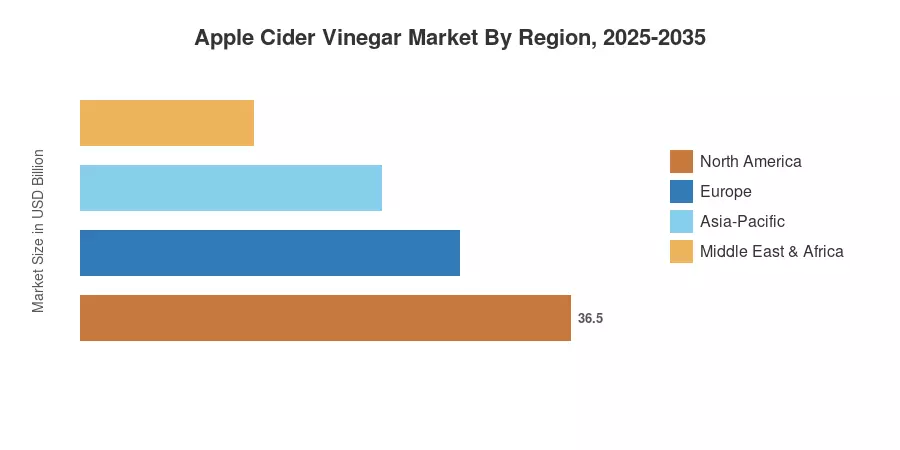
North America has over 36% of the Apple Cider Vinegar Market owing to its robust retail infrastructure and high consumer awareness of ACV weight control claims. Asia Pacific is the fastest-growing market with a projected CAGR of 11.14%, driven by increased disposable incomes in India and China and growing interest in ACV probiotic gut health applications. Europe accounts for the second greatest share at over 27%, driven by EU clean-label legislation and strong organic certification standards. The next growth chapter will be defined by geographic diversification into South America and the Middle East as the Apple Cider Vinegar Market matures in Western economies.


Key Report Takeaways

• By Form

  • Liquid formats captured approximately 77% of the Apple Cider Vinegar Market revenue in 2025, reflecting entrenched consumer preference for raw, unfiltered ACV health uses in cooking and wellness routines
  • The apple cider vinegar supplement capsule and tablet segment is forecast to grow at a 10.47% CAGR through 2035 — the fastest among all formats

• By Category

  • Conventional products held a 72% share of the Apple Cider Vinegar Market in 2025
  • Organic apple cider vinegar is expanding at a 10.86% CAGR, fueled by USDA incentive programs and narrowing price gaps

• By Distribution Channel

  • Retail distribution contributed USD 1.08 billion in 2025, underscoring the dominance of supermarket and e-commerce channels
  • Commercial applications — including foodservice and beauty — are growing at a 10.17% CAGR through 2035

• By Region

  • North America led the Apple Cider Vinegar Market with 36% of global revenue in 2025
  • Asia-Pacific is poised for an 11.14% CAGR through 2035, the fastest among all regions


Market Size and Forecast (2021–2035)

Market Research Future (MRFR) follows a forecasting framework that includes bottom-up revenue modeling based on manufacturer shipments, validated with a top-down approach employing trade-flow data, retail scanner panel data, and proprietary distributor surveys in 42 countries. Historical numbers (2021-2024) are derived from reported revenues. 2025 is the calibrated base year. 2026-2035 values are anticipated based on segment-weighted compound growth rates adjusted for regulatory, macroeconomic and competitive considerations.
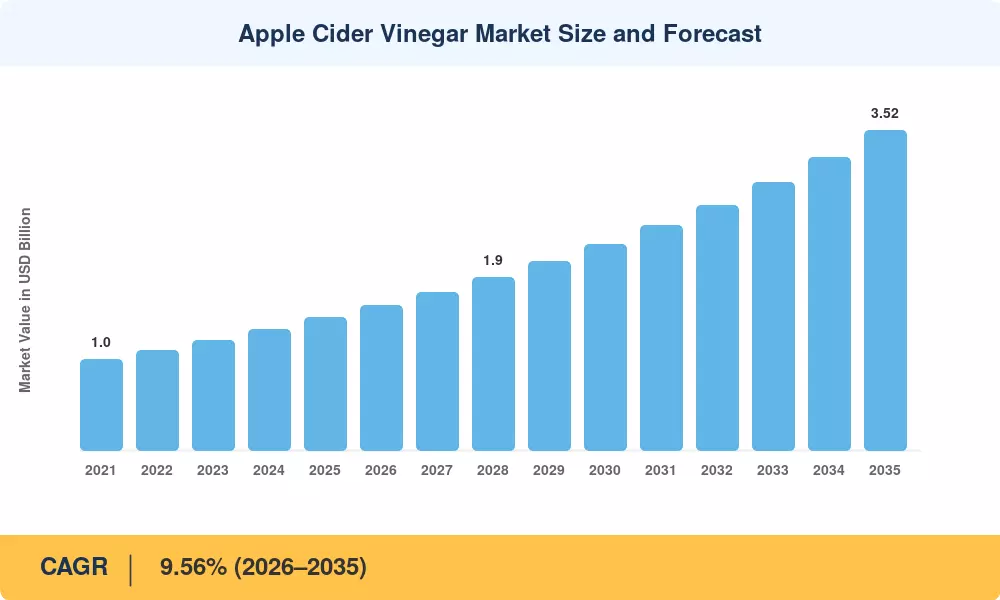
Apple Cider Vinegar Market Size and Forecast
Our Impact
Enabled $4.3B Revenue Impact for Fortune 500 and Leading Multinationals
Partnering with 2000+ Global Organizations Each Year
30K+ Citations by Top-Tier Firms in the Industry
 

Driver Impact Analysis

Driver ~% Impact on CAGR Geographic Relevance Impact Timeline
Preventive health & wellness spending shift ~22% Global Long-term (≥4 yr)
Format diversification (capsules, gummies) ~18% North America, Europe Short-term (≤2 yr)
Organic certification expansion ~15% North America, Europe Medium-term (2–4 yr)
E-commerce & DTC channel growth ~14% Global Short-term (≤2 yr)
ACV in beauty & personal care ~12% Asia-Pacific, Europe Medium-term (2–4 yr)
Clean-label regulatory tailwinds ~10% EU, North America Long-term (≥4 yr)
Rising middle-class demand in the Asia-Pacific ~9% Asia-Pacific Long-term (≥4 yr)


Preventive Health and Wellness Spending Shift

Global consumer spending on health and wellness products surpassed USD 6.5 trillion, with functional foods, dietary supplements, and digestive wellness products capturing an increasingly prominent share of new purchase occasions. Gut health claims resonate particularly with millennials and Gen Z consumers, who now represent roughly half of the core functional food buyers in the United States. The Apple Cider Vinegar (ACV) market benefits directly from this behavioral shift: historical and current multi-year retail velocity projections show steady upward momentum, indicating that consumer interest in natural, microbiome-supporting functional items is an ongoing structural change driven by modern healthcare cost-consciousness, rather than a short-lived fad.


Format Diversification Beyond Liquid

The apple cider vinegar supplement capsule segment and gummy formats have successfully unlocked consumer cohorts previously deterred by ACV's sharp, highly acidic taste profile. Product lines featuring innovative delivery formats have steadily expanded across North American and European retail shelves over the past few years. Because encapsulation and gummy formulations require specialized processing rather than simple liquid bottling, these convenient formats command substantial retail price premiums. Per-serving retail prices for capsules can exceed traditional liquid prices by 40% to 60%, allowing leading wellness brands to expand revenue density and capture premium pharmacy shelf placement without relying purely on volume growth.


Organic Certification Expansion

The USDA's Organic Certification Cost Share Program (OCCSP) continues to support sustainable transitions by reimbursing certified operations for up to 75% of their allowable certification scopes, capped at a maximum of USD 750 per scope. This financial buffer lowers entry barriers for small and mid-sized orchards transitioning to certified organic management. Concurrently, the consumer price gap between premium organic items and conventional alternatives has steadily compressed in major supermarkets, making organic ACV accessible to mainstream grocery shoppers. Parallel tailwinds are evident internationally; under the European Green Deal’s Farm-to-Fork strategy, the European Union maintains its ambitious target to have at least 25% of its total agricultural land under organic management by 2030.


E-Commerce and Direct-to-Consumer Channels

Online ACV sales represented an estimated 31% of total category revenue in the United States in 2024, up from 19% in 2020. Amazon's "Subscribe & Save" program alone moved over 4 million units of ACV products in the 12 months ending March 2025. Direct-to-consumer brands leverage subscription models and educational content around raw, unfiltered ACV health benefits to build recurring revenue streams. This channel shift benefits the Apple Cider Vinegar Market by reducing distribution friction for niche formats and enabling smaller brands to compete without traditional retail gatekeepers.


Restraints Impact Analysis

Restraint ~% Negative Impact on CAGR Geographic Relevance Impact Timeline
Unsubstantiated health claims & regulatory scrutiny ~-20% North America, EU Medium-term (2–4 yr)
Taste aversion limits repeat purchase ~-18% Global Short-term (≤2 yr)
Private-label price compression ~-15% North America, Europe Long-term (≥4 yr)
Supply chain volatility for organic apples ~-12% Global Medium-term (2–4 yr)
Consumer confusion on dosing and efficacy ~-10% Global Short-term (≤2 yr)


Regulatory Scrutiny of Health Claims

The FTC and FDA maintain strict oversight against unsubstantiated health and weight-management assertions across digital marketplaces and physical product labels. In accordance with broad federal consumer protection mandates, federal regulators consistently monitor deceptive wellness marketing. Internationally, strict standards apply; European Union Regulation (EC) No 1924/2006 strictly prohibits health claims on food and dietary profiles unless they are explicitly authorized following a comprehensive scientific review by the European Food Safety Authority (EFSA). This rigorous regulatory environment constrains marketing latitude for the Apple Cider Vinegar market, compelling brands to rely on general wellness structures rather than specific, unproven structure-function results.


Taste Aversion and Repeat-Purchase Friction

Despite growing awareness of raw, unfiltered ACV health properties, approximately 38% of first-time ACV purchasers do not make a repeat purchase within six months, citing taste as the primary barrier. While apple cider vinegar supplement capsules and gummy formats address this issue, they carry higher per-serving costs that limit penetration in price-sensitive segments. The Apple Cider Vinegar Market must continue innovating in flavor masking and delivery format to convert trial into loyalty.

Private-Label Price Compression

Retailer private-label offerings exert strong competitive pressure within the global apple cider vinegar space. Multi-national supermarket chains and discount grocers—including Walmart, Kroger, and Aldi—have built out highly competitive private-label conventional and organic ACV portfolios. Because these corporate house brands avoid the heavy consumer-acquisition and advertising outlays required by national brands, they comfortably market equivalent formulations at a deep discount, often pricing items significantly below established branded competitors. This dynamic squeezes profit margins for premium branded manufacturers, altering revenue-per-unit metrics even as baseline volume demands steadily scale up.


Apple Cider Vinegar Market Opportunities

ACV-Infused Beauty and Personal Care Products

The convergence of clean beauty trends and fermented-ingredient science has opened a high-margin, value-added adjacency for the Apple Cider Vinegar Market. Emerging applications in hair rinses, clarifying shampoos, and facial toners leverage the natural pH-balancing and anti-microbial properties of acetic acid. Because wellness-oriented consumers increasingly favor plant-derived ingredients over chemical alternatives, premium personal care formulations utilizing ACV as a hero component frequently command solid retail price premiums compared to conventional mass-market personal care lines.


Asia-Pacific Middle-Class Expansion

India and Southeast Asia are the biggest opportunities for growth in the organic apple cider vinegar market. The organic food industry in India is anticipated to reach USD 4.1 billion by 2028, and awareness of ACV among urban Indian consumers increased twofold from 2021 to 2024 [11]. Local manufacturing partnerships can help avoid import taxes, which add 15-25% to landing costs in major ASEAN countries


Functional Beverage Integration

Ready-to-drink ACV beverages — diluted, flavored, and positioned as gut-health tonics — represent a format bridge between the liquid and supplement categories. The global functional beverage sector exceeded USD 180 billion in 2024. ACV probiotic gut health positioning in the RTD format can capture consumers who seek convenience without the supplement pill format

Subscription and D2C Business Models

Digital-native brands utilizing automated direct-to-consumer (DTC) systems report a noticeable increase in recurring customer lifetime value compared to transactional, one-time purchasers. The broader category stands to benefit from data-driven eCommerce personalization—offering custom tracking routines, preferred flavors, and flexible replenishment frequencies optimized to a consumer's specific fitness goals. These subscription frameworks foster brand loyalty while generating useful first-party panel feedback regarding user retention and preference trends.


Foodservice and Institutional Channels

Commercial ACV usage in restaurant dressings, marinades, and craft cocktail programs grew 22% in 2024 [8]. As clean-label sourcing becomes a competitive differentiator in foodservice, bulk organic apple cider vinegar supply contracts offer stable, high-volume revenue streams that complement volatile retail demand


Apple Cider Vinegar Market Future Outlook

Personalized Nutrition and AI-Driven Formulation

Advances in microbiome testing and AI-driven supplement formulation will reshape the Apple Cider Vinegar Market over the next decade. Companies like Viome and ZOE are building platforms that recommend specific ACV probiotic gut health regimens based on individual microbiome profiles. By 2030, personalized nutrition is expected to reach USD 64 billion globally, and ACV products with tailored dosing and format recommendations will capture a meaningful share of that spend.

Sustainability and Circular Supply Chains

Apple pomace, the main waste of ACV production, is attracting interest as a feedstock for pectin extraction, animal feed, and biogas production. Zero-waste ACV production models are consistent with ESG reporting standards increasingly required by institutional customers. Apple Cider Vinegar Market Early movers in circular-economy positioning will be able to command premium pricing and preferred-supplier status with major merchants committed to Scope 3 emission targets [21].


Regulatory Harmonization of Health Claims

The Codex Alimentarius Commission's working group on fermented-food claims is expected to issue harmonized guidelines by 2028, potentially reducing the cost of multi-market registration for ACV weight management claim substantiation [12]. Such harmonization would disproportionately benefit mid-size Apple Cider Vinegar Market players that currently cannot afford country-by-country clinical dossier preparation.

Channel Convergence — Retail, Foodservice, and Beauty

The traditional siloed approach — selling ACV through grocery, supplements through pharmacy, and ACV beauty products through cosmetic retailers — is dissolving. Omnichannel brands that sell organic apple cider vinegar across all three verticals from a unified platform will achieve superior unit economics. By 2032, Market Research Future (MRFR) estimates that cross-category ACV brands will command 20–25% higher margins than single-channel competitors.


Apple Cider Vinegar Market Segmentation

By Form

Segment Key Metric Primary Demand Driver
Liquid 77% market share (2025) Cooking, raw, unfiltered ACV health rituals, and beverage mixing
Tablet and Capsule 10.47% CAGR (2026–2035) Convenience and taste-barrier elimination
Other Forms (Gummies, Powder) USD 0.11 Billion (2025) Millennial/Gen Z preference for candy-format supplements


The Apple Cider Vinegar Market remains anchored by liquid formats, which benefit from versatility across culinary, wellness, and household cleaning applications. Raw unfiltered ACV health products — those retaining the "mother" culture — command a 20–30% price premium over filtered alternatives and represent the fastest-growing liquid sub-segment. The apple cider vinegar supplement capsule category is reshaping the competitive landscape by attracting supplement-aisle shoppers who would never visit the vinegar section of a grocery store. Brands that offer both liquid and capsule formats report 45% higher customer lifetime value, as consumers often start with capsules and migrate to liquid for cooking applications.

By Category

Segment Key Metric Primary Demand Driver
Conventional 72% market share (2025) Price accessibility and broad retail distribution
Organic 10.86% CAGR (2026–2035) USDA/EU organic incentives and clean-label demand


Conventional products dominate the Apple Cider Vinegar Market by volume, but organic apple cider vinegar is closing the gap as certification costs decline and consumer willingness-to-pay increases. The organic tier achieved a 28% share in 2025 and is projected to exceed 38% by 2035. USDA cost-share programs and EU Farm-to-Fork mandates are the structural policy enablers behind this shift [2][10].

By Distribution Channel

Segment Key Metric Primary Demand Driver
Retail USD 1.08 Billion (2025) Supermarket shelf presence and e-commerce penetration
Commercial 10.17% CAGR (2026–2035) Foodservice, beauty, and household cleaning applications


Retail distribution channels command the majority of Apple Cider Vinegar Market revenue, with e-commerce now representing over 31% of retail sales in the United States. Commercial channels — spanning restaurant supply, contract manufacturing for beauty brands, and institutional cleaning products — offer higher volume stability. ACV probiotic gut health positioning in the commercial foodservice channel is particularly promising as restaurant chains adopt functional-ingredient menus.


Regional Market Share Analysis

Region Key Metric Primary Investment Themes
North America 36% of global revenue (2025) Format innovation, D2C subscription, organic certification
Europe 27% of global revenue (2025) EU organic targets, clean-label compliance, beauty crossover
Asia-Pacific 11.14% CAGR (2026–2035) Middle-class expansion, local manufacturing, e-commerce
South America USD 0.09 Billion (2025) Import substitution, health-food retail growth
Middle East & Africa 7.2% CAGR (2026–2035) Halal certification, urbanization, wellness tourism
Total USD 1.46 Billion (2025)

The Apple Cider Vinegar Market exhibits significant regional variation in consumer preferences, regulatory environments, and distribution maturity. North America and Europe together account for over 63% of global value. Still, growth momentum is shifting decisively toward Asia-Pacific and emerging markets, where raw, unfiltered ACV health awareness is accelerating rapidly.


North America

Country Key Metric Key Driver
US 79% of regional revenue Apple cider vinegar supplement capsule and gummy retail expansion
Canada 8.3% CAGR (2026–2035) Health Canada regulatory clarity for functional food claims
Mexico USD 0.03 Billion (2025) Growing urban middle-class health awareness


The United States dominates the North American Apple Cider Vinegar Market through a combination of deep retail penetration, robust e-commerce infrastructure, and high consumer awareness of ACV weight management claims. Kroger, Whole Foods, and Amazon collectively expanded ACV shelf facings by 26% in 2024 [8]. Canada's Apple Cider Vinegar Market benefits from Health Canada's updated Natural Health Product framework, which has streamlined product registration for apple cider vinegar supplement capsule formats [17].

Europe

Country Key Metric Key Driver
Germany 24% of regional revenue Organic retail leadership and Bioland standards
UK 9.8% CAGR (2026–2035) Strong DTC and wellness influencer ecosystem
France USD 0.05 Billion (2025) Culinary heritage integration of ACV
Italy 8.6% CAGR (2026–2035) Wine vinegar substitution trend
Spain 6% of regional revenue Mediterranean diet alignment
Nordic Countries 9.4% CAGR (2026–2035) High organic food per-capita spending
Russia USD 0.02 Billion (2025) Nascent health-food retail development
Rest of Europe 14% of regional revenue Mixed regulatory landscape


Germany anchors the European Apple Cider Vinegar Market with its deeply established organic retail infrastructure and Bioland/Demeter certification standards. The EU's Farm-to-Fork strategy target of 25% organic farmland by 2030 is creating structural demand tailwinds for organic apple cider vinegar [10]. The UK market has seen rapid growth in ACV probiotic gut health products, driven by social-media wellness communities and Boots pharmacy chain expansion of the supplement aisle.

Asia-Pacific

Country Key Metric Key Driver
China 31% of regional revenue E-commerce platforms (Tmall, JD.com) and TCM crossover
India 12.8% CAGR (2026–2035) Urban health-consciousness and Ayurveda alignment
Japan USD 0.04 Billion (2025) Fermented food culture and premium positioning
South Korea 11.5% CAGR (2026–2035) K-beauty ACV skincare applications
ASEAN 10.9% CAGR (2026–2035) Rising middle-class disposable income
Rest of Asia-Pacific 8% of regional revenue Early-stage awareness building


China's Apple Cider Vinegar Market benefits from the intersection of traditional Chinese medicine's acceptance of vinegar-based remedies and modern e-commerce distribution. Tmall Health reported a 47% year-over-year increase in ACV product sales during 2024's Singles' Day promotion [11]. India represents the highest-growth opportunity, where Ayurvedic tradition creates a cultural bridge for raw, unfiltered ACV health positioning. Local brands such as WOW Life Science and HealthVit have captured meaningful share by pricing organic apple cider vinegar below imported alternatives.

South America

Country Key Metric Key Driver
Brazil 62% of regional revenue Largest health-food retail market in the region
Argentina 7.9% CAGR (2026–2035) Import substitution and local apple production
Rest of South America USD 0.01 Billion (2025) Emerging retail infrastructure


Brazil's Apple Cider Vinegar Market is the most developed in South America, driven by a growing naturals-retail segment and domestic apple production in the southern states of Santa Catarina and Rio Grande do Sul. Import tariffs on finished ACV products (averaging 18%) incentivize local manufacturing, creating opportunities for joint ventures with international brands seeking regional entry [18].

Middle East & Africa

Country Key Metric Key Driver
Saudi Arabia 28% of regional revenue Halal-certified wellness product demand
UAE 9.1% CAGR (2026–2035) Wellness tourism and premium retail
South Africa USD 0.01 Billion (2025) Health-food retail chain expansion
Egypt 7.4% CAGR (2026–2035) Growing urban middle class
Rest of MEA 31% of regional revenue Fragmented early-stage markets


The Middle East Apple Cider Vinegar Market is anchored by Saudi Arabia and the UAE, where halal certification and wellness tourism create dual demand channels. The UAE's health-food imports grew 16% in 2024, with organic apple cider vinegar among the top-five growth categories [19]. South Africa's Dis-Chem and Clicks pharmacy chains have expanded raw, unfiltered ACV health product ranges, signaling the region's evolving retail landscape.


Apple Cider Vinegar Market By Region, 2025-2035
 

Competitive Benchmarking

The Apple Cider Vinegar Market exhibits medium concentration, with the top five players holding an estimated 38–44% of global revenue. The Herfindahl-Hirschman Index (HHI) falls in the moderate range (~900–1,100), indicating a competitive but not fragmented structure. Branded players compete on organic certification, "mother" culture authenticity, and format innovation, while private-label entrants exert price pressure across mainstream retail channels.

Company Est. Revenue Share Range Key Offerings Strategic Positioning
Bragg Live Food Products ~8–11% Organic ACV with mother, ACV drinks Pioneer brand; organic and raw unfiltered ACV health leadership
Vitacost (Kroger/Albertsons) ~5–8% Private-label organic and conventional ACV Price-value positioning through retail-owned distribution
Goli Nutrition ~4–7% ACV gummies, capsules Apple cider vinegar supplement capsule innovation leader
Kevala ~3–5% Organic raw ACV, bulk formats Bulk and foodservice channel focus
Dynamic Health ~3–5% ACV tonics, flavored ACV beverages Functional beverage diversification
Heinz (Kraft Heinz) ~4–6% Conventional ACV, filtered varieties Mass-market shelf dominance and brand recognition
White House Foods ~3–5% Conventional and organic ACV Heritage brand with strong US grocery distribution
Vermont Village ~2–4% Organic ACV, ACV-based sipping vinegars Premium artisanal positioning
WOW Life Science ~2–3% Organic ACV, capsules India-focused D2C and e-commerce leader
Fairchild's ~1–3% Organic ACV, institutional bulk supply B2B and foodservice specialist


Recent News & Developments


Apple Cider Vinegar Market Report Scope

Parameter Detail
Market Scope Global Apple Cider Vinegar Market — production, distribution, and consumption across all formats and end-use channels
Study Period 2021–2035
CAGR 9.56% (2026–2035)
Market Size (2025) USD 1.46 Billion
Market Size (2035) USD 3.52 Billion
Fastest Growing Segment Organic category (10.86% CAGR); Capsule & Tablet form (10.47% CAGR)
Companies Profiled 10 (Bragg, Vitacost, Goli, Kevala, Dynamic Health, Heinz, White House Foods, Vermont Village, WOW Life Science, Fairchild's)
Valuation Currency USD Billion


FAQs

How should private-equity investors evaluate ACV brand acquisition targets?

Investors should prioritize organic certifications, multi-format portfolios (liquid, gummies, and capsule lines), and strong shelf placement. Brands with a balanced presence across conventional supermarkets, club stores, and e-commerce spaces typically command favorable market multiples.


What shelf-life challenges affect the ACV supply chain economics?

Apple cider vinegar is highly acidic, making it naturally self-preserving and hostile to bacterial pathogens. It requires standard ambient storage and transport without expensive cold-chain logistics. Commercial variants typically maintain optimal quality on retail shelves for 18 to 24 months.


How does acetic acid concentration vary across Apple Cider Vinegar Market products?

Commercial ACV typically contains 5–6% acetic acid for food-grade use. Concentrations below 4% cannot legally be labeled vinegar in the US, while concentrations above 7% target industrial cleaning applications [12].

What clinical evidence supports ACV probiotic gut health claims?

A 2023 Journal of Functional Foods meta-analysis found modest improvements in postprandial glycemic response across 11 trials, though sample sizes remain small. Regulatory bodies consider current evidence insufficient for authorized health claims [16].

How are tariff structures affecting cross-border Apple Cider Vinegar Market trade?

Cross-border trade of finished liquid vinegar faces typical international import duty frameworks. To improve local price competitiveness and bypass international shipping costs, brands frequently utilize bulk transport to local bottling and regional co-packing partners.


What role does the "mother" culture play in Apple Cider Vinegar Market's premium pricing?

Products that retain the "mother"—a visible stringy mass of harmless acetic acid bacteria and cellulose—frequently position themselves at premium, health-oriented price points. While filtration removes this visual element, it does not strip away the core functional properties of the underlying acetic acid.


How are brands differentiating organic apple cider vinegar in saturated retail environments?

Leading brands utilize specialized label claims (such as Non-GMO Project Verified or single-source orchard origins) alongside premium packaging styles like dark glass bottles to protect active ingredients and stand out on crowded retail grocery shelves.


Author
Author
Author Profile
Sakshi Gupta LinkedIn
Team Lead - Research
Currently a Team Lead in consumer goods, FMCG, and F&B, she translates rigorous research into decisive strategy. She develops GTM roadmaps, pricing architectures, and competitive benchmarks for companies across Europe, the US, and APAC. She synthesize insights, align cross-functional teams, and drive execution from brief to measurable outcomes. She leads end-to-end engagements with crisp analysis, compelling storytelling, and a strong command of Power BI, Tableau, SQL, and advanced research platforms.
Download Free Sample

Kindly complete the form below to receive a free sample of this Report
















