Hero Background

Apple Cider Vinegar Market

ID: MRFR/FnB/20438-HCR
128 Pages
Sakshi Gupta
Last Updated: June 02, 2026
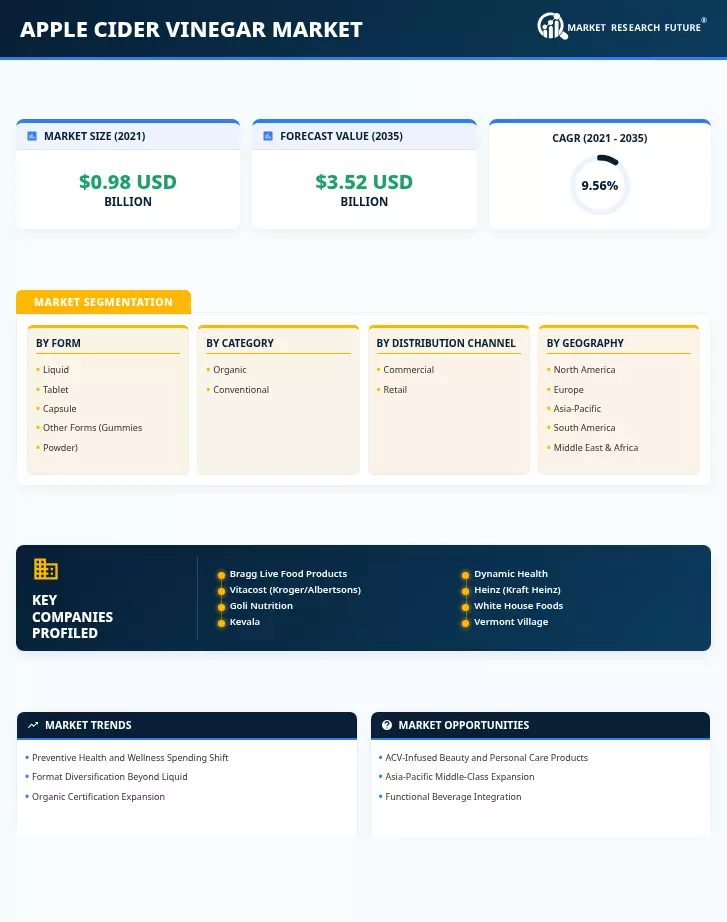
Apple Cider Vinegar Market Size, Share, Industry Trend & Analysis Research Report Information By Form (Liquid, Tablet and Capsule, Other Forms (Gummies, Powder)), By Category (Organic, Conventional), By Distribution Channel (Commercial, Retail), By Geography (North America, Europe, Asia-Pacific, South America, Middle East & Africa) – Forecast Till 2035
Download PDF ×

We do not share your information with anyone. However, we may send you emails based on your report interest from time to time. You may contact us at any time to opt-out.

  1. 1 Market Summary |
    1. 1.1 Study Assumptions & Market Definition |
    2. 1.2 Scope of the Study |
    3. 1.3 Research Methodology
  2. 2 Key Report Takeaways
  3. 3 Market Size and Forecast (2021–2035) |
    1. 3.1 Historical Market Size (2021–2025) |
    2. 3.2 Current & Forecast Market Size (2026–2035) |
    3. 3.3 Market Size by Revenue (USD Billion) |
    4. 3.4 Year-over-Year Growth Analysis
  4. 4 Driver Impact Analysis |
    1. 4.1 Preventive Health and Wellness Spending Shift |
    2. 4.2 Format Diversification Beyond Liquid |
    3. 4.3 Organic Certification Expansion |
    4. 4.4 E-Commerce and Direct-to-Consumer Channels
  5. 5 Restraints Impact Analysis |
    1. 5.1 Regulatory Scrutiny of Health Claims |
    2. 5.2 Taste Aversion and Repeat-Purchase Friction |
    3. 5.3 Private-Label Price Compression
  6. 6 Opportunities |
    1. 6.1 ACV-Infused Beauty and Personal Care Products |
    2. 6.2 Asia-Pacific Middle-Class Expansion |
    3. 6.3 Functional Beverage Integration |
    4. 6.4 Subscription and D2C Business Models |
    5. 6.5 Foodservice and Institutional Channels
  7. 7 Regional Market Share and Country-Level Analysis |
    1. 7.1 North America | |
      1. 7.1.1 United States | |
      2. 7.1.2 Canada | |
      3. 7.1.3 Mexico |
    2. 7.2 Europe | |
      1. 7.2.1 Germany | |
      2. 7.2.2 United Kingdom | |
      3. 7.2.3 France | |
      4. 7.2.4 Italy | |
      5. 7.2.5 Spain | |
      6. 7.2.6 Nordic Countries | |
      7. 7.2.7 Russia | |
      8. 7.2.8 Rest of Europe |
    3. 7.3 Asia-Pacific | |
      1. 7.3.1 China | |
      2. 7.3.2 India | |
      3. 7.3.3 Japan | |
      4. 7.3.4 South Korea | |
      5. 7.3.5 ASEAN | |
      6. 7.3.6 Rest of Asia-Pacific |
    4. 7.4 South America | |
      1. 7.4.1 Brazil | |
      2. 7.4.2 Argentina | |
      3. 7.4.3 Rest of South America |
    5. 7.5 Middle East & Africa | |
      1. 7.5.1 Saudi Arabia | |
      2. 7.5.2 UAE | |
      3. 7.5.3 South Africa | |
      4. 7.5.4 Egypt | |
      5. 7.5.5 Rest of MEA
  8. 8 Future Outlook (2026–2035) |
    1. 8.1 Personalized Nutrition and AI-Driven Formulation |
    2. 8.2 Sustainability and Circular Supply Chains |
    3. 8.3 Regulatory Harmonization of Health Claims |
    4. 8.4 Channel Convergence — Retail, Foodservice, and Beauty
  9. 9 Market Segmentation Analysis |
    1. 9.1 By Form | |
      1. 9.1.1 Liquid | |
      2. 9.1.2 Tablet and Capsule | |
      3. 9.1.3 Other Forms (Gummies, Powder) |
    2. 9.2 By Category | |
      1. 9.2.1 Conventional | |
      2. 9.2.2 Organic |
    3. 9.3 By Distribution Channel | |
      1. 9.3.1 Retail | |
      2. 9.3.2 Commercial
  10. 10 Competitive Landscape |
    1. 10.1 Market Share Analysis (2025) |
    2. 10.2 Competitive Benchmarking Matrix |
    3. 10.3 Company Profiles | |
      1. 10.3.1 Bragg Live Food Products | |
      2. 10.3.2 Vitacost (Kroger/Albertsons) | |
      3. 10.3.3 Goli Nutrition | |
      4. 10.3.4 Kevala | |
      5. 10.3.5 Dynamic Health | |
      6. 10.3.6 Heinz (Kraft Heinz) | |
      7. 10.3.7 White House Foods | |
      8. 10.3.8 Vermont Village | |
      9. 10.3.9 WOW Life Science | |
      10. 10.3.10 Fairchild's
  11. 11 Recent News & Developments
  12. 12 Report Scope & Methodology |
    1. 12.1 Study Period & Base Year |
    2. 12.2 Data Sources & Citations |
    3. 12.3 Abbreviations
  13. 13 Detailed Sources and Citations
  14. 14 Frequently Asked Questions (FAQs)
  15. 1 LIST OF TABLES
  16. 2 LIST OF FIGURES

Segmentation Quick Reference

DimensionSub-SegmentsDominant SegmentFastest Growing Segment
By FormLiquid, Tablet and Capsule; Other Forms (Gummies, Powder)Liquid (77% share, 2025)Tablet and Capsule (10.47% CAGR)
By CategoryOrganic; ConventionalConventional (72% share, 2025)Organic (10.86% CAGR)
By Distribution ChannelCommercial; RetailRetail (USD 1.08 Billion, 2025)Commercial (10.17% CAGR)
By GeographyNorth America; Europe; Asia-Pacific; South America; Middle East & AfricaNorth America (36% share, 2025)Asia-Pacific (11.14% CAGR)


Market Segmentation Overview

By Form

Sub-SegmentKey Trend
LiquidDominant format driven by culinary versatility and raw, unfiltered ACV health rituals; premiumization via "with mother" variants
Tablet and CapsuleFastest-growing format; removes taste barrier and aligns with supplement-aisle shopping behavior.
Other Forms (Gummies, Powder)Rapid innovation cycle; gummy launches tripled year-over-year in 2024; appeals to younger demographics


Liquid ACV retains the largest share due to its dual role in cooking and wellness routines. The tablet and capsule segment is attracting new consumer cohorts — particularly those purchasing apple cider vinegar supplement capsule products through pharmacy and online supplement channels — and is expected to narrow the format share gap over the forecast period.

By Category

Sub-SegmentKey Trend
ConventionalBroad accessibility and private-label proliferation sustain volume leadership.
OrganicAccelerating adoption as USDA and EU certification incentives reduce price premiums; growing alignment with clean-label consumer expectations.


Conventional ACV benefits from mass-market pricing and universal retail availability. Organic apple cider vinegar is the growth engine of this dimension, driven by structural policy tailwinds and consumer willingness-to-pay for certified clean-label products.

By Distribution Channel

Sub-SegmentKey Trend
RetailE-commerce penetration exceeds 31% of retail ACV sales in the US; omnichannel strategies accelerate.
CommercialExpanding into foodservice, beauty contract manufacturing, and institutional cleaning applications


Retail channels dominate revenue, but the commercial segment's higher-volume contracts and diversification into beauty and personal care applications represent the fastest-growing distribution pathway for the Apple Cider Vinegar Market through 2035.

By Region

Sub-SegmentKey Trend
North AmericaMature market with format innovation and D2C subscription models driving incremental growth.
EuropeEU organic mandates and clean-beauty crossover fuel steady expansion
Asia-PacificFastest-growing region; middle-class demand in India and China, plus cultural alignment with fermented health traditions
South AmericaEarly-stage market led by Brazil; import substitution encouraging local ACV production
Middle East & AfricaHalal certification and wellness tourism are creating new demand channels in the GCC.


Asia-Pacific's rapid growth trajectory — underpinned by rising disposable incomes, e-commerce adoption, and cultural affinity for fermented foods — will progressively rebalance the Apple Cider Vinegar Market's geographic revenue mix over the next decade.