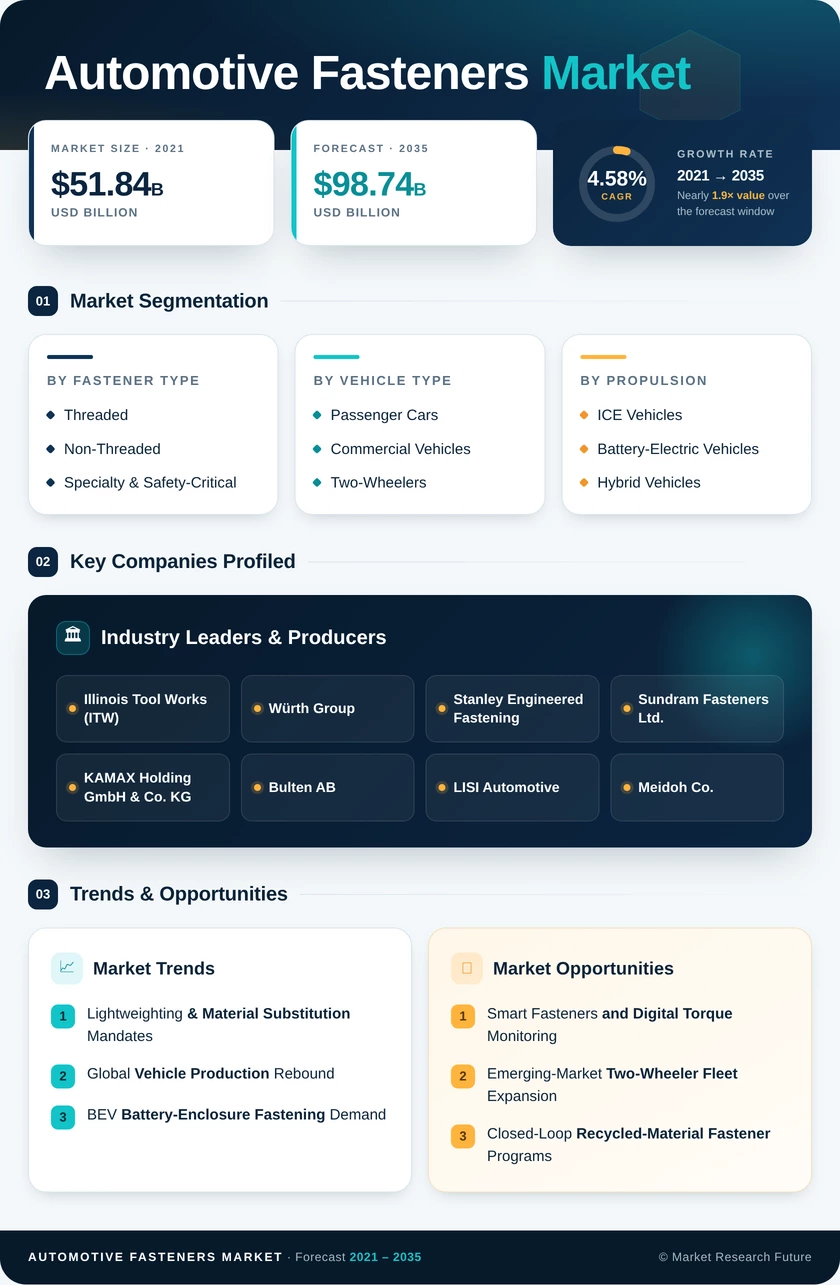
Automotive Fastener Market

ID: MRFR/AT/4938-CR
154 Pages
Triveni Bhoyar
Last Updated: June 22, 2026
Automotive Fasteners Market Research Report By Fastener Type (Threaded Fasteners, Non-Threaded Fasteners, Specialty & Safety-Critical Fasteners), By Vehicle Type (Passenger Cars, Commercial Vehicles, Two-Wheelers), By Propulsion (ICE Vehicles, Battery-Electric Vehicles, Hybrid Vehicles), By Function (Detachable Fasteners, Non-Detachable Fasteners), By Material (Steel, Aluminum, Stainless Steel, Plastics & Composites), By Coating/Finish (Zinc Coatings, Phosphate Coatings, Organic & Dry-Film Technologies, Chrome & Other Finishes), By Application (Body & Exterior, Powertrain, Chassis & Suspension, Electronics & Electrical, Interior), By Distribution Channel (OEM (Direct Supply), Aftermarket) and By Regional (North America, Europe, South America, Asia Pacific, Middle East and Africa) - Forecast to 2035
Download PDF ×

We do not share your information with anyone. However, we may send you emails based on your report interest from time to time. You may contact us at any time to opt-out.

  1. 1 Market Overview |
    1. 1.1 Study Assumptions & Market Definition |
    2. 1.2 Scope of the Study |
    3. 1.3 Research Methodology
  2. 2 Market Summary & Key Takeaways
  3. 3 Market Dynamics |
    1. 3.1 Market Drivers Analysis | |
      1. 3.1.1 Lightweighting & Material Substitution Mandates | |
      2. 3.1.2 Global Vehicle Production Rebound | |
      3. 3.1.3 BEV Battery-Enclosure Fastening Demand | |
      4. 3.1.4 Safety-Critical Joint Liability Tightening | |
      5. 3.1.5 Modular Vehicle Architecture Procurement Shift | |
      6. 3.1.6 Smart-Fastener Digitization & Torque Sensing | |
      7. 3.1.7 Emerging-Market Two-Wheeler Fleet Expansion |
    2. 3.2 Market Restraints Analysis | |
      1. 3.2.1 Adhesive Bonding & Laser Welding Substitution | |
      2. 3.2.2 Trade-Defense Duties on Steel Fasteners | |
      3. 3.2.3 BEV Powertrain Joint Count Reduction | |
      4. 3.2.4 Raw-Material Cost Volatility | |
      5. 3.2.5 Counterfeit Fastener Proliferation in the Aftermarket |
    3. 3.3 Market Opportunity Analysis | |
      1. 3.3.1 Smart Fasteners and Digital Torque Monitoring | |
      2. 3.3.2 Emerging-Market Two-Wheeler Fleet Expansion | |
      3. 3.3.3 Closed-Loop Recycled-Material Fastener Programs | |
      4. 3.3.4 Aftermarket Authenticity and Traceability Platforms | |
      5. 3.3.5 Multi-Material Joining Solutions for Mixed-Architecture Bodies |
    4. 3.4 Industry Value Chain Analysis |
    5. 3.5 Porter's Five Forces Analysis
  4. 4 Global Automotive Fasteners Market Size & Forecast (2021–2035) |
    1. 4.1 Historical Market Size (2021–2025) |
    2. 4.2 Current & Forecast Market Size (2026–2035) |
    3. 4.3 Market Size by Revenue (USD Billion) |
    4. 4.4 Year-over-Year Growth Analysis
  5. 5 Segmentation Analysis |
    1. 5.1 By Fastener Type | |
      1. 5.1.1 Threaded Fasteners | |
      2. 5.1.2 Non-Threaded Fasteners | |
      3. 5.1.3 Specialty & Safety-Critical Fasteners |
    2. 5.2 By Vehicle Type | |
      1. 5.2.1 Passenger Cars | |
      2. 5.2.2 Commercial Vehicles | |
      3. 5.2.3 Two-Wheelers |
    3. 5.3 By Propulsion | |
      1. 5.3.1 ICE Vehicles | |
      2. 5.3.2 Battery-Electric Vehicles | |
      3. 5.3.3 Hybrid Vehicles |
    4. 5.4 By Function | |
      1. 5.4.1 Detachable Fasteners | |
      2. 5.4.2 Non-Detachable Fasteners |
    5. 5.5 By Material | |
      1. 5.5.1 Steel | |
      2. 5.5.2 Aluminum | |
      3. 5.5.3 Stainless Steel | |
      4. 5.5.4 Plastics & Composites |
    6. 5.6 By Coating/Finish | |
      1. 5.6.1 Zinc Coatings | |
      2. 5.6.2 Phosphate Coatings | |
      3. 5.6.3 Organic & Dry-Film Technologies | |
      4. 5.6.4 Chrome & Other Finishes |
    7. 5.7 By Application | |
      1. 5.7.1 Body & Exterior | |
      2. 5.7.2 Powertrain | |
      3. 5.7.3 Chassis & Suspension | |
      4. 5.7.4 Electronics & Electrical | |
      5. 5.7.5 Interior |
    8. 5.8 By Distribution Channel | |
      1. 5.8.1 OEM (Direct Supply) | |
      2. 5.8.2 Aftermarket
  6. 6 Regional Analysis |
    1. 6.1 North America | |
      1. 6.1.1 United States | |
      2. 6.1.2 Canada | |
      3. 6.1.3 Mexico |
    2. 6.2 Europe | |
      1. 6.2.1 Germany | |
      2. 6.2.2 United Kingdom | |
      3. 6.2.3 France | |
      4. 6.2.4 Italy | |
      5. 6.2.5 Spain | |
      6. 6.2.6 Nordic Countries | |
      7. 6.2.7 Russia | |
      8. 6.2.8 Rest of Europe |
    3. 6.3 Asia-Pacific | |
      1. 6.3.1 China | |
      2. 6.3.2 India | |
      3. 6.3.3 Japan | |
      4. 6.3.4 South Korea | |
      5. 6.3.5 ASEAN | |
      6. 6.3.6 Rest of Asia-Pacific |
    4. 6.4 South America | |
      1. 6.4.1 Brazil | |
      2. 6.4.2 Argentina | |
      3. 6.4.3 Rest of South America |
    5. 6.5 Middle East & Africa | |
      1. 6.5.1 Saudi Arabia | |
      2. 6.5.2 UAE | |
      3. 6.5.3 South Africa | |
      4. 6.5.4 Egypt | |
      5. 6.5.5 Rest of MEA
  7. 7 Competitive Landscape |
    1. 7.1 Market Share Analysis (2025) |
    2. 7.2 Competitive Benchmarking Matrix |
    3. 7.3 Company Profiles | |
      1. 7.3.1 Illinois Tool Works (ITW) | |
      2. 7.3.2 Würth Group | |
      3. 7.3.3 Stanley Engineered Fastening | |
      4. 7.3.4 Sundram Fasteners Ltd. | |
      5. 7.3.5 KAMAX Holding GmbH & Co. KG | |
      6. 7.3.6 Bulten AB | |
      7. 7.3.7 LISI Automotive | |
      8. 7.3.8 Meidoh Co., Ltd. | |
      9. 7.3.9 Topura Co., Ltd. | |
      10. 7.3.10 Nifco Inc.
  8. 8 Future Outlook & Strategic Recommendations (2026–2035) |
    1. 8.1 Electrification Supercycle and Fastener Content Shift |
    2. 8.2 AI-Enabled Quality Control and Autonomous Assembly |
    3. 8.3 ESG Reporting and Low-Carbon Fastener Certification |
    4. 8.4 Platform Economics and Tier-2 Consolidation
  9. 9 Recent Developments & News
  10. 10 Frequently Asked Questions (FAQs)
  11. 11 Report Scope & Methodology |
    1. 11.1 Study Period & Base Year |
    2. 11.2 Data Sources & Citations |
    3. 11.3 Abbreviations
  12. 1 LIST OF TABLES
  13. 2 LIST OF FIGURES

Segmentation Quick Reference

DimensionSub-SegmentsDominant SegmentFastest Growing Segment
Fastener TypeThreaded; Non-Threaded; Specialty & Safety-CriticalThreaded FastenersSpecialty & Safety-Critical
Vehicle TypePassenger Cars; Commercial Vehicles; Two-WheelersPassenger CarsTwo-Wheelers
PropulsionICE Vehicles; Battery-Electric Vehicles; Hybrid VehiclesICE VehiclesBattery-Electric Vehicles
FunctionDetachable; Non-DetachableDetachableNon-Detachable
MaterialSteel; Aluminum; Stainless Steel; Plastics & CompositesSteelAluminum
Coating/FinishZinc; Phosphate; Organic & Dry-Film; Chrome & OtherZincOrganic & Dry-Film
ApplicationBody & Exterior; Powertrain; Chassis & Suspension; Electronics & Electrical; InteriorBody & ExteriorElectronics & Electrical
Distribution ChannelOEM (Direct Supply); AftermarketOEM (Direct Supply)Aftermarket


Market Segmentation Overview

By Fastener Type

Sub-SegmentKey Trend
Threaded FastenersDominant category: grade upgrades for BEV safety compliance
Non-Threaded FastenersPush-fit clips and rivets are growing in interior and under-hood trim
Specialty & Safety-CriticalRegulatory reclassification expanding the definition of safety-critical joints


Threaded fasteners — bolts, screws, studs, and nuts — account for the majority of automotive fastening value due to their universal applicability and serviceability. Specialty and safety-critical variants are the fastest-growing sub-segment as OEMs upgrade joint specifications to meet evolving crashworthiness and battery-containment standards.

By Vehicle Type

Sub-SegmentKey Trend
Passenger CarsVolume leader; compact crossover growth, adding incremental fastener counts
Commercial VehiclesHigher per-unit content; fleet electrification driving specification upgrades
Two-WheelersFastest-growing by CAGR; emerging-market motorization rates are accelerating


Passenger cars generate the highest aggregate fastener demand, while two-wheelers are expanding most rapidly as motorcycle and scooter production surges in India, Indonesia, and sub-Saharan Africa.

By Propulsion

Sub-SegmentKey Trend
ICE VehiclesDominant share; gradual erosion as BEV adoption accelerates
Battery-Electric VehiclesFastest-growing; battery-enclosure joints carry premium unit values
Hybrid VehiclesTransitional demand; dual fastening requirements for both ICE and electric components


ICE vehicles remain the primary demand driver by installed base, but battery-electric vehicles are reshaping the fastener product mix toward corrosion-resistant, high-specification enclosure fasteners.

By Function

Sub-SegmentKey Trend
Detachable FastenersDominant; serviceability requirements sustain demand
Non-Detachable FastenersGrowing in structural body applications, permanent joints for stiffness


Detachable fasteners lead because automotive design requires disassembly access for maintenance, repair, and recycling compliance.

By Material

Sub-SegmentKey Trend
SteelLargest share; cost-effective for high-torque structural joints
AluminumFastest-growing; driven by lightweighting and same-material body architectures
Stainless SteelGrowing in BEV enclosure and exhaust applications
Plastics & CompositesExpanding in interior, electronics, and under-hood non-structural roles


Steel dominates on strength-to-cost metrics. Aluminum fasteners are gaining share most rapidly as multi-material vehicle bodies proliferate.

By Coating/Finish

Sub-SegmentKey Trend
Zinc CoatingsLargest share; standard corrosion protection for steel fasteners
Phosphate CoatingsUsed for pre-treatment and lubricity in threaded assemblies
Organic & Dry-Film TechnologiesFastest-growing; REACH-compliant alternatives to hexavalent chromium
Chrome & Other FinishesDecorative and high-durability niche applications


Zinc-based finishes remain the industry standard. Organic and dry-film technologies are expanding fastest as environmental regulations phase out legacy chromium-based coatings.

By Application

Sub-SegmentKey Trend
Body & ExteriorLargest share: panel closure and structural assembly demand
PowertrainDeclining in BEV platforms; sustained in ICE and hybrid
Chassis & SuspensionSafety-critical; specification upgrades ongoing
Electronics & ElectricalFastest-growing: ADAS and infotainment sensor proliferation
InteriorSteady demand; trim and seating fastening


Body and exterior applications command the largest share. Electronics and electrical joints are the fastest-growing application area as vehicle electronic content per unit continues its upward trajectory.

By Distribution Channel

Sub-SegmentKey Trend
OEM (Direct Supply)Dominant; tier-2 consolidation concentrating procurement
AftermarketGrowing, replacement cycles, and traceability platforms are driving value


OEM direct supply accounts for the majority of value, with aftermarket channels expanding as vehicle-parc age and authentication-platform adoption create new demand channels.