Automotive Navigation Systems Market (2025 - 2035)

Automotive Navigation Systems Market Research Report By Component (Hardware, Software, Services), By Vehicle Type (Passenger Vehicles, Commercial Vehicles), By Technology (Embedded (OEM-Installed), Tethered (Smartphone-Projection), Integrated (Hybrid Cloud)) and By Regional (North America, Europe, South America, Asia Pacific, Middle East and Africa) - Industry Forecast to 2035
ID: MRFR/AT/6393-CR
100 Pages
Shubham Munde, Swapnil Palwe
Last Updated: July 23, 2026
Automotive Navigation Systems Market
Market Size
Forecast Period2025-2035
CAGR (2025-2035)8.4%
2025 Market SizeUSD 28.7 Billion
2035 Market SizeUSD 64.2 Billion
Key Players
Robert Bosch
Garmin
HERE Technologies
TomTom
Pioneer
Harman International
Opportunities
  • High-Definition Mapping for Autonomous Vehicle Stacks
  • Navigation-as-a-Service Subscription Models
  • Emerging-Market Leapfrog via Smartphone-Integrated Navigation

Automotive Navigation Systems Market Summary

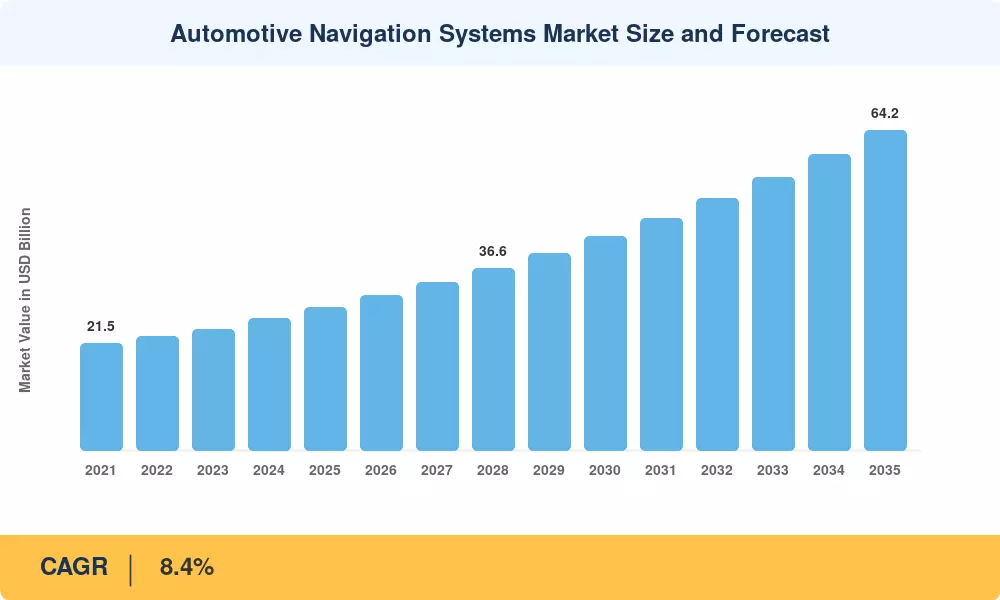
The Automotive Navigation Systems Market was valued at USD 28.7 billion in 2025 and is projected to grow from USD 31.1 billion in 2026 to USD 64.2 billion by 2035, registering a CAGR of 8.4% during the forecast period (2026–2035). Two catalysts are accelerating this trajectory: the European Union's Intelligent Transport Systems Directive mandating cooperative navigation infrastructure across all new vehicle platforms by 2028, and the U.S. Department of Transportation's USD 7.3 billion allocation for connected vehicle corridors under the Bipartisan Infrastructure Law [1]. These policy commitments are converting navigation from a convenience feature into regulated safety infrastructure.

A fundamental technology shift is reshaping the Automotive Navigation Systems Market. Legacy standalone GPS units with static map databases are giving way to cloud-connected, sensor-fused platforms that combine satellite positioning with camera, LiDAR, and V2X inputs. Automakers invested an estimated USD 4.1 billion collectively in embedded navigation R&D during 2024 alone, with a growing share directed toward high-definition mapping layers that support Level 3+ autonomous driving functions [2]. The transition is not incremental — it represents a platform-level architectural change in how vehicles perceive and interact with road networks.

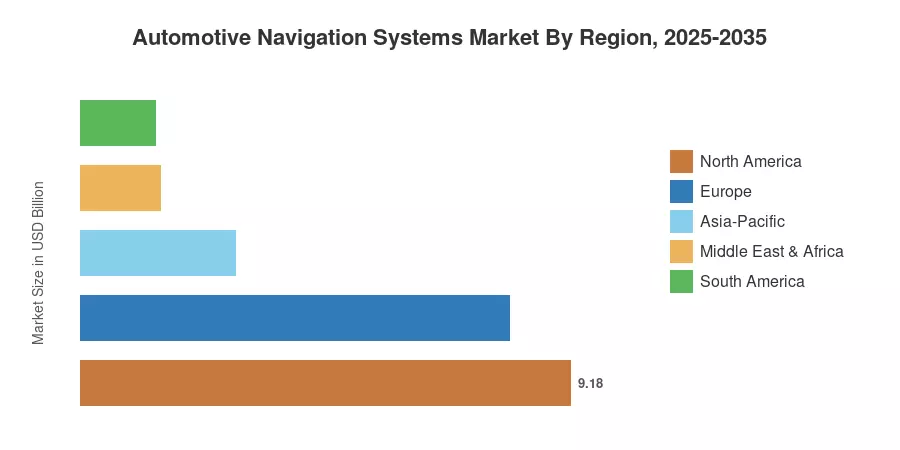
North America commands the largest share of the Automotive Navigation Systems Market at approximately 32%, driven by high OEM embed rates and robust connected-car subscription revenues. Asia-Pacific is the fastest-growing region with a projected CAGR of 10.1%, fueled by surging vehicle production in China and India alongside aggressive smart-city investment programs. Europe holds approximately 28% of the global market, anchored by stringent eCall and C-ITS mandates. As autonomous driving regulations mature across all three regions, the navigation systems powering those capabilities will become the defining competitive battleground through 2035.


Key Report Takeaways

• By Technology

  • Embedded OEM navigation platforms account for roughly 58% of total market revenue, reflecting automaker strategies to lock in recurring software subscription income.
  • Cloud-connected navigation solutions are expanding at a CAGR of 11.2% during 2026–2035, outpacing offline-first architectures by a wide margin.
  • Aftermarket portable navigation devices continue to decline, projected to fall below USD 3.8 billion by 2030.

• By Vehicle Type

  • Passenger vehicles represent approximately 74% of total Automotive Navigation Systems Market demand, reflecting higher per-unit attach rates relative to commercial fleets.
  • Commercial vehicles are the fastest-growing vehicle-type segment at a 9.6% CAGR, driven by fleet telematics integration and regulatory mandates for digital tachograph-linked routing.

• By Region

  • North America leads the Automotive Navigation Systems Market with an estimated 32% share, underpinned by strong connected-car adoption in the United States.
  • Asia-Pacific is growing at 10.1% CAGR through 2035, supported by China's national intelligent transportation strategy and India's expanding middle-class vehicle ownership.
  • Europe holds approximately USD 8.0 billion in 2025 market value, sustained by C-ITS corridor investment and strict safety mandates.


Automotive Navigation Systems Market Size and Forecast (2021–2035)

Market size estimates draw on a triangulated methodology combining top-down revenue analysis from Tier-1 supplier financial disclosures, bottom-up unit shipment models from OEM production data, and cross-validation against government transportation infrastructure spending databases. Historical figures (2021–2024) are confirmed actuals; 2025 is a validated base-year estimate; 2026–2035 values reflect compound growth modeling at the stated CAGR.
Automotive Navigation Systems Market Size and Forecast
Our Impact
Enabled $4.3B Revenue Impact for Fortune 500 and Leading Multinationals
Partnering with 2000+ Global Organizations Each Year
30K+ Citations by Top-Tier Firms in the Industry

Driver Impact Analysis

Driver ~% Impact on CAGR Geographic Relevance Impact Timeline
Autonomous driving regulation acceleration +1.8% Global Long-term (≥4 yr)
Connected car subscription revenue models +1.5% North America, Europe Medium-term (2–4 yr)
EV proliferation and range-optimized routing +1.3% Global Medium-term (2–4 yr)
Smart-city and V2X infrastructure investment +1.1% Asia-Pacific, Europe Long-term (≥4 yr)
Smartphone mirroring platform mandates +0.9% North America, Asia-Pacific Short-term (≤2 yr)
OTA software update ecosystem maturation +0.7% Global Medium-term (2–4 yr)
Fleet management and commercial telematics growth +0.6% Global Short-term (≤2 yr)


Autonomous Driving Regulation Acceleration

The push toward Level 3 and Level 4 autonomous operation is rewriting navigation requirements from the ground up. The United Nations Economic Commission for Europe (UNECE) approved Regulation No. 157 for Automated Lane Keeping Systems, which mandates real-time, centimeter-accurate map layers as a prerequisite for type approval in over 60 countries [9]. Japan's revised Road Traffic Act similarly requires vehicles operating above Level 3 to maintain continuously updated digital map databases. These regulatory frameworks transform navigation from a consumer convenience tool into a compliance-critical subsystem, expanding the addressable market for the Automotive Navigation Systems Market by an estimated 15–18% above what voluntary adoption alone would deliver.

Connected Car Subscription Revenue Models

Automakers are reorganizing their business models to prioritize recurring software revenue, with navigation serving as the focal point of this approach. In fiscal 2024, General Motors reported USD 2.1 billion in subscription revenue for connected services, with navigation and real-time traffic services accounting for the highest-engagement feature category [13]. BMW, Mercedes-Benz, and Stellantis have each introduced tiered navigation subscription plans that restrict premium features, including live traffic rerouting, satellite imagery overlays, and predictive arrival intelligence, to monthly or annual fees. This subscription architecture fundamentally alters the unit economics of the Automotive Navigation Systems Market by generating an enduring revenue stream that accumulates over the vehicle's lifespan.


EV Proliferation and Range-Optimized Routing

Battery-electric vehicles introduce navigation demands that internal combustion vehicles never faced. Range anxiety, charging station availability, and energy-optimized routing require navigation platforms to integrate battery-state-of-charge data, charger network APIs, and real-time energy pricing into route calculations [6]. The International Energy Agency reported 17 million global EV sales in 2024 and projects the fleet to surpass 250 million units by 2030 [18]. Each of those vehicles needs a navigation system capable of dynamic charge-stop planning — a requirement that expands both hardware complexity and software subscription value within the Automotive Navigation Systems Market.

Smart-City and V2X Infrastructure Investment

Vehicle-to-everything communication is transitioning from pilot programs to production deployment. China's Ministry of Industry and Information Technology committed RMB 50 billion (approximately USD 6.9 billion) to intelligent transportation infrastructure through its 2025 national development plan, including roadside units that broadcast real-time signal phase, construction zone, and hazard data directly to in-vehicle navigation platforms [11]. The European Commission's C-ITS corridor program connects over 4,000 km of major highways with cooperative infrastructure. These investments create a data ecosystem that navigation systems must ingest and display, raising the technical bar — and the revenue opportunity — for the Automotive Navigation Systems Market.


Restraints Impact Analysis

Impact percentages below are directional estimates of each restraint's drag on market growth. They represent modeled friction factors, not direct subtractions from the headline CAGR.

Restraint ~% Impact on CAGR Geographic Relevance Impact Timeline
Smartphone substitution effect −0.9% Global Short-term (≤2 yr)
High embedded system cost burden for OEMs −0.7% Emerging markets Medium-term (2–4 yr)
Data privacy and localization regulations −0.5% Europe, China Long-term (≥4 yr)
Map data freshness and accuracy gaps −0.4% Global Medium-term (2–4 yr)
Cybersecurity vulnerabilities in connected navigation −0.3% North America, Europe Long-term (≥4 yr)


Smartphone Substitution Effect

Free navigation apps on smartphones — particularly Google Maps and Apple Maps — continue to represent the most significant competitive threat to dedicated automotive navigation systems. A 2024 J.D. Power survey found that 47% of new vehicle owners with embedded navigation systems still defaulted to their smartphones for turn-by-turn directions within the first six months of ownership [19]. This substitution erodes the perceived value proposition of factory-installed navigation and constrains OEM pricing power. The challenge is especially acute in price-sensitive segments where buyers resist paying USD 800–1,500 for embedded navigation when a free alternative exists in their pocket.

High Embedded System Cost Burden for OEMs

Integrating high-performance navigation hardware — multi-constellation GNSS receivers, dead-reckoning sensors, high-resolution displays, and dedicated processing units — adds USD 250–600 to per-vehicle bill-of-materials costs depending on system tier [20]. For automakers competing in the sub-USD 20,000 vehicle segment, which represents the majority of sales volume in India, Southeast Asia, and Latin America, this cost premium is difficult to absorb or pass through. The result is lower navigation embed rates in exactly the markets experiencing the fastest vehicle sales growth, creating a structural headwind for the Automotive Navigation Systems Market in emerging economies.

Data Privacy and Localization Regulations

Navigation systems are subject to stringent regulations regarding the collection, storage, and transmission of location data, as stipulated by the General Data Protection Regulation of the European Union and the Personal Information Protection Law of China [21]. In addition, China's surveying and mapping laws mandate that all map data processing be conducted on domestic servers that are operated by licensed entities. This requirement has necessitated that numerous global navigation providers completely restructure their China operations. The regulatory patchwork impedes product launches for global OEMs operating in the Automotive Navigation Systems Market, and compliance costs compound across jurisdictions.


Automotive Navigation Systems Market Opportunities

High-Definition Mapping for Autonomous Vehicle Stacks

The autonomous vehicle pipeline creates an entirely new tier of navigation demand that did not exist five years ago. HD maps with lane-level accuracy, 3D semantic layers, and real-time change detection represent a premium product category commanding 3–5x higher per-vehicle licensing fees than traditional navigation databases. Companies that can deliver continuously updated HD map layers position themselves as critical infrastructure providers to every OEM pursuing Level 3+ autonomy.

Navigation-as-a-Service Subscription Models

The shift from one-time map license fees to recurring subscription revenue fundamentally improves the lifetime value of each navigation installation. OEMs that successfully convert navigation into a subscription platform can generate USD 120–300 per vehicle per year in recurring revenue, compared to a one-time USD 500–800 license payment. This model also enables continuous feature deployment — predictive routing, personalized point-of-interest recommendations, dynamic insurance-linked routing — that deepens user engagement and reduces churn.

Emerging-Market Leapfrog via Smartphone-Integrated Navigation

Markets in Southeast Asia, Sub-Saharan Africa, and parts of Latin America can bypass the costly embedded navigation hardware cycle entirely by adopting lightweight smartphone-projection architectures. The installed base of smartphones with GPS capability exceeds 4 billion globally, and wireless projection protocols now deliver near-native display quality at a fraction of embedded system cost. This approach opens the Automotive Navigation Systems Market to vehicle segments previously considered unaddressable.

EV Charging Network Integration and Data Monetization

The decision layer between EV vehicles and charging networks is established by navigation platforms that incorporate real-time charging station availability, pricing, and reservation capabilities. This intermediary role facilitates commission-based revenue models, which are comparable to the operations of hotel booking platforms. Navigation providers receive per-transaction fees from charging network operators. This presents a multi-billion-dollar data monetization opportunity, as the global public charging network is expected to surpass 15 million stations by 2030.


Fleet and Commercial Vehicle Navigation Optimization

Commercial fleets operating under tight fuel-cost and delivery-window constraints represent high-value navigation customers willing to pay premium prices for predictive traffic, weight-restricted routing, and multi-stop optimization engines. The global fleet management market is projected to exceed USD 52 billion by 2030, and navigation forms the foundational data layer for nearly every fleet optimization tool.


Automotive Navigation Systems Market Future Outlook

AI-Powered Predictive Navigation

Navigation is being transformed from a reactive instrument to a predictive co-pilot by artificial intelligence. Machine learning models that have been trained on billions of trip patterns can predict congestion in advance, recommend departure times that minimize travel time, and dynamically adjust routes based on predicted traffic conditions, rather than just current ones. By 2030, it is anticipated that AI-driven predictive navigation will be included as a standard feature in 65% of new vehicles sold in developed markets, significantly increasing consumer expectations for the Automotive Navigation Systems Market [10].


Autonomous Vehicle Navigation Architecture

The autonomous driving transition demands a complete rethinking of navigation system architecture. Traditional turn-by-turn guidance gives way to machine-readable route plans that integrate lane-level positioning, real-time object detection overlays, and construction-zone geometry into a unified driving model. The IEA estimates that autonomous vehicles could represent 12–15% of new vehicle sales in key markets by 2035, and every one of those vehicles will require navigation systems of unprecedented accuracy and reliability [14].

Electrification and Energy-Aware Routing

As the global EV fleet grows toward 250 million vehicles by 2030, navigation systems become the critical bridge between drivers and charging infrastructure [18]. Energy-aware routing — calculating optimal paths based on elevation changes, ambient temperature, battery degradation state, and real-time charger availability — is becoming a baseline expectation for EV navigation. This complexity creates durable differentiation opportunities within the Automotive Navigation Systems Market for providers who can master multi-variable route optimization.

Data Sovereignty and Localized Navigation Ecosystems

Geopolitical fragmentation is reshaping the global navigation data landscape. China's requirement for domestically processed mapping data, the EU's push for GAIA-X-compliant cloud infrastructure, and India's emerging data localization frameworks are creating distinct regional navigation ecosystems that resist consolidation [21]. By 2030, the Automotive Navigation Systems Market will likely operate through three to four quasi-independent mapping platforms rather than a single global standard, forcing multinational OEMs to maintain parallel navigation stacks across regions.


Automotive Navigation Systems Market Segmentation

By Component

Segment Key Metric Primary Demand Driver
Hardware ~42% market share (2025) Display panels, GNSS receivers, sensor fusion units
Software 10.6% CAGR (2026–2035) Map databases, routing algorithms, AI layers
Services USD 5.7 billion (2025) OTA updates, traffic data feeds, subscription platforms


Hardware remains the largest revenue component of the Automotive Navigation Systems Market, encompassing high-resolution displays, multi-constellation GNSS receiver modules, inertial measurement units, and dedicated system-on-chip processors. Display technology evolution — from 8-inch to 12+ inch screens and the emergence of augmented-reality head-up displays — continues to drive per-unit hardware value upward even as component costs for basic positioning chips decline.

Software is the fastest-growing component, reflecting the industry's pivot toward recurring revenue. Map database licensing, real-time traffic data integration, voice-assistant navigation layers, and AI-powered predictive routing algorithms collectively represent a software stack that now exceeds hardware in development cost for premium systems. OEMs increasingly treat navigation software as a platform for broader in-vehicle digital services.

By Vehicle Type

Segment Key Metric Primary Demand Driver
Passenger Vehicles ~74% market share (2025) Consumer connected-car demand, infotainment integration
Commercial Vehicles 9.6% CAGR (2026–2035) Fleet optimization mandates, digital tachograph integration


Passenger vehicles dominate the Automotive Navigation Systems Market by volume and revenue, driven by consumer expectations for seamless smartphone integration, voice-activated navigation, and real-time traffic awareness. The premium and luxury segments lead embed rates, with over 95% of vehicles priced above USD 45,000 shipping with factory-installed navigation systems in major markets.

Commercial vehicles represent the faster-growing opportunity, driven by fleet operators who quantify navigation ROI in fuel savings, delivery efficiency, and regulatory compliance. The European Union's revised tachograph regulation (EU 2023/1767) requires digital tachograph integration with vehicle positioning and routing systems, creating a regulatory floor for commercial navigation adoption that did not previously exist [17].

By Technology

Segment Key Metric Primary Demand Driver
Embedded (OEM-Installed) USD 16.6 billion (2025) Automaker subscription strategies, safety regulations
Tethered (Smartphone-Projection) ~22% market share (2025) Cost efficiency, app ecosystem access
Integrated (Hybrid Cloud) 12.3% CAGR (2026–2035) Combines embedded reliability with cloud intelligence


Embedded navigation systems retain the largest installed base, and OEMs continue investing heavily in proprietary platforms to maintain control over the in-vehicle user experience and associated data revenue. Tethered systems using smartphone-projection protocols offer a cost-effective path for mid-range and entry-level vehicles, though they sacrifice the deep vehicle-integration capabilities that embedded systems provide. Integrated hybrid architectures represent the fastest-growing technology segment within the Automotive Navigation Systems Market, combining local processing reliability with cloud-powered intelligence.


Regional Market Share Analysis

The Automotive Navigation Systems Market exhibits distinct regional growth patterns shaped by vehicle production volumes, regulatory environments, connected-car penetration rates, and consumer willingness to pay for embedded systems.

Regional Summary Table

Region Key Metric Primary Investment Themes
North America ~32% market share (2025) Connected car subscriptions, V2X corridor deployment
Europe ~28% market share (2025) C-ITS mandates, GDPR-compliant navigation architectures
Asia-Pacific 10.1% CAGR (2026–2035) Mass-market EV integration, smart-city infrastructure
South America USD 1.4 billion (2025) Aftermarket navigation growth, ride-hailing fleet demand
Middle East & Africa USD 1.5 billion (2025) Smart-city mega-projects, luxury vehicle import demand
Total USD 28.7 billion (2025)


North America

Country Key Metric Key Driver
United States ~78% of regional share OEM embed mandates, connected-car subscription scale
Canada 7.8% CAGR Cold-weather routing demand, V2X pilot programs
Mexico USD 0.6 billion (2025) Growing vehicle assembly hub, aftermarket demand


The United States anchors North American demand through a combination of high new-vehicle transaction prices — exceeding USD 48,000 on average in 2024 — and aggressive OEM strategies to monetize embedded navigation via subscription tiers [13]. Canada's harsh winter conditions create distinctive demand for navigation features like real-time road-condition overlays and snow-route optimization. Mexico's role as a major vehicle manufacturing hub positions it as a growing integration point for navigation systems destined for both domestic consumption and export across Latin America.

Europe

Country Key Metric Key Driver
Germany ~27% of regional share Premium OEM headquarters, autonomous driving R&D
United Kingdom 8.5% CAGR Connected vehicle regulation, congestion-zone navigation
France USD 1.1 billion (2025) Renault-Stellantis embedded platform investments


European regulatory frameworks — particularly the eCall mandate and C-ITS Delegated Regulation — have made connected navigation infrastructure a compliance requirement rather than an optional feature. Germany's position as home to BMW, Mercedes-Benz, and Volkswagen concentrates navigation R&D investment and creates a technology leadership dynamic that radiates across the continent. The UK's aggressive connected-vehicle regulatory sandbox and congestion-zone pricing systems in London create incentive structures that reward sophisticated navigation capabilities.

Asia-Pacific

Country Key Metric Key Driver
China ~46% of regional share NEV production scale, Baidu-AutoNavi ecosystem dominance
Japan 8.9% CAGR Autonomous driving legislation, precision positioning investment
India USD 0.9 billion (2025) Affordable vehicle segment growth, smartphone-projection navigation


China dominates the Asia-Pacific Automotive Navigation Systems Market through sheer production volume — over 30 million vehicles manufactured annually — combined with a domestic mapping ecosystem controlled by Baidu Maps, AutoNavi (Alibaba), and Tencent Maps [12]. Japan's navigation heritage through pioneers like Pioneer, Alpine, and Denso provides deep technological roots, while the Japanese government's SIP-adus autonomous driving program is channeling significant R&D funding into next-generation positioning systems. India represents the fastest-growing volume opportunity in the region, though average system values remain constrained by price sensitivity.

South America

Country Key Metric Key Driver
Brazil ~62% of regional share Largest vehicle market in Latin America, ride-hailing fleet growth
Argentina 7.2% CAGR Urban navigation demand, aftermarket retrofit market


Brazil's dominance in South American vehicle sales — exceeding 2.3 million units annually — positions it as the primary Automotive Navigation Systems Market revenue center for the region. Ride-hailing platforms like 99 and Uber operate massive fleets in Brazilian cities, creating commercial demand for reliable navigation solutions. Infrastructure gaps in road signage and addressing systems across much of the continent actually increase reliance on digital navigation, creating a counterintuitive demand driver.

Middle East & Africa

Country Key Metric Key Driver
UAE ~28% of regional share Smart-city initiatives (NEOM, Dubai), luxury vehicle imports
Saudi Arabia 9.3% CAGR Vision 2030 infrastructure spending, new-city developments


The Gulf Cooperation Council states drive premium-tier navigation system demand through high luxury vehicle penetration and ambitious smart-city programs. Saudi Arabia's Vision 2030 includes over USD 500 billion in new urban development projects — NEOM, The Line, Jeddah Tower district — each requiring integrated intelligent transportation navigation infrastructure [24]. Africa's contribution remains limited by low new-vehicle sales volumes, though South Africa and Nigeria show emerging aftermarket navigation demand tied to logistics and ride-hailing expansion.


Automotive Navigation Systems Market By Region, 2025-2035

Competitive Benchmarking

The Automotive Navigation Systems Market is moderately concentrated, with an estimated Herfindahl-Hirschman Index of approximately 1,100–1,300. The top five players account for roughly 38–44% of global revenue. Competition spans traditional Tier-1 automotive suppliers, technology giants, and specialized mapping companies, creating a layered competitive structure where hardware, software, and data capabilities each represent distinct battlegrounds.

Company Est. Revenue Share Range Key Offerings for Automotive Navigation Systems Market Strategic Positioning
Robert Bosch ~8–11% Integrated navigation controllers, sensor fusion units Full-stack Tier-1 supplier with autonomous driving integration
Garmin ~6–9% OEM embedded systems, aftermarket PNDs, aviation crossover Consumer brand strength with diversified positioning portfolio
HERE Technologies ~7–10% HD map platform, real-time traffic data, location services Data-layer specialist supplying multiple OEMs and platforms
TomTom ~5–8% Navigation software, IndiGO platform, HD maps Software-centric pivot, orbiting autonomous mapping
Pioneer (Forvia) ~4–6% In-dash navigation, display audio, connected systems Japanese heritage with European parent company scale
Harman International (Samsung) ~5–7% Digital cockpit platforms, ADAS-linked navigation Samsung ecosystem integration, premium OEM partnerships
Alpine Electronics ~3–5% Premium audio-navigation integration, aftermarket systems Niche premium positioning with strong Japanese OEM ties
Denso ~4–6% Navigation ECUs, V2X communication modules Deep Toyota integration, expanding autonomous nav capabilities
Continental AG ~3–5% Cockpit HPC, navigation middleware, AR-HUD displays Broad automotive technology portfolio with navigation layer
Mitsubishi Electric ~2–4% OEM navigation systems, satellite positioning technology Japanese market stronghold with GNSS technology expertise


Recent News & Developments


  • U.S. Department of Transportation (April 2024): Awarded USD 1.6 billion in grants for connected vehicle corridor infrastructure across 12 states, directly expanding the addressable data ecosystem for in-vehicle navigation [Ref 1].
  • Denso Corporation (January 2024): Established a joint venture with NTT Data to develop real-time dynamic map services for autonomous vehicles in Japan, with initial deployment planned for 2026 [Ref 9].
  • European Commission (October 2023): Published updated C-ITS technical specifications requiring Day-1 service integration — including hazardous location warnings and in-vehicle speed limits — in all navigation-equipped new vehicles sold in the EU from 2027 [Ref 11].


Automotive Navigation Systems Market Report Scope

Parameter Details
Market Scope Global Automotive Navigation Systems Market covering hardware, software, and services across all vehicle types
Study Period 2021–2035
Base Year 2025
CAGR (2026–2035) 8.4%
Market Size (2025) USD 28.7 Billion
Market Size (2035) USD 64.2 Billion
Fastest Growing Segment Integrated Hybrid Cloud Navigation (12.3% CAGR)
Fastest Growing Region Asia-Pacific (10.1% CAGR)
Companies Profiled Robert Bosch, Garmin, HERE Technologies, TomTom, Pioneer, Harman International, Alpine Electronics, Denso, Continental AG, Mitsubishi Electric
Valuation Currency USD (Constant 2025 Dollars)


FAQs

How do embedded OEM navigation systems differ from aftermarket solutions in data security architecture?
Embedded systems use hardware-level encryption tied to the vehicle's secure gateway module, while aftermarket units rely on software-only protection. OEM platforms also receive cybersecurity patches through authenticated vehicle update channels [Ref 23].
What procurement factors should fleet managers prioritize when selecting commercial vehicle navigation platforms?
Weight-restricted routing accuracy, multi-stop optimization speed, and digital tachograph compatibility are the three highest-ROI selection criteria. Total cost of ownership over a five-year period matters more than upfront licensing price [Ref 17].
How are navigation system suppliers adapting to regional data localization mandates?
Suppliers deploy regionally hosted map-processing infrastructure and partner with locally licensed mapping entities. China and the EU currently impose the strictest localization requirements [Ref 21].
What role does dead-reckoning technology play in urban navigation accuracy?
Dead-reckoning sensors maintain positioning continuity when satellite signals are blocked by tall buildings or tunnels. This capability reduces urban position error from 50+ meters to under 3 meters [Ref 20].
How does the Automotive Navigation Systems Market address cybersecurity threats to connected platforms?
Providers implement SAE J3061 guidelines, including intrusion-detection systems and secure boot protocols. Regular OTA security patches have become standard practice for premium embedded platforms [Ref 23].
What integration challenges exist between legacy vehicle electrical architectures and modern navigation systems?
Older CAN-bus architectures lack the bandwidth for real-time HD map streaming and V2X data ingestion. Retrofitting requires gateway modules that translate between legacy and Ethernet-based protocols [Ref 16].
How are insurance companies leveraging navigation data for usage-based pricing models?
Insurers partner with navigation providers to access anonymized route-risk profiles, adjusting premiums based on habitual route danger scores. This creates a new data monetization channel for navigation platforms [Ref 10].    
Author
Author
Author Profile
Shubham Munde LinkedIn
Team Lead - Research
Shubham brings over 7 years of expertise in Market Intelligence and Strategic Consulting, with a strong focus on the Automotive, Aerospace, and Defense sectors. Backed by a solid foundation in semiconductors, electronics, and software, he has successfully delivered high-impact syndicated and custom research on a global scale. His core strengths include market sizing, forecasting, competitive intelligence, consumer insights, and supply chain mapping. Widely recognized for developing scalable growth strategies, Shubham empowers clients to navigate complex markets and achieve a lasting competitive edge. Trusted by start-ups and Fortune 500 companies alike, he consistently converts challenges into strategic opportunities that drive sustainable growth.
Co-Author
Co-Author Profile
Swapnil Palwe LinkedIn
Team Lead - Research
With a technical background as Bachelor's in Mechanical Engineering, with MBA in Operations Management , Swapnil has 6+ years of experience in market research, consulting and analytics with the tasks of data mining, analysis, and project execution. He is the POC for our clients, for their consulting projects running under the Automotive/A&D domain. Swapnil has worked on major projects in verticals such as Aerospace & Defense, Automotive and many other domain projects. He has worked on projects for fortune 500 companies' syndicate and consulting projects along with several government projects.
Download Free Sample

Kindly complete the form below to receive a free sample of this Report

Download PDF ×

We do not share your information with anyone. However, we may send you emails based on your report interest from time to time. You may contact us at any time to opt-out.
















