Automotive Secondary Wiring Harness Market (2026 - 2035)

Automotive Secondary Wiring Harness Market Research Report By Application (Body Wiring, Power Distribution, Chassis Wiring, HVAC Wiring, Infotainment & Connectivity Wiring, Others), By Vehicle Type (Passenger Cars, Light Commercial Vehicles, Heavy Commercial Vehicles, Two-Wheelers), By Material Type (Copper, Aluminum, Composites, Others), By Connector Type (Sealed Connectors, Unsealed Connectors, Multi-Connector Systems, Others), By Technology (Conventional Wiring, Smart Wiring Systems), By End User (OEMs, Aftermarket Suppliers) and By Regional (North America, Europe, South America, Asia Pacific, Middle East and Africa) - Forecast to 2035
ID: MRFR/AT/4633-HCR
100 Pages
Triveni Bhoyar, Swapnil Palwe
Last Updated: August 27, 2026
Automotive Secondary Wiring Harness Market
Market Size
Forecast Period2026-2035
CAGR (2026-2035)4.40%
2025 Market SizeUSD 16.08 Billion
2035 Market SizeUSD 24.75 Billion
Key Players
Sumitomo Electric / Sumitomo Wiring Systems
Yazaki Corporation
Aptiv PLC
Samvardhana Motherson International
LEONI AG
Furukawa Electric
Opportunities
  • Sensor-Instrumented Smart Looms
  • Aluminum and Composite Substitution
  • Emerging Market Localization

Automotive Secondary Wiring Harness Market Summary

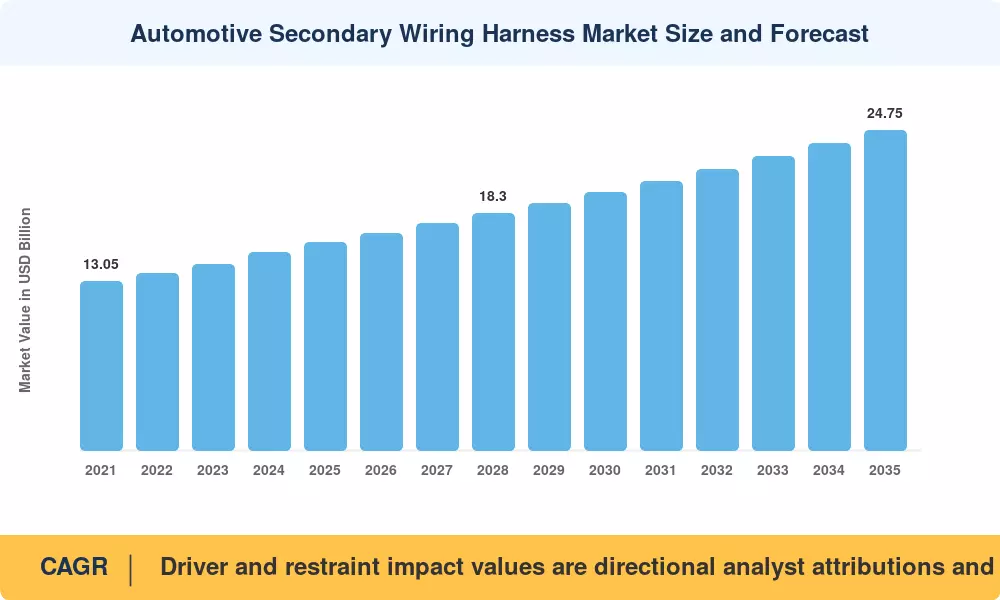
The Automotive Secondary Wiring Harness Market was valued at USD 16.08 billion in 2025, opens the forecast window at USD 16.79 billion in 2026, and is projected to reach USD 24.75 billion by 2035 at a 4.40% CAGR. Growth in the Automotive Secondary Wiring Harness Market is anchored to two catalysts that buyers can actually underwrite: the European Union's proposed End-of-Life Vehicles Regulation, which pushes recycled-content and dismantlability requirements deep into interior assemblies [10], and sustained public support for vehicle electrification programs that keep raising electrical content per unit [16].

Vehicle architecture is doing the heavy lifting here. Point-to-point looms designed around a central body control module are giving way to zonal E/E topologies, dual-voltage 48 V rails, and multiplexed data backbones that shorten some runs while multiplying connector counts elsewhere. Global electric car sales passed 17 million units in 2024, roughly one in five new cars sold [1], and each of those vehicles carries thermal-cycle, shielding, and high-current requirements that legacy 12 V looms were never validated against. Suppliers in the Automotive Secondary Wiring Harness Market are responding with sensor-instrumented assemblies and modular sub-looms built for platform reuse.

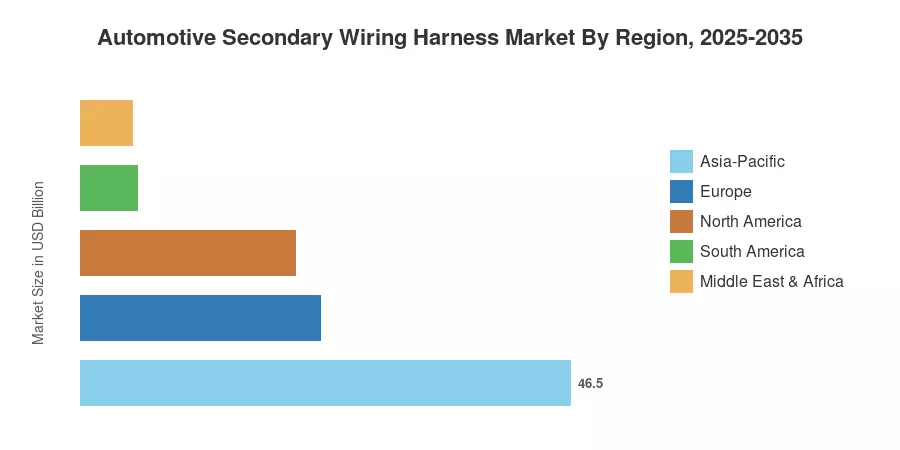
Regionally, Asia-Pacific holds 46.5% of the Automotive Secondary Wiring Harness Market, supported by Chinese output of more than 31 million vehicles in 2024 [3]. India is the fastest-expanding national market at a 6.42% CAGR, driven by feature democratization in sub-USD 15,000 hatchbacks [12]. Europe ranks second at USD 3.67 billion, where premium interior electronics and stringent recyclability rules sustain value per vehicle. Expect content growth, not unit growth, to define the next decade.


Key Report Takeaways

• By Technology

  • Smart wiring systems are the fastest-advancing technology tier at a 7.25% CAGR through 2035, reflecting diagnostic and load-management integration.
  • Conventional wiring still anchors volume shipments across the Automotive Secondary Wiring Harness Market, compounding at 3.62% CAGR.

• By Application

  • Body wiring accounts for 44.1% of application demand, the single largest pool in the Automotive Secondary Wiring Harness Market.

• By Vehicle Type

• By End User

  • Body wiring accounts for 44.1% of application demand, the single largest pool in the Automotive Secondary Wiring Harness Market
  • Passenger cars represent 56.5% of vehicle-type dema
  • OEM channels generated USD 13.48 billion in 2025, with aftermarket suppliers taking the balance.

• By Region

  • Asia-Pacific commands 46.5% of global demand.
  • Europe contributed USD 3.67 billion in 2025.
  • South America is compounding at 4.31% CAGR, led by Brazilian assembly recovery.


Market Size and Forecast (2021–2035)

Estimates were built bottom-up from vehicle production data, harness content-per-vehicle benchmarks by segment, and validated against tier-1 electrical distribution segment disclosures. Historical values reconcile to published production volumes; forecast values apply platform-refresh cycles and electrification penetration curves to a 2025 base for the Automotive Secondary Wiring Harness Market.
Automotive Secondary Wiring Harness Market Size and Forecast
Our Impact
Enabled $4.3B Revenue Impact for Fortune 500 and Leading Multinationals
Partnering with 2000+ Global Organizations Each Year
30K+ Citations by Top-Tier Firms in the Industry

Driver Impact Analysis

Driver ~% Impact on CAGR Geographic Relevance Impact Timeline
Electrification content per vehicle +1.05 pp Global, APAC-led Long-term (≥4 yr)
48 V dual-voltage architecture adoption +0.62 pp Europe, North America Medium-term (2–4 yr)
ADAS sensor and camera proliferation +0.55 pp Global Medium-term (2–4 yr)
Asia-Pacific production volume expansion +0.48 pp Asia-Pacific Short-term (≤2 yr)
Comfort feature democratization in entry trims +0.34 pp India, ASEAN, LatAm Short-term (≤2 yr)
Nearshoring of assembly to Morocco, Egypt, Thailand +0.29 pp EMEA, ASEAN Medium-term (2–4 yr)
Telematics and connectivity retrofits +0.22 pp North America, Europe Long-term (≥4 yr)


Electrification Content Per Vehicle

Battery-electric platforms have far more interior electrical content than the combustion vehicles they replace — higher-gauge power distribution, thermal management monitoring, and pack-adjacent looms that are rated for broader temperature fluctuations. In 2024, worldwide electric car sales hit 17 million units, approximately 20% of new car sales [1], while BloombergNEF’s base case scenario for passenger EV penetration is more than 45% of global sales by 2035 [21]. That mix shift alone adds recurrent dollar content per unit, regardless of output volume.


Dual-Voltage 48 V Architectures

Mild-hybrid systems have quietly become the default, cost-efficient compliance method for European and North American fleets facing stricter CO2 standards. Aptiv’s electrical distribution disclosures point to dual-voltage programs being a fundamental content driver across their book of business [6]. Each 48 V rail has its own conductor sizing, fusing technique, and isolation scheme. This multiplies sub-assembly count within body, door and roof zones.


ADAS Sensor Density

Radar, camera and ultrasonic clusters have shifted from premium to volume segments quicker than most content models have expected. Tracking of ICCT deployments suggests that the great majority of new vehicles in major markets are equipped with automatic emergency braking [9]. Sensors require shielded, properly routed drops. The splice density goes up proportionally. All secondary harness splice connectors in a door or A-pillar path must survive several thousand temperature and vibration cycles without impedance drift.


Asia-Pacific Volume Expansion

China produced over 31 million vehicles in 2024, with new-energy models taking an increasing share of that total [3]. India added capacity in parallel, with domestic passenger vehicle dispatches setting successive records [12]. Volume of this scale keeps unit demand rising even as per-vehicle loom length is engineered downward on newer platforms.


Restraints Impact Analysis


Restraint ~% Impact on CAGR Geographic Relevance Impact Timeline
Copper price volatility −0.48 pp Global Medium-term (2–4 yr)
Zonal consolidation shortening loom runs −0.41 pp Europe, North America Long-term (≥4 yr)
Assembly labor cost inflation −0.33 pp E. Europe, N. Africa, ASEAN Short-term (≤2 yr)
Wireless and power-line data displacing signal wiring −0.26 pp Global Long-term (≥4 yr)
Validation cost of material substitution −0.21 pp Global Medium-term (2–4 yr)


Copper Price Volatility

Copper remains the dominant conductor, and its price path flows almost directly into harness quotations because raw material can exceed half of assembly cost. World Bank commodity forecasting has flagged continued tightness in refined copper balances through the medium term [20], while ICSG guidance projects a refined copper surplus (~96,000 tonnes)[8]. Tier-1 suppliers pass much of this through via indexed contracts, yet the lag erodes margin and dampens OEM appetite for optional content.

Zonal Architecture Consolidation

Architectural remodeling poses the most credible long-run danger to loom volume. Dozens of ECUs are reduced to a handful of zone controllers, which translates to much shorter signal paths and the replacement of meters of copper with short local drops and a shared backbone. Aptiv has publicly stated that this change is at the heart of their electrical distribution strategy [6]. Value is moving toward connectors, power electronics and software — not conductor mass.


Assembly Labor Economics

Harness assembly remains a labor-intensive process despite decades of automation efforts. The fast increase of capacity in Morocco’s automotive ecosystem, which now underpins a substantial share of the wiring supply for Europe, has seen wages and logistics costs climb [14]. Suppliers responded by opening Egyptian and Thai factories [15][24], but every new footprint has qualifying costs before it earns any savings.


Automotive Secondary Wiring Harness Market Opportunities


Sensor-Instrumented Smart Looms

Embedding current sensing and fault localization into the harness converts a passive assembly into a diagnostic asset. UNECE R155 cybersecurity management obligations already require traceable electrical system integrity across the vehicle lifecycle [11], which gives instrumented looms a compliance rationale alongside a warranty one.

Aluminum and Composite Substitution

Weight reduction and copper hedging point in the same direction. Furukawa and other conductor specialists have commercialized secondary harness lightweight aluminum solutions for door, roof, and floor circuits where current draw permits [22]. Adoption hinges on crimp reliability and galvanic corrosion control rather than on material cost alone.

Emerging Market Localization

India, ASEAN, and North Africa offer a rare combination: rising domestic assembly, tariff-advantaged export access, and available labor. Egypt's investment authority has actively courted feeder-industry investment for exactly this reason [24], and Thailand's Board of Investment maintains incentive packages for automotive parts localization [15].

Predictive Maintenance Data Services

Harness-level fault telemetry has commercial value beyond the vehicle warranty period. Fleet operators will pay for early detection of chafing, corrosion, or connector fretting, and suppliers can monetize that stream as a subscription rather than a one-time part sale. This is the clearest new-business-model opening in the sector.

Aftermarket Retrofit Channels

Telematics mandates and insurance-linked device installation sustain retrofit demand across older parc segments. NHTSA rulemaking activity around connected safety functions continues to expand the addressable installed base [17].


Automotive Secondary Wiring Harness Market Future Outlook

Software-Defined Vehicles and Zonal Convergence

By the early 2030s, most volume platforms will run zonal architectures with high-speed automotive Ethernet backbones. Harness suppliers who cannot deliver zone-controller integration and shielded high-bandwidth drops will lose scope to electronics tier-1s. Value in the Automotive Secondary Wiring Harness Market shifts from length to interface complexity.

The Electrification Supercycle

IEA projections place electric models on a path to a majority share of global sales in announced-pledge scenarios [1], while BloombergNEF models a comparable trajectory under economic momentum alone [21]. Sustained EV mix growth raises content per vehicle in a way that survives cyclical volume softness — the single most reliable underpinning of the forecast.

Circularity and Material Accountability

Recycled-content thresholds, dismantlability scoring, and supplier-level reporting obligations arriving under EU rules will reshape design reviews [10]. Suppliers that can document conductor provenance and demonstrate separable connector systems will win nomination on non-price criteria for the first time in this category.

Manufacturing Automation

Automated cutting, crimping, and vision-based inspection are advancing faster than automated routing and taping, which remain stubbornly manual. Closing that gap is the decisive cost lever for the Automotive Secondary Wiring Harness Market over the next decade, particularly for suppliers exposed to wage inflation in North Africa and Eastern Europe [14][19].


Automotive Secondary Wiring Harness Market Segmentation

Segment structure across the Automotive Secondary Wiring Harness Market follows the functional zones of the vehicle interior and the sourcing channels that serve them.

By Application

Segment Share (2025) Primary Demand Driver
Body Wiring 44.1% Door, roof, and seat electrical content
Power Distribution 18.6% Dual-voltage rails and fusing
Chassis Wiring 15.2% Sensor and actuator density
HVAC Wiring 9.4% Thermal management in EVs
Infotainment & Connectivity Wiring 8.3% Display and antenna proliferation
Others 4.4% Lighting and auxiliary circuits


Body wiring leads the Automotive Secondary Wiring Harness Market because it aggregates the highest-count, highest-variation circuits in the vehicle — window lifts, mirrors, ambient lighting, occupant sensing, and seat modules. Power distribution grows faster on a percentage basis as 48 V rails and higher-current accessory loads force conductor upsizing and smarter fusing strategies.

By Vehicle Type

Segment Share (2025) Primary Demand Driver
Passenger Cars 56.5% Volume and feature content
Light Commercial Vehicles 21.3% Last-mile fleet expansion
Heavy Commercial Vehicles 13.8% Telematics and safety mandates
Two-Wheelers 8.4% Electrification in Asia


Passenger cars dominate the Automotive Secondary Wiring Harness Market by absolute demand, yet commercial vehicles are the more interesting growth story: fleet telematics requirements and ADAS mandates for heavy trucks add content to a segment that historically ran lean electrical architectures [17].

By Material Type

Segment Share (2025) Primary Demand Driver
Copper 77.3% Conductivity and supply chain maturity
Aluminum 15.1% Weight and cost hedging
Composites 5.2% Specialty shielding applications
Others 2.4% Coated and clad conductors


Copper's entrenched position across the Automotive Secondary Wiring Harness Market reflects validated crimp science more than material economics. Composites and aluminum expand fastest as OEMs chase mass reduction, but every substitution requires fresh qualification against vibration, corrosion, and thermal-cycle protocols [22].

By Connector Type

Segment Share (2025) Primary Demand Driver
Sealed Connectors 41.0% Ingress protection in door and floor zones
Unsealed Connectors 33.5% Cabin-interior cost optimization
Multi-Connector Systems 17.2% Zonal architecture consolidation
Others 8.3% High-voltage and specialty interfaces


Sealed Connectors lead the Automotive Secondary Wiring Harness Market by connector type with a dominant 41.0% share in 2025, operating as the indispensable standard for wet and high-exposure vehicle zones (such as door harnesses, underbody sensors, and wheel arches). Multi-Connector Systems represent the fastest-growing structural segment with a 17.2% share.

By Technology

Segment CAGR (2026–2035) Primary Demand Driver
Conventional Wiring 3.62% Installed platform continuity
Smart Wiring Systems 7.25% Diagnostics and load management


By End User

Segment Market Size (USD B, 2025) Primary Demand Driver
OEMs 13.48 Build-to-sequence platform supply
Aftermarket Suppliers 2.60 Retrofit, repair, and accessory fitment


Original Equipment Manufacturers (OEMs) lead the Automotive Secondary Wiring Harness Market by end user, capturing USD 13.48 billion in revenue for 2025. This dominant share is driven by high-volume build-to-sequence assembly requirements, expanding factory-installed electronic architectures (such as ADAS and infotainment platforms), and direct integration into modern electric and hybrid vehicle assembly lines. Meanwhile, Aftermarket Suppliers represent a key secondary segment generating USD 2.60 billion, propelled by aging global vehicle fleets requiring electrical fault repairs, harness replacement routines, and third-party accessory or sensor retrofits.


Regional Market Share Analysis

Region Share of Global Market (2025) Primary Investment Themes
Asia-Pacific 46.5% EV platform localization, capacity scale-up
Europe 22.8% Recyclability compliance, premium content
North America 20.4% Nearshoring, 48 V and light-truck content
South America 5.4% Assembly recovery, flex-fuel platforms
Middle East & Africa 4.9% Export-oriented harness manufacturing
Total 100.0%


North America

Country Share of Region (2025) Key Driver
US 63.1% Light-truck electrical content growth
Canada 8.7% EV assembly investment
Mexico 28.2% Harness assembly export base


Mexico functions as the region's manufacturing floor, hosting the bulk of North American harness assembly under USMCA rules of origin. The Department of Energy's vehicle technologies programs continue to fund domestic electrification supply chains [16], while US light-truck platforms — which carry more interior electrical content than sedans — dominate the mix.

Europe

Country Market Size (USD B, 2025) Key Driver
Germany 0.94 Premium interior electronics
UK 0.48 Domestic assembly and export builds
France 0.41 EV platform launches
Italy 0.35 Commercial vehicle output
Spain 0.39 Volume assembly footprint
Nordic Countries 0.19 High EV penetration
Russia 0.26 Localized supply substitution
Rest of Europe 0.65 Central European assembly clusters


Regulatory pressure defines European demand quality. The Commission's End-of-Life Vehicles proposal ties recycled content and dismantlability directly to design decisions, including harness routing and connector accessibility [10]. ACEA data showing an ageing vehicle parc also underpins durable aftermarket volumes [4].

Asia-Pacific

Country CAGR (2026–2035) Key Driver
China 4.86% NEV platform scale
India 6.42% Feature democratization in entry segments
Japan 3.41% Hybrid content, flat volumes
South Korea 3.88% Premium EV exports
ASEAN 5.74% Assembly relocation and incentives
Rest of Asia-Pacific 4.95% Capacity additions


Asia-Pacific dominance in the Automotive Secondary Wiring Harness Market rests on production scale that no other region approaches [2][3]. India deserves particular attention: SIAM records successive record dispatch years, and the content gap between an entry hatchback sold in 2018 and one sold today is substantial [12]. Korean and Japanese suppliers, meanwhile, compete on validation depth rather than price [22][23].

South America

Country Share of Region (2025) Key Driver
Brazil 58.4% Assembly volume recovery
Argentina 19.7% Commercial vehicle demand
Rest of South America 21.9% Import-substitution assembly


Brazilian output anchors the region, and flex-fuel powertrains create a distinct calibration requirement for engine-adjacent secondary circuits. Import duties on completed vehicles continue to favor local assembly, which pulls harness sourcing regional rather than transpacific [2].

Middle East & Africa

Country Share of Region (2025) Key Driver
Saudi Arabia 24.6% New assembly investment
UAE 18.3% Distribution and aftermarket hub
South Africa 27.8% Established export assembly base
Egypt 16.9% Feeder-industry incentives
Rest of MEA 12.4% Aftermarket demand


Egypt and Morocco have converted proximity to Europe into a durable harness manufacturing advantage, with AMICA reporting sustained ecosystem expansion [14] and Egypt's investment authority targeting feeder industries specifically [24]. South Africa retains a mature export-oriented assembly base serving both European and Asian brands.


Automotive Secondary Wiring Harness Market By Region, 2025-2035

Competitive Benchmarking

Concentration in the Automotive Secondary Wiring Harness Market sits in moderate territory, with an estimated HHI near 1,050 and the top five suppliers holding roughly 51–55% of global revenue. Japanese incumbents lead on validated process depth, European players compete on premium-platform engineering, and Indian and Korean suppliers have used labor arbitrage plus acquisition to close scale gaps. Below the top tier, the field fragments quickly into regional specialists.

Company Est. Revenue Share Range Key Offerings for Automotive Secondary Wiring Harness Market Strategic Positioning
Sumitomo Electric / Sumitomo Wiring Systems ~15–18% Body, door, roof and floor looms; connectors Scale leader with deep OEM co-development [5]
Yazaki Corporation ~13–16% Full interior harness systems; terminals Global footprint, EMEA and Africa capacity [7]
Aptiv PLC ~9–12% Electrical distribution systems; zonal interconnect Architecture-led, software-adjacent [6]
Samvardhana Motherson International ~6–9% Modular sub-looms; commercial vehicle harnesses Acquisition-driven global expansion [18]
LEONI AG ~5–7% Wiring systems and cable assemblies European premium platform focus [19]
Furukawa Electric ~5–7% Copper and aluminum conductor harnesses Conductor materials innovator [22]
Lear Corporation ~4–6% E-Systems interior distribution Seating-adjacent integration advantage [13]
Kyungshin Corporation ~3–5% Passenger car secondary looms Korean OEM alignment [23]
Fujikura Ltd. ~3–4% Harness assemblies and connectors Japanese OEM co-location
Kromberg & Schubert ~2–4% Premium interior wiring systems Niche European specialist
Coroplast Group ~1–3% Cable assemblies, harness protection tapes Component-level differentiation


Recent News & Developments

  • Aptiv PLC (January 2025): Announced plans to separate its Electrical Distribution Systems business into a standalone entity, signalling that harness economics and electronics economics no longer fit under one strategy [6].
  • European Commission (July 2023): Published the End-of-Life Vehicles Regulation proposal, extending recycled-content and dismantlability obligations into interior electrical assemblies [10].
  • Sumitomo Wiring Systems (May 2024): Expanded North African harness capacity to serve European assembly programs under shortened lead times [5][14].
  • Yazaki Corporation (July 2023): Commissioned additional Egyptian assembly capacity, deepening the Mediterranean supply corridor into Europe [7][24].
  • Samvardhana Motherson (October 2023): Added wiring harness capacity across Indian and European sites, consolidating its position among the top global suppliers [18].
  • Thailand Board of Investment (October 2024): Approved a fresh incentive tranche for automotive parts localization, directly benefiting harness assemblers serving ASEAN plants [15].


  • LEONI AG (May 2023): Completed a restructuring and ownership transition, refocusing its wiring systems division on higher-margin European platforms [19].


Automotive Secondary Wiring Harness Market Report Scope

Parameter Detail
Market Scope Secondary wiring harness assemblies for body, chassis, power distribution, HVAC, and infotainment circuits across all vehicle classes
Study Period 2021–2035 (Historical 2021–2024; Base Year 2025; Forecast 2026–2035)
CAGR 4.40% (2026–2035)
Market Size Checkpoints USD 16.08 Billion (2025); USD 16.79 Billion (2026); USD 24.75 Billion (2035)
Fastest Growing Segments Smart wiring systems; commercial vehicles; India and ASEAN
Companies Profiled 11 suppliers spanning Japan, Europe, North America, India, and Korea
Valuation Currency USD Billion
CAGR Driver Disclaimer Driver and restraint impact values are directional analyst attributions and are not additive to the headline growth rate

FAQs

How should procurement teams structure multi-year contracts in the Automotive Secondary Wiring Harness Market?
Index copper directly to LME with quarterly resets, and negotiate labor escalators separately by manufacturing country. Bundling both into one fixed price transfers risk; suppliers will price defensively [20].
What qualification hurdles slow aluminum conductor adoption in secondary circuits?
Crimp joint reliability and galvanic corrosion at copper-aluminum interfaces drive most rejections. Expect 18 to 24 months of vibration, salt-spray, and thermal-cycle validation before a production nomination [22].
How does supplier footprint concentration create risk in the Automotive Secondary Wiring Harness Market?
Harness assembly clusters heavily in a few low-cost corridors, so a single regional disruption can halt multiple OEM lines. Dual-source across separate regions, not separate plants within one country [14].
Which validation tests matter most when qualifying a new harness supplier?
Prioritize connector retention force after thermal ageing, terminal fretting resistance, and insulation abrasion at routing clips. These three account for the majority of field failures in interior circuits [17].
Do zonal architectures weaken tier-1 leverage in the Automotive Secondary Wiring Harness Market?
They shift leverage toward suppliers who own the zone controller interface. Pure assembly specialists lose scope unless they add power electronics or diagnostic capability [6].
Are harness assemblies exposed to rules-of-origin risk?
Yes, substantially. USMCA regional value content and EU origin rules both scrutinize conductor sourcing, so a harness assembled locally from imported wire may still fail preferential treatment tests [2].
How do repairability regulations affect aftermarket harness demand?
Dismantlability requirements under proposed EU rules push designs toward separable connectors rather than moulded assemblies. That change enlarges the serviceable repair market over the next decade [10].    
Author
Author
Author Profile
Triveni Bhoyar LinkedIn
Senior Research Analyst
Triveni Bhoyar has over 5 years of experience in the market research industry, specializing in the Automotive and Aerospace & Defense sectors. She has contributed to 200+ reports, including numerous custom projects for leading global companies, delivering solutions to complex business challenges. Renowned for her ability to generate valuable insights, Triveni excels in addressing unique market dynamics with precision and depth. Her expertise spans market sizing, competitive intelligence, and trend analysis, enabling clients to craft data-driven growth strategies. With strong analytical rigor and a client-centric approach, she plays a pivotal role in driving impactful, strategic decision-making.
Co-Author
Co-Author Profile
Swapnil Palwe LinkedIn
Team Lead - Research
With a technical background as Bachelor's in Mechanical Engineering, with MBA in Operations Management , Swapnil has 6+ years of experience in market research, consulting and analytics with the tasks of data mining, analysis, and project execution. He is the POC for our clients, for their consulting projects running under the Automotive/A&D domain. Swapnil has worked on major projects in verticals such as Aerospace & Defense, Automotive and many other domain projects. He has worked on projects for fortune 500 companies' syndicate and consulting projects along with several government projects.

Research Approach


Secondary Research

The secondary research process involved comprehensive analysis of regulatory databases, technical standards repositories, automotive production statistics, and authoritative industry publications. Key sources included the International Organization of Motor Vehicle Manufacturers (OICA) for global vehicle production data; International Energy Agency (IEA) Global EV Outlook and UN ECE (United Nations Economic Commission for Europe) for electric vehicle adoption and regulatory frameworks; SAE International (Society of Automotive Engineers) and ISO (International Organization for Standardization) technical standards (specifically ISO 6722, ISO 19642) for automotive cable specifications; US National Highway Traffic Safety Administration (NHTSA) and Environmental Protection Agency (EPA) for safety and emissions mandates; European Automobile Manufacturers Association (ACEA), China Association of Automobile Manufacturers (CAAM), and Japan Automobile Manufacturers Association (JAMA) for regional production trends; London Metal Exchange (LME) and US Geological Survey (USGS) for copper and aluminum commodity pricing; UN Comtrade (HS codes 8544, 8708) for trade flow analysis; SAE MOBILUS technical papers for engineering architectures; and BloombergNEF, Reuters Automotive, and IHS Markit (S&P Global Mobility) for electric vehicle penetration and wiring harness content per vehicle forecasts.

These sources were utilized to collect vehicle production statistics, regulatory compliance data (LV 148, EMC standards), material substitution trends, high-voltage harness adoption rates in xEVs, and regional manufacturing cost structures across engine, cabin, door, airbag, and HVAC harness categories.


Primary Research

During the primary research process, qualitative and quantitative insights specific to low-voltage (<60V) and high-voltage (60-1,000V) secondary harness architectures were obtained by interviewing supply-side and demand-side stakeholders. The supply-side sources consist of CEOs, VPs of Engineering, Chief Procurement Officers, Heads of E/E Architecture, and Plant Directors from tier-1 wiring harness manufacturers (Yazaki, Sumitomo Electric, Aptiv, LEONI, Furukawa Electric, Fujikura), tier-2 specialized component suppliers (connector, terminal, and corrugated tube manufacturers), and copper/aluminum conductor material providers. Global Directors of Purchasing, Senior Vehicle Line Managers, Chief Engineers for Electrical Systems, and E/E Architecture Leads from major OEMs (Volkswagen Group, Toyota, GM, Ford, Hyundai, BYD, Tesla) and commercial vehicle manufacturers, as well as aftermarket channel strategists and EV platform engineering heads, comprised "demand-side sources." Primary research verified market segmentation across ICE, BEV, PHEV, and HEV platforms, confirmed high-voltage harness content growth trajectories, and gathered insights on aluminum substitution rates, modular harness design adoption, pricing pressures from commodity volatility, and zonal E/E architecture transitions.

Primary Respondent Breakdown:

By Designation: C-level Primaries (32%), Director Level (33%), Others (35%)

By Region: North America (32%), Europe (30%), Asia-Pacific (35%), Rest of World (3%)


Market Size Estimation

Global market valuation was derived through revenue mapping and vehicle-parc analysis specific to secondary harness content per vehicle. The methodology included:

The identification of over 50 essential manufacturers in North America, Europe, Asia-Pacific (including China, Japan, South Korea, and India), and Latin America, which includes global tier-1 harness suppliers and regional specialists.

Product mapping across cabin/interior harnesses, door harnesses, engine harnesses, airbag harnesses, electronic parking brake systems, electronic gear shift systems, HVAC sub-harnesses, ADAS sensor looms, and high-voltage auxiliary harnesses for xEV applications

Vehicle-level content analysis analyzing average wire length, circuit count, and ASP variations across passenger cars (sedans, SUVs, hatchbacks), light commercial vehicles, and heavy-duty trucks/buses, with separate modeling for ICE versus BEV/PHEV architectures (accounting for high-voltage shielding requirements)

Analysis of reported and modeled annual revenues specific to secondary wiring harness portfolios, validated against OEM procurement contract values and tier-1 supplier segment disclosures

Coverage of manufacturers representing 72-78% of global market share in 2024, with particular emphasis on Asian production hubs accounting for ~50% of global vehicle output

Extrapolation using bottom-up (country-level vehicle production × harness content value by vehicle class and propulsion type) and top-down (manufacturer revenue validation against OICA production data) approaches to derive segment-specific valuations for copper versus aluminum conductor materials and low-voltage versus high-voltage applications

Data triangulation was performed against LME copper price indices, IEA electric vehicle stock data, and patent filing trends in automotive optical fiber harnessing to ensure accuracy in forecasting through 2035.

Download Free Sample

Kindly complete the form below to receive a free sample of this Report

* Please use a valid business email

Download PDF ×

We do not share your information with anyone. However, we may send you emails based on your report interest from time to time. You may contact us at any time to opt-out.
















