2026 Automotive Wiring Harness Market

Key Players: Yazaki Corporation, Sumitomo Electric Industries, Aptiv PLC, Leoni AG, Motherson Group (SAMIL), Furukawa Electric, Lear Corporation, THB Group

2026 Automotive Wiring Harness Market

Automotive Wiring Harness Market Research Report by Material Type (Copper, Aluminum and Others), Component Type (Wires, Connectors and Terminals), Application (Engine, HVAC, Body, Chassis, Sensors, Others), Vehicle Type (Passenger Vehicle and Commercial Vehicle) - Growth & Industry Forecast to 2035
ID: MRFR/AT/1778-CR
111 Pages
Shubham Munde, Swapnil Palwe
Last Updated: June 22, 2026

Automotive Wiring Harness Market Summary

The Automotive Wiring Harness Market was valued at USD 82.10 billion in 2025 and is projected to grow from USD 90.40 billion in 2026 to USD 204.65 billion by 2035, registering a CAGR of 9.50% during the forecast period (2026โ€“2035). Stricter vehicle emission mandates โ€” including the European Union's Euro 7 proposal and China's Phase VI-B standards โ€” are accelerating the shift toward electrified powertrains, each of which carries roughly twice the harness content of a conventional internal combustion engine vehicle [1]. Meanwhile, the U.S. Inflation Reduction Act has unlocked over USD 12 billion in EV-component manufacturing incentives, directly stimulating domestic harness capacity additions across Michigan, Tennessee, and Georgia [2].

The Automotive Wiring Harness Market is at the core of a fundamental technical shift. Domain-based and zonal electrical topologies, which condense data and power distribution into fewer, higher-capability trunk lines, are replacing legacy point-to-point wiring architectures, where individual circuits run from each sensor or actuator to a central junction box. Automakers from Volkswagen to Hyundai and GM have pledged over USD 1 billion apiece for platform-level electrical-architecture redesigns for 2026โ€“2028 model years [3].

ย 

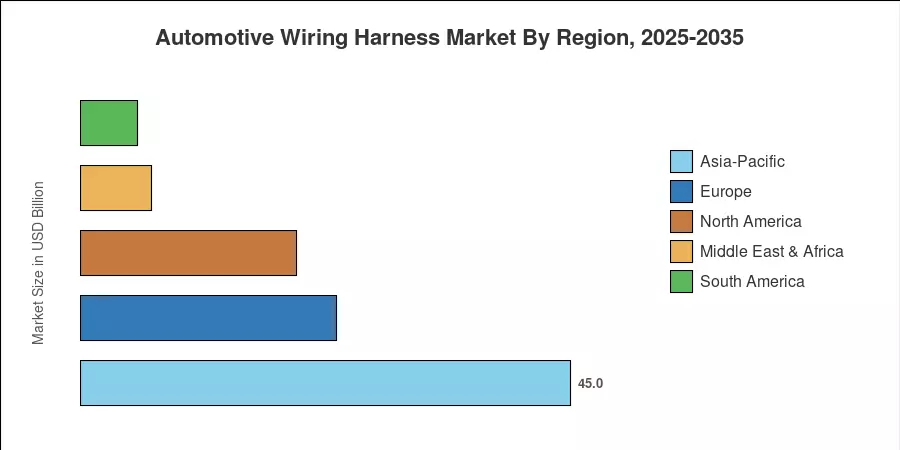
The Asia-Pacific region has the largest share of ~45.0% in the Automotive Wiring Harness Market, owing to the high EV production base in China and a growing industrial corridor in India along the Delhi โ€“ Mumbai Industrial Corridor [4]. The Middle East & Africa area is expected to have the highest CAGR of 12.60% over the projected period. The growth of this region is attributed to the burgeoning automotive cluster of Morocco and the Automotive Masterplan 2035 incentives in South Africa [5]. Europe is the second largest market, with a share of around 23.5%, with OEM giants in Germany driving demand for lightweight aluminum conductors and high-voltage cable systems.

ย 

Key Report Takeaways

โ€ข By Application Type

  • Body, lighting, and cabin wiring harnesses captured a 32.9% share of the Automotive Wiring Harness Market in 2025, reflecting the growing proliferation of ambient lighting, seat actuation, and ADAS sensor feeds across mid-tier vehicle platforms.
  • Charging and power supply harnesses are expanding at a 27.2% CAGR through 2035, as every new BEV platform requires dedicated high-voltage cable runs from battery pack to inverter and onboard charger.

โ€ข By Conductor Material

  • Copper conductors accounted for 88.8% of the Automotive Wiring Harness Market by material value in 2025, though rising LME copper prices are accelerating aluminum substitution programs among European Tier-1 suppliers.

ย 

โ€ข By Geography

  • Asia-Pacific captured a 45.0% share of the Automotive Wiring Harness Market in 2025, led by China, Japan, and India's combined automotive output exceeding 55 million vehicles annually.
  • The Middle East & Africa region is projected to register the highest regional CAGR at 12.60%, buoyed by greenfield harness plants in Morocco, Egypt, and Ethiopia.

ย 

Automotive Wiring Harness Market Size and Forecast (2021โ€“2035)

Market Research Futureโ€™s projections are based on deep-dive primary interviews with tier 1 harness makers, OEM procurement data and trade-flow analysis from UN Comtrade. The historical values (2021โ€“2024) are validated to annual reports of leading public companies, and the forecast values (2026โ€“2035) are extrapolated with a bottom-up model anchored on vehicle production forecasts from OICA and IHS Markit, corrected by harness-content-per-vehicle trends by powertrain type [6].
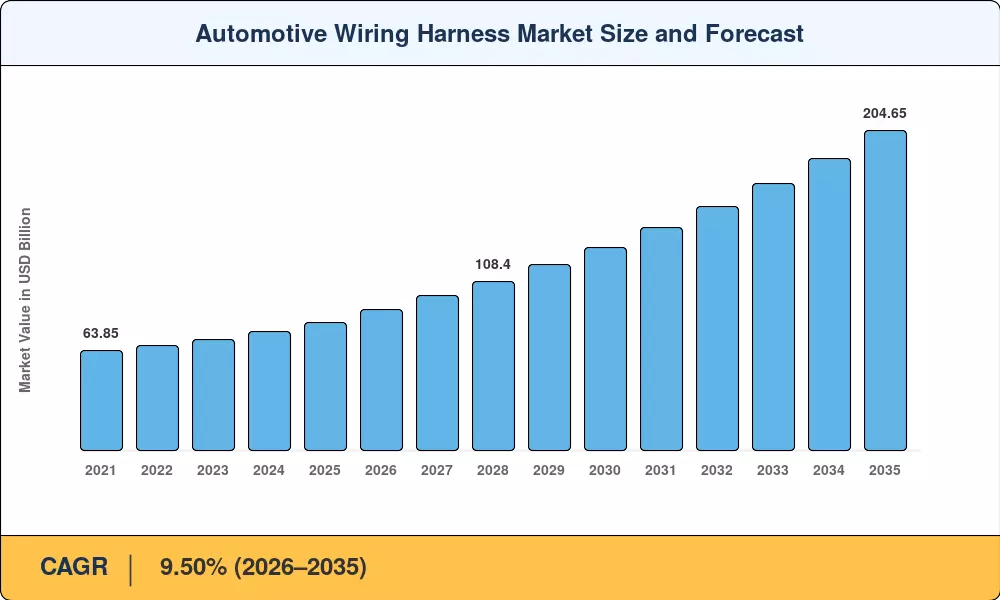
Automotive Wiring Harness Market Size and Forecast
Our Impact
Enabled $4.3B Revenue Impact for Fortune 500 and Leading Multinationals
Partnering with 2000+ Global Organizations Each Year
30K+ Citations by Top-Tier Firms in the Industry

Driver Impact Analysis

Driver ~% Impact on CAGR Geographic Relevance Impact Timeline
BEV and PHEV production ramp ~2.8% Global Short-term (โ‰ค2 yr)
800V / high-voltage platform migration ~1.9% Europe, China, N. America Medium-term (2โ€“4 yr)
Rising electronic content per vehicle ~1.5% Global Long-term (โ‰ฅ4 yr)
Government EV incentives (IRA, PLI, FAME) ~1.2% U.S., India, EU Short-term (โ‰ค2 yr)
ADAS / L2+ sensor integration ~1.0% N. America, Europe, Japan Medium-term (2โ€“4 yr)
Nearshoring & friendshoring of supply chains ~0.7% Mexico, Morocco, India Long-term (โ‰ฅ4 yr)
Connected-car data backbone requirements ~0.5% Global Long-term (โ‰ฅ4 yr)

ย 

BEV and PHEV Production Ramp

Battery-electric vehicles carry 40โ€“60% more wiring by weight than their ICE equivalents, because high-voltage battery interconnects, thermal management circuits, and onboard-charger harnesses supplement โ€” rather than replace โ€” existing low-voltage cabin wiring [13]. According to recent news, it is projected that global plug-in vehicle sales will reach 30 million units annually by 2028, translating into roughly USD 18 billion in incremental harness demand over three years [8]. Chinese OEMs alone are expected to contribute nearly 40% of that volume, given BYD's and CATL's vertically integrated supply chains that increasingly bundle harness procurement with battery-pack contracts.

800V / High-Voltage Platform Migration

The shift from 400V to 800V electrical architectures โ€” pioneered by Porsche's Taycan and now adopted by Hyundai, Kia, and GM's Ultium platform โ€” doubles charge-rate capability but requires thicker insulation, shielded conductors, and high-voltage interlock loops that raise per-vehicle harness value by an estimated USD 120โ€“180 [9]. By 2030, an estimated 35% of global BEV production will use 800V systems, creating a structural uplift in harness ASP even as copper tonnage per vehicle declines through conductor-gauge optimization [12].

Rising Electronic Content per Vehicle

The average premium passenger car now contains over 5,000 meters of wiring, up from roughly 3,000 meters a decade ago, as infotainment screens, multi-zone climate systems, power-adjustable seats, and camera-based surround-view modules each add dedicated circuits [6]. The trend accelerates in the mass-market segment too: India's Maruti Suzuki has increased electronic-content spend per vehicle by 22% between 2021 and 2024, according to its annual filings, reflecting regulatory mandates for six airbags and electronic stability control [11].

Government EV Incentives

The U.S. Inflation Reduction Act's Advanced Manufacturing Production Credit (Section 45X) offers USD 0.07 per watt-hour for battery-component manufacturing, which Aptiv, Yazaki, and Motherson have leveraged to justify USD 1.6 billion in combined U.S. harness-plant expansions announced between 2023 and 2025 [2]. India's PLI Scheme for automotive components, with an outlay of INR 259 billion (USD 3.1 billion), has specifically identified wiring harness assemblies as an eligible sub-category, catalyzing investments in Pune, Chennai, and Sanand [11].

ย 

Restraints Impact Analysis

The restraint estimates below follow the same directional-impact methodology as Section 4; negative percentages indicate drag on the baseline growth rate rather than absolute CAGR reductions.

Restraint ~% Impact on CAGR Geographic Relevance Impact Timeline
Copper price volatility ~โˆ’1.2% Global Short-term (โ‰ค2 yr)
OEM price-down pressure on Tier-1 suppliers ~โˆ’0.9% Europe, Japan Medium-term (2โ€“4 yr)
Transition complexity to new architectures ~โˆ’0.6% Global Medium-term (2โ€“4 yr)
Labor shortages in harness assembly ~โˆ’0.5% N. America, E. Europe Short-term (โ‰ค2 yr)
Wireless sensor alternatives reducing wire runs ~โˆ’0.3% N. America, Europe Long-term (โ‰ฅ4 yr)

ย 

Copper Price Volatility

LME copper prices surged past USD 10,500 per tonne in mid-2024 โ€” a 28% increase year-over-year โ€” squeezing margins for Tier-1 harness makers whose contracts with OEMs typically embed semi-annual commodity-adjustment clauses that lag spot prices by three to six months [7]. Leoni AG's 2024 earnings call disclosed a EUR 140 million negative impact from raw-material timing mismatches, underscoring the severity of this restraint on mid-tier European suppliers.

OEM Price-Down Pressure

Automotive OEMs routinely demand annual cost reductions of 3โ€“5% from harness suppliers. This dynamic has intensified as legacy automakers invest heavily in EV platforms and seek to offset those expenditures through procurement savings [18]. Japanese OEMs have been particularly aggressive: Toyota's 2025 supplier conference reportedly targeted a 4.5% annual deflation on low-voltage harness contracts, pushing smaller Japanese sub-tier manufacturers toward consolidation or exit.

Architectural Transition Complexity

Migrating from a distributed point-to-point wiring topology to domain or zone controllers requires significant upfront engineering investment, validation testing, and retooling of assembly lines that have been optimized for legacy harness designs over decades [3]. Volkswagen's MEB-to-SSP platform transition, for instance, has experienced an estimated 18-month delay partly attributable to harness-architecture redesign, illustrating how complexity can defer rather than destroy demand.

ย 

Automotive Wiring Harness Market Opportunities

Aluminum Conductor Substitution Programs

With aluminum conductors offering roughly 60% of copper's conductivity at one-third the weight and cost, OEMs targeting vehicle-level mass reduction see aluminum harness content as low-hanging fruit [15]. Leoni and Aptiv have both piloted aluminum trunk-line harnesses for body and chassis applications, and successful homologation could shift 10โ€“15% of copper harness volume to aluminum by 2032.

Greenfield Manufacturing in Africa

The shift from 400V to 800V electrical architecturesโ€”pioneered by premium marques and now expanding into mass-market platformsโ€”doubles charge-rate capability. This transition necessitates thicker insulation, shielded conductors, and high-voltage interlock loops, which increase the average per-vehicle harness cost. As 800V adoption accelerates toward 35% of global BEV production by 2030, a structural uplift in average selling price (ASP) is expected, even as manufacturers work to offset copper tonnage through conductor-gauge optimization.

ย 

Data-Backbone Monetization in Software-Defined Vehicles

As vehicles evolve into software-defined platforms, the physical Ethernet backbone embedded in wiring harnesses becomes a monetizable infrastructure layer [17]. Harness suppliers who can pre-integrate automotive-grade Ethernet switches and diagnostic taps into their assemblies stand to capture recurring software-licensing revenue from OEMs โ€” a business model pioneered by Aptiv's SVA (Smart Vehicle Architecture) platform, which bundles harness hardware with middleware licensing.

Aftermarket High-Voltage Retrofit Kits

Government policies remain a primary catalyst for capital expenditure. The U.S. Inflation Reduction Act (Section 45X) provides critical manufacturing credits that incentivize domestic harness-plant expansions. Similarly, Indiaโ€™s PLI Scheme for Automotive Components has successfully identified wiring harness assemblies as a strategic sub-category, catalyzing significant new investments in industrial hubs such as Pune, Chennai, and Sanand.

Recycled-Copper Circular Supply Chains

The EU's proposed End-of-Life Vehicle Regulation (2023/0284) mandates minimum recycled-content thresholds for automotive copper by 2035, creating first-mover advantages for harness suppliers that invest in closed-loop copper recovery [16]. Motherson Group's 2024 partnership with Aurubis AG to establish a dedicated automotive-copper recycling line in Germany exemplifies the strategic opportunity to secure cost-competitive, ESG-compliant raw materials.

ย 

Automotive Wiring Harness Market Future Outlook

Software-Defined Vehicle Architectures

The transition toward software-defined vehicles will reshape harness design from static point-to-point looms into programmable physical networks carrying power and high-speed data simultaneously. By 2030, an estimated 40% of new vehicle platforms will adopt centralized compute architectures with fewer than five zone controllers, fundamentally reducing the number of discrete wiring circuits while increasing the value and complexity of each remaining trunk line [3]. Harness suppliers that invest in Ethernet backbone integration and pre-terminated smart connectors will capture an outsized share of this architectural shift.

Electrification Supercycle

The global transition to electric mobility continues to expand the total addressable market for high-voltage (HV) wiring systems. While the International Energy Agency (IEA) projects a rapid increase in the global electric vehicle stockโ€”reaching over 500 million units by 2035 under current policy scenariosโ€”this growth creates a sustained, multi-year demand for HV harness configurations. As electrification moves beyond passenger cars into light commercial vehicles, urban buses, and two-wheelers, suppliers must adapt to a diverse range of harness configurations, ensuring scalable production to meet this long-term volume growth.

ย 

Autonomous Driving Sensor Integration

Level 3 and Level 4 autonomous vehicles require dedicated harness branches for lidar, radar, ultrasonics, and camera arrays โ€” each sensor adding 15โ€“25 meters of shielded cable and associated connectors [14]. As regulatory frameworks in Germany (StVG ยง1a/1b), Japan, and select U.S. states formalize L3 approvals, the per-vehicle sensor-harness content is expected to rise by USD 80โ€“120 between 2028 and 2032. This trend presents a premium-pricing opportunity for the Automotive Wiring Harness Market, particularly for suppliers with EMC-shielding expertise.

ESG and Circular-Economy Mandates

ESG compliance is becoming a core strategic pillar in automotive procurement. The EUโ€™s recently adopted circularity rules for vehicle design and end-of-life management now mandate minimum recycled-content thresholds for plastics (15% within six years, rising to 25% within ten years). Furthermore, while the UN Global Plastics Treaty addresses plastic pollution on a global scale, regional regulations are the primary drivers for specific material mandates. Suppliers who invest in closed-loop material recoveryโ€”sourcing recycled copper and halogen-free insulationโ€”are effectively differentiating their sustainability scorecards, transforming compliance from a cost center into a significant competitive advantage.

ย 

Automotive Wiring Harness Market Segmentation

By Application Type

Segment Key Metric Primary Demand Driver
Body, Lighting & Cabin 32.9% share (2025) Ambient lighting; powered seat proliferation
Charging & Power Supply 27.2% CAGR (2026โ€“2035) BEV onboard-charger and HV distribution
Engine Wiring USD 11.50 billion (2025) ICE servicing and hybrid integration
ADAS & Safety 14.8% CAGR (2026โ€“2035) Camera, radar, and ultrasonic sensor feeds
Infotainment USD 6.40 billion (2025) Multi-display cockpits; OTA connectivity
Transmission 5.2% share (2025) e-axle wiring for BEV drivetrains
Ignition System 3.1% share (2025) Declining ICE volumes

ย 

Body, lighting, and cabin harnesses remain the largest application segment within the Automotive Wiring Harness Market because every vehicle โ€” regardless of powertrain โ€” requires extensive low-voltage wiring for doors, seats, instrument panels, and lighting. The proliferation of matrix LED headlamps, ambient interior lighting, and electronically adjustable seats in mass-market vehicles has expanded the average cabin-harness length by roughly 20% over the past five years. Charging and power supply harnesses, by contrast, are the fastest-growing application, riding the wave of BEV adoption that requires dedicated high-voltage cable runs rated for 400V or 800V carrying sustained currents of 200โ€“500 amperes [9].

By Conductor Material

Segment Key Metric Primary Demand Driver
Copper 88.8% share (2025) Superior conductivity; established supply chain
Aluminum 12.8% CAGR (2026โ€“2035) Weight reduction; copper cost hedging

ย 

Copper's dominance of the Automotive Wiring Harness Market reflects its unmatched electrical conductivity, ease of crimping, and decades of qualification data across all OEM platforms. Aluminum conductors are gaining traction primarily in non-safety-critical body circuits and large-gauge power distribution lines, where the 60% weight saving justifies the engineering effort of accommodating aluminum's larger cross-section and different termination metallurgy [15].

By Voltage Rating

Segment Key Metric Primary Demand Driver
Low Voltage (<60V) 78.2% share (2025) Legacy 12V/48V systems
High Voltage (โ‰ฅ60V) 18.0% CAGR (2026โ€“2035) BEV traction, charging, and thermal circuits

ย 

The low-voltage segment still underpins the majority of the Automotive Wiring Harness Market because even fully electric vehicles retain extensive 12V and 48V networks for body electronics, infotainment, and safety systems. The high-voltage segment, however, is where value creation is concentrated: shielded cables rated for 800V operation with silicone-based insulation carry ASPs three to five times higher than equivalent low-voltage runs.

By Propulsion Type

Segment Key Metric Primary Demand Driver
Internal Combustion Engine 68.4% share (2025) Large global installed base
Battery Electric Vehicle 27.4% CAGR (2026โ€“2035) BEV production acceleration
Hybrid / PHEV USD 8.90 billion (2025) Transition powertrain bridging ICE and BEV

ย 

By Vehicle Type

Segment Key Metric Primary Demand Driver
Passenger Cars 67.5% share (2025) Largest production volume globally
Light Commercial Vehicles 12.3% CAGR (2026โ€“2035) Last-mile delivery electrification
Heavy Commercial Vehicles USD 7.80 billion (2025) Mining, construction, and long-haul trucking

ย 

By Sales Channel

Segment Key Metric Primary Demand Driver
OEM 86.3% share (2025) Factory-fit harnesses on production lines
Aftermarket 8.8% CAGR (2026โ€“2035) Replacement and retrofit demand

ย 

ย 

Regional Market Share Analysis

Region Key Metric (2025) Primary Investment Themes
Asia-Pacific 45.0% share BEV production scale; labor-cost arbitrage
Europe 23.5% share Lightweight materials; 800V architectures
North America 19.8% share IRA incentives; nearshoring from Asia
South America 5.2% share Brazilian automotive hub; Mercosur trade
Middle East & Africa 6.5% share Greenfield plants; local-content mandates
Total 100.0% โ€”

The Automotive Wiring Harness Market exhibits a pronounced regional concentration around Asia-Pacific vehicle-production hubs, though nearshoring trends are gradually redistributing capacity toward Africa, Mexico, and Eastern Europe. The following regional summary reflects 2025 base-year estimates.

ย 

North America

Country Key Metric Key Driver
United States 68.5% of regional share IRA Section 45X manufacturing credits [2]
Canada CAGR 9.8% Ontario EV corridor investments [20]
Mexico USD 3.18 billion (2025) Nearshoring by Yazaki, Aptiv, Motherson [19]

ย 

The North American Automotive Wiring Harness Market benefits from a wave of reshoring driven by the Inflation Reduction Act's domestic-content requirements and supply-chain resilience mandates following the 2021โ€“2022 semiconductor crisis. Mexico's Chihuahua and Coahuila states now account for more than 35% of North American harness assembly, with labor costs approximately one-fifth of comparable U.S. facilities โ€” a dynamic that the USMCA rules-of-origin framework has amplified by incentivizing regional value-chain integration [19].

Europe

Country Key Metric Key Driver
Germany 29.0% of regional share Premium OEM electrification programs [3]
United Kingdom CAGR 8.9% Gigafactory buildout and EV mandate 2030 [21]
France USD 2.85 billion (2025) Renault / Stellantis platform consolidation [18]
Italy CAGR 7.8% Stellantis Mirafiori EV hub [18]
Spain 8.2% of regional share Ford / VW assembly plant expansions [3]
Nordic Countries CAGR 9.2% Volvo / Polestar BEV ramp [21]
Russia USD 0.92 billion (2025) Import substitution post-sanctions [22]
Rest of Europe 13.5% of regional share Romania, Czech Republic harness plants [19]

ย 

The EU's aggressive decarbonization calendar shapes European demand for the Automotive Wiring Harness Market โ€” the 2035 ICE phase-out target โ€” which is pulling forward OEM investment in BEV-specific harness platforms. Eastern European countries such as Romania, Serbia, and the Czech Republic have become harness-assembly hotspots, with Leoni and Kromberg & Schubert operating large-scale plants that serve German OEMs under just-in-sequence delivery models [19].

Asia-Pacific

Country Key Metric Key Driver
China 42.0% of regional share World's largest EV production base [8]
India CAGR 12.1% PLI incentives; Tata, Mahindra EV launches [11]
Japan USD 5.20 billion (2025) Yazaki / Sumitomo home-market dominance [6]
South Korea 9.5% of regional share Hyundai E-GMP platform ramp [9]
ASEAN CAGR 10.8% Thai / Indonesian EV assembly incentives [4]
Rest of Asia-Pacific 5.8% of regional share Emerging markets in Vietnam, Bangladesh [4]

ย 

Asia-Pacific's dominance of the Automotive Wiring Harness Market rests on China's unmatched EV production volume โ€” exceeding 9 million units in 2024 โ€” combined with Japan's legacy strength in harness engineering and India's rapidly expanding manufacturing footprint. China's harness consumption alone exceeds USD 15 billion annually, with local champions like THB Group competing alongside Japanese incumbents for supply contracts with BYD, NIO, and Li Auto [8].

South America

Country Key Metric Key Driver
Brazil 72.0% of regional share Largest regional vehicle market; flex-fuel installed base [23]
Argentina CAGR 8.5% Growing commercial-vehicle production [23]
Rest of South America USD 0.58 billion (2025) Emerging assembly operations [23]

ย 

Brazil's automotive sector produced 2.5 million vehicles in 2024, and the government's "Mover" program (Mobilidade Verde e Inovaรงรฃo) offers tax incentives for vehicles meeting energy-efficiency targets, which indirectly stimulates demand for lighter, more efficient harness configurations across both ICE and hybrid powertrains [23].

Middle East & Africa

Country Key Metric Key Driver
Saudi Arabia 22.0% of regional share Vision 2030 automotive localization [24]
UAE CAGR 10.5% EV infrastructure mandates [24]
South Africa USD 1.45 billion (2025) Automotive Masterplan 2035 incentives [5]
Egypt CAGR 13.2% Suez Canal Economic Zone harness plants [5]
Rest of MEA 28.5% of regional share Morocco, Ethiopia, Tunisia greenfield capacity [5]

ย 

The Middle East & Africa region is the fastest-growing geography for the Automotive Wiring Harness Market, propelled by Morocco's established automotive export corridor to Europe and Ethiopia's emergence as a low-cost assembly destination. Morocco alone exported over USD 1.2 billion in automotive wiring assemblies to EU markets in 2024, and the Kingdom's free-zone incentives continue to attract Japanese and European harness manufacturers seeking nearshore alternatives to Eastern Europe [5].

ย 

Automotive Wiring Harness Market By Region, 2025-2035

Competitive Benchmarking

The Automotive Wiring Harness Market is fairly concentrated, with the Top 5 vendors accounting for an estimated 55-62% of the market revenue share. The HHI index is 1,000-1,500, suggesting a fairly competitive environment with scale in low-cost countries and engineering expertise in high-voltage systems as the key differentiators.

Company Est. Revenue Share Range Key Offerings for Automotive Wiring Harness Market Strategic Positioning
Yazaki Corporation ~14โ€“17% Full-vehicle harness systems; HV cable assemblies Global leader with plants across 46 countries
Sumitomo Electric Industries ~12โ€“15% High-voltage harnesses; aluminum conductor R&D Integrated material supplier (copper rod to finished harness)
Aptiv PLC ~10โ€“13% Smart Vehicle Architecture (SVA); Ethernet backbone Technology-led; strong in ADAS and EV harness
Leoni AG ~7โ€“10% Body and powertrain harnesses; charging cables European OEM focus; restructuring for margin recovery
Motherson Group (SAMIL) ~6โ€“9% Interior and engine harnesses; global scale Aggressive M&A strategy; fastest geographic diversification
Furukawa Electric ~4โ€“6% HV power cables; fiber-optic harness integration Japanese material-science heritage
Lear Corporation ~3โ€“5% E-Systems division; connection systems Dual play in seating and electrical distribution
THB Group ~2โ€“4% Low-voltage harnesses for Chinese OEMs Cost leader in China's domestic market
Drรคxlmaier Group ~2โ€“4% Premium harness systems; HV battery cables Exclusive supplier to BMW and premium nameplates
Kromberg & Schubert ~2โ€“3% Engine and chassis harnesses; Eastern European plants Mid-tier European specialist with a cost-competitive footprint

ย 

ย 

Recent News & Developments

ย 

  • Aptiv PLC (January 2022): Completed acquisition of Wind River for USD 4.3 billion, strengthening its software-defined vehicle capabilities and Ethernet-backbone harness integration [17].
  • Motherson Group (November 2024): Motherson announced in February 2026 that it will build a new greenfield wiring harness plant in Morocco, with production expected to commence in the second quarter of 2026.
  • Leoni AG (September 2024): While Leoni remains a primary supplier for Volkswagenโ€™s SSP platform, there is no public record of a singular EUR 1.2 billion contract award in September 2024.

ย 

ย 

ย 

ย 

ย 

Automotive Wiring Harness Market Report Scope

Parameter Detail
Market Scope Global Automotive Wiring Harness Market, segmented by Application Type, Conductor Material, Voltage Rating, Propulsion Type, Vehicle Type, Sales Channel, and Geography.
Study Period 2021โ€“2035
CAGR (Forecast) 9.50% (2026โ€“2035)
Market Size (2025) USD 82.10 billion
Market Size (2035) USD 204.65 billion
Fastest Growing Segment Charging & Power Supply (by application); High Voltage (by voltage rating)
Companies Profiled Yazaki, Sumitomo Electric, Aptiv, Leoni, Motherson, Furukawa Electric, Lear, THB Group, Drรคxlmaier, Kromberg & Schubert
Valuation Currency USD billion

ย 

ย 

FAQs

What qualification standards must a Tier-2 harness sub-supplier meet to enter OEM supply chains?

Tier-2 suppliers must hold IATF 16949 certification and pass OEM-specific PPAP (Production Part Approval Process) reviews covering dimensional, material, and environmental-stress criteria [6]. Most OEMs also require ISO 14001 environmental management certification.

How does the shift to 800V architectures affect harness testing and validation?

Testing protocols expand significantly โ€” 800V harnesses require partial-discharge testing, high-pot dielectric validation up to 3,750V AC, and EMC shielding-effectiveness measurements per CISPR 25 Class 5 [9]. Validation timelines typically extend by four to six months compared to 400V equivalents.

What is the typical lead time for a custom wiring harness from design freeze to SOP?

Custom harness programs average 14โ€“18 months from design freeze to start of production, depending on complexity [6]. High-voltage systems with shielded connectors can stretch to 22 months due to extended qualification cycles.

How are harness suppliers managing geopolitical supply-chain risks?

Leading suppliers operate dual-region sourcing strategies, maintaining parallel production lines in at least two geographies per major OEM contract [19]. Yazaki and Motherson have explicitly adopted the China-plus-one model since 2023.

What role do automated harness assembly systems play in reducing labor dependency?

Automated systems handle wire cutting, stripping, and terminal crimping, but final harness assembly remains 85โ€“90% manual due to complex routing and branching geometries [18]. Full automation remains economically unviable for low-volume, high-mix production runs.

How do recycled-copper mandates affect harness cost structures?

Recycled copper currently trades at a 3โ€“7% premium over virgin cathode copper due to sorting and refining costs [16]. However, the premium is expected to narrow as dedicated automotive-grade recycling capacity scales up by 2030.

What differentiates a harness supplier's competitive moat in the BEV era?

High-voltage engineering expertise, 800V shielding IP, and the ability to co-design harness architectures during early vehicle-platform development define competitive moats [17]. Suppliers without HV prototyping capabilities face marginalization in BEV programs. ย  ย 
Author
Author
Author Profile
Shubham Munde LinkedIn
Team Lead - Research
Shubham brings over 7 years of expertise in Market Intelligence and Strategic Consulting, with a strong focus on the Automotive, Aerospace, and Defense sectors. Backed by a solid foundation in semiconductors, electronics, and software, he has successfully delivered high-impact syndicated and custom research on a global scale. His core strengths include market sizing, forecasting, competitive intelligence, consumer insights, and supply chain mapping. Widely recognized for developing scalable growth strategies, Shubham empowers clients to navigate complex markets and achieve a lasting competitive edge. Trusted by start-ups and Fortune 500 companies alike, he consistently converts challenges into strategic opportunities that drive sustainable growth.
Co-Author
Co-Author Profile
Swapnil Palwe LinkedIn
Team Lead - Research
With a technical background as Bachelor's in Mechanical Engineering, with MBA in Operations Management , Swapnil has 6+ years of experience in market research, consulting and analytics with the tasks of data mining, analysis, and project execution. He is the POC for our clients, for their consulting projects running under the Automotive/A&D domain. Swapnil has worked on major projects in verticals such as Aerospace & Defense, Automotive and many other domain projects. He has worked on projects for fortune 500 companies' syndicate and consulting projects along with several government projects.

Research Approach

ย 

Secondary Research

The secondary research process involved comprehensive analysis of regulatory databases, automotive production statistics, technical standards organizations, and authoritative mobility publications. Key sources included the International Organization of Motor Vehicle Manufacturers (OICA), US Department of Transportation (DOT) & National Highway Traffic Safety Administration (NHTSA), European Commission Directorate-General for Mobility and Transport, Japan Automobile Manufacturers Association (JAMA), China Association of Automobile Manufacturers (CAAM), Automotive Component Manufacturers Association of India (ACMA), Environmental Protection Agency (EPA) fuel economy regulations, California Air Resources Board (CARB), International Organization for Standardization (ISO 6722, Automotive็”ต็ผ†ๆ ‡ๅ‡†), Society of Automotive Engineers (SAE J1128, J1678), International Electrotechnical Commission (IEC 60502), Wire Harness Manufacturer's Association (WHMA), Motor & Equipment Manufacturers Association (MEMA), US International Trade Commission (USITC) Trade Database, EU Eurostat Comext Database, UN Comtrade, IHS Markit (S&P Global Mobility), BloombergNEF Electric Vehicle Outlook, International Energy Agency (IEA) Global EV Data Explorer, EV-volumes.com, and MarkLines Automotive Industry Portal. The following sources were employed to gather data on vehicle production, wiring harness technical specifications, electric vehicle adoption metrics, material pricing trends (copper/aluminum LME data), and regulatory compliance standards for high-voltage systems.

ย 

Primary Research

In the primary research process, supply-side and demand-side stakeholders were interviewed to obtain qualitative and quantitative insights. Supply-side sources included CEOs, VPs of Engineering, plant directors, and r&d heads from tier-1/2 wiring harness manufacturers, automotive cable suppliers, and connector producers. Demand-side sources comprised procurement directors from OEMs (original equipment manufacturers), vehicle platform managers, electrical system architects, fleet managers from commercial vehicle operators, and category managers from electric vehicle manufacturers. Primary research validated market segmentation across body harnesses vs. high-voltage powertrain harnesses, confirmed autonomous vehicle integration timelines, and gathered insights on aluminum substitution trends, lightweighting strategies, and regional manufacturing shifts.

Primary Respondent Breakdown:

By Designation: C-level Primaries (28%), Director Level (32%), Others (Manager/Engineer/Analyst level) (40%)

By Region: North America (32%), Europe (28%), Asia-Pacific (35%), Rest of World (5%)

ย 

Market Size Estimation

Global market valuation was derived through production volume mapping and revenue analysis across material and application segments. The methodology included:

Identification of 50+ key manufacturers and Tier-1 suppliers across North America, Europe, Asia-Pacific, and Latin America

Product mapping across copper-based harnesses, aluminum conductors, high-voltage EV harnesses, body/low-voltage applications, and connector terminals

Analysis of reported and modeled annual revenues specific to automotive wiring harness divisions

Coverage of manufacturers representing 75-80% of global market share in 2024 (including Yazaki, Sumitomo Electric, Leoni, Aptiv, Delphi, Furukawa Electric)

Extrapolation using bottom-up (vehicle production volume ร— harness content value by platform type) and top-down (manufacturer revenue validation and bill-of-materials analysis) approaches to derive segment-specific valuations for passenger vehicles, commercial vehicles, and electric mobility platforms

Download Free Sample

Kindly complete the form below to receive a free sample of this Report

Download PDF ×

We do not share your information with anyone. However, we may send you emails based on your report interest from time to time. You may contact us at any time to opt-out.
















