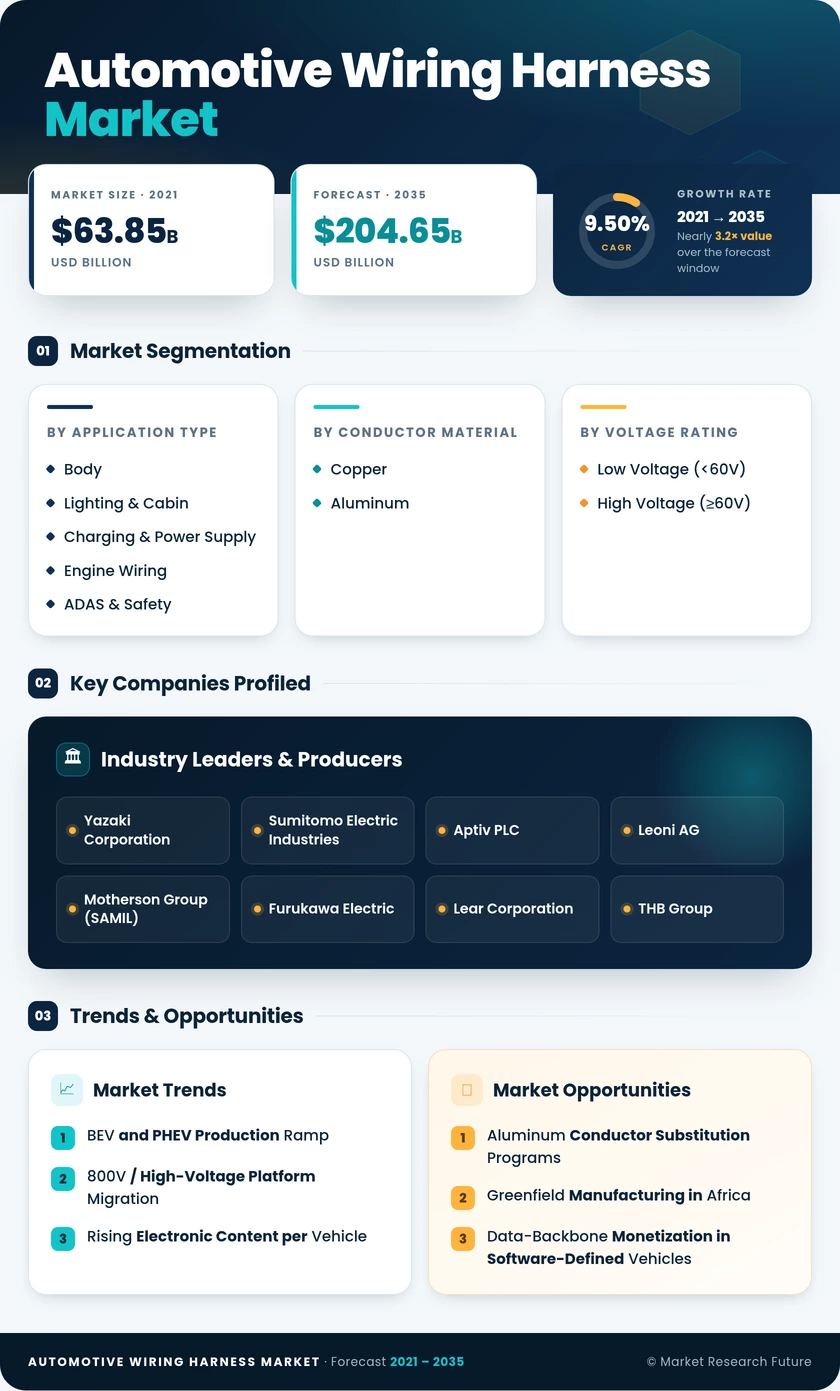
Segmentation Quick Reference
| Dimension | Sub-Segments | Dominant Segment (2025) | Fastest Growing Segment (2026–2035) |
| Application Type | Body, Lighting & Cabin; Charging & Power Supply; Engine Wiring; ADAS & Safety; Infotainment; Transmission; Ignition System | Body, Lighting & Cabin | Charging & Power Supply |
| Conductor Material | Copper; Aluminum | Copper | Aluminum |
| Voltage Rating | Low Voltage (<60V); High Voltage (≥60V) | Low Voltage (<60V) | High Voltage (≥60V) |
| Propulsion Type | Internal Combustion Engine; Battery Electric Vehicle; Hybrid / PHEV | Internal Combustion Engine | Battery Electric Vehicle |
| Vehicle Type | Passenger Cars; Light Commercial Vehicles; Heavy Commercial Vehicles | Passenger Cars | Light Commercial Vehicles |
| Sales Channel | OEM; Aftermarket | OEM | Aftermarket |
Market Segmentation Overview
By Application Type
| Sub-Segment | Key Trend |
| Body, Lighting & Cabin | Multi-zone ambient lighting and powered-seat proliferation extending harness runs |
| Charging & Power Supply | 800V BEV architectures driving dedicated high-voltage cable demand |
| Engine Wiring | Gradual decline in ICE-specific circuits offset by hybrid engine integration |
| ADAS & Safety | Camera, lidar, and radar sensor feeds are adding shielded harness branches. |
| Infotainment | Multi-display cockpit designs are increasing data-cable density. |
| Transmission | E-axle integration replaces conventional transmission harness configurations. |
| Ignition System | Declining relevance as BEV penetration reduces spark-ignition volume. |
Body, lighting, and cabin harnesses represent the broadest application category because they span every vehicle architecture regardless of propulsion type. Charging and power supply harnesses are scaling fastest, driven by new BEV platform launches that require high-voltage cable systems rated for sustained 200–500A operation.
By Conductor Material
| Sub-Segment | Key Trend |
| Copper | Benchmark conductor; facing cost pressure from volatile LME pricing |
| Aluminum | Gaining traction in non-safety body circuits and large-gauge power distribution |
Copper remains the industry-standard conductor due to its superior electrical and thermal conductivity. Still, aluminum adoption is accelerating as OEMs pursue vehicle-level weight reduction targets mandated by emissions regulations.
By Voltage Rating
| Sub-Segment | Key Trend |
| Low Voltage (<60V) | Foundation of all vehicle electrical systems; stable demand |
| High Voltage (≥60V) | Premium-priced shielded cables for BEV traction and charging |
Low-voltage harnesses continue to form the backbone of vehicle electrical systems. In contrast, high-voltage harnesses represent the fastest-growing value segment due to BEV adoption and the migration to 800V architectures.
By Propulsion Type
| Sub-Segment | Key Trend |
| Internal Combustion Engine | Still dominant by volume, declining share as BEV adoption accelerates |
| Battery Electric Vehicle | Double-digit CAGR driven by global EV mandates and OEM platform launches |
| Hybrid / PHEV | Transition powertrain generating dual low-voltage and high-voltage harness demand. |
ICE vehicles account for the largest harness demand by volume. Still, BEV platforms carry significantly higher harness content per vehicle, making the BEV segment the primary growth engine for value creation.
By Vehicle Type
| Sub-Segment | Key Trend |
| Passenger Cars | Largest volume segment; rising electronic content per vehicle |
| Light Commercial Vehicles | Last-mile delivery electrification is driving fast harness growth. |
| Heavy Commercial Vehicles | Automotive Wiring Harness Market and construction applications sustaining premium harness demand |
Passenger cars dominate total harness consumption, but light commercial vehicles are scaling fastest as e-commerce logistics operators electrify urban delivery fleets across Asia, Europe, and North America.
By Sales Channel
| Sub-Segment | Key Trend |
| OEM | Factory-installed harnesses account for the overwhelming majority of demand. |
| Aftermarket | Retrofit kits and replacement harnesses are growing with the aging vehicle parc. |
OEM channels command the vast majority of harness revenue. Still, the aftermarket is expanding as fleet operators seek high-voltage retrofit solutions and as the aging global vehicle parc drives replacement demand for low-voltage harness assemblies.