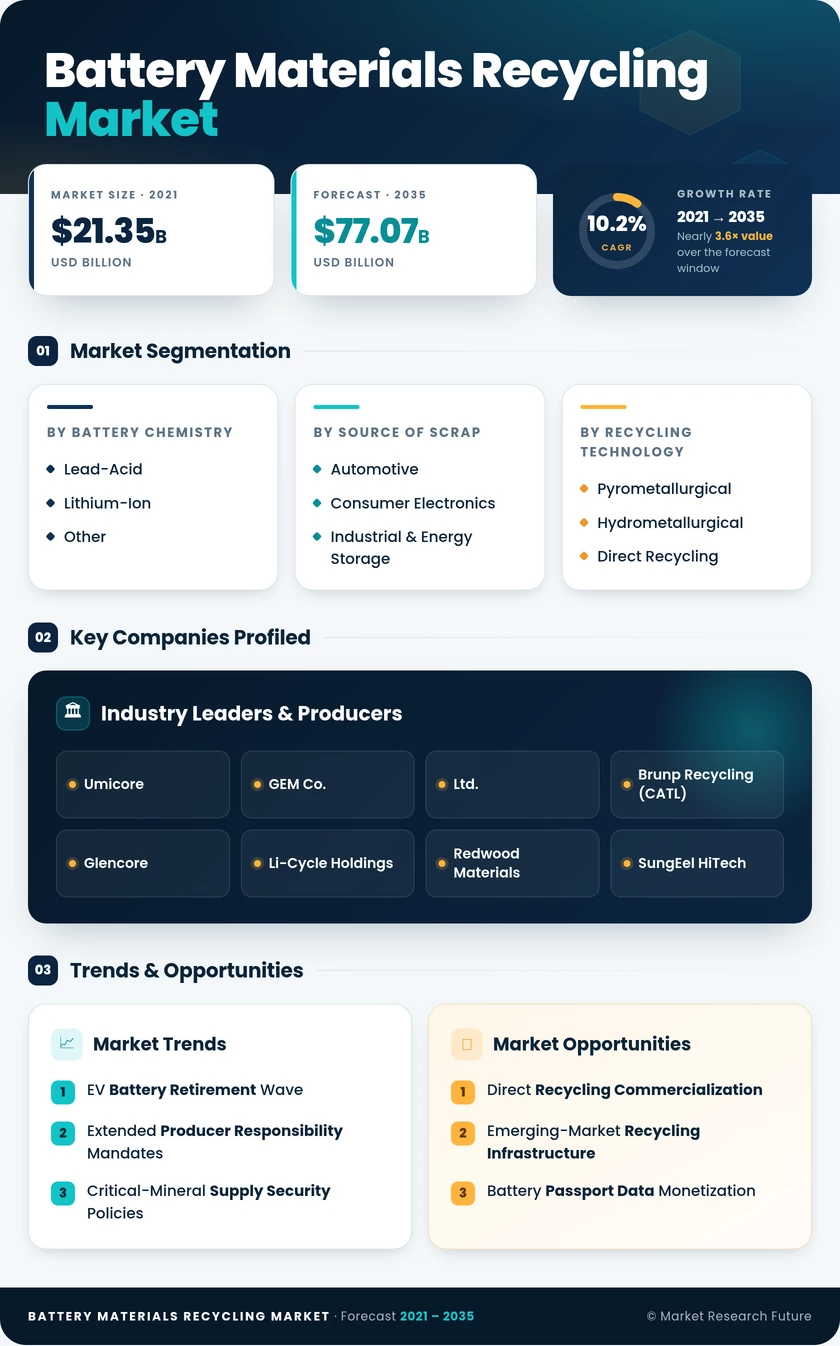
Battery Materials Recycling Market (2026 - 2035)

ID: MRFR/EnP/9942-HCR
100 Pages
Chitranshi Jaiswal
Last Updated: July 23, 2026
Battery Materials Recycling Market Size, Share & Growth Analysis Report By Battery Chemistry (Lead-Acid, Lithium-Ion, Other (Nickel-Cadmium, Alkaline)), By Source of Scrap (Automotive Batteries, Consumer Electronics Batteries, Industrial & Energy Storage Batteries), By Recycling Technology (Pyrometallurgical, Hydrometallurgical, Direct Recycling), By Process Stage (Collection & Transportation, Dismantling & Pre-processing, Material Refining & Recovery, Black-Mass Production), By Application of Recovered Materials (Cathode Active Materials, Battery-Grade Lithium Compounds, Anode Materials, Electrolyte & Separator Recovery), By End-User Industry (Automotive, Consumer Electronics, Energy Storage Systems, Industrial) and By Regional (North America, Europe, South America, Asia Pacific, Middle East and Africa) – Industry Growth & Forecast to 2035
Battery Materials Recycling Market
Market Size
Forecast Period2026-2035
CAGR (2026-2035)10.2%
2021 Market Size29.3 USD Billion
2023 Market Size32.15 USD Billion
Key Players
Umicore
GEM Co., Ltd.
Brunp Recycling
Glencore
Li-Cycle Holdings
Redwood Materials
Opportunities
  • Direct Recycling Commercialization
  • Emerging-Market Recycling Infrastructure
  • Battery Passport Data Monetization
  1. 1 Market Overview |
    1. 1.1 Study Assumptions & Market Definition |
    2. 1.2 Scope of the Study |
    3. 1.3 Research Methodology
  2. 2 Market Summary & Key Takeaways
  3. 3 Market Dynamics |
    1. 3.1 Market Drivers Analysis | |
      1. 3.1.1 EV Battery Retirement Wave | |
      2. 3.1.2 Extended Producer Responsibility Mandates | |
      3. 3.1.3 Critical-Mineral Supply Security Policies | |
      4. 3.1.4 Hydrometallurgical Purity Advancements | |
      5. 3.1.5 IRA and Domestic Content Incentives | |
      6. 3.1.6 OEM Closed-Loop Cathode Supply Agreements | |
      7. 3.1.7 Battery Passport and Traceability Systems |
    2. 3.2 Market Restraints Analysis | |
      1. 3.2.1 Collection Logistics and Reverse-Supply-Chain Costs | |
      2. 3.2.2 LFP Chemistry's Low Recoverable Metal Value | |
      3. 3.2.3 Fragmented Recycling Regulations Across Jurisdictions | |
      4. 3.2.4 High Capital Intensity of Hydromet Facilities | |
      5. 3.2.5 Volatile Metal Pricing Undermining Recycler Margins |
    3. 3.3 Market Opportunity Analysis | |
      1. 3.3.1 Direct Recycling Commercialization | |
      2. 3.3.2 Emerging-Market Recycling Infrastructure | |
      3. 3.3.3 Battery Passport Data Monetization | |
      4. 3.3.4 Second-Life-to-Recycling Arbitrage | |
      5. 3.3.5 Sodium-Ion Battery Recycling Readiness |
    4. 3.4 Industry Value Chain Analysis |
    5. 3.5 Porter's Five Forces Analysis
  4. 4 Global Battery Materials Recycling Market Size & Forecast (2021–2035) |
    1. 4.1 Historical Market Size (2021–2025) |
    2. 4.2 Current & Forecast Market Size (2026–2035) |
    3. 4.3 Market Size by Revenue (USD Billion) |
    4. 4.4 Year-over-Year Growth Analysis
  5. 5 Segmentation Analysis |
    1. 5.1 By Battery Chemistry | |
      1. 5.1.1 Lead-Acid | |
      2. 5.1.2 Lithium-Ion | |
      3. 5.1.3 Other (Nickel-Cadmium, Alkaline) |
    2. 5.2 By Source of Scrap | |
      1. 5.2.1 Automotive Batteries | |
      2. 5.2.2 Consumer Electronics Batteries | |
      3. 5.2.3 Industrial & Energy Storage Batteries |
    3. 5.3 By Recycling Technology | |
      1. 5.3.1 Pyrometallurgical | |
      2. 5.3.2 Hydrometallurgical | |
      3. 5.3.3 Direct Recycling |
    4. 5.4 By Process Stage | |
      1. 5.4.1 Collection & Transportation | |
      2. 5.4.2 Dismantling & Pre-processing | |
      3. 5.4.3 Material Refining & Recovery | |
      4. 5.4.4 Black-Mass Production |
    5. 5.5 By Application of Recovered Materials | |
      1. 5.5.1 Cathode Active Materials | |
      2. 5.5.2 Battery-Grade Lithium Compounds | |
      3. 5.5.3 Anode Materials | |
      4. 5.5.4 Electrolyte & Separator Recovery |
    6. 5.6 By End-User Industry | |
      1. 5.6.1 Automotive | |
      2. 5.6.2 Consumer Electronics | |
      3. 5.6.3 Energy Storage Systems | |
      4. 5.6.4 Industrial
  6. 6 Regional Analysis |
    1. 6.1 North America | |
      1. 6.1.1 United States | |
      2. 6.1.2 Canada | |
      3. 6.1.3 Mexico |
    2. 6.2 Europe | |
      1. 6.2.1 Germany | |
      2. 6.2.2 United Kingdom | |
      3. 6.2.3 France | |
      4. 6.2.4 Italy | |
      5. 6.2.5 Spain | |
      6. 6.2.6 Nordic Countries | |
      7. 6.2.7 Russia | |
      8. 6.2.8 Rest of Europe |
    3. 6.3 Asia-Pacific | |
      1. 6.3.1 China | |
      2. 6.3.2 India | |
      3. 6.3.3 Japan | |
      4. 6.3.4 South Korea | |
      5. 6.3.5 ASEAN | |
      6. 6.3.6 Rest of Asia-Pacific |
    4. 6.4 South America | |
      1. 6.4.1 Brazil | |
      2. 6.4.2 Argentina | |
      3. 6.4.3 Rest of South America |
    5. 6.5 Middle East & Africa | |
      1. 6.5.1 Saudi Arabia | |
      2. 6.5.2 UAE | |
      3. 6.5.3 South Africa | |
      4. 6.5.4 Egypt | |
      5. 6.5.5 Rest of MEA
  7. 7 Competitive Landscape |
    1. 7.1 Market Share Analysis (2025) |
    2. 7.2 Competitive Benchmarking Matrix |
    3. 7.3 Company Profiles | |
      1. 7.3.1 Umicore | |
      2. 7.3.2 GEM Co., Ltd. | |
      3. 7.3.3 Brunp Recycling (CATL) | |
      4. 7.3.4 Glencore | |
      5. 7.3.5 Li-Cycle Holdings | |
      6. 7.3.6 Redwood Materials | |
      7. 7.3.7 SungEel HiTech | |
      8. 7.3.8 Ecobat Technologies | |
      9. 7.3.9 Aqua Metals | |
      10. 7.3.10 Retriev Technologies
  8. 8 Future Outlook & Strategic Recommendations (2026–2035) |
    1. 8.1 AI-Optimized Sorting and Process Control |
    2. 8.2 Electrification Supercycle and Feedstock Abundance |
    3. 8.3 ESG Reporting and Circular-Economy Metrics |
    4. 8.4 Next-Generation Chemistry Preparedness
  9. 9 Recent Developments & News
  10. 10 Frequently Asked Questions (FAQs)
  11. 11 Report Scope & Methodology |
    1. 11.1 Study Period & Base Year |
    2. 11.2 Data Sources & Citations |
    3. 11.3 Abbreviations
  12. 12 LIST OF TABLES
  13. 13 LIST OF FIGURES

Segmentation Quick Reference

DimensionSub-SegmentsDominant SegmentFastest Growing Segment
Battery ChemistryLead-Acid, Lithium-Ion, OtherLead-AcidLithium-Ion
Source of ScrapAutomotive, Consumer Electronics, Industrial & Energy StorageAutomotiveConsumer Electronics
Recycling Battery Materials Recycling MarketPyrometallurgical, Hydrometallurgical, Direct RecyclingPyrometallurgicalDirect Recycling
Process StageCollection & Transportation, Dismantling & Pre-processing, Material Refining & Recovery, Black-Mass ProductionMaterial Refining & RecoveryBlack-Mass Production
Application of Recovered MaterialsCathode Active Materials, Battery-Grade Lithium Compounds, Anode Materials, Electrolyte & Separator RecoveryCathode Active MaterialsBattery-Grade Lithium Compounds
End-User IndustryAutomotive, Consumer Electronics, Energy Storage Systems, IndustrialAutomotiveEnergy Storage Systems
GeographyNorth America, Europe, Asia-Pacific, South America, Middle East & AfricaAsia-PacificNorth America


Market Segmentation Overview

By Battery Chemistry

Sub-SegmentKey Trend
Lead-AcidStable volumes with near-universal collection rates; growth limited by automotive lead-acid demand plateau
Lithium-IonRapid expansion as EV retirements accelerate; NMC and LFP chemistries driving investment in new processing capacity
Other (Nickel-Cadmium, Alkaline)Declining share as consumer and industrial devices shift to lithium-based alternatives


Lead-acid recycling operates as a mature, margin-stable segment with collection rates exceeding 99% across developed economies. Lithium-ion recycling is the primary growth vector, with investment concentrated in hydrometallurgical and direct-recycling capacity to recover high-value cathode materials from retired EV packs.

By Source of Scrap

Sub-SegmentKey Trend
Automotive BatteriesDominant by mass; OEM take-back programs expanding feedstock access
Consumer Electronics BatteriesHigh-frequency replacement cycles generate steady, geographically dispersed scrap
Industrial & Energy Storage BatteriesGrid-storage retirements emerging as a new, large-format feedstock category


Automotive batteries contribute the majority of scrap volume due to their per-unit mass, while consumer electronics create a high-frequency, lightweight waste stream suited to urban municipal collection programs.

By Recycling Battery Materials Recycling Market

Sub-SegmentKey Trend
PyrometallurgicalLegacy dominance from lead-acid, challenged by lower purity outputs and carbon intensity
HydrometallurgicalScaling rapidly to meet cathode producers' demand for battery-grade nickel and cobalt sulfates
Direct RecyclingPre-commercial but promising; preserves cathode crystal structure and offers substantial energy savings


Pyrometallurgy remains the incumbent technology, while hydrometallurgy is scaling to meet stringent purity requirements, and direct recycling is advancing through government-funded pilot programs.

By Process Stage

Sub-SegmentKey Trend
Collection & TransportationReverse logistics costs remain the largest structural barrier to recycling economics
Dismantling & Pre-processingAutomation and robotic disassembly are reducing labor costs and improving safety
Material Refining & RecoveryHighest-value stage, commanding premium pricing for battery-grade metal sulfates
Black-Mass ProductionEmerging as a traded commodity, with spot and contract markets developing globally


Material refining and recovery captures the largest revenue share, while black-mass production is growing fastest as intermediate concentrate gains commodity-market liquidity.

By Application of Recovered Materials

Sub-SegmentKey Trend
Cathode Active MaterialsHighest per-kilogram value; NMC and NCA precursors in strong demand from cell manufacturers
Battery-Grade Lithium CompoundsSupply tightness makes recycled lithium cost-competitive with mined lithium
Anode MaterialsRecycled graphite is gaining acceptance for blending into synthetic anode formulations
Electrolyte & Separator RecoveryFluorine recovery and solvent reclamation are emerging as environmental and economic priorities


Cathode active materials dominate by recovered-product revenue, while battery-grade lithium compounds are the fastest-growing application amid persistent supply constraints.

By End-User Industry

Sub-SegmentKey Trend
AutomotiveOEM closed-loop contracts are accelerating demand for recycled cathode materials
Consumer ElectronicsE-waste regulations in the EU and Asia are driving formalized collection and processing
Energy Storage SystemsGrid-storage retirements are creating a new, large-format feedstock stream
IndustrialSteady but limited growth from forklift, UPS, and telecommunications battery turnover


The automotive segment drives the majority of recycling demand through closed-loop supply agreements, while energy storage systems represent the fastest-emerging feedstock source.


 

Download PDF ×

We do not share your information with anyone. However, we may send you emails based on your report interest from time to time. You may contact us at any time to opt-out.