×
Request Free Sample ×

Kindly complete the form below to receive a free sample of this Report

* Please use a valid business email

Leading companies partner with us for data-driven Insights

clients tt-cursor
Hero Background

Boiler Combustion Chamber Market

ID: MRFR/EnP/6488-HCR
111 Pages
Anshula Mandaokar
October 2025

Boiler Combustion Chamber Market Research Report Information by Type (Single Tube Combustor Chamber, Annular Combustion Chamber and Joint Combustion Chamber), Application (Vehicles, Aircraft & Rocket, Marine and others) and by Region (North America, Europe, Asia-Pacific, the Middle East & Africa and South America) - Forecast till 2035

Share:
Download PDF ×

We do not share your information with anyone. However, we may send you emails based on your report interest from time to time. You may contact us at any time to opt-out.

Boiler Combustion Chamber Market Infographic
Purchase Options

Boiler Combustion Chamber Market Summary

As per MRFR analysis, the Boiler Combustion Chamber Market Size was estimated at 13.1 USD Million in 2024. The Boiler Combustion Chamber industry is projected to grow from 15.23 USD Million in 2025 to 68.96 USD Million by 2035, exhibiting a compound annual growth rate (CAGR) of 16.3 during the forecast period 2025 - 2035.

Key Market Trends & Highlights

The Boiler Combustion Chamber Market is poised for substantial growth driven by sustainability and technological advancements.

  • The market is increasingly influenced by a strong focus on sustainability and energy efficiency initiatives.
  • Technological integration is transforming boiler combustion systems, enhancing performance and reducing emissions.
  • North America remains the largest market, while Asia-Pacific is recognized as the fastest-growing region in this sector.
  • Rising energy demand and regulatory compliance are key drivers propelling growth in the power generation and manufacturing segments.

Market Size & Forecast

2024 Market Size 13.1 (USD Million)
2035 Market Size 68.96 (USD Million)
CAGR (2025 - 2035) 16.3%

Major Players

Babcock & Wilcox (US), Alstom (FR), Siemens (DE), Foster Wheeler (US), Mitsubishi Hitachi Power Systems (JP), General Electric (US), Andritz AG (AT), Doosan Lentjes (DE), Thermo Energy (CA)

Boiler Combustion Chamber Market Trends

The Boiler Combustion Chamber Market is currently experiencing a dynamic evolution, driven by various factors including technological advancements and increasing energy efficiency demands. The market appears to be influenced by a growing emphasis on sustainable practices, as industries seek to reduce emissions and enhance operational efficiency. This shift is likely prompting manufacturers to innovate and develop combustion chambers that not only meet regulatory standards but also align with environmental goals. Furthermore, the rising adoption of automation and smart technologies in boiler systems suggests a trend towards more integrated solutions, potentially enhancing performance and reliability. In addition, the Boiler Combustion Chamber Market seems to be shaped by the expanding industrial sector, particularly in regions where energy consumption is on the rise. As industries strive for greater productivity, the need for efficient and reliable boiler systems becomes paramount. This trend indicates a potential increase in demand for advanced combustion chambers that can support higher operational loads while maintaining safety and efficiency. Overall, the market landscape appears to be shifting towards innovation and sustainability, reflecting broader global energy trends and industrial requirements.

Sustainability Focus

The emphasis on sustainable practices is becoming increasingly pronounced within the Boiler Combustion Chamber Market. Manufacturers are likely prioritizing the development of products that minimize environmental impact, aligning with global efforts to reduce carbon footprints.

Technological Integration

The integration of advanced technologies into boiler systems is a notable trend. Automation and smart technologies are expected to enhance the functionality of combustion chambers, improving efficiency and operational reliability.

Industrial Growth

The expansion of various industrial sectors is driving demand for efficient boiler systems. As industries seek to optimize productivity, the need for high-performance combustion chambers that can handle increased operational demands is likely to rise.

Boiler Combustion Chamber Market Drivers

Shift Towards Renewable Energy Sources

The Global Boiler Combustion Chamber Market Industry is witnessing a paradigm shift towards renewable energy sources as industries seek sustainable alternatives to fossil fuels. The integration of biomass, biogas, and other renewable fuels in combustion systems is gaining traction, driven by both environmental concerns and economic incentives. This transition not only reduces greenhouse gas emissions but also aligns with global sustainability goals. As a result, manufacturers are developing combustion chambers that can efficiently utilize these alternative fuels, thereby expanding their product offerings and enhancing market competitiveness.

Increasing Demand for Energy Efficiency

The Global Boiler Combustion Chamber Market Industry experiences a notable uptick in demand for energy-efficient solutions. As industries strive to reduce operational costs and comply with stringent environmental regulations, the adoption of advanced combustion technologies becomes paramount. For instance, the integration of high-efficiency burners and improved heat recovery systems can lead to substantial energy savings. This trend is reflected in the projected market growth, with the industry expected to reach 12.5 USD Billion in 2024 and 20.3 USD Billion by 2035, indicating a compound annual growth rate of 4.51% from 2025 to 2035.

Rising Industrialization and Urbanization

The Global Boiler Combustion Chamber Market Industry is propelled by the rapid industrialization and urbanization trends observed globally. As countries develop, the demand for energy-intensive industries such as manufacturing, power generation, and construction increases. This surge in industrial activities necessitates the installation of efficient boiler systems, including advanced combustion chambers. The growing population in urban areas further amplifies energy consumption, leading to a higher demand for reliable and efficient heating solutions. This trend is expected to sustain the market's growth trajectory in the coming years.

Technological Advancements in Combustion Systems

Technological advancements play a crucial role in shaping the Global Boiler Combustion Chamber Market Industry. Innovations such as smart controls, predictive maintenance, and real-time monitoring systems enhance operational efficiency and reliability. These technologies not only optimize fuel consumption but also minimize downtime, which is essential for industries with continuous production processes. The integration of Internet of Things (IoT) devices in combustion systems allows for better data analytics and performance tracking, thus driving the adoption of modern combustion chambers across various sectors.

Regulatory Compliance and Environmental Standards

The Global Boiler Combustion Chamber Market Industry is significantly influenced by the increasing regulatory compliance requirements aimed at reducing emissions and enhancing air quality. Governments worldwide are implementing stricter regulations concerning NOx and CO2 emissions, compelling industries to upgrade their combustion systems. This regulatory landscape drives the demand for advanced combustion chambers that meet these standards. Consequently, manufacturers are investing in research and development to innovate cleaner technologies, thereby expanding their market share and contributing to the overall growth of the industry.
Market Segment Insights

By Application: Power Generation (Largest) vs. Residential Heating (Fastest-Growing)

In the Boiler Combustion Chamber Market, the application segments display a diverse distribution of market share. Power Generation holds a significant share owing to its critical role in electricity generation and industrial applications. Moreover, Industrial Heating remains a strong contender, primarily driven by the manufacturing sector's demand for efficient heating systems. Meanwhile, Residential Heating is emerging as a vital segment, attributed to increasing energy efficiency standards and consumer preference for eco-friendly heating solutions. Each of these applications contributes uniquely to the market dynamics, shaping overall trends and consumer choices.

Power Generation (Dominant) vs. Residential Heating (Emerging)

Power Generation stands as the dominant segment within the Boiler Combustion Chamber Market, reflecting its extensive use in large-scale electricity production. This application benefits from advanced technologies designed to optimize efficiency and reduce emissions, making it a backbone of energy infrastructure. On the other hand, Residential Heating represents an emerging segment characterized by a rising shift toward sustainable and energy-efficient heating solutions. As homeowners increasingly seek alternatives to traditional heating methods, modern boiler systems that integrate innovative combustion technologies are gaining traction. This trend highlights the evolving consumer preferences in residential sectors, indicating a potential shift in market focus towards more energy-conscious heating applications.

By End Use: Manufacturing (Largest) vs. Food Processing (Fastest-Growing)

The Boiler Combustion Chamber Market sees significant distribution across various end-use segments, with manufacturing holding the largest share. This segment encompasses a diverse array of industries, including automotive, heavy machinery, and more, that rely on efficient combustion processes for production needs. Construction and energy sectors also contribute substantial shares, while food processing, though smaller, demonstrates noteworthy growth potential driven by increased automation and energy efficiency demands in food production.

Manufacturing: (Dominant) vs. Food Processing (Emerging)

The manufacturing sector dominates the Boiler Combustion Chamber Market, characterized by its robust requirements for high-efficiency combustion systems to support production lines. This sector benefits from continuous technological advancements and the need for reduced emissions. Conversely, the food processing segment is emerging as a fast-growing area, propelled by heightened focus on food safety and sustainability. Innovations in combustion technologies tailored for food production are gaining traction, as processors seek to improve energy efficiency while adhering to strict regulatory standards. Together, these segments shape the landscape of the market.

By Fuel Type: Natural Gas (Largest) vs. Oil (Fastest-Growing)

The Boiler Combustion Chamber Market has a diverse fuel type distribution, with Natural Gas currently holding the largest share due to its efficiency and lower emissions compared to traditional fuels. Oil, Coal, and Biomass also contribute to the market, but their shares are comparatively smaller. As environmental regulations become stricter, the preference for cleaner fuels is driving a shift in market dynamics.

Natural Gas (Dominant) vs. Biomass (Emerging)

Natural Gas continues to dominate the Boiler Combustion Chamber Market, recognized for its high efficiency and lower greenhouse gas emissions. This makes it a preferred choice for many industries looking to comply with environmental standards while maintaining operational efficiency. On the other hand, Biomass is emerging as a significant player due to the increasing focus on renewable energy sources. Its potential for carbon neutrality and availability from waste materials position it as a favorable alternative, particularly in regions emphasizing sustainability.

By Design Type: Fire-Tube (Largest) vs. Water-Tube (Fastest-Growing)

In the Boiler Combustion Chamber Market, the design type plays a critical role in determining efficiency and performance. The Fire-Tube design currently commands the largest market share due to its widespread application in various industrial and commercial settings. This design is favored for its simplicity and reliability, making it a prevalent choice among users. In contrast, Water-Tube boilers are gaining traction, particularly in the industrial sector, due to their efficiency at higher pressures and temperatures, preparing them for increased market acceptance. Growth trends indicate a shift towards more advanced designs such as Water-Tube and Electric boilers. These emerging technologies are driven by the need for enhanced energy efficiency and reduced emissions, catering to stringent regulatory standards. The increasing demand for sustainable heating solutions is propelling Electric boilers, whereas concerns regarding scalability and operational costs are steering attention towards Water-Tube boilers, marking them as the fastest-growing segment in this sector.

Fire-Tube (Dominant) vs. Electric (Emerging)

Fire-Tube boilers remain a dominant force in the Boiler Combustion Chamber Market, attributed to their robust construction and operational reliability. These boilers operate efficiently by sending hot gases through tubes that are surrounded by water, offering effective heat transfer. Their design is increasingly favored in low-pressure applications, making them ideal for many industrial and commercial purposes. On the other hand, Electric boilers are emerging as a competitive alternative, especially in settings where emissions reduction is paramount. These boilers boast minimal environmental impact and operational flexibility, appealing to a growing segment of eco-conscious consumers. As energy efficiency becomes a priority, Electric boilers are swiftly gaining market share, signaling a significant transition in user preferences.

By Material Type: Steel (Largest) vs. Composite (Fastest-Growing)

In the Boiler Combustion Chamber Market, the material type segmentation highlights Steel as the dominant player, capturing a significant market share due to its robust properties and proven durability. Following closely are Cast Iron and Composite materials, each holding substantial portions of the market that cater to specific applications, from residential boilers to heavy industrial use. The variation in material preference reflects the diverse requirements and operational conditions across different boiler types, making Steel the go-to choice for reliability, while Composite material serves specialized needs. The growth trends within the material type segment showcase Composite as the fastest-growing category, driven by an increasing demand for lightweight and corrosion-resistant solutions. The adoption of Composites in boiler design is being propelled by advancements in material technology and the need for energy-efficient systems. As industries push for innovation in boiler efficiency and emissions reduction, the versatility of Composite materials positions them well for future expansion in the market, alongside Steel's long-standing presence and performance assurance.

Steel (Dominant) vs. Composite (Emerging)

Steel has long been the dominant material in boiler combustion chambers, celebrated for its strength, durability, and ability to withstand high-pressure environments. Its resistance to wear and tear enhances the overall longevity of boiler systems, making it a preferred choice among manufacturers. On the other hand, Composite materials are emerging as an innovative solution in this market segment. Their lightweight nature, coupled with superior corrosion resistance, provides manufacturers with modern alternatives that meet contemporary energy standards. Composites are particularly attractive for energy-efficient designs, offering improved thermal performance. As regulatory frameworks tighten around emissions, the demand for Composite materials is expected to grow, indicating a shift towards more sustainable boiler solutions.

Get more detailed insights about Boiler Combustion Chamber Market

Regional Insights

North America : Market Leader in Innovation

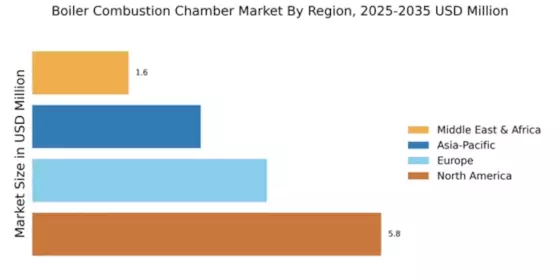
North America is poised to maintain its leadership in the Boiler Combustion Chamber Market, holding a market size of $5.8 billion in 2025. The region's growth is driven by stringent environmental regulations and a shift towards energy-efficient technologies. Increasing investments in infrastructure and a focus on reducing carbon emissions are further propelling demand for advanced boiler systems. The regulatory landscape is supportive, encouraging innovation and sustainability in energy production. The United States and Canada are the leading countries in this market, with major players like Babcock & Wilcox, General Electric, and Foster Wheeler driving competition. The presence of established manufacturers and a robust supply chain enhances market dynamics. As companies invest in R&D to develop cutting-edge solutions, North America is expected to continue its dominance, accounting for a significant share of the global market.

Europe : Sustainable Energy Transition

Europe is experiencing a significant shift towards sustainable energy solutions, with a market size of $3.9 billion in the Boiler Combustion Chamber Market. The region's growth is fueled by stringent EU regulations aimed at reducing greenhouse gas emissions and promoting renewable energy sources. Countries are increasingly adopting advanced boiler technologies to meet these regulatory requirements, driving demand for efficient combustion chambers. Germany, France, and the UK are at the forefront of this transition, with key players like Alstom and Siemens leading the market. The competitive landscape is characterized by innovation and collaboration among manufacturers to develop eco-friendly solutions. As Europe continues to prioritize sustainability, the Boiler Combustion Chamber Market is expected to grow, supported by favorable policies and investments in green technologies.

Asia-Pacific : Emerging Market Potential

Asia-Pacific is emerging as a significant player in the Boiler Combustion Chamber Market, with a market size of $2.8 billion. The region's growth is driven by rapid industrialization, urbanization, and increasing energy demands. Countries are investing heavily in infrastructure development and energy efficiency, leading to a surge in demand for advanced boiler systems. Regulatory frameworks are evolving to support cleaner technologies, further enhancing market prospects. China, Japan, and India are the leading countries in this market, with major companies like Mitsubishi Hitachi Power Systems and Doosan Lentjes actively participating. The competitive landscape is marked by a mix of local and international players, fostering innovation and technological advancements. As the region continues to industrialize, the Boiler Combustion Chamber Market is expected to witness substantial growth, driven by both demand and regulatory support.

Middle East and Africa : Resource-Rich Opportunities

The Middle East and Africa region is witnessing a gradual increase in the Boiler Combustion Chamber Market, with a market size of $1.6 billion. The growth is primarily driven by rising infrastructure investments and a focus on energy efficiency. Governments are implementing policies to enhance energy production capabilities, which is creating opportunities for advanced boiler technologies. The region's diverse energy resources are also contributing to market expansion. Countries like Saudi Arabia and South Africa are leading the charge, with investments in energy projects and modernization of existing facilities. The competitive landscape includes both local and international players, with companies like Andritz AG and Thermo Energy making significant contributions. As the region continues to develop its energy sector, the Boiler Combustion Chamber Market is expected to grow, supported by strategic investments and regulatory initiatives.

Key Players and Competitive Insights

The Boiler Combustion Chamber Market is currently characterized by a dynamic competitive landscape, driven by increasing energy demands and a global shift towards sustainable energy solutions. Key players such as Babcock & Wilcox (US), Alstom (FR), and Siemens (DE) are strategically positioning themselves through innovation and partnerships. Babcock & Wilcox (US) has focused on enhancing its product offerings with advanced technologies aimed at improving efficiency and reducing emissions, while Alstom (FR) emphasizes its commitment to sustainable solutions, particularly in the context of transitioning to greener energy sources. Siemens (DE) appears to be leveraging digital transformation to optimize operations and enhance customer engagement, thereby shaping a competitive environment that prioritizes technological advancement and sustainability.

The market structure is moderately fragmented, with several players vying for market share through various business tactics. Companies are increasingly localizing manufacturing to reduce costs and improve supply chain efficiency. This localization strategy, coupled with supply chain optimization, allows firms to respond more swiftly to market demands and regulatory changes. The collective influence of these key players fosters a competitive atmosphere where innovation and operational efficiency are paramount.

In November 2025, General Electric (US) announced a strategic partnership with a leading renewable energy firm to develop hybrid boiler systems that integrate traditional combustion with renewable energy sources. This move is significant as it aligns with the growing trend towards decarbonization and positions General Electric (US) as a frontrunner in the transition to sustainable energy solutions. The partnership is expected to enhance their product portfolio and cater to a broader market segment seeking eco-friendly options.

In October 2025, Mitsubishi Hitachi Power Systems (JP) unveiled a new line of advanced combustion chambers designed to operate efficiently with lower emissions. This launch is indicative of the company's commitment to innovation and reflects the increasing regulatory pressures for cleaner energy solutions. By investing in R&D, Mitsubishi Hitachi Power Systems (JP) is likely to strengthen its market position and appeal to environmentally conscious customers.

In September 2025, Andritz AG (AT) expanded its operational footprint by establishing a new manufacturing facility in Eastern Europe. This strategic move is aimed at enhancing production capabilities and reducing lead times for customers in the region. The establishment of this facility not only signifies Andritz AG's commitment to growth but also highlights the importance of regional presence in meeting local market demands effectively.

As of December 2025, the competitive trends in the Boiler Combustion Chamber Market are increasingly defined by digitalization, sustainability, and the integration of AI technologies. Strategic alliances are becoming more prevalent, as companies recognize the need to collaborate to enhance their technological capabilities and market reach. The competitive differentiation is likely to evolve from traditional price-based competition to a focus on innovation, technology, and supply chain reliability, reflecting a broader industry shift towards sustainable and efficient energy solutions.

Key Companies in the Boiler Combustion Chamber Market market include

Industry Developments

    • The U.S. government plans to withdraw its largest coal-fired plant in Massachusetts, U.S.A. It is being observed that similar trends have been observed in Maryland, the U.S. Here, the state government is planning to reduce its dependency on coal-based power and has plans to raise tax credits for plants, which efficiently dispose of carbon emissions. The carbon tax bill proposed by the U.S. will increase tax credits for power plants.

Global boiler combustion chamber market has been segmented based on type, application, and region. On the basis of type, it is segmented into tube combustion chamber, annular combustion chamber, and joint combustion chamber. Tube combustor chamber segment is expected to be the fastest growing segment during the forecast period. Based on application, the boiler combustion chamber market has been segmented into vehicles, aircraft & rocket, marine, and others. The vehicles segment is expected to dominate the boiler combustion chamber market during the forecast period.

On the basis of region, the global boiler combustion chamber market is segmented as Asia-Pacific, North America, Europe, the Middle East & Africa, and South America. In 2018, Asia-Pacific was the largest market for boiler combustion chamber, followed by North America and Europe.

China and India are expected to be the largest markets for boiler combustion chambers owing to the significant investments being made in the automobile and marine industries in these countries.  The boiler combustion chamber market is also growing at a steady pace in countries such as the US, Australia, and Germany due to the increasing investments in renewable power generation and oil and gas-fired power generation.

Boiler Combustion Chamber Market Intended Audience

The intended audience in the global boiler combustion chamber market are:

    • Boiler combustion chamber manufacturers and distributors
    • Power generation companies
    • Turbine manufacturers and distributors
    • Engine manufacturers and distributors
    • Environmental research institutes
    • Manufacturing industry
    • Government and research organizations
    • Consulting companies in power sector

Future Outlook

Boiler Combustion Chamber Market Future Outlook

The Boiler Combustion Chamber Market is projected to grow at a 16.3% CAGR from 2024 to 2035, driven by increasing energy efficiency demands and regulatory support for cleaner technologies.

New opportunities lie in:

  • Development of advanced combustion control systems for enhanced efficiency.
  • Expansion into emerging markets with tailored boiler solutions.
  • Integration of IoT technologies for real-time monitoring and predictive maintenance.

By 2035, the market is expected to achieve substantial growth, reflecting evolving energy needs and technological advancements.

Market Segmentation

Boiler Combustion Chamber Market End Use Outlook

  • Manufacturing
  • Construction
  • Energy
  • Food Processing

Boiler Combustion Chamber Market Fuel Type Outlook

  • Natural Gas
  • Oil
  • Coal
  • Biomass

Boiler Combustion Chamber Market Application Outlook

  • Power Generation
  • Industrial Heating
  • Residential Heating
  • Process Heating

Boiler Combustion Chamber Market Design Type Outlook

  • Fire-Tube
  • Water-Tube
  • Electric
  • Combination

Boiler Combustion Chamber Market Material Type Outlook

  • Steel
  • Cast Iron
  • Composite
  • Aluminum

Report Scope

MARKET SIZE 202413.1(USD Million)
MARKET SIZE 202515.23(USD Million)
MARKET SIZE 203568.96(USD Million)
COMPOUND ANNUAL GROWTH RATE (CAGR)16.3% (2024 - 2035)
REPORT COVERAGERevenue Forecast, Competitive Landscape, Growth Factors, and Trends
BASE YEAR2024
Market Forecast Period2025 - 2035
Historical Data2019 - 2024
Market Forecast UnitsUSD Million
Key Companies ProfiledBabcock & Wilcox (US), Alstom (FR), Siemens (DE), Foster Wheeler (US), Mitsubishi Hitachi Power Systems (JP), General Electric (US), Andritz AG (AT), Doosan Lentjes (DE), Thermo Energy (CA)
Segments CoveredApplication, End Use, Fuel Type, Design Type, Material Type
Key Market OpportunitiesIntegration of advanced materials for enhanced efficiency in the Boiler Combustion Chamber Market.
Key Market DynamicsTechnological advancements and regulatory pressures drive innovation and efficiency in the Boiler Combustion Chamber Market.
Countries CoveredNorth America, Europe, APAC, South America, MEA

Market Highlights

Author
Anshula Mandaokar
Team Lead - Research

Anshula Mandaokar holds an academic degree in Chemical Engineering and has been contributing to the field for more than 5 years. She has expertise in Market Research and Business Consulting and serves as a Team Lead for a reputed Market Research firm under the Chemicals and Materials domain spectrum. She has worked on multiple projects, generating explicit results in a quick turnaround time. Her understanding of data interpretation justifies her role as a leader.

Leave a Comment

FAQs

Which competitors are expected are the peak in the boiler combustion chamber market?

Skipperseil (India), PMF Industries, Inc. (US), Toshiba Corporation (Japan), Grayd-A Metal Fabricators (US), and Trojan Energy Systems, Inc. (US) are the market players.

Which regions are complementing the boiler combustion chamber market in the coming years?

The largest regional market contribution is from the PAC region in the forecast period.

What is the CAGR proficiency of the boiler combustion chamber market?

A 3.91% CAGR is predicted to augment market growth in the upcoming period.

What factors are the catalyst for boiler combustion chamber market development in the coming period?

An upsurge in the installation of equipment is projected to motivate the market in the forthcoming period.

What are the factors that may stall the boiler combustion chamber market expansion?

The lack of protocol concerning boiler combustion chambers is projected to put off the market developments.

Download Free Sample

Kindly complete the form below to receive a free sample of this Report

Compare Licence

×
Features License Type
Single User Multiuser License Enterprise User
Price $4,950 $5,950 $7,250
Maximum User Access Limit 1 User Upto 10 Users Unrestricted Access Throughout the Organization
Free Customization
Direct Access to Analyst
Deliverable Format
Platform Access
Discount on Next Purchase 10% 15% 15%
Printable Versions