×
Request Free Sample ×

Kindly complete the form below to receive a free sample of this Report

* Please use a valid business email

Leading companies partner with us for data-driven Insights

clients tt-cursor
Hero Background

Business Process Management Market

ID: MRFR/ICT/2403-HCR
100 Pages
Ankit Gupta
October 2025

Business Process Management Market Research Report By Solution (Process Improvement, Content and Document Management), By Service (Training and Education), By Business Department (Operation and Support, Accounting & Finance) - Forecast 2032

Share:
Download PDF ×

We do not share your information with anyone. However, we may send you emails based on your report interest from time to time. You may contact us at any time to opt-out.

Business Process Management Market Infographic
Purchase Options

Business Process Management Market Summary

As per MRFR analysis, the Business Process Management Market Size was estimated at 19.4 USD Billion in 2024. The Business Process Management industry is projected to grow from 22.64 USD Billion in 2025 to 126.56 USD Billion by 2035, exhibiting a compound annual growth rate (CAGR) of 18.78 during the forecast period 2025 - 2035.

Key Market Trends & Highlights

The Business Process Management Market is experiencing a transformative shift towards automation and customer-centric strategies.

  • North America remains the largest market for Business Process Management, driven by advanced technology adoption.
  • Asia-Pacific is the fastest-growing region, reflecting a surge in digital transformation initiatives.
  • Process Automation is the largest segment, while Workflow Management is emerging as the fastest-growing segment.
  • Rising demand for operational efficiency and increased regulatory compliance requirements are key drivers of market growth.

Market Size & Forecast

2024 Market Size 19.4 (USD Billion)
2035 Market Size 126.56 (USD Billion)
CAGR (2025 - 2035) 18.78%

Major Players

IBM (US), Appian (US), Pega (US), Oracle (US), SAP (DE), Bizagi (GB), Kissflow (IN), BonitaSoft (FR), Zoho (IN), Microsoft (US)

Business Process Management Market Trends

The Business Process Management Market is currently experiencing a transformative phase characterized by the integration of advanced technologies and a growing emphasis on operational efficiency. Organizations are increasingly recognizing the necessity of streamlining processes to enhance productivity and reduce costs. This shift is driven by the need for agility in responding to market demands and the desire to improve customer experiences. As businesses navigate a complex landscape, the adoption of automation and data analytics is becoming more prevalent, enabling firms to make informed decisions and optimize workflows. Furthermore, the rise of remote work and digital collaboration tools has prompted a reevaluation of traditional business processes, leading to innovative approaches that prioritize flexibility and responsiveness. In addition, the Business Process Management Market is witnessing a surge in interest from small and medium-sized enterprises, which are now leveraging these solutions to compete effectively with larger organizations. The democratization of technology has made it feasible for smaller players to access sophisticated tools that were once the domain of larger corporations. This trend suggests a potential shift in market dynamics, as agility and innovation become critical differentiators. Overall, the Business Process Management Market appears poised for continued growth, driven by technological advancements and an evolving business landscape that prioritizes efficiency and adaptability.

Increased Automation Adoption

The Business Process Management Market is seeing a notable rise in the adoption of automation technologies. Organizations are increasingly implementing robotic process automation and artificial intelligence to streamline repetitive tasks, thereby enhancing efficiency and reducing human error. This trend indicates a shift towards more intelligent processes that can adapt to changing business needs.

Focus on Customer Experience

There is a growing emphasis on improving customer experience within the Business Process Management Market. Companies are re-evaluating their processes to ensure they align with customer expectations. This focus on customer-centricity suggests that organizations are prioritizing feedback and engagement to refine their offerings and enhance satisfaction.

Integration of Cloud Solutions

The integration of cloud-based solutions is becoming a prominent trend in the Business Process Management Market. Organizations are increasingly migrating their processes to the cloud, which offers scalability and flexibility. This shift indicates a move towards more collaborative and accessible business environments, allowing for real-time data sharing and improved decision-making.

Business Process Management Market Drivers

Market Growth Projections

The Global Business Process Management Market Industry is poised for remarkable growth, with projections indicating a market value of 19.4 USD Billion in 2024 and an anticipated increase to 106.6 USD Billion by 2035. This growth trajectory reflects a compound annual growth rate of 16.75% from 2025 to 2035, highlighting the increasing adoption of BPM solutions across various sectors. The market dynamics are influenced by factors such as technological advancements, the need for operational efficiency, and the growing emphasis on customer experience. These projections underscore the potential for BPM to reshape business operations in the coming years.

Focus on Operational Efficiency

Operational efficiency remains a pivotal driver in the Global Business Process Management Market Industry. Businesses are compelled to optimize their processes to remain competitive in an increasingly dynamic environment. By adopting BPM solutions, organizations can identify bottlenecks, enhance workflow, and reduce operational costs. This focus on efficiency is underscored by the anticipated growth trajectory, with the market expected to reach 106.6 USD Billion by 2035. Companies that prioritize BPM initiatives are likely to achieve significant improvements in productivity and customer satisfaction, thereby reinforcing the importance of BPM in contemporary business strategies.

Increasing Demand for Automation

The Global Business Process Management Market Industry is experiencing a notable surge in demand for automation solutions. Organizations are increasingly recognizing the need to streamline operations, reduce manual errors, and enhance efficiency. This trend is evidenced by the projected market value of 19.4 USD Billion in 2024, reflecting a growing inclination towards automated processes. Companies across various sectors are investing in BPM tools to facilitate real-time data analysis and improve decision-making. As automation technologies evolve, they are likely to drive further adoption, positioning the Global Business Process Management Market Industry for substantial growth.

Integration of Advanced Technologies

The integration of advanced technologies such as artificial intelligence and machine learning is transforming the Global Business Process Management Market Industry. These technologies enable organizations to analyze vast amounts of data, predict trends, and automate complex processes. As businesses seek to leverage these innovations, the BPM market is expected to witness accelerated growth. The anticipated compound annual growth rate of 16.75% from 2025 to 2035 suggests a robust expansion driven by technological advancements. Organizations that embrace these technologies are likely to enhance their operational capabilities and gain a competitive edge in the marketplace.

Regulatory Compliance and Risk Management

The necessity for regulatory compliance and effective risk management is a critical factor influencing the Global Business Process Management Market Industry. Organizations are under constant pressure to adhere to stringent regulations across various jurisdictions. BPM solutions facilitate compliance by automating documentation and reporting processes, thereby minimizing the risk of non-compliance. As regulatory frameworks evolve, the demand for BPM tools that can adapt to these changes is likely to increase. This trend not only enhances operational integrity but also positions organizations to mitigate risks effectively, further driving the growth of the Global Business Process Management Market Industry.

Growing Need for Enhanced Customer Experience

The emphasis on delivering superior customer experiences is a significant driver in the Global Business Process Management Market Industry. Companies are increasingly recognizing that customer satisfaction is paramount to their success. BPM solutions enable organizations to streamline customer interactions, personalize services, and respond swiftly to customer needs. As businesses strive to enhance their customer engagement strategies, the demand for BPM tools that facilitate these objectives is likely to rise. This focus on customer experience not only fosters loyalty but also contributes to the overall growth of the Global Business Process Management Market Industry.

Market Segment Insights

By Application: Process Automation (Largest) vs. Workflow Management (Fastest-Growing)

In the Business Process Management Market, the application segment showcases diverse functionalities with distinct market shares. Process Automation emerges as the largest application area, largely favored by enterprises aiming for efficiency and cost reduction through automated workflows. Following closely, Workflow Management has caught the attention of organizations looking to foster collaboration and streamline their operational processes, reflecting a significant portion of the overall market share.

Application: Process Automation (Dominant) vs. Workflow Management (Emerging)

Process Automation serves as the dominant force within the Business Process Management Market, offering organizations the ability to automate repetitive tasks, thus enhancing productivity. It's characterized by its robustness and integration capabilities with existing systems, making it a preferred choice for many enterprises. On the other hand, Workflow Management is rapidly emerging as a critical application. It focuses on orchestrating complex business processes and facilitating real-time visibility, which is essential for modern, agile organizations. As businesses increasingly prioritize collaboration and efficiency, Workflow Management's relevance and adoption are poised to accelerate, presenting itself as a key growth driver in this evolving market.

By Deployment Type: Cloud-Based (Largest) vs. Hybrid (Fastest-Growing)

The Business Process Management (BPM) market features a diverse deployment landscape, with cloud-based solutions currently holding the largest share. Organizations are increasingly opting for cloud deployment due to its scalability and flexibility, enabling them to adapt to dynamic business environments without the need for substantial upfront investments. Meanwhile, hybrid deployment is gaining traction, appealing to businesses that require a blend of on-premises control and cloud versatility. This dual approach allows for improved data security and regulatory compliance while embracing cloud efficiencies. The growth trends within the BPM deployment segment reveal a significant shift towards cloud-based solutions, driven by the need for remote accessibility and real-time collaboration. Furthermore, the rise of hybrid models is fueled by organizations seeking tailored approaches to meet specific operational requirements. As businesses continue to recognize the advantages of these deployments, the market is likely to witness a robust adoption of hybrid solutions alongside the sustained dominance of cloud-based options.

Cloud-Based (Dominant) vs. Hybrid (Emerging)

Cloud-based Business Process Management solutions dominate the market, offering unparalleled flexibility and accessibility for organizations. These solutions facilitate seamless integrations with other cloud applications, allowing companies to streamline workflows and reduce operational costs. The ability to scale resources as needed makes cloud BPM particularly attractive for businesses of all sizes. In contrast, hybrid BPM solutions are emerging as a compelling option for organizations that want the best of both worlds: the control and security of on-premises systems combined with the agility of cloud services. This flexibility enables businesses to navigate compliance concerns while benefiting from cloud innovations, making hybrid solutions a favorable choice for those in highly regulated industries.

By End User: BFSI (Largest) vs. Healthcare (Fastest-Growing)

In the Business Process Management Market, the end-user segment showcases a diverse distribution of market share across various sectors. The Banking, Financial Services, and Insurance (BFSI) industry holds the largest share due to its critical need for streamlined operations, compliance, and customer engagement. Healthcare follows as a substantial segment, leveraging BPM to enhance patient care and administrative efficiency, driven by regulatory requirements and technological advancements. Growth trends indicate that the healthcare sector is the fastest-growing end-user segment, propelled by the rising demand for digital transformation and improved patient experiences. This shift is fueled by the need for operational efficiencies amidst increasing healthcare costs and regulatory pressures. Additionally, BFSI continues to maintain its dominance, adapting to changing consumer preferences and services, leveraging BPM tools for enhanced risk management and customer service efficiency.

BFSI: Dominant vs. Healthcare: Emerging

Within the Business Process Management Market, the BFSI sector stands as the dominant player, characterized by its requirement for stringent compliance and risk management processes. This segment's size and need for efficiency drive significant investments in BPM solutions, making it a critical area for innovation and technological adoption. Conversely, the healthcare sector is emerging rapidly as a significant player, marked by an urgent need for improved operational processes and patient management. The integration of BPM in healthcare focuses on automating workflows, enhancing data analytics capabilities, and ensuring better patient engagement, reflecting a shift towards more patient-centric models.

Get more detailed insights about Business Process Management Market

Regional Insights

North America : Market Leader in BPM Solutions

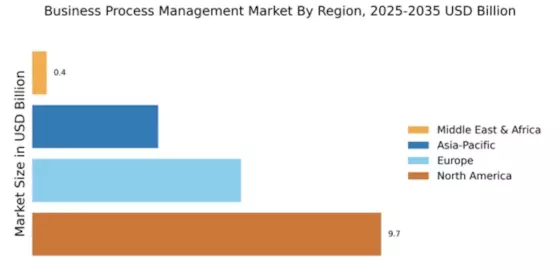
North America continues to lead the Business Process Management (BPM) market, holding a significant share of 9.7 in 2024. The region's growth is driven by rapid technological advancements, increasing demand for automation, and a strong focus on operational efficiency. Regulatory support for digital transformation initiatives further catalyzes market expansion, making it a hub for BPM innovation. The competitive landscape is characterized by major players such as IBM, Appian, and Oracle, which dominate the market with their comprehensive BPM solutions. The U.S. remains the largest contributor, supported by a robust infrastructure and a high adoption rate of cloud-based services. This region's focus on integrating AI and machine learning into BPM processes positions it for sustained growth in the coming years.

Europe : Emerging BPM Adoption Trends

Europe's Business Process Management market is projected to reach 5.8 by 2025, driven by increasing digitalization and the need for efficient business operations. Regulatory frameworks, such as the GDPR, encourage organizations to adopt BPM solutions to enhance compliance and operational transparency. The growing emphasis on sustainability and digital transformation initiatives further fuels demand for BPM technologies across various sectors. Leading countries like Germany, the UK, and France are at the forefront of BPM adoption, with a competitive landscape featuring key players such as SAP and Bizagi. The presence of innovative startups and established firms fosters a dynamic environment for BPM solutions. As organizations seek to streamline processes and improve customer experiences, the European market is poised for significant growth.

Asia-Pacific : Rapid Growth in BPM Solutions

The Asia-Pacific region is experiencing rapid growth in the Business Process Management market, projected to reach 3.5 by 2025. Factors such as increasing investments in digital transformation, a growing middle class, and the rise of SMEs are driving demand for BPM solutions. Governments in the region are also promoting initiatives to enhance business efficiency and competitiveness, further supporting market growth. Countries like India and China are leading the charge, with a burgeoning number of BPM providers emerging to cater to diverse industry needs. Key players such as Kissflow and Zoho are capitalizing on the growing demand for cloud-based BPM solutions. The competitive landscape is evolving, with both established firms and startups vying for market share, indicating a vibrant future for BPM in Asia-Pacific.

Middle East and Africa : Emerging BPM Market Potential

The Middle East and Africa (MEA) region presents a nascent yet promising Business Process Management market, with a size of 0.4 projected for 2025. The growth is primarily driven by increasing investments in technology and a shift towards digital transformation across various sectors. Governments are recognizing the importance of BPM in enhancing operational efficiency and are implementing supportive policies to encourage adoption. Countries like South Africa and the UAE are leading the way in BPM initiatives, with a growing number of local and international players entering the market. The competitive landscape is characterized by a mix of established firms and emerging startups, creating opportunities for innovation and collaboration. As organizations in the MEA region seek to optimize their processes, the BPM market is set for gradual yet steady growth.

Key Players and Competitive Insights

The Business Process Management Market is currently characterized by a dynamic competitive landscape, driven by the increasing demand for operational efficiency and digital transformation across various industries. Key players such as IBM (US), Appian (US), and SAP (DE) are strategically positioning themselves through innovation and partnerships, which collectively shape the competitive environment. IBM (US) focuses on integrating AI capabilities into its BPM solutions, enhancing automation and analytics, while Appian (US) emphasizes low-code development to accelerate application deployment. SAP (DE) is leveraging its extensive enterprise resource planning (ERP) ecosystem to offer integrated BPM solutions, thereby enhancing customer value.

The market structure appears moderately fragmented, with numerous players vying for market share. Key business tactics include localizing services to meet regional demands and optimizing supply chains to enhance responsiveness. The collective influence of these major players fosters a competitive atmosphere where agility and adaptability are paramount, allowing them to respond effectively to evolving customer needs.

In November 2025, IBM (US) announced a strategic partnership with a leading cloud provider to enhance its BPM offerings through cloud-native solutions. This move is significant as it positions IBM to capitalize on the growing trend of cloud adoption, enabling clients to achieve greater scalability and flexibility in their business processes. The partnership is likely to enhance IBM's competitive edge by providing integrated solutions that align with modern enterprise needs.

In October 2025, Appian (US) launched a new feature within its platform that utilizes machine learning to optimize workflow processes. This innovation is crucial as it not only streamlines operations but also empowers organizations to make data-driven decisions, thereby enhancing overall productivity. The introduction of such advanced features indicates Appian's commitment to maintaining a competitive advantage through continuous innovation.

In September 2025, SAP (DE) expanded its BPM capabilities by acquiring a niche software company specializing in process automation. This acquisition is indicative of SAP's strategy to bolster its technological portfolio and enhance its service offerings. By integrating advanced automation tools, SAP aims to provide comprehensive solutions that address the complexities of modern business environments, thereby reinforcing its market position.

As of December 2025, current competitive trends in the Business Process Management Market are heavily influenced by digitalization, sustainability, and AI integration. Strategic alliances are increasingly shaping the landscape, allowing companies to leverage complementary strengths and enhance their service offerings. The shift from price-based competition to a focus on innovation, technology, and supply chain reliability is evident, suggesting that future differentiation will hinge on the ability to deliver cutting-edge solutions that meet the evolving demands of businesses.

Key Companies in the Business Process Management Market market include

Industry Developments

  • Q2 2024: Appian Announces Acquisition of Lana Labs to Expand Process Mining Capabilities Appian announced the acquisition of Lana Labs, a process mining company, to enhance its business process management platform with advanced process mining and automation features.
  • Q2 2024: Nintex Appoints New CEO to Accelerate Growth and Innovation Nintex announced the appointment of a new Chief Executive Officer, aiming to drive the next phase of growth and product innovation in the business process management sector.
  • Q1 2024: UiPath Launches New AI-Powered Business Automation Platform UiPath introduced a new version of its business automation platform, integrating advanced AI capabilities to streamline business process management and automation for enterprise clients.
  • Q2 2024: ServiceNow to Acquire UltimateSuite, Expanding Process Mining Portfolio ServiceNow announced an agreement to acquire UltimateSuite, a process mining software provider, to strengthen its business process management and automation offerings.
  • Q1 2024: Camunda Raises $100M Series C to Scale Open Source Process Automation Camunda, an open-source business process automation company, secured $100 million in Series C funding to accelerate product development and global expansion.
  • Q2 2024: Kissflow Launches Unified Work Platform for Business Process Management Market Kissflow launched a new unified work platform designed to streamline business process management, project management, and workflow automation for enterprises.
  • Q1 2024: Pegasystems Announces Strategic Partnership with AWS to Enhance BPM Solutions Pegasystems entered a strategic partnership with Amazon Web Services to deliver enhanced business process management solutions leveraging AWS cloud infrastructure.
  • Q2 2024: IBM Launches New AI-Driven Business Process Automation Suite IBM unveiled a new AI-driven business process automation suite aimed at helping organizations optimize workflows and improve operational efficiency.
  • Q1 2024: Kofax Acquires PSIGEN Software to Expand Intelligent Automation Portfolio Kofax announced the acquisition of PSIGEN Software, a provider of document capture and workflow automation solutions, to strengthen its business process management and automation offerings.
  • Q2 2024: Bonitasoft Launches New Version of BPM Platform with Enhanced Low-Code Capabilities Bonitasoft released a new version of its business process management platform, featuring enhanced low-code development tools to accelerate digital transformation initiatives.
  • Q1 2024: Newgen Software Launches Contextual Content Services Platform for BPM Newgen Software launched a new contextual content services platform designed to integrate with its business process management solutions, enabling improved information management and workflow automation.
  • Q2 2024: Bizagi Announces Partnership with Microsoft to Enhance BPM Integration with Azure Bizagi announced a partnership with Microsoft to deliver enhanced business process management integration with Microsoft Azure, enabling customers to leverage cloud-based automation and workflow solutions.

Future Outlook

Business Process Management Market Future Outlook

The Business Process Management Market is projected to grow at an 18.78% CAGR from 2024 to 2035, driven by digital transformation, automation, and enhanced operational efficiency.

New opportunities lie in:

  • Integration of AI-driven analytics for process optimization
  • Development of cloud-based BPM solutions for scalability
  • Expansion into emerging markets with tailored BPM services

By 2035, the market is expected to be robust, reflecting substantial growth and innovation.

Market Segmentation

Business Process Management Market End User Outlook

  • BFSI
  • Healthcare
  • Manufacturing
  • Retail
  • Telecommunications

Business Process Management Market Application Outlook

  • Process Automation
  • Workflow Management
  • Business Rule Management
  • Content Management
  • Integration and API Management

Business Process Management Market Deployment Type Outlook

  • On-Premises
  • Cloud-Based
  • Hybrid

Report Scope

MARKET SIZE 202419.4(USD Billion)
MARKET SIZE 202522.64(USD Billion)
MARKET SIZE 2035126.56(USD Billion)
COMPOUND ANNUAL GROWTH RATE (CAGR)18.78% (2024 - 2035)
REPORT COVERAGERevenue Forecast, Competitive Landscape, Growth Factors, and Trends
BASE YEAR2024
Market Forecast Period2025 - 2035
Historical Data2019 - 2024
Market Forecast UnitsUSD Billion
Key Companies ProfiledIBM (US), Appian (US), Pega (US), Oracle (US), SAP (DE), Bizagi (GB), Kissflow (IN), BonitaSoft (FR), Zoho (IN), Microsoft (US)
Segments CoveredApplication, Deployment Type, End User
Key Market OpportunitiesIntegration of artificial intelligence enhances efficiency in the Business Process Management Market.
Key Market DynamicsRising demand for automation drives innovation and competition in the Business Process Management market.
Countries CoveredNorth America, Europe, APAC, South America, MEA

Market Highlights

Author
Ankit Gupta
Senior Research Analyst

Ankit Gupta is an analyst in market research industry in ICT and SEMI industry. With post-graduation in "Telecom and Marketing Management" and graduation in "Electronics and Telecommunication" vertical he is well versed with recent development in ICT industry as a whole. Having worked on more than 150+ reports including consultation for fortune 500 companies such as Microsoft and Rio Tinto in identifying solutions with respect to business problems his opinions are inclined towards mixture of technical and managerial aspects.

Leave a Comment

FAQs

What are the key drivers influencing the market to evolve more in the future?

The key drivers influencing the business process management market are directed towards cloud solution technology.

What the future valuation of the market estimated in the study?

The market will be gaining a valuation of USD 63.4 Billion by 2032.

what is the registered CAGR for the market to grow in the future?

The market will be expanding at 18.9% of CAGR in the future.

What factors are triggering the North America region to rise high than other regions?

The growing demand for efficient software for business operation and the presence of major BPM vendors is triggering the market growth in the North America region.

Why Asia Pacific region is regarded to be prominent vital players in the market?

The Asia‐Pacific region is the prominent player in the market because of enormous investment by enterprises in swelling business efficiency and productivity.

Download Free Sample

Kindly complete the form below to receive a free sample of this Report

Compare Licence

×
Features License Type
Single User Multiuser License Enterprise User
Price $4,950 $5,950 $7,250
Maximum User Access Limit 1 User Upto 10 Users Unrestricted Access Throughout the Organization
Free Customization
Direct Access to Analyst
Deliverable Format
Platform Access
Discount on Next Purchase 10% 15% 15%
Printable Versions