Request Free Sample ×

Kindly complete the form below to receive a free sample of this Report

* Please use a valid business email

Leading companies partner with us for data-driven Insights

clients tt-cursor
Hero Background

Circuit Breaker Market

ID: MRFR/EnP/0416-HCR
188 Pages
Anshula Mandaokar
Last Updated: June 01, 2026
Circuit Breaker Market Size, Share & Growth Analysis Report By Type (Miniature Circuit Breakers, Molded Case Circuit Breakers, Air Circuit Breakers, Hydraulic Magnetic Circuit Breakers), By Voltage Rating (Low Voltage Circuit Breakers, Medium Voltage Circuit Breakers, High Voltage Circuit Breakers), By Application (Residential, Commercial, Industrial, Utility), By End Use (Power Generation, Power Distribution, Renewable Energy, Transportation) and By Regional (North America, Europe, South America, Asia Pacific, Middle East and Africa) - Trends & Industry Forecast to 2035
Download PDF ×

We do not share your information with anyone. However, we may send you emails based on your report interest from time to time. You may contact us at any time to opt-out.

Circuit Breaker Market Summary

The global Circuit Breaker Market reached an estimated USD 23.18 billion in 2025 and is projected to grow from USD 24.61 billion in 2026 to USD 39.72 billion by 2035, registering a CAGR of 6.15% over the forecast period. Grid-modernization programs—particularly the USD 65 billion earmarked under the U.S. Bipartisan Infrastructure Law for power-grid upgrades—are driving a replacement cycle for aging switchgear across transmission and distribution networks [2]. Parallel investment in renewable-energy interconnection and industrial electrification is broadening the addressable base for advanced interruption devices.

Technology transformation is in the air as traditional oil-filled and SF₆ gas circuit breakers are replaced by vacuum circuit breaker MV distribution units and SF6-free circuit breaker green alternatives. As a response, the European Commission proposes a phase-down legislation for F-gases, aiming to reduce the use of SF 6 by 80% by 2030, driving manufacturers towards solid-dielectric and eco-gas interruption media [3]. Solid-state breakers, which were previously relegated to specialized HVDC high voltage DC circuit breaker applications, are now finding their way into data-center campuses and EV charging areas where sub-millisecond fault clearing is required.

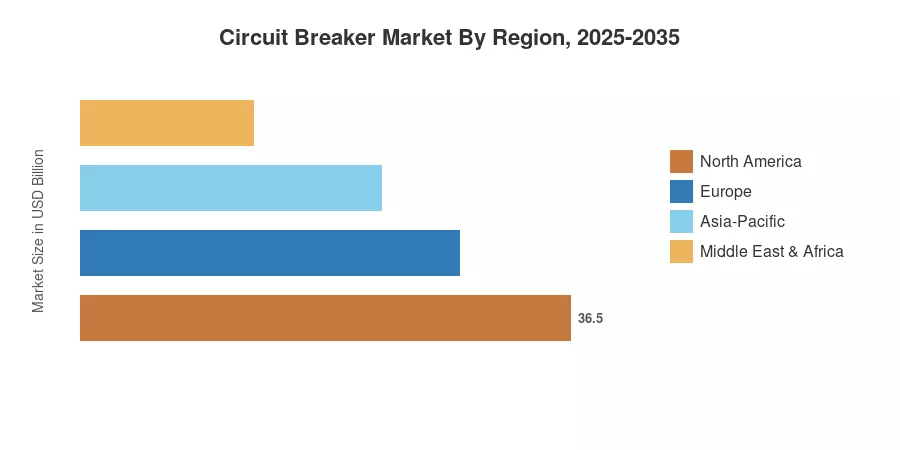
The Asia-Pacific region holds around 42.3% of the global Circuit Breaker Market revenue, led by the growth of China’s State Grid Corporation and India’s Revamped Distribution Sector Scheme (RDSS). Europe maintains the second-biggest proportion, some 23.5%, led by offshore-wind grid connections and smart-grid retrofits. The market for MCB miniature circuit breaker panels in Asia-Pacific is expected to rise at the quickest CAGR of 7.2% through 2035, owing to an expansion in household electrification projects


Key Report Takeaways

• By Type

  • Vacuum circuit breaker MV distribution technology captured 36.6% of the Circuit Breaker Market in 2024, reflecting strong adoption in medium-voltage switchgear replacements
  • Solid-state interruption devices are forecast to expand at a 9.4% CAGR through 2035, propelled by data-center and HVDC high voltage DC circuit breaker deployments


• By Voltage

  • Medium-voltage equipment held 39.1% of the Circuit Breaker Market in 2024, underpinned by distributed solar and wind integration


• By Mounting

  • Live-tank mounting variants led with a 38.2% share, while dead-tank configurations are advancing at a 8.6% CAGR to 2035

• By End User

  • Utilities accounted for 41.0% of Circuit Breaker Market revenue in 2024 and remain the dominant procurement channel


• By Region

  • Asia-Pacific's 7.2% CAGR makes it the fastest-growing region, with China and India contributing over 60% of regional demand


Market Size and Forecast (2021–2035)

The figures below are derived from MRFR’s unique bottoms-up methodology, which compiles switchgear procurement data from utilities’ tenders, industrial CAPEX filings and OEM shipment disclosures in 42 countries. Historical values (2021-2024) are harmonized with customs-trade databases. Forecast figures use a calibrated CAGR of 6.15%.
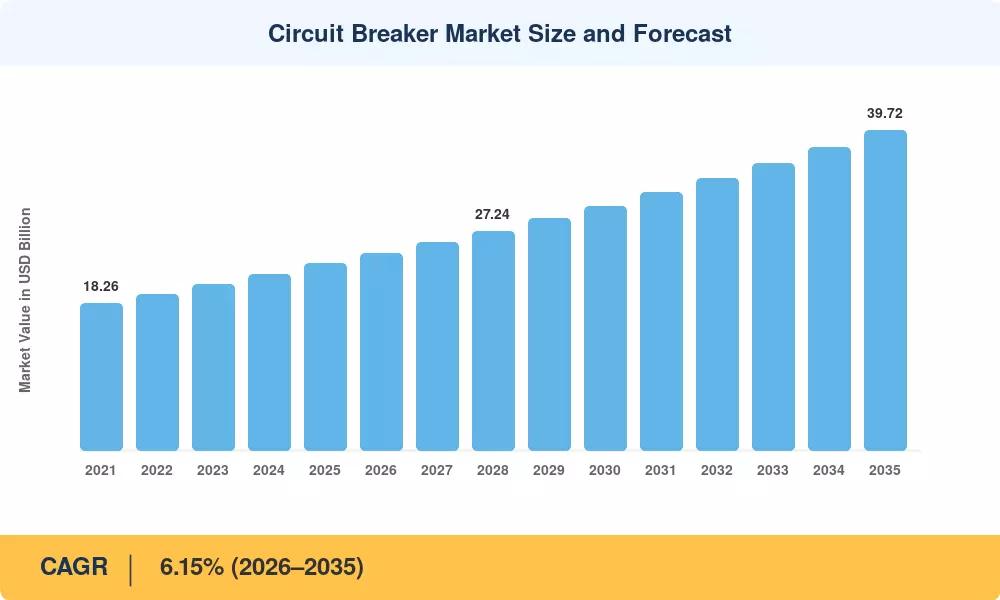
Circuit Breaker Market Size and Forecast
Our Impact
Enabled $4.3B Revenue Impact for Fortune 500 and Leading Multinationals
Partnering with 2000+ Global Organizations Each Year
30K+ Citations by Top-Tier Firms in the Industry

Driver Impact Analysis

Driver ~% Impact on CAGR Geographic Relevance Impact Timeline
Grid modernization & aging infrastructure replacement +1.4% North America, Europe Medium-term (2–4 yr)
Renewable-energy interconnection (solar, wind) +1.2% Asia-Pacific, Europe Long-term (≥4 yr)
Data-center campus electrification +0.8% North America, Asia-Pacific Short-term (≤2 yr)
EV charging infrastructure rollout +0.7% Europe, China Medium-term (2–4 yr)
SF₆ phase-down & eco-gas mandates +0.5% Europe, Global Long-term (≥4 yr)
Industrial electrification & process automation +0.4% Asia-Pacific, MEA Medium-term (2–4 yr)
HVDC transmission corridor expansion +0.3% Asia-Pacific, Europe Long-term (≥4 yr)


Grid Modernization and Aging Infrastructure Replacement

The U.S. Department of Energy's Grid Resilience and Innovation Partnerships (GRIP) program has allocated USD 10.5 billion specifically for transmission and distribution upgrades, a large share of which flows into switchgear procurement [2]. In Europe, the TEN-E regulation mandates cross-border grid reinforcement projects totaling an estimated EUR 584 billion through 2030, creating sustained demand for MCCB molded case circuit breakers and vacuum circuit breaker MV distribution equipment at substations [10]. Utilities are replacing 30-to-40-year-old oil circuit breakers with modern vacuum and SF6-free circuit breaker eco units that offer digital monitoring, lower maintenance costs, and compatibility with bidirectional power flows from distributed generation.

Renewable-Energy Interconnection

The International Energy Agency projects global renewable capacity additions of 560 GW annually through 2030, each gigawatt requiring multiple medium-voltage and high-voltage breaker installations at the point of interconnection [5]. India's RDSS program alone targets 25 million smart meters and associated MCB miniature circuit breaker panel upgrades across distribution feeders, representing a procurement pipeline exceeding USD 3.2 billion [11]. These installations demand breakers capable of handling variable fault currents from inverter-based resources, driving the Circuit Breaker Market toward adaptive-trip and solid-state technologies.

Data-Center Campus Electrification

Hyperscale data-center operators are deploying campuses that draw 100–300 MW each, requiring redundant busway systems protected by MCCB molded case circuit breaker assemblies rated for rapid fault isolation [6]. The global data-center construction pipeline, estimated at USD 48 billion for 2025 alone, is a direct catalyst for high-amperage, low-voltage circuit breaker procurement. Solid-state breakers are particularly attractive here because they eliminate arc-flash risk and clear faults in under one millisecond, reducing downtime exposure.

EV Charging Infrastructure Expansion

The European Alternative Fuels Infrastructure Regulation (AFIR) mandates a fast-charging station every 60 km along TEN-T core corridors by 2025, with each station requiring dedicated RCCB residual current circuit breaker protection against DC fault leakage [7]. China's charging-station count surpassed 3.1 million units in 2024, and the State Council plans to double that by 2027, generating massive Circuit Breaker Market demand at the distribution-panel level.


Restraints Impact Analysis

Restraint ~% Impact on CAGR Geographic Relevance Impact Timeline
Copper and raw-material price volatility –0.6% Global Short-term (≤2 yr)
SF₆ replacement technology maturity gaps –0.4% Europe, North America Medium-term (2–4 yr)
Skilled-labor shortages in switchgear installation –0.3% North America, MEA Long-term (≥4 yr)
Fragmented standards across emerging markets –0.3% South America, Africa Medium-term (2–4 yr)
Supply-chain bottlenecks for semiconductors in solid-state breakers –0.2% Global Short-term (≤2 yr)


Copper and Raw-Material Price Volatility

Copper prices surged 28% between Q1 2023 and Q3 2024, squeezing margins for MCB miniature circuit breaker panel and MCCB molded case circuit breaker manufacturers who rely on copper bus bars and contact assemblies [4]. Spot-price swings of this magnitude force OEMs into hedging contracts that lock capital and can delay product launches. Smaller manufacturers in South America and Southeast Asia face disproportionate impact because they lack the procurement scale to negotiate long-term supply agreements.

SF₆ Replacement Technology Maturity

While SF6-free circuit breaker eco solutions are gaining market traction, several alternative gases—including fluoronitrile (3M Novec 4710) and clean-air technology—still face field-validation hurdles at voltages above 145 kV [12]. Utilities require at least five years of operational data before qualifying a new interruption medium for critical transmission assets, slowing the Circuit Breaker Market transition timeline. The cost premium of 15–25% for eco-gas switchgear further deters budget-constrained utilities in emerging economies.

Skilled-Labor Shortages

The U.S. Bureau of Labor Statistics projects a 6% decline in available electrical lineworkers by 2030, even as switchgear installation volumes rise [13]. In the Middle East and Africa, rapid grid-expansion programs outpace local workforce development, creating dependency on imported technical labor. These constraints extend project lead times by 3–6 months, indirectly dampening the Circuit Breaker Market's near-term growth trajectory.


Circuit Breaker Market Opportunities

HVDC Transmission Corridor Build-Out

HVDC high voltage DC circuit breaker technology is transitioning from pilot to commercial scale as cross-border super-grid projects in Europe (North Sea Wind Power Hub) and Asia (China's ±800 kV UHV lines) expand [9]. Breaker manufacturers that develop reliable DC fault-interruption at 500 kV and above stand to capture a segment projected to exceed USD 2.8 billion by 2032

Digital Twin and Condition-Based Monitoring

Embedding IoT sensors in vacuum circuit breaker MV distribution units enables predictive maintenance and digital-twin modeling. Utilities using condition-based monitoring have reported 20–30% reductions in unplanned outage costs. This opens a recurring-revenue opportunity for OEMs willing to sell breaker-as-a-service subscriptions that bundle hardware with cloud analytics

Emerging-Market Rural Electrification

Sub-Saharan Africa's electrification rate remains below 50%, and the African Development Bank has committed USD 25 billion over ten years for grid extension and mini-grid projects [17]. Each mini-grid installation requires an MCB miniature circuit breaker panel and RCCB residual current circuit breaker protection, presenting a greenfield procurement channel for the Circuit Breaker Market

Solid-State Breaker Commercialization for Microgrids

Military bases, remote industrial sites, and island communities are early adopters of solid-state breakers that enable seamless microgrid islanding The U.S. Department of Defense has earmarked USD 1.7 billion for energy-resilience upgrades across 130 installations, much of which will flow into advanced breaker procurement [18].

Retrofitting SF₆ Panels with Eco-Gas Alternatives

Europe's installed base of approximately 1.2 million SF₆-insulated switchgear panels presents a multi-billion-dollar retrofit opportunity for SF6-free circuit breaker eco drop-in replacements [3]. First-mover OEMs offering backward-compatible eco-gas modules can capture replacement demand without requiring full substation redesigns


Circuit Breaker Market Future Outlook

AI-Enabled Autonomous Switchgear Operations

The medium-voltage switchgear segment is undergoing a significant digital shift, with next-generation installations increasingly integrating embedded AI inference chips. These advancements allow for autonomous fault classification and self-healing grid reconfiguration. As hardware becomes more commoditized across the global landscape, OEMs within the Circuit Breaker Market are actively shifting their competitive focus toward advanced software capabilities, digital-twin platforms, and interconnected ecosystem dynamics to drive brand differentiation.


Electrification Supercycle and Load Growth

A prolonged global electrification supercycle remains a core driver for long-term power infrastructure expansion. Driven by the mass adoption of electric vehicles, residential heat pumps, and the widespread electrification of heavy industrial processes, global electricity demand is projected to climb steadily over the next several decades. This massive surge in electricity generation and grid capacity requires extensive infrastructure investments, creating a continuous, multi-decade demand funnel for circuit breakers across transmission and distribution networks.


ESG Reporting and SF₆ Elimination Mandates

Regulatory pressures regarding environmental sustainability are radically restructuring infrastructure requirements. Under frameworks like the EU Corporate Sustainability Reporting Directive (CSRD) and updated regional F-gas regulations, utilities face strict requirements to monitor, report, and systematically eliminate greenhouse gas emissions. The strict phase-out timelines for sulfur hexafluoride ($\text{SF}_6$) in medium- and high-voltage applications are forcing a rapid shift toward eco-friendly, gas-free, or vacuum-insulated circuit breaker alternatives, while simultaneously boosting the market for advanced emissions monitoring and retrofitting services.


Platform Economics and Breaker-as-a-Service Models

Faced with compressing hardware margins due to the rapid scaling of production capacity across emerging manufacturing hubs, leading global OEMs are shifting toward service-centric business frameworks. Companies are increasingly moving away from pure hardware sales by bundling molded case circuit breakers (MCCBs) and vacuum units with recurring digital offerings. These packages feature cloud-based predictive maintenance analytics, continuous condition monitoring, and digital-twin software subscriptions, creating highly resilient, long-term customer relationships and optimizing long-term operational profitability.


Circuit Breaker Market Segmentation

By Type

Segment Metric (one only) Primary Demand Driver
Air USD 3.47 Billion (2025) Low-voltage distribution panels
Vacuum 36.6% share (2024) MV distribution replacement cycle
SF₆ 5.1% CAGR HV transmission (declining share)
Oil USD 1.62 Billion (2025) Legacy installed base, emerging markets
Hybrid 7.8% CAGR Compact substation designs
Solid-State 9.4% CAGR Data centers, HVDC, microgrids


The Circuit Breaker Market by type is defined by vacuum technology's dominance in medium-voltage applications. Vacuum circuit breaker MV distribution units deliver maintenance-free operation, compact footprints, and high short-circuit ratings that align with utility requirements for distributed-generation integration. ABB, Siemens Energy, and Schneider Electric collectively supply a majority of global vacuum-breaker shipments, competing on digital-monitoring features and eco-design certifications.

Solid-state breakers represent the fastest-growing type segment in the Circuit Breaker Market, driven by their sub-millisecond fault-clearing capability and absence of mechanical wear parts. HVDC high-voltage DC circuit breaker variants are critical for multi-terminal DC grids, where conventional mechanical breakers cannot interrupt DC fault currents quickly enough to prevent cascading failures.

By Voltage

Segment Metric (one only) Primary Demand Driver
Low Voltage USD 5.12 Billion (2025) Commercial buildings, residential panels
Medium Voltage 39.1% share (2024) Renewable interconnection, industrial
High Voltage 6.4% CAGR Transmission upgrades
Extra/Ultra-High Voltage 10.3% CAGR UHVDC corridors, cross-border grids


Medium-voltage equipment anchors the Circuit Breaker Market because every solar farm, wind park, and industrial substation requires MV switchgear as the interface between generation assets and the transmission network. Extra/ultra-high-voltage breakers, though a smaller share by unit volume, carry the highest per-unit value—exceeding USD 500,000 for 800 kV HVDC high voltage DC circuit breaker systems—and are growing fastest as intercontinental super-grids materialize.

By Mounting

Segment Metric (one only) Primary Demand Driver
Fixed USD 4.38 Billion (2025) Cost-sensitive LV/MV applications
Withdrawable 6.2% CAGR Maintenance-friendly utility substations
Live Tank 38.2% share (2024) Established HV transmission networks
Dead Tank 8.6% CAGR Seismic zones, compact station designs


By End User

Segment Metric (one only) Primary Demand Driver
Commercial USD 3.94 Billion (2025) Data centers, retail, healthcare
Residential 5.4% CAGR MCB/RCCB panel upgrades
Industrial USD 5.28 Billion (2025) Process electrification, mining
Utility 41.0% share (2024) T&D CAPEX programs


Utilities remain the largest end-user segment in the Circuit Breaker Market, driven by multi-year transmission and distribution CAPEX programs in China, India, and Europe. Residential demand for RCCB residual current circuit breaker protection is accelerating in markets where building codes now mandate arc-fault and earth-leakage protection at the consumer-unit level—particularly in India, Australia, and the EU.


Regional Market Share Analysis

Region Share / USD / CAGR (one metric) Primary Investment Themes
Asia-Pacific 42.3% share Grid expansion, renewables, industrial electrification
Europe 23.5% share Offshore wind, SF₆ phase-down, smart-grid retrofits
North America 20.8% share Grid resilience, data centers, EV charging
South America 7.2% share Mining electrification, distribution upgrades
Middle East & Africa 6.2% share Rural electrification, megaproject grids
Total 100%

The Circuit Breaker Market displays a pronounced Asia-Pacific tilt, though every region contributes meaningful demand tied to distinct investment cycles. Regional shares below reflect 2024 revenue estimates.


North America

Country Metric (one only) Key Driver
United States 7.2% CAGR GRIP program, data-center construction
Canada USD 1.03 Billion (2025) Hydro-grid modernization
Mexico 5.8% CAGR Nearshoring industrial parks


The United States accounts for the vast majority of the North American Circuit Breaker Market revenue, with DOE's GRIP grants and the Inflation Reduction Act channeling investment into grid-hardening and clean-energy interconnection [2]. Canada's provincial hydro utilities—BC Hydro, Hydro-Québec—are replacing decades-old oil breakers with vacuum circuit breaker MV distribution units, while Mexico's nearshoring boom is spurring demand for MCCB molded case circuit breaker panels in new industrial facilities along the northern border corridor.

Europe

Country Metric (one only) Key Driver
Germany 22.1% of regional share Energiewende grid reinforcement
United Kingdom 6.9% CAGR Offshore-wind connections
France USD 1.18 Billion (2025) Nuclear fleet upgrades
Italy 5.5% CAGR Smart-meter rollout
Spain USD 0.62 Billion (2025) Solar interconnection
Nordic Countries 6.4% CAGR Cross-border HVDC links
Russia USD 0.48 Billion (2025) Domestic substitution programs
Rest of Europe 5.1% CAGR EU cohesion fund grid projects


The EU's revised F-gas Regulation and the Clean Energy Package are the twin policy engines of Europe's Circuit Breaker Market growth. Germany's Energiewende requires an estimated EUR 110 billion in grid investment by 2030, creating robust demand for SF6-free circuit breaker eco switchgear [3]. The United Kingdom's Contracts for Difference program is driving 50 GW of offshore-wind capacity that needs dedicated high-voltage breaker installations at onshore landing points.

Asia-Pacific

Country Metric (one only) Key Driver
China 38.5% of regional share State Grid UHVDC expansion
India 8.1% CAGR RDSS distribution upgrades
Japan USD 1.74 Billion (2025) Grid decarbonization
South Korea 6.8% CAGR Offshore wind, hydrogen infrastructure
ASEAN USD 1.42 Billion (2025) Industrial electrification
Rest of Asia-Pacific 7.0% CAGR Data centers, mining


China's State Grid Corporation planned USD 75 billion in CAPEX for 2024, a significant portion directed toward HVDC high voltage DC circuit breaker procurement for ±800 kV corridors linking western renewables to eastern load centers [9]. India's RDSS program and Saubhagya electrification scheme together are fueling demand for MCB miniature circuit breaker panel assemblies at the last-mile distribution level, making the Circuit Breaker Market in India one of the fastest-growing globally.

South America

Country Metric (one only) Key Driver
Brazil 52.8% of regional share Pre-salt energy, wind farms
Argentina 5.9% CAGR Vaca Muerta electrification
Rest of South America USD 0.38 Billion (2025) Mining, small hydro


Brazil's ANEEL-regulated distribution concessions are upgrading MCB miniature circuit breaker panel infrastructure as part of loss-reduction mandates. At the same time, Argentina's Vaca Muerta shale development requires medium-voltage switchgear for remote processing facilities. The Circuit Breaker Market in South America benefits from commodity-driven industrial cycles that elevate power-infrastructure spending.

Middle East & Africa

Country Metric (one only) Key Driver
Saudi Arabia 31.4% of regional share NEOM, Vision 2030 megaprojects
UAE 6.7% CAGR Smart-city utility grids
South Africa USD 0.29 Billion (2025) Eskom grid rehabilitation
Egypt 6.3% CAGR New Administrative Capital
Rest of MEA USD 0.34 Billion (2025) Mini-grid rural electrification


Saudi Arabia's NEOM and Red Sea megaprojects are generating large-scale procurement orders for vacuum circuit breaker MV distribution equipment and RCCB residual current circuit breaker panels. South Africa's Eskom recapitalization plan, backed by an international USD 8.5 billion Just Energy Transition Partnership, is accelerating replacement of end-of-life oil-filled switchgear [17].


Circuit Breaker Market By Region, 2025-2035

Competitive Benchmarking

The Circuit Breaker Market is moderately concentrated, with an estimated CR5 between 48% and 55% and an HHI between 700 and 900. The competition is powered by a breadth of technology (vacuum, SF6-free circuit breaker eco, solid state), geography and digital services capacity. Chinese manufacturers are stepping up price rivalry in mid-voltage segments while European incumbents differentiate themselves in regulated markets with eco-gas portfolios.


Company Est. Revenue Share Range Key Offerings for Circuit Breaker Market Strategic Positioning
ABB Ltd. ~10–14% ADVAC vacuum, AirPlus eco-gas, Emax solid-state Full-spectrum T&D; digital-twin integration
Siemens Energy ~9–13% 3AV1 vacuum, Blue GIS (clean-air), SION SF6-free pioneer; strong in European utilities
Schneider Electric ~8–12% Masterpact MTZ, SM AirSet, EasyPact MV/LV breadth; sustainability-linked product lines
Eaton Corporation ~5–8% Power Defense, Magnum DS, VCP-W vacuum North American industrial/commercial focus
Mitsubishi Electric ~5–7% AE series MCCB, VCB for MV Strong APAC presence; high-voltage R&D
Hitachi Energy ~4–7% DCB dead-tank, HPL hybrid HVDC specialization; grid-automation platform
General Electric (GE Vernova) ~4–6% EntelliGuard, SecoVac Utility and industrial switchgear
Toshiba Energy Systems ~3–5% GCB, VCB series Japan-centric; nuclear-grade breakers
Hyundai Electric ~2–4% SF6 GCB, vacuum VCB Cost-competitive Korean manufacturer
CG Power (Crompton Greaves) ~2–4% Indoor/outdoor VCB, SF₆ panels India distribution-segment leader


Recent News & Developments

  • ABB (March 2025): Launched the AirPlus 170 kV clean-air circuit breaker, the industry's highest-rated SF6-free circuit breaker eco unit, targeting European transmission operators [19].
  • Siemens Energy (January 2025): Commissioned a Blue GIS production line in Berlin with an annual capacity of 2,500 bays, scaling SF6-free circuit breaker eco manufacturing [20].
  • Schneider Electric (October 2024): Expanded SM AirSeT medium-voltage switchgear production in India to serve the RDSS upgrade pipeline, reinforcing the Circuit Breaker Market's growth in the subcontinent [21].
  • Eaton Corporation (July 2024): Acquired a solid-state breaker start-up to accelerate entry into the HVDC high voltage DC circuit breaker segment for data-center applications [22].
  • European Commission (April 2024): Published the revised F-gas Regulation mandating a scheduled phase-down of SF₆ in new medium-voltage switchgear from 2026, reshaping the Circuit Breaker Market competitive landscape [3].
  • Hitachi Energy (February 2024): Delivered the world's first ±525 kV HVDC breaker to the SuedOstLink project in Germany [23].
  • India Ministry of Power (November 2023): Released RDSS Phase-II guidelines requiring smart MCB miniature circuit breaker panel metering infrastructure across 250 distribution circles [11].


Circuit Breaker Market Report Scope

Parameter Detail
Market Scope Global Circuit Breaker Market by Type, Voltage, Mounting, End User, and Geography
Study Period 2021–2035
CAGR (Forecast) 6.15% (2026–2035)
Market Size (2025) USD 23.18 Billion
Market Size (2035) USD 39.72 Billion
Fastest Growing Segment Solid-state breakers (by Type); Extra/Ultra-High Voltage (by Voltage)
Companies Profiled ABB, Siemens Energy, Schneider Electric, Eaton, Mitsubishi Electric, Hitachi Energy, GE Vernova, Toshiba, Hyundai Electric, CG Power
Valuation Currency USD Billion


FAQs

How do procurement cycles differ between utility and industrial buyers in the Circuit Breaker Market?

Utilities procure through multi-year framework agreements linked to regulatory CAPEX cycles, often locking in pricing 2–3 years ahead. Industrial buyers use project-specific RFQs with 6–12 month lead times, creating more price sensitivity and vendor switching.

What testing standards should buyers evaluate when specifying vacuum circuit breaker MV distribution units?

IEC 62271-100 and IEEE C37.09 govern type-testing for dielectric, short-circuit, and mechanical endurance performance. Buyers should confirm third-party test reports from accredited labs such as KEMA or CESI [9].

How does the total cost of ownership for SF6-free circuit breaker eco units compare to conventional SF₆ gear?

Upfront costs run 15–25% higher, but elimination of SF₆ gas handling, leak monitoring, and end-of-life disposal reduces lifecycle costs by roughly 10–18% over a 25-year service life [12].

What role do HVDC high-voltage DC circuit breaker systems play in offshore-wind grid design?

HVDC breakers enable multi-terminal offshore networks where individual wind farms can be isolated without de-energizing the entire DC link, improving system availability by 8–12% [9].

Which RCCB residual current circuit breaker types are mandated under India's updated wiring code?

The IS 732:2019 amendment requires Type A RCCBs with 30 mA sensitivity at the consumer unit in all new residential construction, driving significant MCB miniature circuit breaker panel demand [11].

How are solid-state breakers addressing arc-flash safety in the Circuit Breaker Market?

Solid-state devices eliminate the mechanical arc by using semiconductor switches that clear faults in under one millisecond, reducing arc-flash incident energy to near zero and lowering personal-protective-equipment requirements [6].

What supply-chain strategies are Circuit Breaker Market leaders adopting to mitigate copper price risk?

Leading OEMs are dual-sourcing copper rod from South American and African smelters while qualifying aluminum alloy contacts for select MCB miniature circuit breaker panel lines to reduce copper dependency [4].


Author
Author
Author Profile
Anshula Mandaokar LinkedIn
Team Lead - Research
Anshula Mandaokar holds an academic degree in Chemical Engineering and has been contributing to the field for more than 5 years. She has expertise in Market Research and Business Consulting and serves as a Team Lead for a reputed Market Research firm under the Chemicals and Materials domain spectrum. She has worked on multiple projects, generating explicit results in a quick turnaround time. Her understanding of data interpretation justifies her role as a leader.

Research Approach


Secondary Research

The secondary research process involved comprehensive analysis of regulatory databases, technical standards repositories, energy sector publications, and authoritative electrical infrastructure organizations. Key sources included the US Department of Energy (DOE), Federal Energy Regulatory Commission (FERC), National Electrical Manufacturers Association (NEMA), International Electrotechnical Commission (IEC), Institute of Electrical and Electronics Engineers (IEEE), European Network of Transmission System Operators (ENTSO-E), EU Agency for the Cooperation of Energy Regulators (ACER), International Energy Agency (IEA), US Energy Information Administration (EIA), Power Transmission and Distribution Association (PTDA), International Council on Large Electric Systems (CIGRE), China Electrical Equipment Industry Association (CEEIA), Electrical Equipment Manufacturers Association of India (EEMA), and national utility regulatory commissions from key markets. These sources were used to collect installed base statistics, grid modernization investment data, transmission and distribution infrastructure metrics, regulatory compliance standards (IEC 60947, IEEE C37, UL 489), and market landscape analysis for low voltage, medium voltage, and high voltage circuit breaker technologies across residential, commercial, industrial, and utility sectors.


Primary Research

To gather both qualitative and quantitative insights, supply-side and demand-side stakeholders were interviewed during the primary research phase. CEOs, VPs of business development, heads of product engineering, regulatory compliance officers, and regional sales directors from makers of circuit breakers, switchgear OEMs, and suppliers of electrical components were examples of supply-side sources. Electrical contractors that specialize in commercial infrastructure, sustainability directors from renewable energy project developers, plant engineering managers from heavy industrial facilities (such as steel, chemical, and oil and gas), procurement heads from transmission and distribution utilities, and chief electrical engineers were among the demand-side sources. Primary research established product certification timescales, validated market segmentation across voltage categories and installation types, and collected data on smart breaker adoption rates, aftermarket service dynamics, and grid modernization procurement patterns.

Primary Respondent Breakdown:

By Designation: C-level Primaries (28%), Director Level (32%), Others (40%)

By Region: North America (32%), Europe (30%), Asia-Pacific (28%), Rest of World (10%)


Market Size Estimation

Global market valuation was derived through revenue mapping and installation volume analysis. The methodology included:

Identification of 50+ key manufacturers across North America, Europe, Asia-Pacific, and Latin America

Product mapping across Miniature Circuit Breakers (MCB), Molded Case Circuit Breakers (MCCB), Air Circuit Breakers (ACB), Vacuum Circuit Breakers (VCB), SF6 and SF6-free technologies, and solid-state circuit breaker categories

Analysis of reported and modeled annual revenues specific to circuit breaker product lines and switchgear portfolios

Coverage of manufacturers representing 75-80% of global market share in 2024

Extrapolation using bottom-up (installation volume × ASP by voltage type and end-use sector) and top-down (manufacturer revenue validation) approaches to derive segment-specific valuations across power generation, transmission & distribution utilities, industrial manufacturing, commercial buildings, and residential infrastructure sectors

Download Free Sample

Kindly complete the form below to receive a free sample of this Report
















