×
Request Free Sample ×

Kindly complete the form below to receive a free sample of this Report

Leading companies partner with us for data-driven Insights

clients tt-cursor
Hero Background

Cold Stamping Body In White Market

ID: MRFR/AT/33400-HCR
100 Pages
Swapnil Palwe
October 2025

Cold Stamping Body in White Market Research Report By Application (Automotive Body Parts, Structural Components, Chassis Components), By Material Type (Steel, Aluminum, Advanced High-Strength Steel), By Manufacturing Process (Single Stage Stamping, Progressive Stamping, Compound Stamping), By End Use Industry (Passenger Vehicles, Commercial Vehicles, Electric Vehicles) and By Regional (North America, Europe, South America, Asia Pacific, Middle East and Africa) - Forecast to 2035

Share:
Download PDF ×

We do not share your information with anyone. However, we may send you emails based on your report interest from time to time. You may contact us at any time to opt-out.

Cold Stamping Body In White Market Infographic
Purchase Options

Cold Stamping Body In White Market Summary

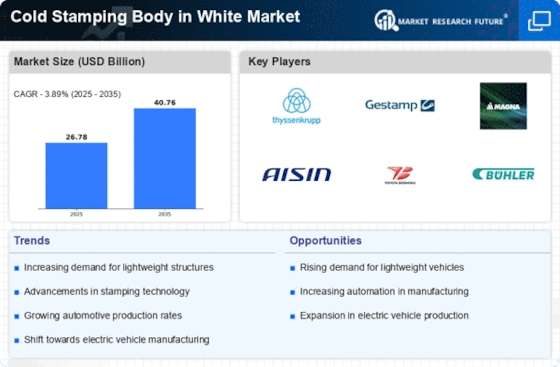
As per MRFR analysis, the Cold Stamping Body in White Market Size was estimated at 26.78 USD Billion in 2024. The Cold Stamping Body in White industry is projected to grow from 27.82 USD Billion in 2025 to 40.76 USD Billion by 2035, exhibiting a compound annual growth rate (CAGR) of 3.89 during the forecast period 2025 - 2035.

Key Market Trends & Highlights

The Cold Stamping Body in White Market is poised for growth driven by technological advancements and sustainability initiatives.

  • North America remains the largest market for cold stamping body in white, driven by robust automotive production.
  • Asia-Pacific is the fastest-growing region, reflecting increasing investments in manufacturing capabilities and infrastructure.
  • The automotive body parts segment dominates the market, while chassis components are emerging as the fastest-growing segment.
  • Technological advancements in cold stamping and rising demand for electric vehicles are key drivers propelling market expansion.

Market Size & Forecast

2024 Market Size 26.78 (USD Billion)
2035 Market Size 40.76 (USD Billion)
CAGR (2025 - 2035) 3.89%

Major Players

Thyssenkrupp AG (DE), Gestamp Automoción S.A. (ES), Magna International Inc. (CA), Aisin Seiki Co., Ltd. (JP), Toyota Boshoku Corporation (JP), Bühler AG (CH), Friedrichshafen AG (DE), Sodecia (PT), Hirschvogel Umformtechnik GmbH (DE)

Cold Stamping Body In White Market Trends

The Cold Stamping Body in White Market is currently experiencing a notable transformation, driven by advancements in manufacturing technologies and increasing demand for lightweight automotive components. This market segment appears to be gaining traction as manufacturers seek to enhance vehicle performance while adhering to stringent environmental regulations. The shift towards electric vehicles and the need for improved fuel efficiency seem to be influencing the design and production processes within this sector. As a result, companies are investing in innovative cold stamping techniques that allow for the creation of complex geometries and high-strength components, which could potentially lead to reduced production costs and improved overall vehicle safety. Moreover, the Cold Stamping Body in White Market is likely to witness a rise in collaborations between automotive manufacturers and technology providers. This trend suggests a growing emphasis on integrating smart manufacturing solutions, such as automation and data analytics, into the production process. Such partnerships may facilitate the development of more efficient production lines and enhance the adaptability of manufacturing systems to meet evolving consumer preferences. Overall, the market appears poised for growth, driven by technological advancements and a shift towards sustainable automotive solutions.

Technological Advancements in Manufacturing

The Cold Stamping Body in White Market is witnessing a surge in technological innovations that enhance production efficiency. New machinery and techniques are being developed to improve precision and reduce waste, which may lead to cost savings for manufacturers. These advancements could also enable the production of more complex designs, catering to the evolving needs of the automotive industry.

Sustainability and Lightweighting Trends

There is a growing focus on sustainability within the Cold Stamping Body in White Market, as manufacturers aim to produce lighter components that contribute to improved fuel efficiency. This trend aligns with global efforts to reduce carbon emissions and meet regulatory standards. Lightweight materials are increasingly being utilized, which may enhance vehicle performance while minimizing environmental impact.

Collaborative Industry Partnerships

The Cold Stamping Body in White Market is likely to see an increase in collaborations between automotive manufacturers and technology firms. These partnerships may foster innovation by integrating advanced technologies into production processes. Such collaborations could lead to the development of smarter manufacturing solutions, enhancing overall efficiency and responsiveness to market demands.

Cold Stamping Body In White Market Drivers

Sustainability Initiatives

Sustainability is becoming increasingly pivotal in the Cold Stamping Body in White Market. As environmental regulations tighten and consumer preferences shift towards eco-friendly products, manufacturers are compelled to adopt sustainable practices. This includes the use of recyclable materials and energy-efficient processes that minimize carbon footprints. The industry is witnessing a rise in the demand for lightweight components, which contribute to improved fuel efficiency in vehicles. According to recent data, the market for lightweight automotive materials is projected to grow significantly, indicating a shift towards sustainability. Companies that prioritize eco-friendly practices not only enhance their brand image but also gain a competitive edge in the Cold Stamping Body in White Market. This trend is likely to continue as stakeholders increasingly emphasize the importance of sustainability in their operations.

Collaborative Industry Partnerships

Collaborative partnerships within the Cold Stamping Body in White Market are emerging as a strategic driver for growth. Manufacturers are increasingly forming alliances with suppliers, technology providers, and research institutions to leverage shared expertise and resources. These collaborations facilitate the development of innovative solutions that enhance production capabilities and reduce costs. For instance, partnerships focused on research and development can lead to breakthroughs in material science, resulting in stronger and lighter components. Additionally, joint ventures can enable companies to access new markets and expand their customer base. As the industry evolves, these collaborative efforts are likely to play a crucial role in shaping the future landscape of the Cold Stamping Body in White Market.

Rising Demand for Electric Vehicles

The surge in electric vehicle (EV) adoption is significantly influencing the Cold Stamping Body in White Market. As automakers pivot towards electrification, the need for lightweight and efficient body structures becomes paramount. Cold stamping processes are particularly well-suited for producing the intricate designs required for EVs, which often feature unique shapes and materials. Market data suggests that the EV segment is expected to account for a substantial share of the automotive market in the coming years, driving demand for advanced manufacturing techniques. This shift not only presents opportunities for growth within the Cold Stamping Body in White Market but also necessitates innovation in material selection and design to accommodate the specific requirements of electric vehicles.

Regulatory Compliance and Safety Standards

Regulatory compliance and safety standards are critical drivers in the Cold Stamping Body in White Market. As governments worldwide implement stricter regulations regarding vehicle safety and emissions, manufacturers must adapt their processes to meet these requirements. Compliance with safety standards not only ensures the protection of consumers but also enhances the credibility of manufacturers. The industry is witnessing an increased focus on quality assurance and testing protocols to ensure that stamped components meet regulatory benchmarks. This emphasis on compliance can lead to higher production costs; however, it also fosters innovation as companies seek to develop safer and more efficient products. Consequently, adherence to regulatory frameworks is likely to remain a significant factor influencing the Cold Stamping Body in White Market.

Technological Advancements in Cold Stamping

The Cold Stamping Body in White Market is experiencing a notable transformation due to rapid technological advancements. Innovations in stamping machinery and automation are enhancing production efficiency and precision. For instance, the integration of robotics and artificial intelligence in manufacturing processes is streamlining operations, reducing waste, and improving product quality. As a result, manufacturers are able to produce complex geometries with tighter tolerances, which is crucial for meeting the evolving demands of the automotive sector. Furthermore, the adoption of Industry 4.0 principles is facilitating real-time monitoring and data analytics, allowing for proactive maintenance and optimization of production lines. This technological evolution not only boosts productivity but also positions companies to respond swiftly to market changes, thereby driving growth in the Cold Stamping Body in White Market.


Market Segment Insights

By Application: Automotive Body Parts (Largest) vs. Chassis Components (Fastest-Growing)

In the Cold Stamping Body in White Market, the segmentation indicates that Automotive Body Parts holds the largest share, driven by the increasing demand for lightweight and durable materials that enhance vehicle performance. Chassis Components follow as a significant contributor, reflecting their essential role in vehicle structure and safety features. Structural Components also play an important role, although they represent a smaller portion of the market. The growth of the Automotive Body Parts segment is propelled by the rising production of electric and hybrid vehicles that require advanced materials, while Chassis Components are witnessing rapid growth due to advancements in technology that improve structural integrity and fuel efficiency. This transition in consumer preference towards more eco-friendly vehicles is set to continue influencing market dynamics favorably for these segments.

Automotive Body Parts (Dominant) vs. Chassis Components (Emerging)

The Automotive Body Parts segment stands out as a dominant force in the Cold Stamping Body in White Market due to its essentiality in vehicle construction and the burgeoning automotive sector. This segment focuses on manufacturing parts such as doors, hoods, and roofs, which are critical for vehicle aesthetics and functionality. With the emphasis on lightweight materials to improve fuel efficiency, Automotive Body Parts are increasingly being fabricated using advanced cold stamping technologies. On the other hand, Chassis Components are identified as an emerging segment, evolving rapidly with innovations like integrated structures that enhance the safety and performance of vehicles. As automotive manufacturers strive for more efficient designs and sustainability, Chassis Components are becoming integral to the overall vehicle architecture, signaling their potential for future growth.

By Material Type: Steel (Largest) vs. Aluminum (Fastest-Growing)

The Cold Stamping Body in White Market is predominantly driven by steel, which accounts for the largest share in material usage. Steel's robust properties and historical significance in automotive manufacturing make it the leading choice among manufacturers. Meanwhile, aluminum is steadily gaining traction due to its lightweight characteristics, resulting in increased fuel efficiency and performance in vehicles. Its growing adoption is a response to stricter regulations on emissions and the industry's shift towards more sustainable practices.

Steel (Dominant) vs. Aluminum (Emerging)

Steel remains the dominant material in the Cold Stamping Body in White Market due to its excellent strength-to-weight ratio, cost-effectiveness, and ability to be easily formed into complex shapes. It is widely recognized for providing structural integrity and durability in automotive applications. Aluminum, on the other hand, is emerging as a preferred alternative because of its lightweight nature, which contributes to improved vehicle efficiency and reduced greenhouse gas emissions. As manufacturers seek to meet environmental regulations and consumer demands for efficiency, aluminum's popularity is soaring, making it a key player in the transition towards innovative vehicle designs.

By Manufacturing Process: Single Stage Stamping (Largest) vs. Progressive Stamping (Fastest-Growing)

In the Cold Stamping Body in White Market, Single Stage Stamping holds the largest market share, characterized by its simplicity and cost-effectiveness in manufacturing. This process involves a single stroke of the stamping press to form the desired part, making it a favorable choice for high-volume production of simpler shapes. On the other hand, Progressive Stamping is gaining traction, offering more complexity in part design with multiple operations in a single press cycle. Its ability to lower labor costs and enhance production efficiency contributes to its growing market presence.

Single Stage Stamping (Dominant) vs. Progressive Stamping (Emerging)

Single Stage Stamping, as the dominant manufacturing process, is favored for its efficiency and lower operational costs. It is primarily used in high-volume production environments where simplicity in part shape is paramount. In contrast, Progressive Stamping represents an emerging manufacturing process that caters to more intricate designs. This method allows manufacturers to create complex parts within a single production cycle, accommodating a diverse range of applications. As the automotive industry seeks innovative solutions to reduce weight and increase structural integrity, the demand for Progressive Stamping is expected to rise, marking it as a significant player in the future of cold stamping.

By End Use Industry: Passenger Vehicles (Largest) vs. Electric Vehicles (Fastest-Growing)

The Cold Stamping Body in White Market exhibits a diverse distribution in the end-use industry segment, with passenger vehicles dominating the market share. This segment includes a wide array of models, driving demand thanks to consumer preferences for personal transportation. In contrast, while commercial vehicles hold a notable position, it is the electric vehicles segment that is gaining significant traction, ensuring a more competitive landscape as it expands. Electric vehicles are emerging as a pivotal force in the Cold Stamping Body in White Market, propelled by technological advancements and government incentives promoting green transportation. The rising shift toward sustainable mobility is attracting investments in lightweight materials and innovative manufacturing processes. As the electric vehicle segment is forecasted to witness rapid growth, traditional passenger and commercial vehicle markets will need to adapt to the evolving consumer demands and regulatory changes more aggressively.

Passenger Vehicles: Dominant vs. Electric Vehicles: Emerging

Passenger vehicles are characterized by their established manufacturing processes and large-scale production capabilities in the Cold Stamping Body in White Market. This segment benefits from robust consumer demand, leading to optimized designs that deliver lightweight structures while maintaining vehicle safety standards. With automotive manufacturers investing in improved stamping technologies, the passenger vehicle segment continues to yield significant profit margins due to economies of scale. On the other hand, electric vehicles represent an emerging segment fueled by innovation and sustainability, attracting substantial investments from both established automakers and startups. Companies are focusing on developing lighter materials to enhance battery efficiencies, necessitating advanced cold stamping techniques. As these vehicles prioritize energy efficiency and sustainability, they are reshaping industry dynamics and contributing to a balanced competitive environment.
Get more detailed insights about Cold Stamping Body In White Market

Regional Insights

North America : Automotive Innovation Hub

The North American cold stamping body in white market is driven by increasing automotive production and a shift towards lightweight materials. The region holds approximately 35% of the global market share, making it the largest market. Regulatory support for fuel efficiency and emissions reduction is further propelling demand for advanced manufacturing techniques. The growing trend of electric vehicles is also contributing to this growth, as manufacturers seek to optimize body structures for performance and sustainability. Leading countries in this region include the United States and Canada, with major automotive hubs in Detroit and Ontario. Key players such as Magna International and Thyssenkrupp AG are heavily investing in innovative stamping technologies. The competitive landscape is characterized by collaborations between automotive manufacturers and suppliers to enhance production efficiency and reduce costs, ensuring a robust market presence.

Europe : Manufacturing Powerhouse

Europe's cold stamping body in white market is characterized by a strong emphasis on sustainability and innovation. The region accounts for approximately 30% of the global market share, making it the second largest market. Regulatory frameworks such as the European Green Deal are catalyzing the adoption of eco-friendly manufacturing processes. The demand for lightweight materials in automotive production is also on the rise, driven by stringent emissions regulations and consumer preferences for fuel-efficient vehicles. Germany, France, and Spain are leading countries in this sector, with Germany being home to major players like Thyssenkrupp AG and Gestamp Automoción. The competitive landscape is marked by a focus on technological advancements and partnerships aimed at enhancing production capabilities. European manufacturers are increasingly investing in R&D to develop innovative stamping solutions that meet evolving market demands, ensuring their competitive edge in the global arena.

Asia-Pacific : Emerging Market Dynamics

The Asia-Pacific region is witnessing rapid growth in the cold stamping body in white market, driven by increasing automotive production and rising consumer demand. This region holds approximately 25% of the global market share, with countries like China and Japan leading the charge. The push for electric vehicles and government incentives for local manufacturers are key factors driving this growth. Additionally, the region's focus on technological advancements in manufacturing processes is enhancing production efficiency and reducing costs. China is the largest market in this region, followed by Japan and South Korea. Major players such as Aisin Seiki and Toyota Boshoku are investing heavily in innovative stamping technologies to meet the growing demand. The competitive landscape is characterized by a mix of local and international players, with collaborations and partnerships becoming increasingly common to leverage technological advancements and expand market reach.

Middle East and Africa : Resource-Rich Frontier

The Middle East and Africa region is emerging as a significant player in the cold stamping body in white market, driven by increasing investments in automotive manufacturing. This region holds approximately 10% of the global market share, with countries like South Africa and the UAE leading the way. The growth is supported by government initiatives aimed at boosting local manufacturing capabilities and attracting foreign investments. Additionally, the rising demand for vehicles in the region is further propelling market growth. South Africa is the largest market in this region, with a growing number of automotive assembly plants and suppliers. The competitive landscape is evolving, with both local and international players vying for market share. Key players are focusing on establishing production facilities to cater to the increasing demand, while also investing in technology to enhance manufacturing processes and improve product quality.

Cold Stamping Body In White Market Regional Image

Key Players and Competitive Insights

The Cold Stamping Body in White Market is witnessing dynamic competitive shifts as manufacturers adapt to evolving automotive technology and consumer preferences.

The competitive landscape is defined by a mixture of established players and emerging companies that are iterating on traditional methods and introducing innovative processes to enhance production efficiency and product durability.

Key drivers in this market include advancements in lightweight materials that contribute to improved fuel efficiency; regulatory pressures focused on emission reductions and the adoption of automation within manufacturing processes.

Moreover, the push for sustainability is reshaping how companies operate, compelling them to explore eco-friendlier materials and production techniques. The players in this space are also focusing on forming strategic collaborations and partnerships to leverage complementary strengths and expand their market reach.

Dana Incorporated has established a robust presence in the Cold Stamping Body in White Market through its commitment to engineering excellence and product innovation. The company's strength lies in its comprehensive portfolio, which includes a wide range of stamped components that meet stringent automotive standards.

Dana brings extensive expertise in materials science, allowing it to produce lightweight and high-strength components that enhance vehicle performance and efficiency. Its strong focus on research and development aids in creating advanced manufacturing processes that reduce production costs while maintaining quality.

Dana's well-established relationships with major automakers further bolster its competitive position, enabling the company to effectively respond to customer needs and industry trends.

General Motors is a significant player in the Cold Stamping Body in White Market, recognized for its pioneering approach to automotive design and manufacturing. The company leverages cutting-edge technologies and innovation to create body-in-white structures that are not only lightweight but also provide excellent structural integrity and safety.

General Motors has made substantial investments in automation and digital manufacturing techniques, enhancing production efficiency and reducing lead times. Its focus on sustainability is evident in its initiatives to utilize recycled materials and explore alternative manufacturing methods, aligning with global environmental objectives.

General Motors' ability to integrate advanced engineering solutions into its cold stamping processes positions it favorably within the competitive landscape, reinforcing its commitment to delivering high-quality vehicles in a rapidly evolving market.

Key Companies in the Cold Stamping Body In White Market market include

Industry Developments

In recent developments within the Cold Stamping Body in White Market, companies such as Magna International and Ford Motor Company have been focusing on advancing their manufacturing capabilities to enhance the efficiency and quality of their automotive components.

Dana Incorporated has also initiated collaborations aimed at integrating innovative lightweight materials into their stamping processes. Market dynamics have seen a notable shift, with manufacturers like Nippon Steel Corporation ramping up investment in advanced manufacturing technologies to cater to the growing demand for electric vehicles and lightweight structures.

Moreover, the market has witnessed significant acquisitions, such as Thyssenkrupp AG's recent expansion of their joint ventures, bolstering their presence in the cold stamping sector. Furthermore, SABIC and BASF SE have shown increased interest in sustainable raw materials for stamping processes, aligning with global trends towards environmentally friendly manufacturing.

As these changes transpire, analysts suggest that these companies' strategic moves are likely to influence market valuations, facilitating growth and competitive positioning within the Cold Stamping Body in White Market.

Future Outlook

Cold Stamping Body In White Market Future Outlook

The Cold Stamping Body in White Market is projected to grow at a 3.89% CAGR from 2024 to 2035, driven by technological advancements and increasing automotive production.

New opportunities lie in:

  • Expansion into electric vehicle body components
  • Development of lightweight materials for enhanced fuel efficiency
  • Strategic partnerships with automotive manufacturers for innovative designs

By 2035, the market is expected to solidify its position as a leader in automotive manufacturing.

Market Segmentation

Cold Stamping Body In White Market Application Outlook

  • Automotive Body Parts
  • Structural Components
  • Chassis Components

Cold Stamping Body In White Market Material Type Outlook

  • Steel
  • Aluminum
  • Advanced High-Strength Steel

Cold Stamping Body In White Market End Use Industry Outlook

  • Passenger Vehicles
  • Commercial Vehicles
  • Electric Vehicles

Cold Stamping Body In White Market Manufacturing Process Outlook

  • Single Stage Stamping
  • Progressive Stamping
  • Compound Stamping

Report Scope

MARKET SIZE 202426.78(USD Billion)
MARKET SIZE 202527.82(USD Billion)
MARKET SIZE 203540.76(USD Billion)
COMPOUND ANNUAL GROWTH RATE (CAGR)3.89% (2024 - 2035)
REPORT COVERAGERevenue Forecast, Competitive Landscape, Growth Factors, and Trends
BASE YEAR2024
Market Forecast Period2025 - 2035
Historical Data2019 - 2024
Market Forecast UnitsUSD Billion
Key Companies ProfiledMarket analysis in progress
Segments CoveredMarket segmentation analysis in progress
Key Market OpportunitiesAdvancements in lightweight materials enhance efficiency in the Cold Stamping Body in White Market.
Key Market DynamicsTechnological advancements and regulatory changes drive innovation and competition in the Cold Stamping Body in White Market.
Countries CoveredNorth America, Europe, APAC, South America, MEA

Leave a Comment

FAQs

What is the projected market valuation of the Cold Stamping Body in White Market by 2035?

The projected market valuation for the Cold Stamping Body in White Market is expected to reach 40.76 USD Billion by 2035.

What was the overall market valuation of the Cold Stamping Body in White Market in 2024?

The overall market valuation of the Cold Stamping Body in White Market was 26.78 USD Billion in 2024.

What is the expected CAGR for the Cold Stamping Body in White Market during the forecast period 2025 - 2035?

The expected CAGR for the Cold Stamping Body in White Market during the forecast period 2025 - 2035 is 3.89%.

Which companies are considered key players in the Cold Stamping Body in White Market?

Key players in the Cold Stamping Body in White Market include Thyssenkrupp AG, Gestamp Automoción S.A., and Magna International Inc.

What are the main application segments in the Cold Stamping Body in White Market?

The main application segments include Automotive Body Parts, Structural Components, and Chassis Components, with valuations ranging from 8.0 to 15.0 USD Billion.

How does the material type segment perform in the Cold Stamping Body in White Market?

The material type segment shows valuations for Steel at 15.0 to 23.0 USD Billion, Aluminum at 7.0 to 10.0 USD Billion, and Advanced High-Strength Steel at 4.78 to 7.76 USD Billion.

What are the manufacturing processes involved in the Cold Stamping Body in White Market?

Manufacturing processes include Single Stage Stamping, Progressive Stamping, and Compound Stamping, with valuations from 8.0 to 15.0 USD Billion.

What end-use industries are driving the Cold Stamping Body in White Market?

End-use industries driving the market include Passenger Vehicles, Commercial Vehicles, and Electric Vehicles, with valuations between 8.0 and 15.0 USD Billion.

How does the Cold Stamping Body in White Market compare to other automotive manufacturing processes?

The Cold Stamping Body in White Market appears to be growing steadily, with a projected increase in valuation, indicating a robust demand compared to other processes.

What trends are influencing the growth of the Cold Stamping Body in White Market?

Trends influencing growth include advancements in material technology and increasing demand for lightweight automotive components, particularly in electric vehicles.

Download Free Sample

Kindly complete the form below to receive a free sample of this Report

Compare Licence

×
Features License Type
Single User Multiuser License Enterprise User
Price $4,950 $5,950 $7,250
Maximum User Access Limit 1 User Upto 10 Users Unrestricted Access Throughout the Organization
Free Customization
Direct Access to Analyst
Deliverable Format
Platform Access
Discount on Next Purchase 10% 15% 15%
Printable Versions














