Request Free Sample ×

Kindly complete the form below to receive a free sample of this Report

* Please use a valid business email

Leading companies partner with us for data-driven Insights

clients tt-cursor
Hero Background

Cyber Warfare Market

ID: MRFR/AD/11000-HCR
200 Pages
Abbas Raut
Last Updated: May 31, 2026
Cyber Warfare Market Size, Share, Industry Trend & Analysis Research Report By Component (Solution, Services), By Deployment Mode (On-Premises, Cloud-Based, Hybrid), By End-User Industry (Defense and Aerospace, BFSI, Corporate, Power and Utilities, Government, Healthcare, Transportation and Logistics, Other), By Geography (North America, Europe, Asia-Pacific, South America, Middle East & Africa) - Forecast to 2035
Download PDF ×

We do not share your information with anyone. However, we may send you emails based on your report interest from time to time. You may contact us at any time to opt-out.

  1. 1 Market Overview |
    1. 1.1 Study Assumptions & Market Definition |
    2. 1.2 Scope of the Study |
    3. 1.3 Research Methodology
  2. 2 Market Summary & Key Takeaways
  3. 3 Market Dynamics |
    1. 3.1 Market Drivers Analysis | |
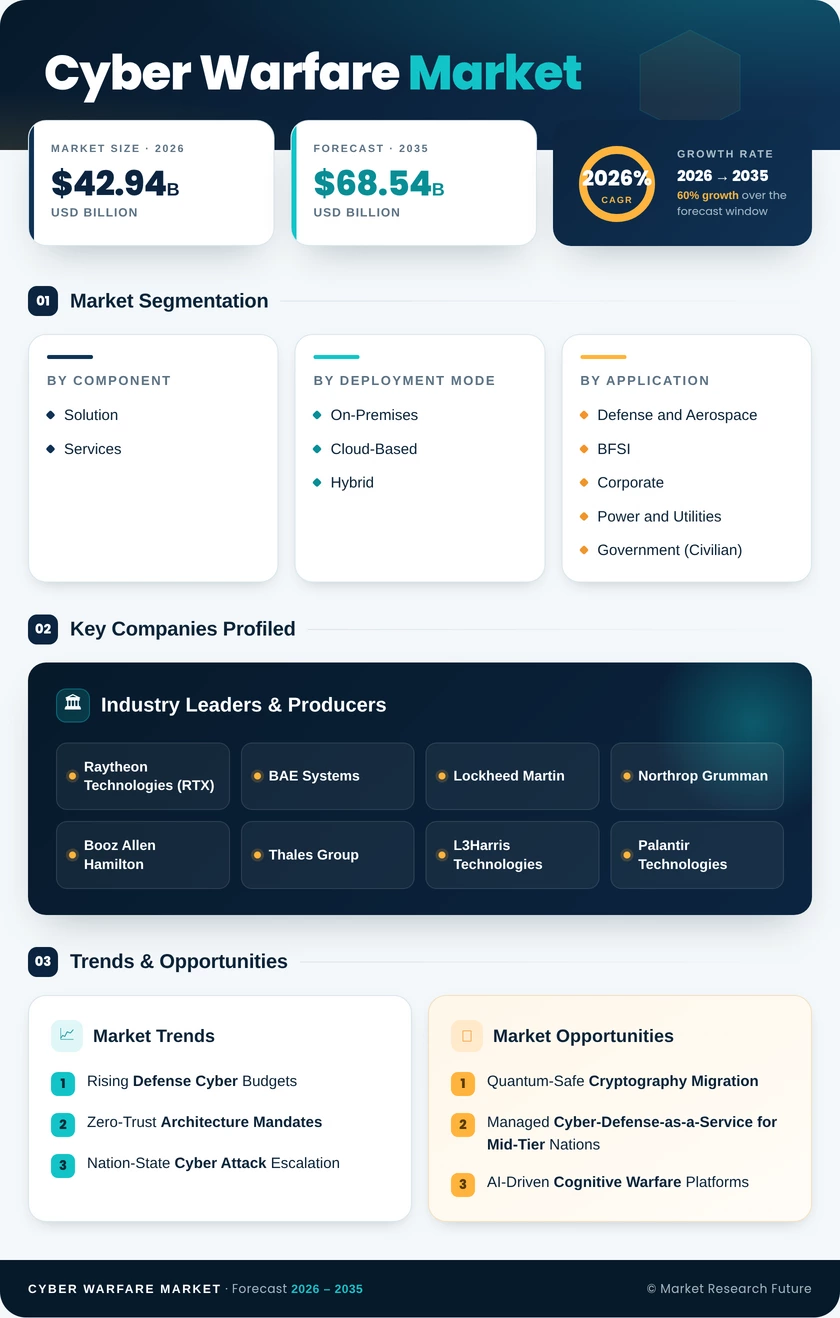
      1. 3.1.1 Rising Defense Cyber Budgets | |
      2. 3.1.2 Zero-Trust Architecture Mandates | |
      3. 3.1.3 Nation-State Cyber Attack Escalation | |
      4. 3.1.4 AI/ML-Powered Autonomous Threat Hunting | |
      5. 3.1.5 Critical Infrastructure Ransomware Surge | |
      6. 3.1.6 Cyberspace Domain Military Doctrine Adoption | |
      7. 3.1.7 Cleared-Workforce Shortage Driving Managed Services |
    2. 3.2 Market Restraints Analysis | |
      1. 3.2.1 Classification Barriers Limiting Vendor Collaboration | |
      2. 3.2.2 Fragmented International Cyber Norms | |
      3. 3.2.3 Talent Shortage of Cleared Cyber Professionals | |
      4. 3.2.4 Budget Sequestration and Fiscal Austerity Risks | |
      5. 3.2.5 Interoperability Gaps Across Allied Systems |
    3. 3.3 Market Opportunity Analysis | |
      1. 3.3.1 Quantum-Safe Cryptography Migration | |
      2. 3.3.2 Managed Cyber-Defense-as-a-Service for Mid-Tier Nations | |
      3. 3.3.3 AI-Driven Cognitive Warfare Platforms | |
      4. 3.3.4 Cyber Range and Digital-Twin Simulation | |
      5. 3.3.5 Space-Cyber Convergence |
    4. 3.4 Industry Value Chain Analysis |
    5. 3.5 Porter's Five Forces Analysis
  4. 4 Global Cyber Warfare Market Size & Forecast (2021–2035) |
    1. 4.1 Historical Market Size (2021–2025) |
    2. 4.2 Current & Forecast Market Size (2026–2035) |
    3. 4.3 Market Size by Revenue (USD Billion) |
    4. 4.4 Year-over-Year Growth Analysis
  5. 5 Segmentation Analysis |
    1. 5.1 By Component | |
      1. 5.1.1 Solution | |
      2. 5.1.2 Services |
    2. 5.2 By Deployment Mode | |
      1. 5.2.1 On-Premises | |
      2. 5.2.2 Cloud-Based | |
      3. 5.2.3 Hybrid |
    3. 5.3 By End-User Industry | |
      1. 5.3.1 Defense and Aerospace | |
      2. 5.3.2 BFSI | |
      3. 5.3.3 Corporate | |
      4. 5.3.4 Power and Utilities | |
      5. 5.3.5 Government (Civilian) | |
      6. 5.3.6 Healthcare | |
      7. 5.3.7 Transportation and Logistics | |
      8. 5.3.8 Other End-User Industries
  6. 6 Regional Analysis |
    1. 6.1 North America | |
      1. 6.1.1 United States | |
      2. 6.1.2 Canada | |
      3. 6.1.3 Mexico |
    2. 6.2 Europe | |
      1. 6.2.1 Germany | |
      2. 6.2.2 United Kingdom | |
      3. 6.2.3 France | |
      4. 6.2.4 Italy | |
      5. 6.2.5 Spain | |
      6. 6.2.6 Nordic Countries | |
      7. 6.2.7 Russia | |
      8. 6.2.8 Rest of Europe |
    3. 6.3 Asia-Pacific | |
      1. 6.3.1 China | |
      2. 6.3.2 India | |
      3. 6.3.3 Japan | |
      4. 6.3.4 South Korea | |
      5. 6.3.5 ASEAN | |
      6. 6.3.6 Rest of Asia-Pacific |
    4. 6.4 South America | |
      1. 6.4.1 Brazil | |
      2. 6.4.2 Argentina | |
      3. 6.4.3 Rest of South America |
    5. 6.5 Middle East & Africa | |
      1. 6.5.1 Saudi Arabia | |
      2. 6.5.2 UAE | |
      3. 6.5.3 South Africa | |
      4. 6.5.4 Egypt | |
      5. 6.5.5 Rest of MEA
  7. 7 Competitive Landscape |
    1. 7.1 Market Share Analysis (2025) |
    2. 7.2 Competitive Benchmarking Matrix |
    3. 7.3 Company Profiles | |
      1. 7.3.1 Raytheon Technologies (RTX) | |
      2. 7.3.2 BAE Systems | |
      3. 7.3.3 Lockheed Martin | |
      4. 7.3.4 Northrop Grumman | |
      5. 7.3.5 Booz Allen Hamilton | |
      6. 7.3.6 Thales Group | |
      7. 7.3.7 L3Harris Technologies | |
      8. 7.3.8 Palantir Technologies | |
      9. 7.3.9 CrowdStrike | |
      10. 7.3.10 Mandiant (Google Cloud)
  8. 8 Future Outlook & Strategic Recommendations (2026–2035) |
    1. 8.1 AI-Autonomous Cyber Operations |
    2. 8.2 Platform Consolidation and Vendor Ecosystem Shift |
    3. 8.3 Quantum-Threat Preparedness |
    4. 8.4 Cyberspace Domain Military Doctrine Maturation
  9. 9 Recent Developments & News
  10. 10 Frequently Asked Questions (FAQs)
  11. 11 Report Scope & Methodology |
    1. 11.1 Study Period & Base Year |
    2. 11.2 Data Sources & Citations |
    3. 11.3 Abbreviations
  12. 12 LIST OF TABLES |
  13. TABLE 1 Global Cyber Warfare Market Size & Forecast, by Revenue (USD Billion), 2021–2035 |
  14. TABLE 2 Global Cyber Warfare Market – Year-over-Year Growth Analysis, 2021–2035 |
  15. TABLE 3 Global Cyber Warfare Market – Driver Impact Analysis |
  16. TABLE 4 Global Cyber Warfare Market – Restraint Impact Analysis |
  17. TABLE 5 Global Cyber Warfare Market Size, by Component, 2021–2035 (USD Billion) |
  18. TABLE 6 Global Cyber Warfare Market Size, by Deployment Mode, 2021–2035 (USD Billion) |
  19. TABLE 7 Global Cyber Warfare Market Size, by End-User Industry, 2021–2035 (USD Billion) |
  20. TABLE 8 Global Cyber Warfare Market Size, by Region, 2021–2035 (USD Billion) |
  21. TABLE 9 North America Cyber Warfare Market Size, by Country, 2021–2035 (USD Billion) |
  22. TABLE 10 Europe Cyber Warfare Market Size, by Country, 2021–2035 (USD Billion) |
  23. TABLE 11 Asia-Pacific Cyber Warfare Market Size, by Country, 2021–2035 (USD Billion) |
  24. TABLE 12 South America Cyber Warfare Market Size, by Country, 2021–2035 (USD Billion) |
  25. TABLE 13 Middle East & Africa Cyber Warfare Market Size, by Country, 2021–2035 (USD Billion) |
  26. TABLE 14 North America Cyber Warfare Market Size, by Component, 2021–2035 (USD Billion) |
  27. TABLE 15 North America Cyber Warfare Market Size, by Deployment Mode, 2021–2035 (USD Billion) |
  28. TABLE 16 North America Cyber Warfare Market Size, by End-User Industry, 2021–2035 (USD Billion) |
  29. TABLE 17 Europe Cyber Warfare Market Size, by Component, 2021–2035 (USD Billion) |
  30. TABLE 18 Europe Cyber Warfare Market Size, by Deployment Mode, 2021–2035 (USD Billion) |
  31. TABLE 19 Europe Cyber Warfare Market Size, by End-User Industry, 2021–2035 (USD Billion) |
  32. TABLE 20 Asia-Pacific Cyber Warfare Market Size, by Component, 2021–2035 (USD Billion) |
  33. TABLE 21 Asia-Pacific Cyber Warfare Market Size, by Deployment Mode, 2021–2035 (USD Billion) |
  34. TABLE 22 Asia-Pacific Cyber Warfare Market Size, by End-User Industry, 2021–2035 (USD Billion) |
  35. TABLE 23 South America Cyber Warfare Market Size, by Component, 2021–2035 (USD Billion) |
  36. TABLE 24 South America Cyber Warfare Market Size, by Deployment Mode, 2021–2035 (USD Billion) |
  37. TABLE 25 South America Cyber Warfare Market Size, by End-User Industry, 2021–2035 (USD Billion) |
  38. TABLE 26 Middle East & Africa Cyber Warfare Market Size, by Component, 2021–2035 (USD Billion) |
  39. TABLE 27 Middle East & Africa Cyber Warfare Market Size, by Deployment Mode, 2021–2035 (USD Billion) |
  40. TABLE 28 Middle East & Africa Cyber Warfare Market Size, by End-User Industry, 2021–2035 (USD Billion) |
  41. TABLE 29 Competitive Benchmarking Matrix – Global Cyber Warfare Market, 2025 |
  42. TABLE 30 Company Profiles – Key Players, Global Cyber Warfare Market |
  43. TABLE 31 Recent Developments & Strategic Announcements, 2024–2025 |
  44. TABLE 32 Report Scope & Methodology Summary |
  45. TABLE 33 Detailed Sources and Citations
  46. 13 LIST OF FIGURES |
  47. FIGURE 1 Global Cyber Warfare Market Dynamics – Drivers, Restraints, and Opportunities |
  48. FIGURE 2 Cyber Warfare Market Industry Value Chain Analysis |
  49. FIGURE 3 Porter's Five Forces Analysis – Global Cyber Warfare Market |
  50. FIGURE 4 Global Cyber Warfare Market Size Trend (USD Billion), 2021–2035 |
  51. FIGURE 5 Global Cyber Warfare Market Share, by Component, 2025 (%) |
  52. FIGURE 6 Global Cyber Warfare Market Share, by Deployment Mode, 2025 (%) |
  53. FIGURE 7 Global Cyber Warfare Market Share, by End-User Industry, 2025 (%) |
  54. FIGURE 8 Global Cyber Warfare Market Share, by Region, 2025 (%) |
  55. FIGURE 9 North America Cyber Warfare Market Size Trend, 2021–2035 (USD Billion) |
  56. FIGURE 10 Europe Cyber Warfare Market Size Trend, 2021–2035 (USD Billion) |
  57. FIGURE 11 Asia-Pacific Cyber Warfare Market Size Trend, 2021–2035 (USD Billion) |
  58. FIGURE 12 South America Cyber Warfare Market Size Trend, 2021–2035 (USD Billion) |
  59. FIGURE 13 Middle East & Africa Cyber Warfare Market Size Trend, 2021–2035 (USD Billion) |
  60. FIGURE 14 Competitive Landscape – Market Share Distribution, 2025 (%) |
  61. FIGURE 15 Competitive Positioning Matrix – Key Players, 2025

Segmentation Quick Reference

DimensionSub-SegmentsDominant SegmentFastest Growing Segment
ComponentSolution, ServicesSolution (71.89% share, 2025)Services (6.84% CAGR)
Deployment ModeOn-Premises, Cloud-Based, HybridOn-Premises (USD 15.62B, 2025)Cloud-Based (7.28% CAGR)
End-User IndustryDefense and Aerospace, BFSI, Corporate, Power and Utilities, Government, Healthcare, Transportation and Logistics, OtherDefense and Aerospace (34.22% share, 2025)Healthcare (7.71% CAGR)
GeographyNorth America, Europe, Asia-Pacific, South America, Middle East & AfricaNorth America (42.18% share, 2025)Asia-Pacific (7.58% CAGR)


Market Segmentation Overview

By Component

Sub-SegmentKey Trend
SolutionDemand for integrated SIEM/SOAR platforms with embedded AI analytics
ServicesShift toward managed detection-and-response contracts driven by workforce shortages


Solution offerings dominate spending as governments seek proprietary control over offensive and defensive toolsets. Services are growing faster as managed SOC and cyber threat intelligence subscriptions address the persistent shortage of cleared personnel.

By Deployment Mode

Sub-SegmentKey Trend
On-PremisesMandatory for classified environments; shrinking share as cloud accreditation expands
Cloud-BasedAccelerated by IC Cloud Enterprise contracts and elastic-compute demand
HybridBalances classified data residency with cloud-based analytics scalability


On-premises remains the default for top-secret workloads, but hybrid and cloud-based models are gaining traction as intelligence-community cloud environments receive higher accreditation levels.

By End-User Industry

Sub-SegmentKey Trend
Defense and AerospaceCore anchor; offensive and defensive program funding
BFSIFinancial-system resilience mandates post-SWIFT and exchange breaches
CorporateSupply-chain cyber risk management and third-party vendor assessments
Power and UtilitiesICS/SCADA monitoring driven by NERC-CIP and ENISA directives
Government (Civilian)Zero-trust modernization across federal and state agencies
HealthcareRansomware-driven emergency investment cycle
Transportation and LogisticsSmart-port, rail, and aviation cyber mandates
Other End-User IndustriesTelecom, education, and research institutions


Defense and aerospace remain the largest end-user, but healthcare's rapid growth reflects the sector's acute vulnerability to ransomware campaigns targeting patient data and hospital operations.

By Geography

Sub-SegmentKey Trend
North AmericaU.S. Cyber Command and CISA are anchoring global spending leadership
EuropeNIS2 compliance and NATO interoperability driving investment
Asia-PacificIndo-Pacific geopolitical tensions and indigenous capability programs
South AmericaEmerging military cyber commands and banking-sector mandates
Middle East & AfricaPetro-state OT protection and sovereign cyber-force establishment


North America leads in absolute spending, while Asia-Pacific's rapid growth trajectory reflects the region's escalating geopolitical competition and national-level cyber capability investments.