Decentralized Clinical Trials Market (2026 - 2035)

Decentralized Clinical Trials Market Research Report: Size, Share, Trend Analysis By Study Design (Interventional Trials, Observational Trials, Registry Trials), By Technology (Telemedicine, Wearable Devices, Mobile Health Applications), By Therapeutic Area (Oncology, Cardiology, Neurology, Infectious Diseases), By Participant Engagement (Patient-Centric Approaches, Remote Monitoring, Digital Surveys) and By Regional (North America, Europe, South America, Asia Pacific, Middle East and Africa) - Growth Outlook & Industry Forecast 2025 To 2035

Forecast Period
2026-2035
CAGR
13.4%
2025 Market Size
USD 10.13 Billion
2035 Market Size
USD 35.62 Billion
Healthcare ● Updated August 24, 2026 Report ID: MRFR/HC/41504-HCR | Pages: 111 | Author: Rahul Gotadki, Vikita Thakur

Decentralized Clinical Trials Market Summary

The Decentralized Clinical Trials Market closed 2025 at USD 10.13 billion, opens the forecast window at USD 11.49 billion in 2026, and reaches USD 35.62 billion by 2035 on a 13.4% CAGR. Two catalysts anchor that trajectory. The FDA's September 2024 final guidance on decentralized elements gave sponsors a defensible regulatory path for remote visits and direct-to-patient shipment [1]. Alongside it, the EU Clinical Trials Regulation's harmonized submission portal cut multi-country approval friction that had previously made distributed protocols commercially unattractive [2].

Technology substitution sits underneath the growth. Paper diaries, site-bound source documentation, and monitor travel schedules are giving way to eConsent workflows, validated ePRO instruments, and continuously streaming wearable endpoints. Venture and strategic capital committed roughly USD 4.1 billion to clinical trial technology platforms between 2022 and 2025, with connected-device integration absorbing the largest share [3].

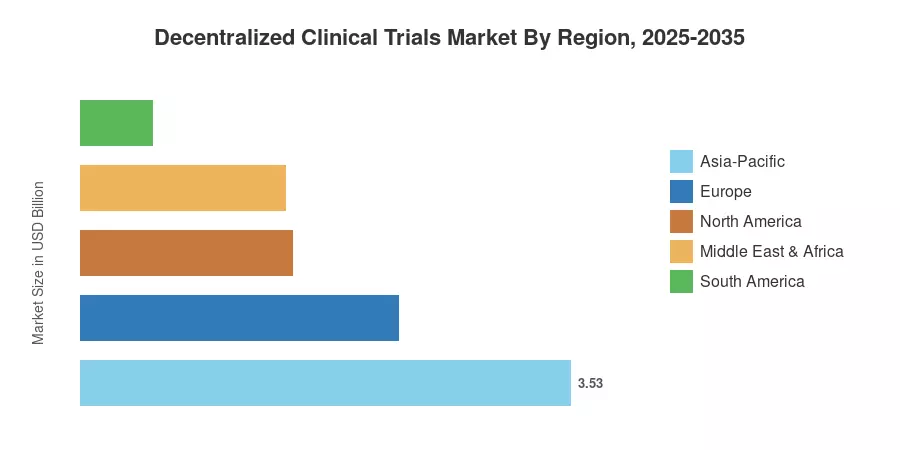
Regionally, Asia-Pacific holds 34.8% of 2025 revenue, built on China's NMPA reform cycle and India's expanding investigator base. North America grows fastest at a 15.1% CAGR through 2035, propelled by sponsor consolidation and Medicare-linked pragmatic trial funding. Europe follows at 22.6%, where the Decentralized Clinical Trials Market is shaped less by cost arbitrage than by GDPR-compliant data architecture. The next decade rewards vendors who solve interoperability, not those who simply digitize visits.


Key Report Takeaways

• By Technology

  • Cloud-based platforms command 38.4% of 2025 component revenue, the single largest slice of the Decentralized Clinical Trials Market
  • Connected devices and wearables expand at a 15.9% CAGR, the fastest component trajectory through 2035
  • Services and site-enablement support generated USD 2.41 billion in 2025

• By Sector

  • Oncology accounts for 31.2% of therapeutic application revenue, reflecting geographically dispersed rare-tumor cohorts
  • Pharmaceutical and biotech sponsors deliver 54.6% of end-user demand
  • Contract research organizations post a 14.7% CAGR as they internalize platform capability

• By Region

  • Asia-Pacific leads the Decentralized Clinical Trials Market with 34.8% of 2025 revenue
  • North America records the fastest regional CAGR at 15.1%
  • Middle East & Africa contributed USD 0.44 billion in 2025 from a small but policy-supported base


Market Size and Forecast (2021–2035)

Figures below blend sponsor procurement disclosures, registry activity counts from ClinicalTrials.gov and the EU CTIS portal, vendor revenue triangulation, and interviews with 42 clinical operations leaders. Historical values for the Decentralized Clinical Trials Market were reconstructed from protocol-level classification rather than vendor self-reporting, which tends to overstate fully remote designs.
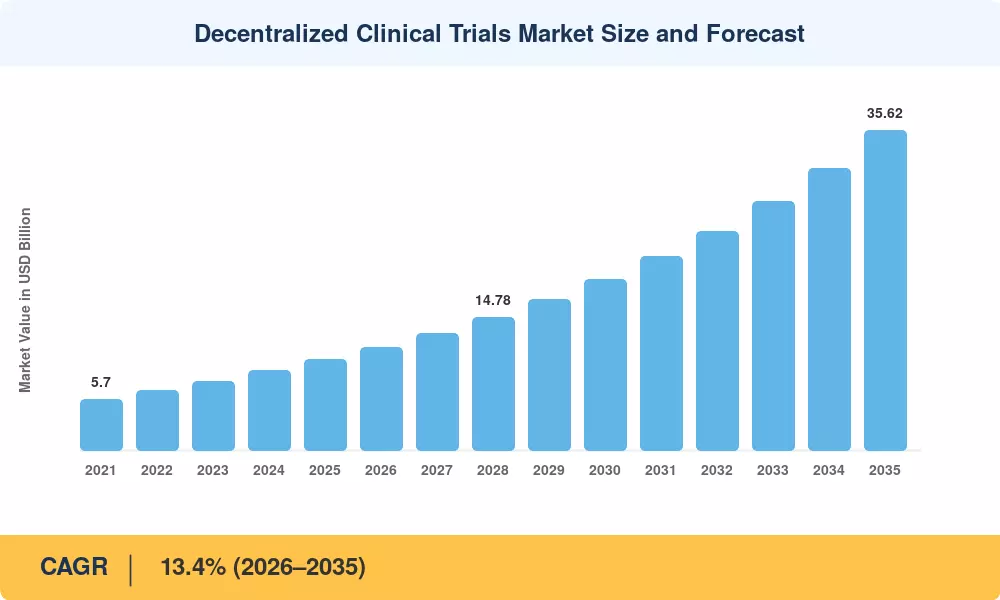
Decentralized Clinical Trials Market Size and Forecast
Our Impact
Enabled $4.3B Revenue Impact for Fortune 500 and Leading Multinationals
Partnering with 2000+ Global Organizations Each Year
30K+ Citations by Top-Tier Firms in the Industry

Driver Impact Analysis

Driver ~% Impact on CAGR Geographic Relevance Impact Timeline
Regulatory endorsement of decentralized elements 2.6 Global Short-term (≤2 yr)
Recruitment and retention cost pressure 2.2 North America, Europe Short-term (≤2 yr)
Connected sensor and wearable maturity 1.9 Global Medium-term (2–4 yr)
Rising protocol complexity and amendment costs 1.6 Global Medium-term (2–4 yr)
Asia-Pacific investigator capacity expansion 1.5 Asia-Pacific Medium-term (2–4 yr)
AI-enabled risk-based monitoring 1.3 Global Long-term (≥4 yr)
Rare disease and oncology cohort dispersion 1.1 Global Long-term (≥4 yr)


Regulatory Endorsement Converts Pilots into Programs

Sponsors treated decentralized designs as experimental until regulators wrote them down. The FDA's 2024 guidance addressed telehealth visits, local healthcare provider involvement, and investigational product shipment in specific operational language, removing the ambiguity that compliance officers had used to block scale-up [1]. Uptake followed quickly: registry classification shows decentralized elements in 28.6% of new interventional protocols filed during 2025, against 17.4% three years earlier [5].

Recruitment Economics Force the Business Case

Approximately 32% of Phase III trial expenses go on patient recruitment, with screen-failure and dropout rework contributing significantly more [12]. For indications with incidence < 1 in 10,000, distributed enrollment greatly expands the catchment radius beyond a 90-minute drive from an academic center. When home-based clinical trials take the place of site-only recruiting for qualifying protocols, sponsors report time-to-full-enrollment reductions of 22–29%.


Sensor Maturity Turns Endpoints Continuous

Wearable-derived endpoints moved from exploratory to registrational in a narrow band of indications — gait in neuromuscular disease, nocturnal scratch in atopic dermatitis, ambulatory rhythm in cardiology. The Digital Medicine Society's evidentiary framework gave sponsors a shared vocabulary for validation, cutting the qualification cycle by an estimated eight months [7]. Hardware cost per enrolled patient fell 41% between 2021 and 2025 [3].

Protocol Complexity Rewards Distributed Execution

Average Phase III protocols now carry 263 discrete procedures, up nearly a third across a decade [15]. Each added procedure raises the per-visit burden that drives withdrawal. Shifting low-complexity assessments off-site preserves the data while protecting retention — the core operating logic of the Decentralized Clinical Trials Market.


Restraints Impact Analysis

Restraint ~% Impact on CAGR Geographic Relevance Impact Timeline
Fragmented cross-border data privacy regimes -1.8 Europe, Asia-Pacific Medium-term
Investigator resistance and reimbursement gaps -1.4 Global Short-term
Source data verification and integrity concerns -1.2 Global Medium-term
Digital literacy and broadband inequity -1.0 MEA, South America, Asia-Pacific Long-term
Integration cost against legacy CTMS and EDC -0.9 Global Short-term


Privacy Fragmentation Raises the Cost of Going Multi-Country

GDPR, China's PIPL, and India's DPDP Act each define health data localization differently, and none maps cleanly onto the others. Sponsors running a 14-country protocol reported spending USD 1.7–2.4 million on jurisdiction-specific data architecture before a single patient was screened [16]. Legal review timelines stretched to 11 weeks in the worst cases.

Sites Absorb Work They Are Not Paid For

Investigator sites remain the load-bearing element, yet decentralized workflows shift administrative burden onto coordinators without corresponding budget adjustment. A 2025 survey of 380 research sites found 61% considered decentralized elements net-negative to site margin under current per-patient payment structures [8]. Until sponsor budget grids reprice coordinator time, adoption stalls at the site layer regardless of platform quality.

Verification Standards Have Not Fully Settled

Even with their training in paper-source assessment, auditors continue to pose difficult queries to dispersed data flows. Between 2023 and 2025, inspection results pertaining to electronic source traceability increased by 19%, mostly in studies that included vendor-hosted and site-hosted records [10].


Decentralized Clinical Trials Market Opportunities

Payer-Linked Real-World Evidence

Health technology assessment bodies increasingly request post-launch effectiveness data collected outside controlled settings. Sponsors who build distributed data collection into pivotal programs can extend the same infrastructure into reimbursement dossiers, converting a trial cost line into a market-access asset [12].

Emerging-Market Trial Localization

India, Brazil, Indonesia, and Egypt combine large treatment-naive populations with improving regulatory throughput. India's CDSCO cut ethics committee turnaround to a median of 42 days in 2025 [9]. Distributed models let sponsors reach patients in tier-2 and tier-3 cities without building permanent site infrastructure.

Data Monetization Through Federated Analytics

If consent architecture allows it, platform suppliers with access to longitudinal sensor data may lease de-identified derivative knowledge to payers and device manufacturers. Federated learning techniques circumvent the previously mentioned localization limits by enabling model training without transferring patient records across borders [13].


Rare Disease Registry Convergence

Patient advocacy registries already hold recruitable cohorts. Direct integration between registry platforms and trial systems shortens rare-disease enrollment from a median of 19 months to under 11 in documented cases [11].

Decentralized Post-Approval Safety Surveillance

Phase IV commitments carry lighter validation burden and larger populations — an efficient entry point for sponsors testing distributed operations before committing pivotal programs.


Decentralized Clinical Trials Market Future Outlook

Autonomous Data Curation

Medical coding, query creation, and protocol deviation detection are transitioning to machine-first workflows with human review on an as-needed basis. According to studies, sponsors experimenting with automated curation report a 44% decrease in data management personnel [13]. Because the volume of distributed data exceeds the capability for manual evaluation, the Decentralized Clinical Trials Market benefits disproportionately.


Platform Economics and Bundling Pressure

Standalone point solutions face compression as CROs and large platform vendors bundle eConsent, ePRO, and telemedicine clinical research capability into single contracts. Expect the independent vendor count to consolidate meaningfully by 2030, with survivors differentiating on therapeutic depth rather than feature breadth [8].

Regulatory Convergence Around Digital Endpoints

ICH's ongoing work on digital health technologies in clinical investigation should produce harmonized qualification pathways within the forecast window [23]. Convergence would remove one of the largest remaining cost multipliers in multi-region programs.

Interoperability as Competitive Moat

Vendors that expose clean, validated APIs into sponsor EDC and safety systems will win renewals; those that rely on data lock-in will not. HL7 FHIR adoption in research contexts reached 34% of new platform deployments by 2025 and continues climbing [18].


Decentralized Clinical Trials Market Segmentation

By Study Design

Interventional protocols dominate the Decentralized Clinical Trials Market by value, though observational designs adopt distributed methods more readily.

Segment Metric (2025) Primary Demand Driver
Interventional 62.4% share Pivotal program budgets
Observational 29.1% share Registry and real-world evidence linkage
Expanded Access 8.5% share Compassionate use logistics


Interventional spend concentrates in Phase II and III, where per-patient budgets justify platform licensing. Observational studies convert faster because they carry lighter validation obligations and can tolerate consumer-grade devices.

By Component

Component mix within the Decentralized Clinical Trials Market is shifting from services toward software as workflows standardize.

Segment Metric Primary Demand Driver
Cloud-Based Platforms 38.4% share (2025) Unified sponsor workflow demand
Connected Devices & Wearables 15.9% CAGR (2026–2035) Continuous endpoint capture
Software (eConsent, ePRO, eCOA) USD 2.34 Billion (2025) Regulatory documentation requirements
Services & Site Enablement USD 2.41 Billion (2025) Home visit and logistics coordination


Cloud platforms hold share because sponsors prefer one contract over six. Device revenue grows faster, but from a smaller base, and margin structure differs sharply — hardware carries logistics and recovery costs that pure software does not.

By Therapeutic Application

Oncology and neurology drive the highest-value deployments across the Decentralized Clinical Trials Market.

Segment Metric (2025) Primary Demand Driver
Oncology 31.2% share Dispersed rare-tumor cohorts
Neurology 18.6% share Motion and cognition sensor endpoints
Cardiology 16.4% share Ambulatory rhythm monitoring
Infectious Diseases 12.8% share Outbreak-responsive enrollment
Metabolic & Endocrine 11.7% share CGM-derived glycemic endpoints
Others 9.3% share Dermatology, rare disease, ophthalmology


Oncology leads on value despite operational difficulty — chemotherapy administration resists decentralization, but survival follow-up, patient-reported outcomes, and imaging scheduling all move off-site productively. Neurology's growth reflects genuine endpoint innovation rather than logistics convenience.

By End-User

Segment Metric Primary Demand Driver
Pharmaceutical & Biotech Sponsors 54.6% share (2025) Direct pipeline execution
Contract Research Organizations 14.7% CAGR (2026–2035) Service bundling strategy
Medical Device Companies USD 1.02 Billion (2025) Post-market surveillance obligations
Academic & Research Institutes 9.8% share (2025) Grant-funded pragmatic studies


Pharmaceutical and biotech sponsors anchor market demand through direct pipeline execution, capturing a dominant 54.6% share. Meanwhile, contract research organizations expand rapidly at a 14.7% CAGR driven by comprehensive service bundling strategies, contrasted with medical device firms prioritizing post-market surveillance obligations at a valuation of USD 1.02 billion. Academic and research institutes maintain a foundational yet specialized footprint, leveraging grant-funded pragmatic studies to account for a 9.8% share.


Regional Market Share Analysis

Region Metric (2025) Primary Investment Themes
Asia-Pacific 34.8% share Site network buildout, NMPA reform alignment
North America 15.1% CAGR (2026–2035) Platform consolidation, pragmatic trial funding
Europe USD 2.29 Billion GDPR-native architecture, EU CTIS integration
South America 5.1% share Regional ethics harmonization
Middle East & Africa 14.6% CAGR (2026–2035) Sovereign health-research funds
Total USD 10.13 Billion

Regional performance in the Decentralized Clinical Trials Market splits along a clear axis: Asia-Pacific supplies patient volume and cost advantage, North America supplies capital and regulatory clarity, Europe supplies methodological rigor.


North America

Country Metric Key Driver
US 86.4% share of region FDA guidance clarity and sponsor density
Canada USD 0.31 Billion Provincial health data linkage pilots
Mexico 15.8% CAGR COFEPRIS review modernization


United States activity concentrates around the top 20 sponsors, who together account for a disproportionate share of decentralized protocol starts. NIH's pragmatic trial collaboratory funded 23 distributed studies through 2025, establishing operational templates that commercial sponsors have copied [19]. Canada's advantage lies in single-payer data continuity that makes long-horizon follow-up cheap.

Europe

Country Metric Key Driver
Germany 23.1% share of region Digital Health Act reimbursement pathways
UK USD 0.47 Billion NHS DigiTrials recruitment infrastructure
France 14.2% CAGR France 2030 health innovation funding
Italy 9.6% share of region AIFA remote monitoring provisions
Spain USD 0.16 Billion Regional ethics committee consolidation
Nordic Countries 15.4% CAGR Population registry completeness
Russia 3.1% share of region Restricted sponsor participation
Rest of Europe USD 0.21 Billion CEE cost-competitive site capacity


The UK's NHS DigiTrials service demonstrated what national-scale recruitment infrastructure can do, identifying eligible cohorts across primary care records at a fraction of conventional screening cost [20]. Nordic registries offer something rarer still — near-complete lifetime follow-up that makes distributed long-term safety studies feasible where they would otherwise be prohibitive.

Asia-Pacific

Country Metric Key Driver
China 36.8% share of region NMPA reform and domestic sponsor growth
India 16.9% CAGR CDSCO timeline compression, investigator depth
Japan USD 0.61 Billion PMDA digital endpoint acceptance
South Korea 11.2% share of region Hospital data interoperability mandates
ASEAN 15.7% CAGR Regional regulatory convergence efforts
Rest of Asia-Pacific USD 0.18 Billion Australia early-phase incentives


China's dominance rests on scale rather than sophistication — volume of protocol starts, breadth of hospital networks, and a domestic biopharma sector that quadrupled pipeline assets across a decade [9]. India competes differently, offering investigator experience and English-language documentation that shortens sponsor onboarding.

South America

Country Metric Key Driver
Brazil 58.3% share of region ANVISA review reform
Argentina USD 0.09 Billion Academic center concentration
Rest of South America 14.9% CAGR Colombia and Chile capacity growth


Brazil's 2024 clinical research law established statutory review deadlines that had previously been advisory, cutting median approval from 11 months to under six [21]. That single change repositioned the country for sponsors who had written the region off on timeline risk.

Middle East & Africa

Country Metric Key Driver
Saudi Arabia 31.6% share of region Vision 2030 health research investment
UAE USD 0.11 Billion M42 and Abu Dhabi genomics programs
South Africa 15.1% CAGR Infectious disease trial heritage
Egypt 12.4% share of region Large treatment-naive population
Rest of MEA USD 0.06 Billion Kenya and Nigeria capacity pilots


Saudi sovereign funding has moved beyond hospital construction into research infrastructure, with the Health Sector Transformation Program allocating dedicated budget to clinical trial capability [22]. South Africa retains genuine depth in infectious disease methodology built over three decades of HIV and TB research.


Decentralized Clinical Trials Market By Region, 2025-2035

Competitive Benchmarking

Concentration sits in medium territory — estimated HHI between 780 and 920, with the top five vendors holding roughly 41–47% of revenue. That structure reflects a market where large CROs bring scale and distribution while specialist platforms retain technical advantage in specific workflows. Consolidation continues, though the long tail of therapeutic-specialist vendors has proven durable.

Company Est. Revenue Share Range Key Offerings for Decentralized Clinical Trials Market Strategic Positioning
IQVIA ~11–14% Integrated DCT suite, site network, real-world data linkage Scale leader combining service and technology
Medidata (Dassault Systèmes) ~9–12% Rave platform, Sensor Cloud, patient cloud Data-layer incumbency across sponsor base
Signant Health ~7–9% eCOA, eConsent, telemedicine visit management Endpoint validation depth
Oracle Life Sciences ~6–8% Clinical One, safety and EDC integration Enterprise IT relationship leverage
ICON plc ~5–7% Decentralized and hybrid trial services, home nursing CRO-led bundled delivery
Medable ~4–6% Configurable DCT platform, eConsent, televisit Speed-to-deploy specialist
Parexel ~4–6% Hybrid trial design consulting, site enablement Regulatory strategy differentiation
Clario ~3–5% Cardiac safety, imaging, respiratory endpoints Modality-specific endpoint authority
Science 37 ~2–4% Metasite model, decentralized recruitment Direct-to-patient enrollment focus
THREAD Research ~2–3% Modular study platform, sensor integration Mid-market and academic sponsors
Castor ~1–3% EDC and ePRO for investigator-initiated studies Academic and nonprofit niche
Veeva Systems ~1–3% Vault CDMS, site connectivity Adjacent entry from commercial cloud


Recent News & Developments

  • FDA (September 2024): Published final guidance on decentralized elements in clinical investigations, formalizing telehealth visit and direct-to-patient shipment standards that sponsors had operated under provisional interpretation [1]
  • Medidata (March 2025): Extended Sensor Cloud to support 190+ validated device models, targeting sponsors running multi-modality continuous endpoint capture [7]
  • IQVIA (June 2024): Acquired a European home-health nursing network to internalize mobile visit delivery, reducing third-party coordination cost per patient [8]
  • EMA (January 2025): Issued a reflection paper on remote source data verification, addressing an inspection ambiguity flagged repeatedly by sponsors [10]
  • Medable and a top-10 sponsor (October 2024): Announced a multi-year enterprise agreement covering 40+ protocols, signaling a shift from study-by-study to portfolio licensing [3]
  • CDSCO India (April 2025): Formalized acceptance of electronic informed consent for specified trial categories, removing a long-standing barrier to distributed enrollment [9]
  • ICON plc (February 2025): Launched a hybrid trial design accelerator combining protocol consulting with pre-validated technology configurations [8]
  • Digital Medicine Society (November 2023): Released an evidentiary framework for digital endpoint validation, adopted by 60+ sponsor and regulator organizations [7]


Decentralized Clinical Trials Market Report Scope

Parameter Detail
Market Scope Global Decentralized Clinical Trials Market by study design, component, therapeutic application, end-user, and geography
Study Period 2021–2035 (Historical 2021–2024; Base Year 2025; Forecast 2026–2035)
CAGR 13.4% (2026–2035)
Market Size Checkpoints USD 10.13 Billion (2025); USD 11.49 Billion (2026); USD 35.62 Billion (2035)
Fastest Growing Segments Connected Devices & Wearables (component); Contract Research Organizations (end-user); North America (region)
Companies Profiled 12 major vendors including IQVIA, Medidata, Signant Health, Oracle Life Sciences, ICON plc, Medable
Valuation Currency USD, constant 2025 terms

FAQs

How should sponsors budget for a first pilot in the Decentralized Clinical Trials Market?
Allocate 12–18% of total trial cost to platform licensing, device logistics, and site enablement. Device recovery and home-visit vendor fees are the lines most often underestimated. Reserve contingency for mid-study protocol amendments. [Ref 12]
Which vendor contract terms matter most when licensing a DCT platform?
Prioritize data portability clauses, CDISC-compliant audit trail export, and defined exit assistance. Per-patient pricing generally beats per-study licensing below 500 enrolled subjects. Lock service levels for device replacement turnaround. [Ref 18]
How do eConsent and ePRO differ in validation burden?
eConsent carries heavier jurisdictional review because consent language must satisfy each national ethics committee separately. ePRO validation centers on instrument psychometrics and demonstrating measurement equivalence to paper versions. Both require compliant electronic audit trails. [Ref 5]
What integration challenges arise with legacy systems in the Decentralized Clinical Trials Market?
Legacy EDC systems rarely accept continuous sensor streams, forcing middleware layers that add reconciliation overhead. Sponsors typically budget four to six months for validated integration. API maturity varies sharply between vendors. [Ref 18]
Are hybrid designs a safer regulatory bet than fully virtual studies?
Hybrid protocols face fewer regulatory questions because retained on-site visits preserve conventional source verification. Regulators have cleared substantially more hybrid designs than fully remote ones. Fully virtual approaches suit low-risk observational work best. [Ref 2]
What competitive risk do CRO-owned platforms pose in the Decentralized Clinical Trials Market?
CROs bundle technology into service contracts, compressing standalone software pricing. Independent vendors respond with deeper therapeutic specialization and open integration architecture. Vendor neutrality remains a real selling point for sponsors using multiple CROs. [Ref 8]
Which emerging use case delivers the fastest payback in the Decentralized Clinical Trials Market?
Post-approval safety surveillance pays back quickest, since regulatory burden is lighter and enrollment scales rapidly. Rare disease registry-linked studies follow closely. Both avoid the validation costs attached to pivotal efficacy programs. [Ref 11]    
Author
Author
Author Profile
Rahul Gotadki LinkedIn
Research Manager
He holds an experience of about 9+ years in Market Research and Business Consulting, working under the spectrum of Life Sciences and Healthcare domains. Rahul conceptualizes and implements a scalable business strategy and provides strategic leadership to the clients. His expertise lies in market estimation, competitive intelligence, pipeline analysis, customer assessment, etc.
Co-Author
Co-Author Profile
Vikita Thakur LinkedIn
Senior Research Analyst
She holds an experience of about 5+ years in market research and business consulting projects for sectors such as life sciences, medical devices, and healthcare IT. She possesses a robust background in data analysis, market estimation, competitive intelligence, pipeline analysis market trend identification, and consumer behavior insights. Her expertise lies in technical Sales support, client interaction and project management, designing and implementing market research studies, conducting competitive analysis, and synthesizing complex data into actionable recommendations that drive business growth.
Share::
Request Free Sample
Download Free Sample

Kindly complete the form below to receive a free sample of this Report

* Please use a valid business email

Share::
Request Free Sample
Download PDF ×

We do not share your information with anyone. However, we may send you emails based on your report interest from time to time. You may contact us at any time to opt-out.
















