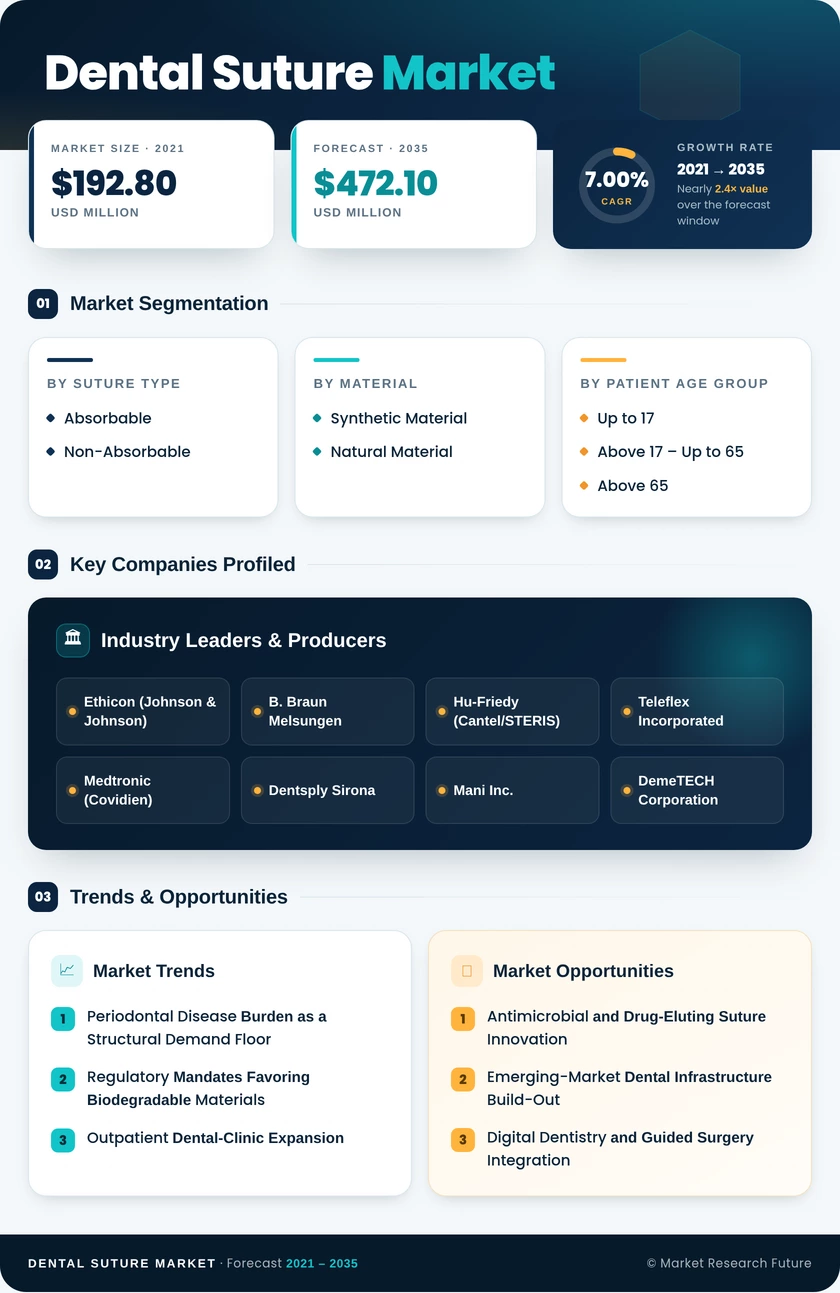
Segmentation Quick Reference
| Dimension | Sub-Segments | Dominant Segment | Fastest Growing Segment |
| By Suture Type | Absorbable, Non-Absorbable | Non-Absorbable (50.30% share, 2025) | Absorbable (7.30% CAGR) |
| By Material | Synthetic Material, Natural Material | Synthetic Material (64.00% share, 2025) | Natural Material (5.90% CAGR) |
| By Patient Age Group | Up to 17, Above 17 – Up to 65, Above 65 | Above 17 – Up to 65 (49.70% share, 2025) | Up to 17 (8.00% CAGR) |
| By Application | Tooth Extraction, Periodontal Procedure, Cosmetic Dentistry, Other Applications | Tooth Extraction (USD 82.10 M, 2025) | Cosmetic Dentistry (7.95% CAGR) |
| By End Use | Dental Clinics, Hospitals, Ambulatory Surgical Centers | Dental Clinics (58.70% share, 2025) | Ambulatory Surgical Centers (7.80% CAGR) |
Market Segmentation Overview
By Suture Type
| Sub-Segment | Key Trend |
| Non-Absorbable | Preferred for maxillofacial reconstruction requiring prolonged tensile retention |
| Absorbable | Rapidly gaining share due to patient convenience and reduced follow-up visits. |
A trade-off between longevity and convenience defines the suture-type dimension. Non-absorbable variants remain the standard in complex surgical reconstructions, while absorbable dental stitches are becoming the default for routine periodontal and extraction closures.
By Material
| Sub-Segment | Key Trend |
| Synthetic Material | Batch-to-batch uniformity and low antigenicity drive two-thirds of demand |
| Natural Material | Collagen and silk sutures maintain niches in pediatric and geriatric care. |
Synthetic oral surgery suture materials dominate procurement because they offer predictable absorption timelines and reduced inflammatory response compared with natural gut-based sutures.
By Patient Age Group
| Sub-Segment | Key Trend |
| Up to 17 | School-based dental screening programs expand pediatric surgical volumes |
| Above 17 – Up to 65 | Peak periodontal disease incidence and cosmetic demand concentrate here. |
| Above 65 | Geriatric tooth loss and implant procedures sustain steady consumption. |
The working-age adult cohort generates the highest procedure volume, but pediatric dental intervention rates are rising fastest as preventive screening identifies surgical needs earlier.
By Application
| Sub-Segment | Key Trend |
| Tooth Extraction | Most common surgical procedure globally; baseline suture demand anchor |
| Periodontal Procedure | Growing periodontitis awareness drives increasing intervention rates. |
| Cosmetic Dentistry | Social-media-driven aesthetics culture accelerates elective procedure growth. |
| Other Applications | Implantology, trauma repair, and oral oncology reconstruction |
Tooth extraction remains the volume leader, but cosmetic and periodontal applications are converging as patients seek both functional and aesthetic outcomes from a single clinical visit.
By End Use
| Sub-Segment | Key Trend |
| Dental Clinics | The outpatient shift concentrates the majority of suture consumption here |
| Hospitals | Complex maxillofacial and oncological cases sustain hospital-channel demand. |
| Ambulatory Surgical Centers | Cost-efficiency advantages attract payers and drive channel migration. |
The ongoing shift from inpatient to outpatient oral surgery reinforces dental clinics as the primary distribution channel for wound closure dental materials, with ambulatory surgical centers emerging as the fastest-growing alternate channel.