×
Request Free Sample ×

Kindly complete the form below to receive a free sample of this Report

* Please use a valid business email

Leading companies partner with us for data-driven Insights

clients tt-cursor
Hero Background

Diesel Exhaust Fluid Market

ID: MRFR/CnM/3599-CR
111 Pages
Chitranshi Jaiswal
November 2024

Diesel Exhaust Fluid (AdBlue) Market Research Report Information By Storage Solution (Bulk Storage, Dispensers, Tanks, Portable Containers, Others), By Application (Automotive, Construction Machinery, Farm Machinery, Electronic Generators, Railway Engines, Others), By Region -Global Forecast to 2035

Share:
Download PDF ×

We do not share your information with anyone. However, we may send you emails based on your report interest from time to time. You may contact us at any time to opt-out.

Diesel Exhaust Fluid Market Infographic
Purchase Options

Diesel Exhaust Fluid Market Summary

As per MRFR analysis, the Diesel Exhaust Fluid Market was estimated at 1.78 USD Million in 2024. The Diesel Exhaust Fluid industry is projected to grow from 1.94 in 2025 to 4.38 by 2035, exhibiting a compound annual growth rate (CAGR) of 8.5 during the forecast period 2025 - 2035.

Key Market Trends & Highlights

The Diesel Exhaust Fluid Market is experiencing robust growth driven by regulatory pressures and technological advancements.

  • North America remains the largest market for Diesel Exhaust Fluid, primarily due to stringent regulatory compliance.
  • The Asia-Pacific region is emerging as the fastest-growing market, fueled by increasing diesel vehicle adoption and environmental awareness.
  • The automotive segment dominates the market, while the agriculture segment is witnessing rapid growth as farmers seek to comply with emissions standards.
  • Key market drivers include regulatory compliance pressure and rising diesel vehicle population, which are propelling demand for Diesel Exhaust Fluid.

Market Size & Forecast

2024 Market Size 1.78 (USD Million)
2035 Market Size 4.38 (USD Million)
CAGR (2025 - 2035) 8.5%

Major Players

Yara International ASA (NO), CF Industries Holdings, Inc. (US), BASF SE (DE), Air Products and Chemicals, Inc. (US), GreenChem (NL), Groupe Renault (FR), Nissan Chemical Corporation (JP), Kost USA, Inc. (US)

Diesel Exhaust Fluid Market Trends

The Diesel Exhaust Fluid Market is currently experiencing a notable transformation, driven by increasing regulatory pressures aimed at reducing nitrogen oxide emissions from diesel engines. This shift is largely influenced by global initiatives to enhance air quality and promote sustainable practices within the transportation sector. As a result, manufacturers are focusing on developing high-quality, efficient, and environmentally friendly diesel exhaust fluid solutions. The growing adoption of selective catalytic reduction technology in heavy-duty vehicles further propels the demand for diesel exhaust fluid, as it plays a crucial role in meeting stringent emission standards. Moreover, the Diesel Exhaust Fluid Market is witnessing a rise in consumer awareness regarding the environmental impact of diesel emissions. This heightened consciousness is prompting fleet operators and individual consumers alike to seek out compliant solutions that not only adhere to regulations but also contribute to a cleaner environment. The expansion of distribution networks and the introduction of innovative packaging solutions are also enhancing accessibility, thereby facilitating market growth. Overall, the Diesel Exhaust Fluid Market appears poised for continued expansion as stakeholders adapt to evolving environmental standards and consumer preferences.

Regulatory Influence

The Diesel Exhaust Fluid Market is significantly shaped by stringent regulations aimed at curbing emissions from diesel engines. Governments worldwide are implementing policies that necessitate the use of diesel exhaust fluid to comply with environmental standards, thereby driving market growth.

Technological Advancements

Innovations in selective catalytic reduction technology are enhancing the efficiency of diesel exhaust fluid applications. These advancements not only improve emission control but also optimize the performance of diesel engines, making them more appealing to consumers.

Consumer Awareness

There is a growing awareness among consumers regarding the environmental implications of diesel emissions. This trend is leading to increased demand for diesel exhaust fluid as individuals and businesses seek solutions that align with sustainable practices.

Diesel Exhaust Fluid Market Drivers

Regulatory Compliance

The Global Diesel Exhaust Fluid Market (AdBlue) Market Industry is significantly driven by stringent regulations aimed at reducing nitrogen oxide emissions from diesel engines. Governments worldwide are enforcing standards that mandate the use of AdBlue in heavy-duty vehicles, which is expected to bolster market growth. For instance, the European Union's Euro 6 standards have necessitated the adoption of selective catalytic reduction technology, which relies on AdBlue. This regulatory framework is likely to enhance the demand for Diesel Exhaust Fluid Market, contributing to the market's projected value of 12.3 USD Billion in 2024.

Market Growth Projections

The Global Diesel Exhaust Fluid Market (AdBlue) Market Industry is projected to experience substantial growth over the coming years. With an anticipated market value of 12.3 USD Billion in 2024, the industry is set to expand significantly, reaching 37.0 USD Billion by 2035. This growth trajectory reflects a compound annual growth rate (CAGR) of 10.58% from 2025 to 2035. Such projections indicate a robust demand for Diesel Exhaust Fluid Market, driven by regulatory pressures, technological advancements, and increasing environmental consciousness among consumers and industries alike.

Technological Advancements

Technological advancements in the production and distribution of Diesel Exhaust Fluid Market are enhancing the efficiency of the Global Diesel Exhaust Fluid Market (AdBlue) Market Industry. Innovations in manufacturing processes, such as improved purification techniques and packaging solutions, are making AdBlue more accessible and cost-effective. Additionally, advancements in logistics and supply chain management are facilitating the timely delivery of AdBlue to consumers. These developments are likely to stimulate market growth, as they address potential supply chain challenges and ensure that the fluid is readily available for end-users.

Expansion of Automotive Sector

The expansion of the automotive sector, particularly in emerging economies, is a crucial driver for the Global Diesel Exhaust Fluid Market (AdBlue) Market Industry. As countries like India and Brazil experience rapid industrialization and urbanization, the demand for commercial vehicles is surging. This increase in vehicle production and sales necessitates the use of AdBlue to meet emission standards. Consequently, the market is expected to reach 37.0 USD Billion by 2035, as more manufacturers integrate AdBlue systems into their diesel engines to comply with international regulations.

Growing Environmental Awareness

Increasing global awareness regarding environmental sustainability is propelling the Global Diesel Exhaust Fluid Market (AdBlue) Market Industry. As consumers and businesses alike become more conscious of their carbon footprints, the demand for cleaner technologies, including the use of AdBlue, is on the rise. This shift is particularly evident in the transportation sector, where companies are investing in AdBlue-compatible vehicles to comply with environmental regulations. The market is projected to grow at a CAGR of 10.58% from 2025 to 2035, reflecting a broader trend towards sustainable practices and the adoption of cleaner fuels.

Increased Adoption in Agriculture and Construction

The Global Diesel Exhaust Fluid Market (AdBlue) Market Industry is also driven by the increased adoption of AdBlue in agriculture and construction sectors. As these industries utilize diesel-powered machinery, the need for compliance with emission regulations becomes paramount. The integration of AdBlue in agricultural equipment and construction vehicles not only helps in meeting regulatory requirements but also enhances operational efficiency. This trend is expected to contribute to the overall growth of the market, as more operators recognize the benefits of using AdBlue to reduce emissions and improve equipment performance.
Market Segment Insights

By Application: Automotive (Largest) vs. Agriculture (Fastest-Growing)

The Diesel Exhaust Fluid (DEF) market exhibits a distinctive distribution among its application segments, with the automotive sector dominating the landscape. As manufacturers increasingly comply with stringent emission regulations, the automotive segment captures a significant share of DEF consumption, driven by the widespread use of Selective Catalytic Reduction (SCR) technology in new diesel vehicles. Conversely, the Agriculture segment is emerging rapidly, spurred by the growing adoption of diesel-powered farming equipment, which necessitates DEF use to meet environmental standards and improve fuel efficiency. Growth trends in the application segment reflect broader industry dynamics, notably a shift towards sustainable practices. The automotive sector's substantial share showcases its robust demand, while agriculture is experiencing a surge due to heightened awareness of emissions reduction. The construction and industrial sectors remain key players as well, benefitting from improvements in equipment efficiency and regulatory compliance that drive DEF consumption across various applications.

Automotive: Dominant vs. Agriculture: Emerging

The Automotive application of Diesel Exhaust Fluid plays a crucial role in the DEF market, acting as a dominant force due to the integration of advanced SCR systems in modern diesel vehicles. This segment relies heavily on compliance with regulatory pressures to reduce nitrogen oxides (NOx) emissions. As a result, an increasing number of automobile manufacturers are standardizing DEF usage across their fleets, solidifying its market position. In contrast, the Agriculture segment is labeled as emerging, characterized by rapid adoption driven by the necessity for efficient and eco-friendly farming practices. Agricultural machinery, powered by diesel systems, now commonly incorporates DEF usage to fulfill emissions requirements, thus driving growth in this segment and attracting investments aimed at enhancing technological innovations.

By End Use: Light Duty Vehicles (Largest) vs. Heavy Duty Vehicles (Fastest-Growing)

In the Diesel Exhaust Fluid Market, the end-use segment reflects distinct share distributions among light duty vehicles, heavy duty vehicles, commercial vehicles, and passenger vehicles. Currently, light duty vehicles hold the largest share, showcasing the profound impact of stricter emission regulations and the increasing adoption of cleaner technologies. Conversely, heavy duty vehicles are witnessing rapid growth attributed to their prominent use in logistics and freight transportation, which demands effective emissions control solutions. The growth trends for these segments are notably driven by environmental regulations encouraging the adoption of diesel exhaust fluid (DEF) for emissions control across all vehicle categories. Heavy duty vehicles, in particular, are advancing due to significant investments in technology enhancements, while increasing consumer awareness regarding vehicle emissions is fostering the growth of passenger and commercial vehicles. This duality in market dynamics illustrates the evolving priorities within the diesel exhaust fluid domain.

Light Duty Vehicles (Dominant) vs. Heavy Duty Vehicles (Emerging)

Light duty vehicles represent the dominant segment in the Diesel Exhaust Fluid Market due to their extensive utilization in civilian transportation and compliance with stringent emission standards. These vehicles benefit primarily from consumer preference for environmentally friendly options, resulting in a steady demand for diesel exhaust fluid. In contrast, heavy duty vehicles are emerging as a significant force, evolving rapidly to meet market needs driven by industrial demands and regulatory frameworks. The growth of this segment is facilitated by advancements in diesel technology and increased operational efficiency, making heavy duty vehicles a focal point for emission reductions. Together, both segments reflect a dynamic landscape, addressing both consumer and industry needs for sustainable vehicle operations.

By Distribution Channel: Direct Sales (Largest) vs. Online Sales (Fastest-Growing)

The Diesel Exhaust Fluid Market exhibits a varied distribution channel landscape, with direct sales commanding the largest share. This channel benefits from established relationships with customers, ensuring consistent demand and reliability. Online sales have emerged as a significant player, capturing attention due to the increasing trend of e-commerce and the need for convenience among customers. Retail sales and wholesale also play essential roles in the distribution but do not exhibit the same growth trajectories as the leading channels.

Direct Sales (Dominant) vs. Online Sales (Emerging)

Direct sales dominate the Diesel Exhaust Fluid Market by providing a personal touch and fostering relationships between suppliers and end-users. This approach allows for tailored solutions and effective communication, resulting in high customer retention rates. In contrast, online sales are rapidly emerging as a preferred alternative, especially among tech-savvy customers who appreciate the accessibility and ease of purchasing through digital platforms. The shift towards online channels is driven by the growing preference for online shopping, further accelerated by the pandemic, making it a vital segment for future growth.

By Formulation Type: Aqueous Urea Solution (Largest) vs. Non-Aqueous Urea Solution (Fastest-Growing)

The Diesel Exhaust Fluid Market is primarily segmented by formulation type, with Aqueous Urea Solution taking the largest market share. This segment is widely used in various applications, making it the most preferred choice among consumers and industries. In contrast, Non-Aqueous Urea Solutions are gaining traction as they cater to specific operational demands, although they currently hold a smaller share of the market. The increasing regulations and scrutiny towards emissions are shaping the consumer choices, influencing the distribution of market shares among these formulation types. As we look towards the future, it is essential to note that growth trends indicate a shift towards more innovative solutions such as Non-Aqueous Urea Solutions, which are demonstrating rapid adoption in newer diesel technologies and equipment.

Aqueous Urea Solution (Dominant) vs. Non-Aqueous Urea Solution (Emerging)

Aqueous Urea Solutions dominate the Diesel Exhaust Fluid Market due to their established use in compliance with NOx emissions regulations, making them the standard choice for many diesel engines. Their utility in broad applications ensures sustained demand. Conversely, Non-Aqueous Urea Solutions represent an emerging segment, positioned to meet specific needs that Aqueous Solutions may not address fully. This includes enhanced performance in certain climatic conditions or operational efficiencies that advance compliance without sacrificing engine performance. As the industry evolves, the potential of Non-Aqueous Urea Solutions offers growth opportunities, catering to more specialized requirements while reinforcing the need for innovation in formulation types.

Get more detailed insights about Diesel Exhaust Fluid Market

Regional Insights

North America : Market Leader in DEF

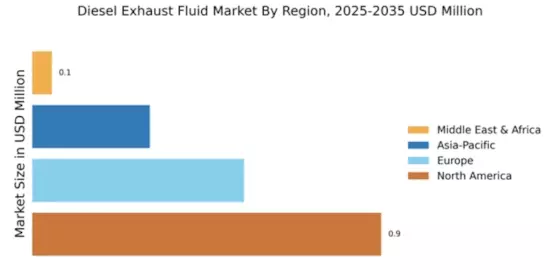
North America is poised to maintain its leadership in the Diesel Exhaust Fluid (DEF) market, holding a significant share of 0.89 in 2025. The growth is driven by stringent environmental regulations aimed at reducing NOx emissions from diesel engines, alongside increasing adoption of SCR technology in heavy-duty vehicles. The region's robust infrastructure and investment in clean technologies further bolster demand for DEF, making it a critical component in achieving compliance with emission standards. The United States and Canada are the leading countries in this market, with major players like CF Industries Holdings, Inc. and Yara International ASA driving innovation and supply chain efficiency. The competitive landscape is characterized by strategic partnerships and collaborations among key players, ensuring a steady supply of high-quality DEF. As the market evolves, the presence of established companies will continue to shape the industry's future.

Europe : Regulatory-Driven Market Growth

Europe's Diesel Exhaust Fluid market is projected to grow significantly, with a market size of 0.54 in 2025. The region's growth is primarily fueled by stringent EU regulations aimed at reducing vehicular emissions, which have led to increased adoption of SCR technology across various sectors. The European market is also witnessing a shift towards sustainable practices, further driving the demand for DEF as a key solution for compliance with environmental standards. Germany, France, and the UK are the leading countries in this market, hosting major players like BASF SE and Air Products and Chemicals, Inc. The competitive landscape is marked by innovation and a focus on sustainability, with companies investing in research and development to enhance product efficiency. The presence of regulatory bodies ensures that the market remains aligned with environmental goals, fostering a robust DEF ecosystem. "The European Union is committed to reducing emissions from diesel vehicles, making DEF an essential component of our environmental strategy."

Asia-Pacific : Emerging Market Potential

The Asia-Pacific region is emerging as a significant player in the Diesel Exhaust Fluid market, with a projected size of 0.3 in 2025. The growth is driven by increasing industrialization and urbanization, leading to a rise in diesel vehicle usage. Additionally, government initiatives aimed at improving air quality and reducing emissions are catalyzing the adoption of DEF in countries like China and India, where regulatory frameworks are becoming more stringent. China and India are at the forefront of this market, with local manufacturers and international players like Nissan Chemical Corporation expanding their footprint. The competitive landscape is evolving, with a focus on cost-effective solutions and local partnerships to enhance distribution networks. As the region continues to develop, the demand for DEF is expected to rise, supported by both regulatory and market-driven factors.

Middle East and Africa : Developing Market Landscape

The Middle East and Africa region presents a nascent market for Diesel Exhaust Fluid, with a size of 0.05 in 2025. The growth potential is hindered by limited regulatory frameworks and lower adoption rates of SCR technology. However, increasing awareness of environmental issues and the need for cleaner fuels are beginning to drive interest in DEF solutions. As governments in the region start to implement stricter emission standards, the market is expected to gradually evolve. Countries like South Africa and the UAE are showing early signs of market development, with local and international players exploring opportunities. The competitive landscape is still in its infancy, with few established players. However, as awareness grows and regulations tighten, the demand for DEF is likely to increase, paving the way for new entrants and innovations in the market.

Key Players and Competitive Insights

The Diesel Exhaust Fluid Market is currently characterized by a competitive landscape that is both dynamic and multifaceted. Key growth drivers include stringent emissions regulations, increasing adoption of diesel vehicles, and a growing emphasis on sustainability. Major players such as Yara International ASA (Norway), CF Industries Holdings, Inc. (US), and BASF SE (Germany) are strategically positioned to leverage these trends. Yara International ASA (Norway) focuses on innovation in production processes, aiming to enhance the efficiency of DEF manufacturing. Meanwhile, CF Industries Holdings, Inc. (US) emphasizes regional expansion, particularly in North America, to capitalize on the rising demand for DEF in the transportation sector. BASF SE (Germany) is investing in digital transformation initiatives to optimize its supply chain and improve customer engagement, collectively shaping a competitive environment that is increasingly reliant on technological advancements.

In terms of business tactics, companies are localizing manufacturing to reduce logistics costs and enhance supply chain resilience. The market structure appears moderately fragmented, with several key players exerting influence over their respective regions. This fragmentation allows for a diverse range of offerings, yet the collective strength of these companies fosters a competitive atmosphere where innovation and operational efficiency are paramount.

In November 2025, Yara International ASA (Norway) announced a partnership with a leading logistics firm to enhance its distribution network across Europe. This strategic move is likely to improve delivery times and reduce costs, thereby strengthening Yara's market position in a region where timely supply is critical for maintaining customer satisfaction. The partnership underscores the importance of logistics in the DEF market, where efficiency can significantly impact competitiveness.

In October 2025, CF Industries Holdings, Inc. (US) launched a new line of DEF products specifically designed for heavy-duty vehicles. This product line aims to meet the evolving needs of the trucking industry, which is increasingly focused on compliance with emissions standards. By diversifying its product offerings, CF Industries is positioning itself to capture a larger share of the market, particularly as regulations become more stringent.

In September 2025, BASF SE (Germany) unveiled a digital platform that integrates supply chain management with customer relationship management. This platform is designed to enhance transparency and streamline operations, allowing BASF to respond more effectively to market demands. The integration of digital tools into traditional supply chain processes indicates a significant shift towards data-driven decision-making in the DEF market, which could redefine competitive strategies moving forward.

As of December 2025, current competitive trends in the Diesel Exhaust Fluid Market are heavily influenced by digitalization, sustainability initiatives, and the integration of artificial intelligence. Strategic alliances are becoming increasingly prevalent, as companies recognize the value of collaboration in enhancing their market positions. Looking ahead, competitive differentiation is likely to evolve from traditional price-based competition to a focus on innovation, technological advancements, and supply chain reliability. This shift suggests that companies that prioritize these areas will be better positioned to thrive in an increasingly complex market.

Key Companies in the Diesel Exhaust Fluid Market market include

Industry Developments

  • Q2 2025: Navigating 2025's US Diesel Exhaust Fluid Market Supply Squeeze Several major US diesel exhaust fluid production plants began scheduled maintenance periods lasting up to eight months, causing significant supply constraints and price increases across the domestic DEF market.

Diesel Exhaust Fluid Market (AdBlue) Market Segmentation

Diesel Exhaust Fluid Market (AdBlue) Market Storage Solution Outlook

    • Bulk Storage
    • Dispensers
    • Tanks
    • Portable Containers
    • Others

Diesel Exhaust Fluid Market (AdBlue) Market Application Outlook

    • Automotive
    • Construction Machinery
    • Farm Machinery
    • Electronic Generators
    • Railway Engines Others

Diesel Exhaust Fluid Market (AdBlue) Market Regional Outlook

    • North America
      • US
      • Canada
      • Mexico
    • Europe
      • Germany
      • France
      • UK
      • Spain
      • Italy
      • Russia
      • Rest of Europe
    • Asia-Pacific
      • China
      • India
      • Japan
      • South Korea
      • Rest of Asia-Pacific
      • Middle East & Africa
      • South Africa
      • GCC Countries
      • Rest of the Middle East & Africa
    • South America
      • Brazil
      • Argentina
      • Rest of South America

Future Outlook

Diesel Exhaust Fluid Market Future Outlook

The Diesel Exhaust Fluid Market is projected to grow at an 8.5% CAGR from 2024 to 2035, driven by stringent emission regulations and increasing demand for cleaner technologies.

New opportunities lie in:

  • Expansion of distribution networks in emerging markets
  • Development of high-efficiency DEF formulations
  • Integration of DEF solutions with telematics for fleet management

By 2035, the market is expected to achieve robust growth, solidifying its role in sustainable transportation.

Market Segmentation

Diesel Exhaust Fluid Market End Use Outlook

  • Light Duty Vehicles
  • Heavy Duty Vehicles
  • Commercial Vehicles
  • Passenger Vehicles

Diesel Exhaust Fluid Market Application Outlook

  • Automotive
  • Agriculture
  • Construction
  • Marine
  • Industrial

Diesel Exhaust Fluid Market Formulation Type Outlook

  • Aqueous Urea Solution
  • Non-Aqueous Urea Solution
  • Urea-Based Solutions

Diesel Exhaust Fluid Market Distribution Channel Outlook

  • Direct Sales
  • Online Sales
  • Retail Sales
  • Wholesale

Report Scope

MARKET SIZE 20241.78(USD Million)
MARKET SIZE 20251.94(USD Million)
MARKET SIZE 20354.38(USD Million)
COMPOUND ANNUAL GROWTH RATE (CAGR)8.5% (2024 - 2035)
REPORT COVERAGERevenue Forecast, Competitive Landscape, Growth Factors, and Trends
BASE YEAR2024
Market Forecast Period2025 - 2035
Historical Data2019 - 2024
Market Forecast UnitsUSD Million
Key Companies ProfiledYara International ASA (NO), CF Industries Holdings, Inc. (US), BASF SE (DE), Air Products and Chemicals, Inc. (US), GreenChem (NL), Groupe Renault (FR), Nissan Chemical Corporation (JP), Kost USA, Inc. (US)
Segments CoveredApplication, End Use, Distribution Channel, Formulation Type
Key Market OpportunitiesIncreasing demand for low-emission vehicles drives growth in the Diesel Exhaust Fluid Market.
Key Market DynamicsRising regulatory pressures drive demand for diesel exhaust fluid, enhancing adoption in commercial transportation sectors.
Countries CoveredNorth America, Europe, APAC, South America, MEA

Market Highlights

Author
Chitranshi Jaiswal
Research Analyst Level I

In her 3 years of experience in the market research field, she has handled critical cross-domain projects. She has an in-depth knowledge of market estimation & analysis, problem-solving, primary as well as secondary research, and team management.She holds an engineering degree and is an MBA professional from a well-known university, capable of evaluating the market and competitive conditions. An exceptional strategist with excellent communication skills and a passion for delivering cutting-edge & practical insights for the market. Proficient in multi-tasking, and can successfully deal with competing demands, while maintaining complete confidentiality. Generated business through active client and project development, networking, and high-quality responses. Her knowledge and skills have helped in making solid business decisions, securing funding from investors, and avoiding business failures.

Leave a Comment

FAQs

Which region held the largest market share in Diesel Exhaust Fluid (AdBlue) Market?

The North America region dominated the Diesel Exhaust Fluid (AdBlue) Market with the largest market revenue share of 57.52% in 2020.

Who are the key players in the Diesel Exhaust Fluid (AdBlue) Market?

BASF SE, Yara, Mitsui Chemicals Inc, BP p.l.c, Borealis AG, Nissan Chemical Corporation, GreenChem, NOVAX Material & Technology Inc, Royal Dutch Shell PLC and Adeco doo

Which Storage solution had the largest market share in the Diesel Exhaust Fluid (AdBlue) Market?

The Bulk Storage segment dominated the global market with the largest revenue share of 40.87% in 2020.

Which Application had the largest market share in the Diesel Exhaust Fluid (AdBlue) Market?

The Automotive segment dominated the global market with the largest revenue share of 65.21% in 2020.

Download Free Sample

Kindly complete the form below to receive a free sample of this Report

Compare Licence

×
Features License Type
Single User Multiuser License Enterprise User
Price $4,950 $5,950 $7,250
Maximum User Access Limit 1 User Upto 10 Users Unrestricted Access Throughout the Organization
Free Customization
Direct Access to Analyst
Deliverable Format
Platform Access
Discount on Next Purchase 10% 15% 15%
Printable Versions