Digital Process Automation Market (2026 - 2035)

Digital Process Automation Market Size, Share and Research Report By Component (Solution & Services), By Business Function (Sales Process Automation, Supply Chain Automation, Claims Automation & Marketing Automation), By Deployment Type (On-Premises & On Cloud), By Organization Size (SMEs & Large Enterprise), By Industry Vertical (Manufacturing, Consumer Goods & Retail, BFSI, Telecom & IT, Energy & Utility, Media & Entertainment, Healthcare & Others) and Region (North America, Europe, Asia-Pacific & Rest Of The World) - Industry Forecast Till 2035
ID: MRFR/SEM/5188-HCR
100 Pages
Ankit Gupta, Shubham Munde
Last Updated: June 22, 2026
Digital Process Automation Market
Market Size
Forecast Period2026-2035
CAGR (2026-2035)12.30%
2025 Market SizeUSD 16.52 Billion
2035 Market SizeUSD 52.68 Billion
Key Players
Microsoft
IBM
Appian
Pegasystems
Nintex
OpenText
Opportunities
  • AI-Agent Orchestration Platforms
  • Process-Automation-as-a-Service for Emerging Markets
  • Sustainability and ESG Workflow Automation

Digital Process Automation Market Summary

The Digital Process Automation Market reached a valuation of USD 16.52 Billion in 2025 and is projected to grow from USD 18.54 Billion in 2026 to USD 52.68 Billion by 2035, registering a CAGR of 12.30% during the forecast period (2026–2035). This trajectory reflects a structural shift across industries toward end-to-end workflow orchestration, driven in part by regulatory mandates such as the EU's Digital Operational Resilience Act (DORA) and the U.S. Federal Zero Trust Architecture strategy, both of which compel organizations to digitize, audit, and automate core business processes [1][2].

The technology landscape is moving beyond simple task-level scripting. Legacy business process management suites — often rigid, developer-dependent, and siloed — are giving way to unified low-code platforms that embed process mining, event-driven orchestration, and generative AI capabilities into a single design surface. Enterprise spending on intelligent automation platforms exceeded USD 8.2 Billion globally in 2024, according to estimates, and cloud hyperscalers are embedding native AI into their workflow tools, intensifying competitive pressure on traditional vendors [3][4].

North America commands the largest share of the Digital Process Automation Market at 38.2% of 2025 revenue, supported by mature cloud infrastructure and early adoption of hyper-automation frameworks. Asia-Pacific is the fastest-growing region with a projected CAGR of 14.20%, fueled by aggressive digitization policies in India, China, and Southeast Asian economies. Europe holds the second-largest position at 27.5% share, with demand anchored in compliance-driven automation across financial services and manufacturing. As sustainability reporting mandates expand globally, the Digital Process Automation Market is positioned for sustained double-digit growth through the next decade.


Key Report Takeaways

• By Component

  • The solution segment accounted for 58.5% of the Digital Process Automation Market in 2025, driven by enterprise demand for integrated low-code orchestration platforms.
  • Services are projected to register a CAGR of 13.90% through 2035 as implementation consulting and managed automation services scale alongside platform adoption.

• By End User

  • BFSI held a 29.5% share of the Digital Process Automation Market in 2025, reflecting regulatory pressure to automate compliance and customer onboarding workflows.
  • Healthcare is anticipated to grow at a 14.40% CAGR, making it the fastest-expanding vertical through 2035.

• By Region

  • North America led the Digital Process Automation Market with 38.2% of global revenue in 2025.
  • Asia-Pacific is forecast to advance at a 14.20% CAGR through 2035, led by India's Digital India initiative and China's state-backed enterprise digitization programs.


Digital Process Automation Market Size and Forecast (2021–2035)

Market Research Future's sizing methodology combines top-down industry supply analysis with bottom-up vendor revenue aggregation, cross-validated against enterprise IT spending surveys and regulator-mandated disclosure databases. Historical figures (2021–2024) are actuals; 2025 is the calibrated base year; 2026–2035 values are forecast using proprietary demand modeling.
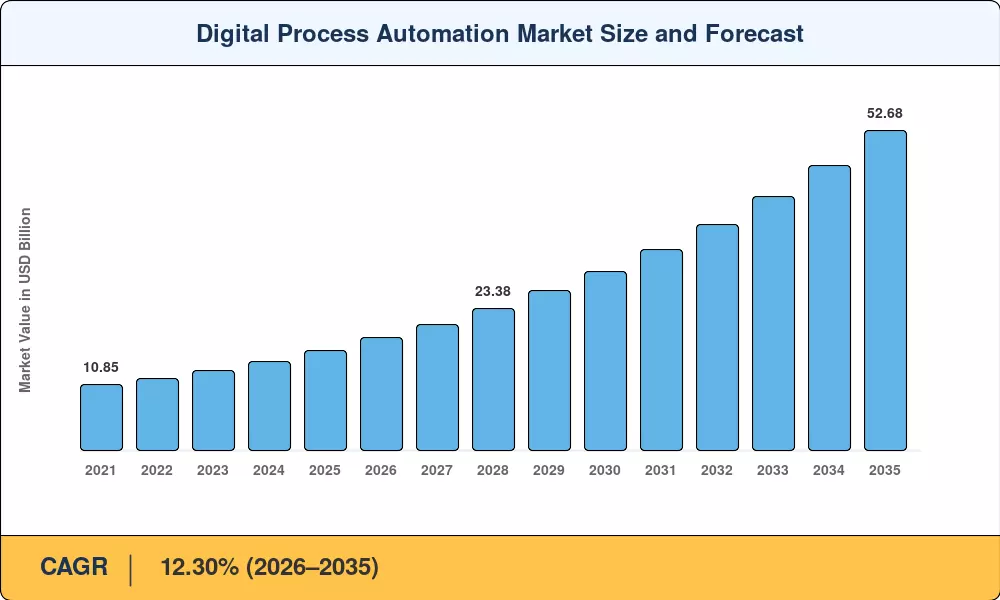
Digital Process Automation Market Size and Forecast
Our Impact
Enabled $4.3B Revenue Impact for Fortune 500 and Leading Multinationals
Partnering with 2000+ Global Organizations Each Year
30K+ Citations by Top-Tier Firms in the Industry

Driver Impact Analysis

Driver ~% Impact on CAGR Geographic Relevance Impact Timeline
Regulatory compliance mandates (DORA, Zero Trust) ~18% North America, Europe Short-term (≤2 yr)
Generative AI integration into workflow platforms ~22% Global Medium-term (2–4 yr)
Cloud hyperscaler native automation suites ~15% North America, Asia-Pacific Short-term (≤2 yr)
SME digital transformation acceleration ~12% Asia-Pacific, South America Medium-term (2–4 yr)
Sustainability and ESG reporting mandates ~10% Europe, North America Long-term (≥4 yr)
Process mining and diagnostic analytics adoption ~13% Global Medium-term (2–4 yr)
Customer experience optimization pressure ~10% Global Short-term (≤2 yr)


Regulatory Compliance Mandates

The EU's Digital Operational Resilience Act, effective January 2025, requires financial entities to demonstrate automated ICT risk management and incident reporting capabilities. Compliance spending on process automation tools across European banking alone is estimated at USD 1.4 Billion annually through 2027 [2]. In the United States, the federal Zero Trust Architecture mandate under Executive Order 14028 compels agencies to adopt automated identity verification and continuous monitoring workflows, driving public-sector procurement of the Digital Process Automation Market solutions at a pace not seen since the initial e-government push of the early 2000s [1].

Generative AI Integration

projected that by 2026, over 80% of organizations will have deployed generative AI-enabled APIs or applications in production environments, up from under 5% in early 2023 [7]. Within the Digital Process Automation Market, this translates to AI copilots that auto-generate workflow logic, extract unstructured document data, and recommend process optimizations in real time. Microsoft's Copilot integration into Power Automate and Salesforce's Einstein GPT for Flow Builder have already reshaped buyer expectations around intelligent automation.

Cloud Hyperscaler Platform Expansion

Amazon Web Services, Microsoft Azure, and Google Cloud are each embedding native automation capabilities directly into their cloud stacks, collapsing the distance between infrastructure and process logic. AWS Step Functions processed over 15 Billion state transitions monthly by mid-2024, a 47% year-over-year increase [4]. This trend puts pricing and feature pressure on standalone vendors while expanding the total addressable market by lowering the entry barrier for mid-market and SME buyers in the Digital Process Automation Market.

SME Digital Transformation

Small and medium-sized enterprises represent the next adoption frontier for the Digital Process Automation Market. A 2024 World Bank survey found that 62% of SMEs in emerging economies cited manual workflows as their primary productivity bottleneck [10]. Low-code platforms priced below USD 25 per user per month are enabling firms with fewer than 500 employees to deploy department-level automation without dedicated IT teams, particularly across India, Brazil, and Southeast Asia.


Restraints Impact Analysis

The restraint impact percentages below are directional and represent estimated headwinds to market growth, not direct subtractions from the headline CAGR.

Restraint ~% Drag on CAGR Geographic Relevance Impact Timeline
Integration complexity with legacy ERP systems ~–15% Global Short-term (≤2 yr)
Data privacy and sovereignty concerns ~–12% Europe, Asia-Pacific Medium-term (2–4 yr)
Shortage of skilled automation architects ~–10% Global Medium-term (2–4 yr)
Vendor lock-in and platform fragmentation ~–8% North America, Europe Long-term (≥4 yr)
High total cost of ownership for complex deployments ~–7% South America, MEA Short-term (≤2 yr)


Legacy System Integration Complexity

A survey of 400 enterprises found that 58% of digital process automation projects exceeded their initial timeline by at least six months due to integration challenges with legacy on-premise ERP and CRM platforms [17]. Middleware costs, API customization, and data migration efforts can account for 30–40% of total implementation budgets, dampening ROI expectations and slowing enterprise rollouts of the Digital Process Automation Market, especially in manufacturing and government sectors with decades-old system architectures.

Data Privacy and Sovereignty Regulations

Cross-border data flow restrictions under GDPR, China's Personal Information Protection Law, and India's Digital Personal Data Protection Act create jurisdictional complexity for organizations deploying cloud-based automation across multiple geographies [18]. A 2024 analysis estimated that multinational firms spend an average of USD 2.8 Million annually on data residency compliance related to workflow automation, a cost that disproportionately affects the Digital Process Automation Market in regulated verticals such as healthcare and financial services.

Skilled Talent Shortage

The World Economic Forum's 2024 Future of Jobs Report estimated a global shortfall of 1.2 million automation and AI specialists through 2028 [19]. Without sufficient process architects, citizen-developer enablement, and change management expertise, enterprises struggle to scale pilot projects into enterprise-wide deployments — a bottleneck that constrains the full growth potential of the Digital Process Automation Market in both mature and emerging economies.


Digital Process Automation Market Opportunities

AI-Agent Orchestration Platforms

The advent of autonomous AI agents capable of reasoning and tool usage across several steps offers the potential for a new class of Digital Process Automation Market solutions that transcend predetermined workflows. Platforms that manage fleets of specialized agents -- managing document intake, exception resolution and compliance verification in tandem -- might tap into a USD 4-6 Billion incremental income pool by 2032 [9].


Process-Automation-as-a-Service for Emerging Markets

Subscription-based, fully managed automation services allow companies in Latin America, Sub-Saharan Africa and South Asia that don’t have in-house IT teams to access the Digital Process Automation Market. India’s MeitY cloud-first policy and Brazil’s digital government plan promote hosted workflow solutions, forming a greenfield opportunity of an estimated USD 2.1 Billion by 2030 [10].


Sustainability and ESG Workflow Automation

The EU Corporate Sustainability Reporting Directive, which will apply to more than 50,000 organizations by 2026, needs automated data collection and audit-trail capabilities that cannot be achieved at scale using human techniques [13]. Vendors who offer pre-built ESG reporting templates and integrations for emissions tracking could benefit from a compliance tsunami that spreads beyond Europe, as ISSB rules take hold globally.


Healthcare Process Digitization

Global healthcare IT investment reached over USD 340 billion in 2024, with high-ROI automation use cases such as prior-authorization automation, clinical trial administration, and patient intake digitization [22]. The U.S. Centers for Medicare & Medicaid Services’ 2024 interoperability standards demand FHIR-based data sharing, providing a regulatory push to healthcare-specific Digital Process Automation Market platforms.


Data Monetization Through Process Intelligence

Organizations that instrument their automated workflows with process mining and behavioral analytics generate proprietary operational datasets. Monetizing these insights — via benchmarking services, industry performance indices, or anonymized training data for AI models — represents an adjacent revenue stream for the Digital Process Automation Market that could exceed USD 1.5 Billion by 2033 [11].


Digital Process Automation Market Future Outlook

Autonomous AI-Driven Operations

By 2030, expects that 30% of enterprise operational decisions will be made autonomously by AI agents embedded within Digital Process Automation Market platforms [9]. This shift from "human-in-the-loop" to "human-on-the-loop" models will redefine how organizations staff operations centers, manage exceptions, and govern algorithmic decision-making across financial services, supply chain, and customer operations.

Platform Consolidation and Ecosystem Economics

The Digital Process Automation Market is entering a consolidation phase. Between 2023 and 2025, over USD 12 Billion in M&A activity targeted workflow automation vendors [8]. By 2030, the market is expected to coalesce around 4–5 dominant ecosystem platforms — each integrating process mining, RPA, document intelligence, and decision management — with long-tail specialists serving vertical niches in healthcare, government, and industrial IoT.

Citizen Development and Democratized Automation

projects that by 2028, citizen developers will build more automated workflows than professional developers [14]. Low-code and no-code platforms are shifting the center of gravity in the Digital Process Automation Market from IT departments to business units. Organizations that establish governance frameworks early — balancing agility with security and compliance — will capture the productivity gains while managing shadow-automation risk.

ESG and Sustainability-Driven Automation

The International Sustainability Standards Board's global baseline reporting standards are projected to influence over 40,000 companies worldwide by 2028 [13]. Automated ESG data collection, carbon accounting workflows, and audit-trail management represent a structural growth vector for the Digital Process Automation Market that extends well beyond European regulatory borders into Asia-Pacific and Latin American markets.


Digital Process Automation Market Segmentation

By Component

Segment Key Metric Primary Demand Driver
Solution 58.5% share (2025) Integrated low-code orchestration platforms
Service 13.90% CAGR (2026–2035) Implementation consulting and managed services


The solution segment dominates the Digital Process Automation Market as enterprises prioritize platform investments that consolidate workflow design, execution, and monitoring into single environments. Leading platforms now bundle process mining, decision engines, and AI-assisted design tools, reducing the need for separate point solutions. The services segment is growing faster, however, as organizations require specialized consulting to map legacy processes, manage change, and train citizen developers at scale. Managed automation services — where providers operate workflows on behalf of clients — are gaining traction among mid-market firms that lack internal automation expertise.

By Deployment

Segment Key Metric Primary Demand Driver
On-Demand (Cloud) 62.2% share (2025) Scalability, lower upfront investment
On-Premise 10.80% CAGR (2026–2035) Data sovereignty, legacy infrastructure


Cloud-based on-demand deployment commands the majority of the Digital Process Automation Market because it eliminates capital-intensive infrastructure provisioning and accelerates time-to-value. Large financial institutions and government agencies, however, continue to invest in on-premise solutions where data residency regulations or existing IT commitments make cloud migration impractical in the near term.

By Organization Size

Segment Key Metric Primary Demand Driver
Large Enterprises 76.2% share (2025) Complex, multi-departmental workflow needs
SMEs 13.20% CAGR (2026–2035) Affordable low-code tools, cloud accessibility


Large enterprises account for the bulk of Digital Process Automation Market revenue due to the scale and complexity of their operational workflows. SMEs, however, represent the fastest-growing segment as per-user pricing models and no-code interfaces eliminate traditional cost and skills barriers to adoption.

By End User

Segment Key Metric Primary Demand Driver
BFSI 29.5% share (2025) KYC, AML, and regulatory compliance
Manufacturing USD 3.08 Billion (2025) Supply chain and quality process automation
IT & Telecommunication 12.50% CAGR (2026–2035) Service desk and DevOps workflow automation
Healthcare 14.40% CAGR (2026–2035) Prior authorization, clinical trial management
Others USD 2.74 Billion (2025) Government, retail, energy, education


BFSI is the largest vertical in the Digital Process Automation Market, where anti-money-laundering compliance, customer onboarding digitization, and claims processing automation generate consistent demand. Healthcare is advancing fastest, propelled by interoperability mandates, electronic health record integration, and the need to reduce administrative burden on clinical staff — U.S. hospitals spend an estimated USD 39 Billion annually on billing-related administrative tasks alone [22].


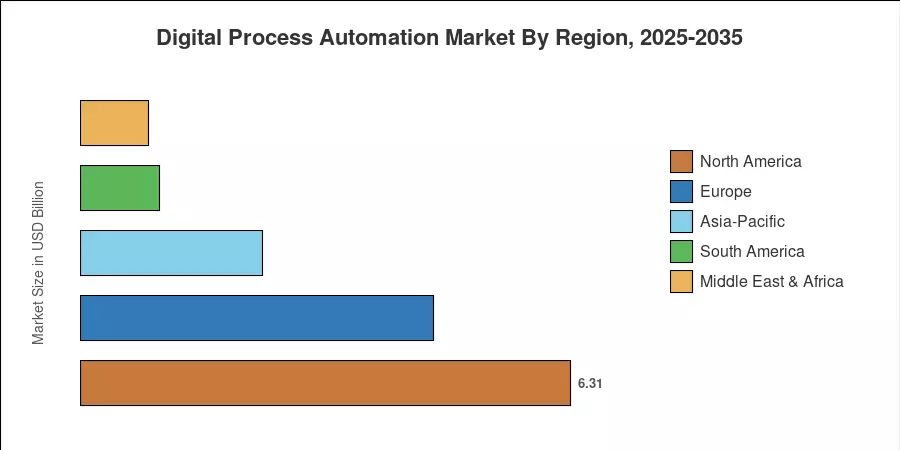
Regional Market Share Analysis

Region Key Metric (2025) Primary Investment Themes
North America 38.2% revenue share Cloud-native platforms, regulatory compliance
Europe 27.5% revenue share DORA compliance, ESG automation
Asia-Pacific 14.20% CAGR (2026–2035) Digital government programs, SME adoption
South America USD 1.02 Billion Banking digitization, cloud migration
Middle East & Africa USD 0.88 Billion Smart government, oil & gas process digitization
Total USD 16.52 Billion

The Digital Process Automation Market exhibits pronounced geographic variation in maturity, growth velocity, and primary adoption drivers. North America and Europe account for the majority of installed automation infrastructure, while Asia-Pacific and South America represent the highest growth trajectories.


North America

Country Key Metric Key Driver
US 78.4% of regional share Federal Zero Trust mandate, enterprise cloud spend
Canada 13.1% of regional share Open Banking Act, public sector modernization
Mexico 8.5% of regional share Nearshoring wave, banking digitization


The United States remains the single largest country market for the Digital Process Automation Market, with federal agencies and Fortune 500 enterprises driving adoption. Canada's 2024 Open Banking framework is generating new demand for automated onboarding and compliance workflows, while Mexico benefits from nearshoring investment that brings multinational automation standards into local manufacturing supply chains [1][2].

Europe

Country Key Metric Key Driver
Germany 11.65% CAGR Industry 4.0 integration
UK 22.8% of regional share Financial services automation
France USD 1.18 Billion Public sector digital transformation
Italy 11.40% CAGR Manufacturing process digitization
Spain USD 0.62 Billion Tourism and services automation
Nordic Countries 12.10% CAGR Digital-first governance, sustainability
Russia USD 0.34 Billion Import substitution, domestic platform development
Rest of Europe USD 0.72 Billion EU cohesion fund digitization programs


DORA compliance is the defining near-term catalyst for the Digital Process Automation Market across European financial institutions. Germany's Industry 4.0 initiative continues to push manufacturing workflow automation into new sectors, while the Nordic economies lead in citizen-facing digital process automation for government services [2][13].

Asia-Pacific

Country Key Metric Key Driver
China 31.5% of regional share State-backed enterprise digitization
India 15.20% CAGR Digital India, UPI-driven fintech automation
Japan USD 0.68 Billion Legacy system renewal, workforce shortage
South Korea 13.80% CAGR K-Digital Training, smart factory programs
ASEAN USD 0.54 Billion Banking modernization, e-government
Rest of Asia-Pacific 12.90% CAGR Emerging digital infrastructure


India's Digital India program has allocated over USD 7 Billion in cumulative IT modernization funding, catalyzing demand for the Digital Process Automation Market across tax administration, welfare distribution, and banking. China's enterprise digitization targets under its 14th Five-Year Plan position the country as Asia's largest automation market by absolute value [10].

South America

Country Key Metric Key Driver
Brazil 62.3% of regional share Open Finance regulation, Pix ecosystem
Argentina 12.60% CAGR Fintech modernization
Rest of South America USD 0.24 Billion Mining and telecom digitization


Brazil's central bank-mandated Open Finance framework is creating a direct pull for automated customer data management and regulatory reporting workflows. Argentine fintechs are increasingly deploying cloud-native process automation to serve unbanked populations at scale [21].

Middle East & Africa

Country Key Metric Key Driver
Saudi Arabia 34.2% of regional share Vision 2030 digital government
UAE 13.50% CAGR Smart Dubai, financial hub automation
South Africa USD 0.14 Billion Banking sector modernization
Egypt 12.80% CAGR Digital Egypt initiative
Rest of MEA USD 0.18 Billion Oil & gas operational efficiency


Saudi Arabia's Vision 2030 has earmarked over USD 1.2 Billion for government digital transformation, directly driving procurement of the Digital Process Automation Market solutions in public administration, healthcare, and energy. The UAE's Smart Dubai initiative aims for 100% paperless government transactions, anchoring automation demand in the Gulf region [16].


Digital Process Automation Market By Region, 2025-2035

Competitive Benchmarking

The Digital Process Automation Market exhibits medium concentration, with the top five vendors accounting for an estimated 35–42% of global revenue. The Herfindahl-Hirschman Index sits in the 800–1,200 range, characteristic of a market where a handful of platform leaders compete with dozens of specialized and regional players. Competitive dynamics are intensifying as cloud hyperscalers embed native automation features into their platforms, pressuring standalone vendors to differentiate through vertical expertise, AI capabilities, or ecosystem partnerships.

Company Est. Revenue Share Range Key Offerings Strategic Positioning
Microsoft ~8–11% Power Automate, Copilot Studio Hyperscaler with embedded AI and broadest enterprise distribution
IBM ~6–9% Cloud Pak for Automation, watsonx Orchestrate Hybrid-cloud automation with deep AI/NLP integration
Appian ~5–7% Appian Platform, Process Mining Low-code leader with strong government and financial services focus
Pegasystems ~5–7% Pega Infinity, Process AI Decisioning-centric platform for complex case management
Nintex ~3–5% Nintex Process Platform, K2 Mid-market workflow automation with strong SharePoint integration
OpenText ~3–5% AppWorks, Content Suite Document-centric automation and information management
SAP ~4–6% SAP Build Process Automation ERP-embedded workflow automation for SAP-centric enterprises
Newgen Software ~2–4% NewgenONE Emerging-market focus with strong BFSI and government capabilities
Kissflow ~1–3% Kissflow Work Platform SME-focused no-code platform with rapid deployment model
Bizagi ~1–3% Bizagi Modeler, Automation Server Process modeling and execution with strong Latin American presence


Recent News & Developments

  • Microsoft (November 2024): Launched autonomous agent capabilities in Copilot Studio, enabling enterprises to build AI-driven workflow agents without code — a move that directly expands the accessible automation surface for the Digital Process Automation Market [4].


  • IBM (June 2024): Released watsonx Orchestrate for enterprise workflow automation, combining generative AI with pre-built connectors for over 150 enterprise applications, positioning IBM at the convergence of AI and process orchestration [7].
  • Pegasystems (March 2024): Introduced Pega GenAI Blueprint, an AI tool that converts natural-language process descriptions into executable workflow designs, reducing deployment timelines by up to 60% according to pilot customer data [14].
  • European Commission (January 2025): DORA took effect, requiring all EU financial entities to implement automated ICT risk management and incident-reporting workflows, directly catalyzing procurement across the Digital Process Automation Market [2].


Digital Process Automation Market Report Scope

Item Detail
Market Scope Global Digital Process Automation Market — solutions, services, and platforms enabling end-to-end workflow automation
Study Period 2021–2035
CAGR (Forecast) 12.30% (2026–2035)
Base Year Market Size USD 16.52 Billion (2025)
2035 Forecast Market Size USD 52.68 Billion
Fastest Growing Segment Healthcare (by end user); Services (by component)
Companies Profiled Microsoft, IBM, Appian, Pegasystems, Nintex, OpenText, SAP, Newgen Software, Kissflow, Bizagi
Valuation Currency USD Billion


FAQs

How does the Digital Process Automation Market differ from traditional BPM software?
Digital process automation integrates AI, process mining, and low-code design into unified platforms, whereas legacy BPM suites require extensive developer coding and lack embedded intelligence. The shift emphasizes continuous optimization over static workflow modeling [14].
Which procurement model offers the fastest ROI for mid-market buyers in the Digital Process Automation Market?
Cloud-based subscription models typically deliver ROI within 9–14 months for mid-market firms, compared to 18–24 months for on-premise deployments. Lower upfront costs and faster provisioning drive the difference [3].
What interoperability risks should buyers evaluate in the Digital Process Automation Market?
Buyers should assess API compatibility with existing ERP and CRM systems, data format standardization, and vendor lock-in clauses. Pre-built connector libraries vary significantly across platforms [15].
How are AI agents reshaping competitive dynamics in the Digital Process Automation Market?
AI agents are shifting competition from workflow builder UX toward orchestration intelligence and model accuracy. Vendors with proprietary training data and process mining assets hold an emerging advantage [9].
What is the typical implementation timeline for enterprise-scale automation within the Digital Process Automation Market?
Enterprise deployments average 6–12 months from pilot to production, depending on integration complexity and change management readiness. Phased rollouts across departments reduce risk [17].
How do data sovereignty laws affect cloud deployment choices in the Digital Process Automation Market?
GDPR, China's PIPL, and India's DPDP Act require in-region data storage, pushing regulated buyers toward local cloud instances or hybrid architectures. Compliance costs average USD 2.8 Million annually for multinationals [18].
What emerging vertical shows the strongest untapped potential in the Digital Process Automation Market?
Education and public administration are underpenetrated verticals where enrollment processing, grant management, and citizen services automation present significant growth headroom through 2035 [10].    
Author
Author
Author Profile
Ankit Gupta LinkedIn
Team Lead - Research
Ankit Gupta is a seasoned market intelligence and strategic research professional with over six plus years of experience in the ICT and Semiconductor industries. With academic roots in Telecom, Marketing, and Electronics, he blends technical insight with business strategy. Ankit has led 200+ projects, including work for Fortune 500 clients like Microsoft and Rio Tinto, covering market sizing, tech forecasting, and go-to-market strategies. Known for bridging engineering and enterprise decision-making, his insights support growth, innovation, and investment planning across diverse technology markets.
Co-Author
Co-Author Profile
Shubham Munde LinkedIn
Team Lead - Research
Shubham brings over 7 years of expertise in Market Intelligence and Strategic Consulting, with a strong focus on the Automotive, Aerospace, and Defense sectors. Backed by a solid foundation in semiconductors, electronics, and software, he has successfully delivered high-impact syndicated and custom research on a global scale. His core strengths include market sizing, forecasting, competitive intelligence, consumer insights, and supply chain mapping. Widely recognized for developing scalable growth strategies, Shubham empowers clients to navigate complex markets and achieve a lasting competitive edge. Trusted by start-ups and Fortune 500 companies alike, he consistently converts challenges into strategic opportunities that drive sustainable growth.

Research Approach


Secondary Research

The secondary research process involved comprehensive analysis of technology databases, industry publications, government IT reports, and authoritative enterprise technology sources. Key sources included the International Data Corporation (IDC), Gartner Research, Forrester Research, US Bureau of Economic Analysis (BEA), European Commission Digital Economy Reports, National Institute of Standards and Technology (NIST), Organization for Economic Co-operation and Development (OECD) Digital Economy Outlook, World Economic Forum (WEF) Future of Jobs Report, International Telecommunication Union (ITU), US Census Bureau Business Dynamics Statistics, Eurostat ICT Statistics, Asian Development Bank (ADB) Digital Transformation Reports, International Organization for Standardization (ISO), Institute of Electrical and Electronics Engineers (IEEE) Xplore Digital Library, ACM Digital Library, McKinsey Global Institute Automation Reports, PwC Global Digital Operations Study, Deloitte Digital Transformation Survey, and national digital transformation agency reports from key markets. These sources were used to collect enterprise software adoption statistics, digital transformation spending data, RPA and workflow automation trends, cloud computing metrics, and market landscape analysis for solutions, services, sales process automation, supply chain automation, claims automation, and marketing automation technologies.


Primary Research

To gather both qualitative and quantitative insights, supply-side and demand-side stakeholders were interviewed during the primary research phase. CEOs, CTOs, VPs of Product Development, Chief Automation Officers, and commercial directors from cloud service providers, system integrators, and DPA software vendors were examples of supply-side sources. Chief information officers (CIOs), chief digital officers (CDOs), directors of process improvement, leaders of IT procurement, and operations managers from the manufacturing, BFSI, healthcare, retail, telecom & IT, and energy & utility sectors were among the demand-side sources. Primary research verified AI integration roadmaps, validated market segmentation across on-premises and cloud deployments, and collected data on business adoption trends, price structures, and implementation difficulties.

Primary Respondent Breakdown:

By Designation: C-level Primaries (32%), Director Level (35%), Others (33%)

By Region: North America (38%), Europe (25%), Asia-Pacific (28%), Rest of World (9%)


Market Size Estimation

Global market valuation was derived through revenue mapping and enterprise deployment analysis. The methodology included:

Identification of 50+ key vendors across robotic process automation (RPA), business process management (BPM), low-code platforms, and AI-powered workflow automation

Product mapping across solutions (RPA platforms, BPM suites, intelligent document processing) and services (consulting, implementation, training, support)

Analysis of reported and modeled annual revenues specific to DPA portfolios

Coverage of vendors representing 75-80% of global market share in 2024

Extrapolation using bottom-up (enterprise deployment volume × ASP by region) and top-down (vendor revenue validation) approaches to derive segment-specific valuations across business functions (sales, supply chain, claims, marketing automation), deployment types, organization sizes, and industry verticals

Download Free Sample

Kindly complete the form below to receive a free sample of this Report

Download PDF ×

We do not share your information with anyone. However, we may send you emails based on your report interest from time to time. You may contact us at any time to opt-out.
















