Request Free Sample ×

Kindly complete the form below to receive a free sample of this Report

* Please use a valid business email

Leading companies partner with us for data-driven Insights

clients tt-cursor
Hero Background

Digital Twin Market

ID: MRFR/ICT/3089-CR
200 Pages
Aarti Dhapte
Last Updated: May 25, 2026
Digital Twin Market Size, Share & Trends Analysis Research Report By Application (Manufacturing, Healthcare, Smart Cities, Automotive, Energy Management), By Technology (IoT-Enabled Digital Twins, AI-Driven Digital Twins, Simulation-Based Digital Twins, Data-Driven Digital Twins), By End Use (B2B, B2C, Government), By Deployment Type (Cloud-Based, On-Premises) and By Regional (North America, Europe, South America, Asia Pacific, Middle East and Africa) - Forecast to 2035
Download PDF ×

We do not share your information with anyone. However, we may send you emails based on your report interest from time to time. You may contact us at any time to opt-out.

  1. 1 Market Overview |
    1. 1.1 Study Assumptions & Market Definition |
    2. 1.2 Scope of the Study |
    3. 1.3 Research Methodology
  2. 2 Market Summary & Key Takeaways
  3. 3 Market Dynamics |
    1. 3.1 Market Drivers Analysis | |
      1. 3.1.1 Industrial IoT Platform Maturation | |
      2. 3.1.2 Edge-AI and On-Device Inference | |
      3. 3.1.3 Regulatory Mandates for Safety-Critical Infrastructure | |
      4. 3.1.4 Cloud-Native Deployment & SaaS Twin Platforms | |
      5. 3.1.5 Smart-City and Urban-Planning Programs | |
      6. 3.1.6 Sustainability Reporting & ESG Compliance | |
      7. 3.1.7 5G / Private-Network Rollouts |
    2. 3.2 Market Restraints Analysis | |
      1. 3.2.1 Cyber-Security Gaps in Twin-to-Physical Feedback Loops | |
      2. 3.2.2 Scarce Physics-Based Modeling Talent | |
      3. 3.2.3 Data Interoperability and Vendor Lock-In | |
      4. 3.2.4 High Upfront Integration Costs for SMEs | |
      5. 3.2.5 Intellectual-Property and Data-Sovereignty Concerns |
    3. 3.3 Market Opportunity Analysis | |
      1. 3.3.1 Generative-AI-Augmented Twin Creation | |
      2. 3.3.2 Digital Twin as a Service (DTaaS) for SMEs | |
      3. 3.3.3 Emerging-Market Adoption through Public Digitalization Programs | |
      4. 3.3.4 Data-Monetization and Simulation-as-a-Product Business Models | |
      5. 3.3.5 Real-Time Grid Twins for Energy Transition |
    4. 3.4 Industry Value Chain Analysis |
    5. 3.5 Porter's Five Forces Analysis
  4. 4 Global Digital Twin Market Size & Forecast (2021–2035) |
    1. 4.1 Historical Market Size (2021–2025) |
    2. 4.2 Current & Forecast Market Size (2026–2035) |
    3. 4.3 Market Size by Revenue (USD Billion) |
    4. 4.4 Year-over-Year Growth Analysis
  5. 5 Segmentation Analysis |
    1. 5.1 By Application | |
      1. 5.1.1 Manufacturing | |
      2. 5.1.2 Energy and Power | |
      3. 5.1.3 Aerospace and Defense | |
      4. 5.1.4 Oil and Gas | |
      5. 5.1.5 Automotive | |
      6. 5.1.6 Others |
    2. 5.2 By Component | |
      1. 5.2.1 Solutions / Platforms | |
      2. 5.2.2 Services |
    3. 5.3 By Deployment Mode | |
      1. 5.3.1 On-Premises | |
      2. 5.3.2 Cloud |
    4. 5.4 By Enterprise Size | |
      1. 5.4.1 Large Enterprises | |
      2. 5.4.2 Small and Medium Enterprises (SMEs)
  6. 6 Regional Analysis |
    1. 6.1 North America | |
      1. 6.1.1 United States | |
      2. 6.1.2 Canada | |
      3. 6.1.3 Mexico |
    2. 6.2 Europe | |
      1. 6.2.1 Germany | |
      2. 6.2.2 United Kingdom | |
      3. 6.2.3 France | |
      4. 6.2.4 Italy | |
      5. 6.2.5 Spain | |
      6. 6.2.6 Nordic Countries | |
      7. 6.2.7 Russia | |
      8. 6.2.8 Rest of Europe |
    3. 6.3 Asia-Pacific | |
      1. 6.3.1 China | |
      2. 6.3.2 India | |
      3. 6.3.3 Japan | |
      4. 6.3.4 South Korea | |
      5. 6.3.5 ASEAN | |
      6. 6.3.6 Rest of Asia-Pacific |
    4. 6.4 South America | |
      1. 6.4.1 Brazil | |
      2. 6.4.2 Argentina | |
      3. 6.4.3 Rest of South America |
    5. 6.5 Middle East & Africa | |
      1. 6.5.1 Saudi Arabia | |
      2. 6.5.2 UAE | |
      3. 6.5.3 South Africa | |
      4. 6.5.4 Egypt | |
      5. 6.5.5 Rest of MEA
  7. 7 Competitive Landscape |
    1. 7.1 Market Share Analysis (2025) |
    2. 7.2 Competitive Benchmarking Matrix |
    3. 7.3 Company Profiles | |
      1. 7.3.1 Siemens AG | |
      2. 7.3.2 General Electric (GE) | |
      3. 7.3.3 Microsoft Corporation | |
      4. 7.3.4 IBM Corporation | |
      5. 7.3.5 PTC Inc. | |
      6. 7.3.6 Dassault Systèmes | |
      7. 7.3.7 ANSYS Inc. | |
      8. 7.3.8 Robert Bosch GmbH | |
      9. 7.3.9 Oracle Corporation | |
      10. 7.3.10 SAP SE
  8. 8 Future Outlook & Strategic Recommendations (2026–2035) |
    1. 8.1 AI-Autonomous Operations and Self-Optimizing Twins |
    2. 8.2 Platform Economics and Twin Marketplaces |
    3. 8.3 Sustainability Reporting and Carbon-Twin Mandates |
    4. 8.4 Convergence with Spatial Computing and Extended Reality
  9. 9 Recent Developments & News
  10. 10 Frequently Asked Questions (FAQs)
  11. 11 Report Scope & Methodology |
    1. 11.1 Study Period & Base Year |
    2. 11.2 Data Sources & Citations |
    3. 11.3 Abbreviations
  12. 1 LIST OF TABLES |
  13. TABLE 1 Global Digital Twin Market Size & Forecast, by Revenue (USD Billion), 2021–2035 |
  14. TABLE 2 Global Digital Twin Market — Year-over-Year Growth Analysis, 2021–2035 |
  15. TABLE 3 Global Digital Twin Market — Driver Impact Analysis |
  16. TABLE 4 Global Digital Twin Market — Restraint Impact Analysis |
  17. TABLE 5 Global Digital Twin Market Size, by Application, 2021–2035 (USD Billion) |
  18. TABLE 6 Global Digital Twin Market Size, by Component, 2021–2035 (USD Billion) |
  19. TABLE 7 Global Digital Twin Market Size, by Deployment Mode, 2021–2035 (USD Billion) |
  20. TABLE 8 Global Digital Twin Market Size, by Enterprise Size, 2021–2035 (USD Billion) |
  21. TABLE 9 Global Digital Twin Market Size, by Region, 2021–2035 (USD Billion) |
  22. TABLE 10 North America Digital Twin Market Size, by Country, 2021–2035 (USD Billion) |
  23. TABLE 11 Europe Digital Twin Market Size, by Country, 2021–2035 (USD Billion) |
  24. TABLE 12 Asia-Pacific Digital Twin Market Size, by Country, 2021–2035 (USD Billion) |
  25. TABLE 13 South America Digital Twin Market Size, by Country, 2021–2035 (USD Billion) |
  26. TABLE 14 Middle East & Africa Digital Twin Market Size, by Country, 2021–2035 (USD Billion) |
  27. TABLE 15 Competitive Benchmarking Matrix — Global Digital Twin Market, 2025 |
  28. TABLE 16 Company Profiles — Key Players, Global Digital Twin Market |
  29. TABLE 17 Recent Developments & Strategic Announcements, 2023–2025 |
  30. TABLE 18 Report Scope & Methodology Summary |
  31. TABLE 19 Detailed Sources and Citations
  32. 2 LIST OF FIGURES |
  33. FIGURE 1 Global Digital Twin Market Dynamics — Drivers, Restraints, and Opportunities |
  34. FIGURE 2 Industry Value Chain Analysis — Digital Twin Market |
  35. FIGURE 3 Porter's Five Forces Analysis — Digital Twin Market |
  36. FIGURE 4 Global Digital Twin Market Size Trend (USD Billion), 2021–2035 |
  37. FIGURE 5 Digital Twin Market Share, by Application (%), 2025 |
  38. FIGURE 6 Digital Twin Market Share, by Component (%), 2025 |
  39. FIGURE 7 Digital Twin Market Share, by Deployment Mode (%), 2025 |
  40. FIGURE 8 Digital Twin Market Share, by Enterprise Size (%), 2025 |
  41. FIGURE 9 Digital Twin Market Share, by Region (%), 2025 |
  42. FIGURE 10 North America Digital Twin Market Share, by Country (%), 2025 |
  43. FIGURE 11 Europe Digital Twin Market Share, by Country (%), 2025 |
  44. FIGURE 12 Asia-Pacific Digital Twin Market Share, by Country (%), 2025 |
  45. FIGURE 13 South America Digital Twin Market Share, by Country (%), 2025 |
  46. FIGURE 14 Middle East & Africa Digital Twin Market Share, by Country (%), 2025 |
  47. FIGURE 15 Competitive Landscape — Market Concentration & Top-5 Share, 2025

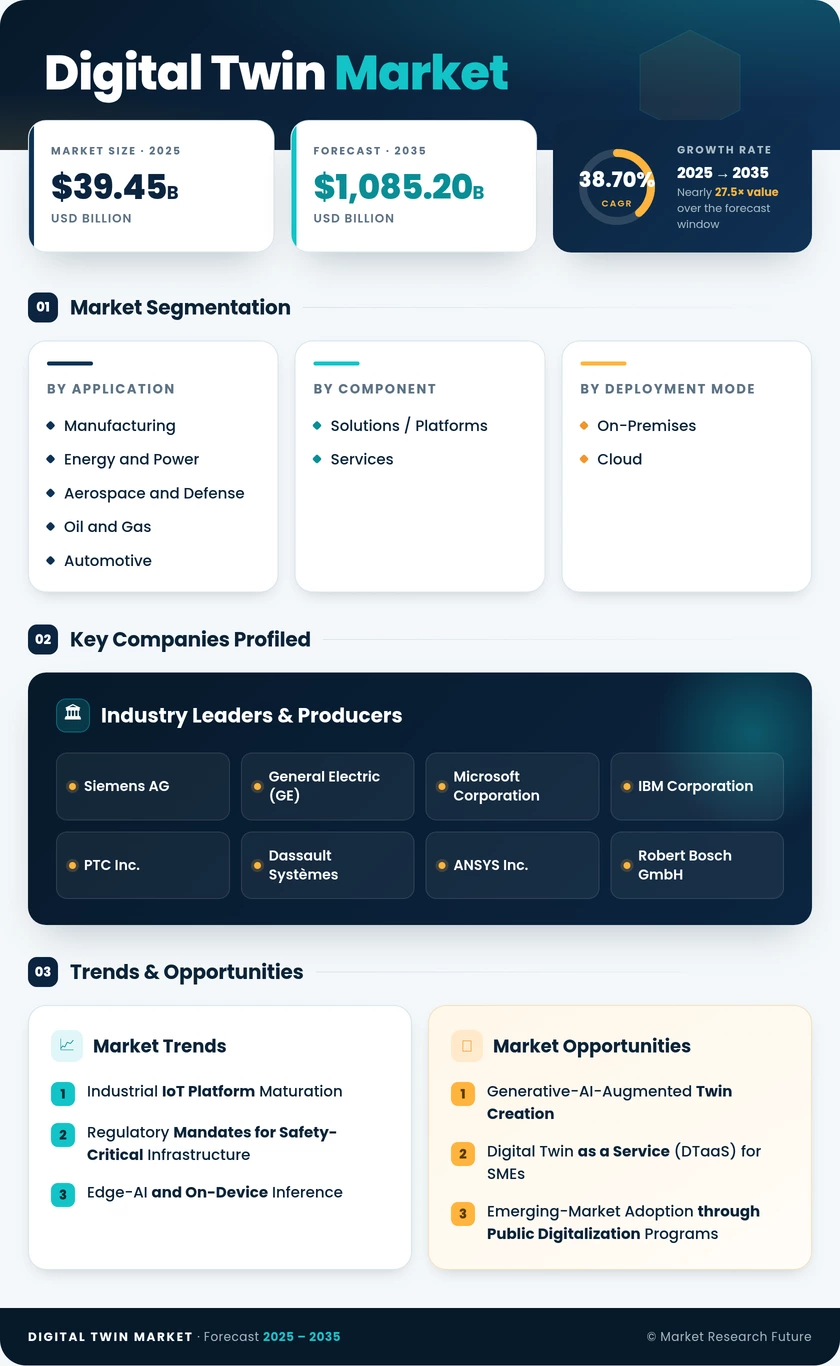
Segmentation Quick Reference

Dimension Sub-Segments Dominant Segment Fastest Growing Segment
By Application Manufacturing, Energy and Power, Aerospace and Defense, Oil and Gas, Automotive, Others Manufacturing Oil and Gas
By Component Solutions / Platforms, Services Solutions / Platforms Services
By Deployment Mode On-Premises, Cloud On-Premises Cloud
By Enterprise Size Large Enterprises, Small and Medium Enterprises (SMEs) Large Enterprises SMEs


Market Segmentation Overview

By Application

Sub-Segment Key Trend
Manufacturing Smart-factory deployments driving yield optimization and defect reduction
Energy and Power Grid modernization mandates fueling real-time twin adoption.
Aerospace and Defense Digital-thread procurement embedding twins into product lifecycles
Oil and Gas Offshore asset-integrity programs accelerating predictive-maintenance twins.
Automotive EV platform simulation and virtual crash-testing replacing physical prototyping
Others Healthcare (surgical twins), retail (store-layout optimization), construction (BIM-to-twin)


Manufacturing holds the largest share of the digital twin application landscape, supported by over a decade of smart-factory investment and mature IoT infrastructure. Oil & Gas is emerging as the fastest-growing vertical, driven by harsh-environment asset monitoring and regulatory pressure to reduce flaring and emissions through continuous simulation.

By Component

Sub-Segment Key Trend
Solutions / Platforms Enterprise simulation suites and IoT middleware platforms dominate spending.
Services System-integration consulting and managed-twin-operations contracts are scaling rapidly.


Solutions and platforms account for the majority of current spending as enterprises build foundational twin capabilities. Services are accelerating as organizations recognize the complexity of multi-domain integration and seek external expertise to bridge physics modeling, data engineering, and change management.

By Deployment Mode

Sub-Segment Key Trend
On-Premises Preferred by defense, regulated energy, and data-sovereign industries
Cloud SaaS twin platforms and elastic compute are driving rapid adoption.


On-premises deployment retains the larger installed base due to latency and data-sovereignty requirements in critical sectors. Cloud deployment is the fastest-growing mode as hyperscaler platforms reduce infrastructure costs and enable global-scale scenario simulation.

By Enterprise Size

Sub-Segment Key Trend
Large Enterprises Established IoT estates and dedicated budgets enabling comprehensive twin programs
Small and Medium Enterprises (SMEs) DTaaS subscriptions and no-code builders are lowering the adoption threshold.


Large enterprises dominate current market revenue, but SMEs represent the highest-growth opportunity as digital-twin-as-a-service platforms democratize access through subscription pricing and pre-configured industry templates.