Egg Allergy Market Research Report Information by Age Group (Children and Adults), Diagnosis & Treatment (Diagnosis [Skin Test, Blood Test, Food Challenge and others] and Treatment [Medication and Oral Immunotherapy]), End User (Hospitals and Clinics, Diagnostic Centers, Research Institutes and others) - Forecast till 2035
As per MRFR analysis, the Egg Allergy Market Size was estimated at 1395.48 USD Million in 2024. The Egg Allergy industry is projected to grow from 1507.2 USD Million in 2025 to 2907.78 USD Million by 2035, exhibiting a compound annual growth rate (CAGR) of 6.86% during the forecast period 2025 - 2035.
Key Market Trends & Highlights
The Egg Allergy Market is experiencing a notable shift towards allergen-free products and innovative food solutions.
The demand for allergen-free products is rising, particularly in North America, which remains the largest market for egg allergy solutions.
Innovation in food technology is driving new product development, especially within the food products segment, which is currently the largest.
The Asia-Pacific region is emerging as the fastest-growing market, reflecting a broader shift towards plant-based diets and dairy alternatives.
Increased awareness of food allergies and regulatory support for allergen labeling are key drivers propelling market growth.
Enabled $4.3B Revenue Impact for Fortune 500 and Leading Multinationals
Partnering with 2000+ Global Organizations Each Year
30K+ Citations by Top-Tier Firms in the Industry
Egg Allergy Market Trends
The Egg Allergy Market is currently experiencing notable shifts driven by increasing awareness of food allergies and the rising prevalence of egg allergies among children. This heightened awareness is prompting parents and caregivers to seek alternatives and solutions that cater to the dietary restrictions imposed by such allergies. Consequently, manufacturers are responding by innovating and diversifying their product offerings, which include egg-free substitutes and allergen-free food options. The market landscape is evolving as stakeholders strive to meet the demands of consumers who are increasingly vigilant about food safety and ingredient transparency.
Moreover, the Egg Allergy Market is influenced by advancements in food technology and the growing trend of plant-based diets. As consumers become more health-conscious, there is a discernible shift towards products that not only avoid allergens but also promote overall well-being. This trend is likely to encourage the development of new formulations that appeal to a broader audience, including those without allergies. The market appears poised for growth as it adapts to these changing consumer preferences and the ongoing quest for safe, nutritious food alternatives.
Rising Demand for Allergen-Free Products
There is an increasing consumer demand for products that are free from common allergens, including eggs. This trend is driven by heightened awareness of food allergies and the need for safe dietary options.
Innovation in Food Technology
Advancements in food technology are facilitating the creation of egg substitutes and allergen-free alternatives. This innovation is crucial for meeting the needs of consumers with egg allergies.
Shift Towards Plant-Based Diets
The growing popularity of plant-based diets is influencing the Egg Allergy Market. Consumers are seeking healthier, egg-free options that align with their dietary preferences.
Egg Allergy Market Drivers
Rising Prevalence of Egg Allergy
The increasing incidence of egg allergy, particularly among children, is a primary driver of the Global Egg Allergy Market Industry. Studies indicate that egg allergy affects approximately 1.5 to 2.5% of children globally, with many outgrowing it by adolescence. However, the persistent cases contribute to a growing demand for allergen-free products. As awareness of food allergies rises, parents and caregivers are more vigilant, leading to increased consumption of egg-free alternatives. This trend is expected to propel the market, with projections estimating the market value to reach 1.48 USD Billion in 2024.
Market Segment Insights
By Application: Baked Goods (Largest) vs. Dairy Alternatives (Fastest-Growing)
In the Egg Allergy Market, the application segment is predominantly influenced by food products, including baked goods, dairy alternatives, and nutritional supplements. Baked goods hold the largest share as consumers increasingly seek egg-free options in their diets. This is followed by dairy alternatives, which are gaining significant traction as more individuals adopt plant-based diets, further expanding their market presence within this segment.
Baked Goods (Dominant) vs. Dairy Alternatives (Emerging)
Baked goods, as the dominant application segment, encompass a wide range of products, including cakes, cookies, and breads that are formulated without eggs to cater to consumers with egg allergies. Their established presence in the market makes them a trusted choice among consumers. On the other hand, dairy alternatives represent the emerging segment, gaining momentum as innovative products like egg-free mayonnaise and plant-based egg substitutes enter the market. This segment is driven by the rising trend of veganism and lactose intolerance, leading to increased demand for versatile and allergen-free options.
By End Use: Household (Largest) vs. Food Service (Fastest-Growing)
In the Egg Allergy Market, the distribution of market share among various end use segments reveals that the Household segment dominates significantly. This segment captures a substantial portion of consumers dealing with egg allergies, as families increasingly seek alternatives to traditional egg-based products, emphasizing safety and convenience. Other segments, such as Food Service and Healthcare Facilities, hold noteworthy shares, but the focus remains largely on households where egg substitutes are becoming vital for daily meal preparation.
Meanwhile, food service is emerging as the fastest-growing segment, propelled by rising awareness about food allergies and increased demand for allergen-free dining options. Catering Services and Educational Institutions are also showing steady growth as schools and institutions increasingly adopt egg-free policies to safeguard the health of students. This shift signals a broader trend towards inclusive dining experiences across various end uses in the Egg Allergy Market.
Household (Dominant) vs. Healthcare Facilities (Emerging)
The Household segment represents the dominant force in the Egg Allergy Market, characterized by families seeking egg alternatives to accommodate allergy concerns. This segment thrives on the demand for versatile, safe products that align with health-conscious consumer behavior. In contrast, Healthcare Facilities emerge as a significant segment, focusing on the preparation of allergen-free food for patients. This segment influences market dynamics through institutional catering, thereby promoting safe eating practices within healthcare settings. While the Household segment highlights consumer-driven choices, Healthcare Facilities illustrate an institutional response to the increasing prevalence of food allergies, indicating a trend towards comprehensive allergy management in diverse environments.
By Type of Allergy: IgE-Mediated Allergy (Largest) vs. Non-IgE-Mediated Allergy (Fastest-Growing)
In the Egg Allergy Market, the distribution of market share among the type of allergies highlights IgE-Mediated Allergy as the largest segment, accounting for a significant proportion of the overall cases. This segment is well-defined and impacts many individuals, mainly children, leading to higher identification and diagnosis rates. Conversely, Non-IgE-Mediated Allergy is growing in prominence and represents an emerging area of focus with increasing awareness and detection of symptoms. This segment addresses the needs of patients who may experience delayed allergic reactions, marking a shift in how allergists are approaching egg allergy diagnoses.
IgE-Mediated Allergy (Dominant) vs. Non-IgE-Mediated Allergy (Emerging)
IgE-Mediated Allergy is characterized by immediate allergic reactions triggered by specific proteins in eggs, resulting in symptoms such as hives, swelling, and anaphylaxis. This segment is currently the dominant force in the egg allergy market, supported by a wealth of clinical data highlighting the urgency for diagnosis and treatment. In contrast, Non-IgE-Mediated Allergy, though emerging, is becoming more recognized as it encompasses conditions like food protein-induced enterocolitis syndrome (FPIES). This segment is crucial for understanding delayed type reactions and managing allergenic food intake, thereby driving the demand for tailored dietary solutions and increased research initiatives in the egg allergy sector.
By Age Group: Children (Largest) vs. Infants (Fastest-Growing)
The Egg Allergy Market exhibits a varied distribution of segments across different age groups. Among these, children represent the largest share, reflecting heightened awareness regarding food allergies in younger populations and ensuing dietary adjustments by parents and caregivers. Infants, on the other hand, are emerging as a focal point of concern given their developing immune systems and rising instances of allergy reports. This dynamic in age-specific market share underscores the necessity for tailored products and educational resources.
As consumer awareness grows, growth trends indicate a shift towards preventive approaches, particularly in the case of infants. The rising prevalence of egg allergies in early childhood pushes manufacturers to innovate and introduce allergy-friendly alternatives. Furthermore, increased support from healthcare professionals, coupled with a rising number of awareness campaigns, contributes to the fast-paced growth of segment targeting infants, while the established routines for managing allergies in children solidify their dominant market position.
Children (Dominant) vs. Infants (Emerging)
In the Egg Allergy Market, children stand as the dominant segment, primarily due to established dietary practices that emphasize allergen avoidance, bolstered by widespread education on food allergies. Their familiarity with egg-free products reflects a market that has adapted over time, offering various alternatives ranging from egg substitutes to specialty foods. Simultaneously, the infant segment is emerging rapidly, marked by an increasing focus on early detection and management of food allergies. Products targeting infants are often characterized by mild formulations and are designed to meet the unique nutritional needs of developing children. With parents increasingly vigilant about allergens, the demand for specially formulated infant foods is likely to rise, setting the stage for further innovation and market expansion.
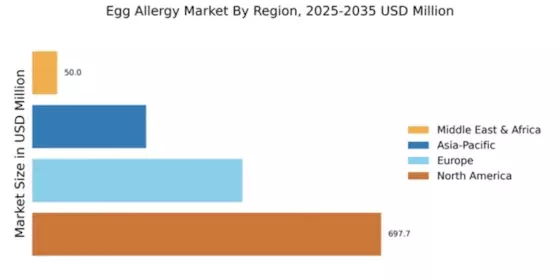
North America is poised to maintain its leadership in the egg allergy market, with a market size of $697.74M in 2025. The region's growth is driven by increasing awareness of food allergies, rising demand for allergen-free products, and stringent food safety regulations. The prevalence of egg allergies among children has prompted manufacturers to innovate and diversify their product offerings, catering to health-conscious consumers seeking safe alternatives.
The competitive landscape in North America is robust, featuring key players such as Kraft Heinz, General Mills, and Unilever. These companies are investing in research and development to create egg-free products that meet consumer demands. The U.S. leads the market, supported by a strong distribution network and consumer preference for allergen-free options. The presence of established brands enhances market penetration, ensuring a steady growth trajectory for the egg allergy segment.
Europe : Emerging Market for Alternatives
Europe is witnessing significant growth in the egg allergy market, with a market size of €420.0M in 2025. The region's growth is fueled by increasing incidences of food allergies, heightened consumer awareness, and regulatory support for allergen labeling. European countries are implementing stringent regulations to ensure food safety, which is driving demand for egg-free alternatives in various food products, including baked goods and dairy substitutes.
Leading countries in this market include Germany, France, and the UK, where consumer preferences are shifting towards healthier, allergen-free options. Key players like Danone and Nestle are actively expanding their product lines to cater to this demand. The competitive landscape is characterized by innovation and collaboration among manufacturers to develop new formulations that meet regulatory standards and consumer expectations. "The European food safety authority emphasizes the importance of clear allergen labeling to protect consumers."
Asia-Pacific : Growing Awareness and Demand
Asia-Pacific is emerging as a significant market for egg allergy solutions, with a market size of $227.74M in 2025. The growth in this region is driven by increasing awareness of food allergies, changing dietary habits, and a rise in the number of health-conscious consumers. Governments are also beginning to implement regulations that promote allergen awareness, which is expected to further boost market growth in the coming years.
Countries like Australia, Japan, and China are leading the charge in adopting allergen-free products. The competitive landscape features both local and international players, including Oatly and Blue Diamond Growers, who are innovating to meet the specific needs of consumers. The market is characterized by a growing trend towards plant-based alternatives, which are gaining traction among consumers looking for healthier options. The presence of established brands is crucial for market penetration and consumer trust.
Middle East and Africa : Niche Market with Potential
The Middle East and Africa region is a niche market for egg allergy solutions, with a market size of $50.0M in 2025. The growth in this region is primarily driven by increasing awareness of food allergies and a gradual shift towards healthier eating habits. Although the market is still developing, there is a growing demand for allergen-free products, particularly among urban populations who are becoming more health-conscious and informed about food safety.
Countries like South Africa and the UAE are beginning to see a rise in the availability of egg-free alternatives. The competitive landscape is still emerging, with local manufacturers and international brands exploring opportunities to introduce innovative products. As consumer awareness increases, the market is expected to grow, driven by the need for safe food options. "The health ministry emphasizes the importance of allergen awareness in food safety regulations."
Key Players and Competitive Insights
The Egg Allergy Market is currently characterized by a dynamic competitive landscape, driven by increasing consumer awareness regarding food allergies and the rising prevalence of egg allergies among children. Key players such as Nestle (CH), Danone (FR), and Kraft Heinz (US) are strategically positioning themselves through innovation and product diversification. Nestle (CH) has focused on developing allergen-free alternatives, while Danone (FR) emphasizes its commitment to sustainability and health-focused products. Kraft Heinz (US) is leveraging its extensive distribution network to enhance market penetration, thereby collectively shaping a competitive environment that prioritizes health-conscious offerings and consumer education.In terms of business tactics, companies are increasingly localizing manufacturing to reduce supply chain vulnerabilities and enhance responsiveness to regional demands. The market structure appears moderately fragmented, with several players vying for market share. However, the collective influence of major companies is significant, as they drive trends in product development and consumer engagement, thereby shaping the overall market dynamics.
In November Nestle (CH) announced the launch of a new line of egg-free protein products aimed at children with allergies. This strategic move not only addresses a growing consumer need but also positions Nestle (CH) as a leader in allergen-free food innovation. The introduction of these products is likely to enhance brand loyalty among health-conscious parents, further solidifying Nestle's market presence.
In October Danone (FR) expanded its partnership with local farmers to source organic ingredients for its allergen-free product range. This initiative underscores Danone's commitment to sustainability and local sourcing, which resonates well with environmentally conscious consumers. By strengthening its supply chain, Danone (FR) is not only ensuring product quality but also enhancing its brand image in the competitive landscape.
In September Kraft Heinz (US) launched a digital marketing campaign aimed at educating consumers about egg allergies and promoting its allergen-free product line. This campaign reflects a broader trend towards digital engagement and consumer education, which is becoming increasingly vital in the food industry. By positioning itself as a knowledgeable resource, Kraft Heinz (US) is likely to foster trust and loyalty among consumers, thereby enhancing its competitive edge.
As of December current trends in the Egg Allergy Market indicate a strong emphasis on digitalization, sustainability, and the integration of AI technologies in product development and marketing strategies. Strategic alliances among key players are shaping the landscape, facilitating knowledge sharing and resource optimization. Looking ahead, competitive differentiation is expected to evolve, with a shift from price-based competition to a focus on innovation, technology, and supply chain reliability. Companies that can effectively leverage these trends will likely secure a more robust position in the market.
Key Companies in the Egg Allergy Market include
Future Outlook
Egg Allergy Market Future Outlook
The Egg Allergy Market is projected to grow at a 6.86% CAGR from 2025 to 2035, driven by increasing awareness, innovative product development, and rising prevalence of allergies.
New opportunities lie in:
Development of allergen-free egg substitutes for food manufacturers.
Expansion of educational programs for healthcare professionals on egg allergies.
Investment in digital platforms for personalized allergy management solutions.
By 2035, the Egg Allergy Market is expected to be robust, reflecting significant growth and innovation.
Market Segmentation
Egg Allergy Market End Use Outlook
Household
Food Service
Healthcare Facilities
Educational Institutions
Catering Services
Egg Allergy Market Application Outlook
Food Products
Baked Goods
Confectionery
Dairy Alternatives
Nutritional Supplements
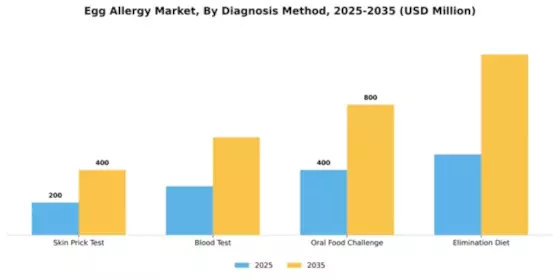
Egg Allergy Market Diagnosis Method Outlook
Skin Prick Test
Blood Test
Oral Food Challenge
Elimination Diet
Egg Allergy Market Type of Egg Allergy Outlook
IgE-Mediated Allergy
Non-IgE-Mediated Allergy
Mixed Allergy
Report Scope
MARKET SIZE 2024
1395.48(USD Million)
MARKET SIZE 2025
1507.2(USD Million)
MARKET SIZE 2035
2907.78(USD Million)
COMPOUND ANNUAL GROWTH RATE (CAGR)
6.86% (2025 - 2035)
REPORT COVERAGE
Revenue Forecast, Competitive Landscape, Growth Factors, and Trends
What is the current valuation of the Egg Allergy Market as of 2024?
The Egg Allergy Market was valued at approximately 1395.48 USD Million in 2024.
What is the projected market size for the Egg Allergy Market by 2035?
The market is projected to reach approximately 2907.78 USD Million by 2035.
What is the expected CAGR for the Egg Allergy Market during the forecast period 2025 - 2035?
The expected CAGR for the Egg Allergy Market during the forecast period 2025 - 2035 is 6.86%.
Which companies are considered key players in the Egg Allergy Market?
Key players in the Egg Allergy Market include Nestle, Danone, Kraft Heinz, Unilever, General Mills, Bunge Limited, Oatly, and Blue Diamond Growers.
What are the main application segments of the Egg Allergy Market?
The main application segments include Food Products, Baked Goods, Dairy Alternatives, and Nutritional Supplements.
How does the Egg Allergy Market segment by end use?
The market segments by end use into Household, Food Service, Healthcare Facilities, and Educational Institutions.
What types of egg allergies are recognized in the market?
The market recognizes IgE-Mediated Allergy, Non-IgE-Mediated Allergy, and Mixed Allergy.
Which age groups are primarily affected by egg allergies?
The primary age groups affected include Infants, Children, Adults, and the Elderly.
What was the valuation of the Dairy Alternatives segment in 2024?
The Dairy Alternatives segment was valued at approximately 350.0 USD Million in 2024.
What is the projected growth for the Baked Goods segment by 2035?
The Baked Goods segment is projected to grow to approximately 600.0 USD Million by 2035.
Author
Author
Vikita Thakur
Senior Research Analyst
She holds an experience of about 5+ years in market research and business consulting projects for sectors such as life sciences, medical devices, and healthcare IT. She possesses a robust background in data analysis, market estimation, competitive intelligence, pipeline analysis market trend identification, and consumer behavior insights. Her expertise lies in technical Sales support, client interaction and project management, designing and implementing market research studies, conducting competitive analysis, and synthesizing complex data into actionable recommendations that drive business growth.
read more
Co-Author
Rahul Gotadki
Research Manager
He holds an experience of about 9+ years in Market Research and Business Consulting, working under the spectrum of Life Sciences and Healthcare domains. Rahul conceptualizes and implements a scalable business strategy and provides strategic leadership to the clients. His expertise lies in market estimation, competitive intelligence, pipeline analysis, customer assessment, etc.
The secondary research process involved comprehensive analysis of regulatory databases, peer-reviewed medical journals, clinical publications, epidemiological studies, and authoritative health organizations. Key sources included the US Food & Drug Administration (FDA), European Medicines Agency (EMA), European Food Safety Authority (EFSA), National Institutes of Health (NIH), National Institute of Allergy and Infectious Diseases (NIAID), Centers for Disease Control and Prevention (CDC), World Health Organization (WHO) Global Health Observatory, American Academy of Allergy, Asthma & Immunology (AAAAI), European Academy of Allergy and Clinical Immunology (EAACI), Food Allergy Research & Education (FARE), National Center for Biotechnology Information (NCBI/PubMed), CDC National Center for Health Statistics, EU Eurostat Health Database, Food Safety and Inspection Service (FSIS), National Institute for Health and Care Excellence (NICE), and national health ministry reports from key markets. These sources were used to collect epidemiology statistics, prevalence data by age group, diagnostic protocol standards, treatment guidelines, regulatory frameworks for allergen labeling, clinical safety studies for oral immunotherapy, and competitive landscape analysis for egg-free food products, diagnostic testing kits, and pharmaceutical interventions.
Primary Research
Qualitative and quantitative insights were obtained by interviewing supply-side and demand-side stakeholders during the primary research process. The supply-side sources consist of CEOs, VPs of Product Development, Heads of Allergen-Free Innovation, regulatory affairs heads, and commercial directors from food and beverage manufacturers, diagnostic laboratory equipment manufacturers, oral immunotherapy developers, and egg substitute ingredient suppliers. Board-certified allergists/immunologists, physicians, diagnostic laboratory directors, hospital procurement managers, food service operators, and clinical research coordinators from allergy treatment centers, hospitals, diagnostic chains, and research institutes comprised demand-side sources. Primary research validated market segmentation by allergy type (IgE-mediated vs. Non-IgE-mediated), confirmed oral immunotherapy pipeline timelines, and gathered insights on clinical adoption patterns of diagnostic testing (skin prick vs. blood tests vs. oral food challenges), pricing strategies for epinephrine auto-injectors and antihistamines, and procurement dynamics for allergen-free food products in institutional settings.
Primary Respondent Breakdown:
• By Designation: C-level Primaries (32%), Director Level (31%), Others (37%)
• By Region: North America (38%), Europe (25%), Asia-Pacific (28%), Rest of World (9%)
Market Size Estimation
Global market valuation was derived through revenue mapping, procedure volume analysis, and consumption pattern assessment. The methodology included:
• Identification of 50+ key manufacturers and solution providers across North America, Europe, Asia-Pacific, Latin America, and Middle East & Africa
• Analysis of reported and modeled annual revenues specific to egg allergy portfolios including diagnostic services, therapeutics, and allergen-free food products
• Coverage of manufacturers and service providers representing 72-78% of global market share in 2024
• Extrapolation using bottom-up (patient volume × treatment cost by country/region, procedure volume × ASP by diagnostic category, and household consumption × retail pricing by food category) and top-down (manufacturer revenue validation and service provider revenue analysis) approaches to derive segment-specific valuations for IgE-mediated vs. Non-IgE-mediated allergy treatments, pediatric vs. adult patient populations, and institutional vs. household end-use consumption
“This is really good guys. Excellent work on a tight deadline. I will continue to use you going forward and recommend you to others. Nice job”
Noah MalgeriCo-Founder
“Thanks. It’s been a pleasure working with you, please use me as reference with any other Intel employees.”
Joseph AguayoSales Operations & Pricing Manager
“Thanks for sending the report it gives us a good global view of the Betaïne market.”
Peter Groot koerkampAccount and Business Manager
“Thank you, this will be very helpful for OQS.”
La Terria DoddProgram Support Specialist
“We found the report very insightful! we found your research firm very helpful. I'm sending this email to secure our future business.”
Younghwan ChoiSenior Retail Manager
“I am very pleased with how market segments have been defined in a relevant way for my purposes (such as "Portable Freezers & refrigerators" and "last-mile").
In general the report is well structured. Thanks very much for your efforts.”
Mark IrwinManagement Consultant
“I have been reading the first document or the study, ,the Global HVAC and FP market report 2021 till 2026. Must say, good info! I have not gone in depth at all parts, but got a good indication of the data inside!”
Rob KooikerGroup Product Manager HVAC & Fire Protection GMA
“We got the report in time, we really thank you for your support in this process. I also thank to all of your team as they did a great job.”
Akif MorogluStrategy & Business Development Director
“The Automotive 48V ECU Components Procurement Intelligence Study” was a complex project, but the Market Research Future (MRFR) team handled it with quality, agility, and customer-centricity. They delivered all requested data on time and within the agreed scope. The team, including Shubhendra Anand and Rahul Gotadki, was always readily available to clarify questions and swiftly implement necessary adjustments, driving the project to a successful conclusion within a very demanding timeframe.
I would also like to specifically commend Akshay Agarwal for his responsiveness and support at every stage—from our initial inquiry on May 6th through to final delivery on June 18th. His dedication made the entire process seamless.”
Guilherme Gomes MartinsProduct Management Director