Request Free Sample ×

Kindly complete the form below to receive a free sample of this Report

* Please use a valid business email

Leading companies partner with us for data-driven Insights

clients tt-cursor
Hero Background

Emotion Analytics Market

ID: MRFR/ICT/3887-HCR
100 Pages
Ankit Gupta
Last Updated: May 25, 2026
Emotion Analytics Market Size, Share and Trends Analysis Report By Application (Voice Analysis, Facial Expression Recognition, Text Analysis, Psychographic Analysis), By Deployment Type (On-Premises, Cloud-Based), By End Use (Retail, Healthcare, Automotive, Media Entertainment, Education), By Technology (Machine Learning, Deep Learning, Natural Language Processing) and By Regional (North America, Europe, South America, Asia Pacific, Middle East and Africa) - Forecast to 2035
Download PDF ×

We do not share your information with anyone. However, we may send you emails based on your report interest from time to time. You may contact us at any time to opt-out.

  1. 1 Market Overview |
    1. 1.1 Study Assumptions & Market Definition |
    2. 1.2 Scope of the Study |
    3. 1.3 Research Methodology
  2. 2 Market Summary & Key Takeaways
  3. 3 Market Dynamics |
    1. 3.1 Market Drivers Analysis | |
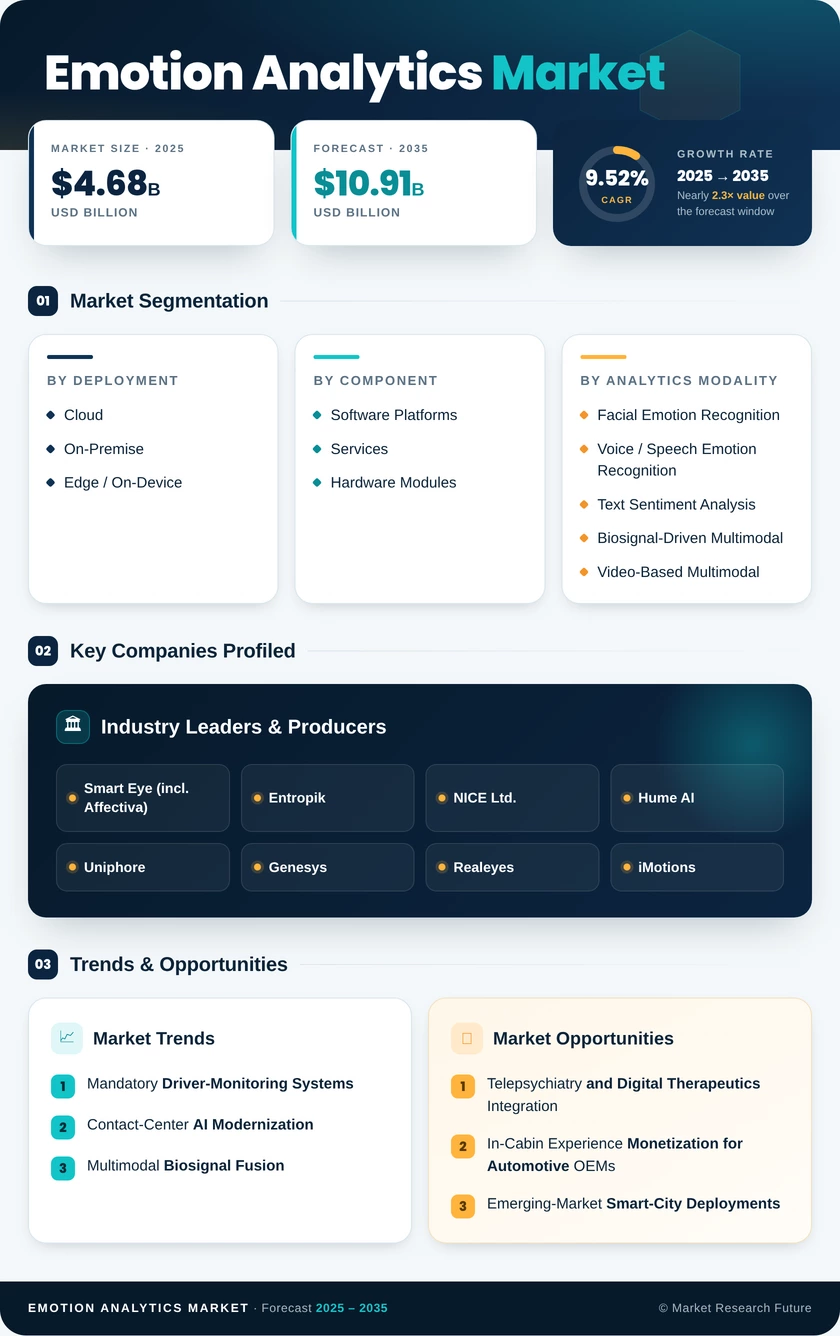
      1. 3.1.1 Mandatory Driver-Monitoring Systems (DMS) in Automotive | |
      2. 3.1.2 Contact-Center AI Modernization | |
      3. 3.1.3 Multimodal Biosignal Fusion Platforms | |
      4. 3.1.4 Privacy-Preserving Federated Learning Adoption | |
      5. 3.1.5 Telepsychiatry and Remote Patient Monitoring Reimbursement | |
      6. 3.1.6 Smart-City and Public Safety Deployments | |
      7. 3.1.7 Edge-AI Silicon Cost Reduction |
    2. 3.2 Market Restraints Analysis | |
      1. 3.2.1 Biometric Consent and Regulatory Fragmentation | |
      2. 3.2.2 Accuracy Degradation Across Demographics | |
      3. 3.2.3 Data Labeling Cost and Subjectivity | |
      4. 3.2.4 Consumer Privacy Backlash and Opt-Out Trends | |
      5. 3.2.5 Integration Complexity with Legacy CRM/ERP Stacks |
    3. 3.3 Market Opportunity Analysis | |
      1. 3.3.1 Telepsychiatry and Digital Therapeutics Integration | |
      2. 3.3.2 In-Cabin Experience Monetization for Automotive OEMs | |
      3. 3.3.3 Emerging-Market Smart-City Deployments | |
      4. 3.3.4 Emotion-as-a-Service API Monetization | |
      5. 3.3.5 Wearable Biosignal Integration |
    4. 3.4 Industry Value Chain Analysis |
    5. 3.5 Porter's Five Forces Analysis
  4. 4 Global Emotion Analytics Market Size & Forecast (2021–2035) |
    1. 4.1 Historical Market Size (2021–2025) |
    2. 4.2 Current & Forecast Market Size (2026–2035) |
    3. 4.3 Market Size by Revenue (USD Billion) |
    4. 4.4 Year-over-Year Growth Analysis
  5. 5 Segmentation Analysis |
    1. 5.1 By Deployment | |
      1. 5.1.1 Cloud | |
      2. 5.1.2 On-Premise | |
      3. 5.1.3 Edge / On-Device |
    2. 5.2 By Component | |
      1. 5.2.1 Software Platforms | |
      2. 5.2.2 Services | |
      3. 5.2.3 Hardware Modules |
    3. 5.3 By Analytics Modality | |
      1. 5.3.1 Facial Emotion Recognition | |
      2. 5.3.2 Voice / Speech Emotion Recognition | |
      3. 5.3.3 Text Sentiment Analysis | |
      4. 5.3.4 Biosignal-Driven Multimodal | |
      5. 5.3.5 Video-Based Multimodal |
    4. 5.4 By Application | |
      1. 5.4.1 Customer Service & Contact Centers | |
      2. 5.4.2 Product & Market Research | |
      3. 5.4.3 Healthcare & Well-Being | |
      4. 5.4.4 Automotive & Transportation | |
      5. 5.4.5 Education & E-Learning | |
      6. 5.4.6 Gaming and Entertainment | |
      7. 5.4.7 Security and Public Safety
  6. 6 Regional Analysis |
    1. 6.1 North America | |
      1. 6.1.1 United States | |
      2. 6.1.2 Canada | |
      3. 6.1.3 Mexico |
    2. 6.2 Europe | |
      1. 6.2.1 Germany | |
      2. 6.2.2 United Kingdom | |
      3. 6.2.3 France | |
      4. 6.2.4 Italy | |
      5. 6.2.5 Spain | |
      6. 6.2.6 Nordic Countries | |
      7. 6.2.7 Russia | |
      8. 6.2.8 Rest of Europe |
    3. 6.3 Asia-Pacific | |
      1. 6.3.1 China | |
      2. 6.3.2 India | |
      3. 6.3.3 Japan | |
      4. 6.3.4 South Korea | |
      5. 6.3.5 ASEAN | |
      6. 6.3.6 Rest of Asia-Pacific |
    4. 6.4 South America | |
      1. 6.4.1 Brazil | |
      2. 6.4.2 Argentina | |
      3. 6.4.3 Rest of South America |
    5. 6.5 Middle East & Africa | |
      1. 6.5.1 Saudi Arabia | |
      2. 6.5.2 UAE | |
      3. 6.5.3 South Africa | |
      4. 6.5.4 Egypt | |
      5. 6.5.5 Rest of MEA
  7. 7 Competitive Landscape |
    1. 7.1 Market Share Analysis (2025) |
    2. 7.2 Competitive Benchmarking Matrix |
    3. 7.3 Company Profiles | |
      1. 7.3.1 Smart Eye (incl. Affectiva) | |
      2. 7.3.2 Entropik | |
      3. 7.3.3 NICE Ltd. | |
      4. 7.3.4 Hume AI | |
      5. 7.3.5 Uniphore | |
      6. 7.3.6 Genesys | |
      7. 7.3.7 Realeyes | |
      8. 7.3.8 iMotions | |
      9. 7.3.9 Cogito (Sprinklr AI) | |
      10. 7.3.10 Noldus Information Technology
  8. 8 Future Outlook & Strategic Recommendations (2026–2035) |
    1. 8.1 Generative AI and Emotion-Aware Conversational Agents |
    2. 8.2 Edge-AI Silicon Economics |
    3. 8.3 Regulatory Convergence and Global Standards |
    4. 8.4 Wellness Economy and Employee Experience Platforms
  9. 9 Recent Developments & News
  10. 10 Frequently Asked Questions (FAQs)
  11. 11 Report Scope & Methodology |
    1. 11.1 Study Period & Base Year |
    2. 11.2 Data Sources & Citations |
    3. 11.3 Abbreviations
  12. 12 LIST OF TABLES |
  13. TABLE 1 Global Emotion Analytics Market Size & Forecast, by Revenue (USD Billion), 2021–2035 |
  14. TABLE 2 Global Emotion Analytics Market — Year-over-Year Growth Analysis, 2021–2035 |
  15. TABLE 3 Driver Impact Analysis — Emotion Analytics Market, 2026–2035 |
  16. TABLE 4 Restraint Impact Analysis — Emotion Analytics Market, 2026–2035 |
  17. TABLE 5 Regional Market Share Summary — Emotion Analytics Market, 2025 |
  18. TABLE 6 North America Emotion Analytics Market Size, by Country, 2021–2035 (USD Billion) |
  19. TABLE 7 Europe Emotion Analytics Market Size, by Country, 2021–2035 (USD Billion) |
  20. TABLE 8 Asia-Pacific Emotion Analytics Market Size, by Country, 2021–2035 (USD Billion) |
  21. TABLE 9 South America Emotion Analytics Market Size, by Country, 2021–2035 (USD Billion) |
  22. TABLE 10 Middle East & Africa Emotion Analytics Market Size, by Country, 2021–2035 (USD Billion) |
  23. TABLE 11 Emotion Analytics Market Size, by Deployment, 2021–2035 (USD Billion) |
  24. TABLE 12 Emotion Analytics Market Size, by Component, 2021–2035 (USD Billion) |
  25. TABLE 13 Emotion Analytics Market Size, by Analytics Modality, 2021–2035 (USD Billion) |
  26. TABLE 14 Emotion Analytics Market Size, by Application, 2021–2035 (USD Billion) |
  27. TABLE 15 Competitive Benchmarking Matrix — Emotion Analytics Market, 2025 |
  28. TABLE 16 Company Profiles — Key Players, Emotion Analytics Market |
  29. TABLE 17 Recent Developments & Strategic Announcements, 2023–2025 |
  30. TABLE 18 Report Scope & Methodology Summary |
  31. TABLE 19 Detailed Sources and Citations
  32. 13 LIST OF FIGURES |
  33. FIGURE 1 Emotion Analytics Market Dynamics — Drivers, Restraints, and Opportunities |
  34. FIGURE 2 Industry Value Chain Analysis — Emotion Analytics Market |
  35. FIGURE 3 Porter's Five Forces Analysis — Emotion Analytics Market |
  36. FIGURE 4 Global Emotion Analytics Market Size Trend (USD Billion), 2021–2035 |
  37. FIGURE 5 Emotion Analytics Market Share, by Deployment, 2025 |
  38. FIGURE 6 Emotion Analytics Market Share, by Component, 2025 |
  39. FIGURE 7 Emotion Analytics Market Share, by Analytics Modality, 2025 |
  40. FIGURE 8 Emotion Analytics Market Share, by Application, 2025 |
  41. FIGURE 9 Emotion Analytics Market Share, by Region, 2025 |
  42. FIGURE 10 North America Emotion Analytics Market — Country Share, 2025 |
  43. FIGURE 11 Europe Emotion Analytics Market — Country Share, 2025 |
  44. FIGURE 12 Asia-Pacific Emotion Analytics Market — Country Share, 2025 |
  45. FIGURE 13 South America Emotion Analytics Market — Country Share, 2025 |
  46. FIGURE 14 Middle East & Africa Emotion Analytics Market — Country Share, 2025 |
  47. FIGURE 15 Competitive Landscape — Market Share Analysis, 2025

Segmentation Quick Reference

Dimension Sub-Segments Dominant Segment Fastest Growing Segment
Deployment Cloud, On-Premise, Edge / On-Device Cloud (58.2% share, 2025) Edge / On-Device (10.78% CAGR)
Component Software Platforms, Services, Hardware Modules Software Platforms (USD 2.16B, 2025) Hardware Modules (10.05% CAGR)
Analytics Modality Facial Emotion Recognition, Voice/Speech, Text Sentiment, Biosignal-Driven Multimodal, Video-Based Multimodal Facial Emotion Recognition (41.5% share, 2025) Biosignal-Driven Multimodal (11.68% CAGR)
Application Customer Service & Contact Centers, Product & Market Research, Healthcare & Well-Being, Automotive & Transportation, Education & E-Learning Customer Service & Contact Centers (59.1% share, 2025) Healthcare & Well-Being (9.69% CAGR)
Geography North America, Europe, Asia-Pacific, South America, Middle East & Africa North America (39.1% share, 2025) Asia-Pacific (12.38% CAGR)


Market Segmentation Overview

By Deployment

Sub-Segment Key Trend
Cloud SaaS-first CCaaS migration driving dominant adoption; continuous model updates as differentiator
On-Premise Data sovereignty requirements in banking, defense, and healthcare are sustaining demand
Edge / On-Device Automotive DMS mandates and latency-critical clinical use cases are accelerating NPU adoption


Cloud remains the default deployment for the Emotion Analytics Market, but the edge segment is closing the gap as automotive safety regulations and real-time clinical monitoring impose strict latency ceilings that cloud round-trips cannot satisfy.

By Component

Sub-Segment Key Trend
Software Platforms Omnichannel emotion analytics suites integrating facial, voice, and text modalities
Services System integration and managed emotion analytics services for complex enterprise deployments
Hardware Modules Dedicated emotion inference NPUs embedded in automotive and IoT edge SoCs


Software platforms capture the largest revenue share, but hardware modules are experiencing the fastest growth as semiconductor vendors integrate emotion-specific processing cores at the silicon level.

By Analytics Modality

Sub-Segment Key Trend
Facial Emotion Recognition Mature modality leveraging ubiquitous camera infrastructure and action-unit coding
Voice / Speech Emotion Recognition Deep integration with contact-center platforms for real-time agent coaching
Text Sentiment Analysis NLP-driven expansion into social media monitoring and CX feedback loops
Biosignal-Driven Multimodal Fusion of galvanic skin response, HRV, and EEG with visual/acoustic data
Video-Based Multimodal Combined facial and body-language analysis for retail and education settings


Multimodal approaches that combine three or more input channels are redefining accuracy benchmarks, with biosignal-driven fusion systems leading performance gains in clinical and automotive validation studies.

By Application

Sub-Segment Key Trend
Customer Service & Contact Centers Real-time emotion scoring for agent coaching, predictive routing, and churn prevention
Product & Market Research Neuromarketing and ad pre-testing using implicit emotional response measurement
Healthcare & Well-Being Telepsychiatry affects monitoring, digital therapeutics, and remote patient engagement
Automotive & Transportation Driver monitoring, in-cabin personalization, occupant safety alerting
Education & E-Learning Engagement scoring, adaptive content delivery, student wellbeing tracking


Contact centers remain the revenue engine, but healthcare and automotive applications represent the highest-growth frontiers as regulatory mandates and reimbursement reforms create new procurement pathways.