×
Request Free Sample ×

Kindly complete the form below to receive a free sample of this Report

* Please use a valid business email

Leading companies partner with us for data-driven Insights

clients tt-cursor
Hero Background

Europe Centralised Workstations Market

ID: MRFR/ICT/57502-HCR
200 Pages
Garvit Vyas
October 2025

Europe Centralized Workstations Market Research Report: By Type (1-to-1 Workstations, 1-to-Many Workstations), By Operating System (Windows Centralized Workstations, Linux Centralized Workstations, Unix Centralized Workstations), By Enterprise Size (Large Enterprise, Small and Medium-Sized Enterprise), By Application (Healthcare, Education, Banking and Finance, Manufacturing, Media & Entertainment, Engineering & Design) andBy Regional (Germany, UK, France, Russia, Italy, Spain, Rest of Europe)- Forecast to 2035

Share:
Download PDF ×

We do not share your information with anyone. However, we may send you emails based on your report interest from time to time. You may contact us at any time to opt-out.

Europe Centralised Workstations Market Infographic
Purchase Options

Europe Centralised Workstations Market Summary

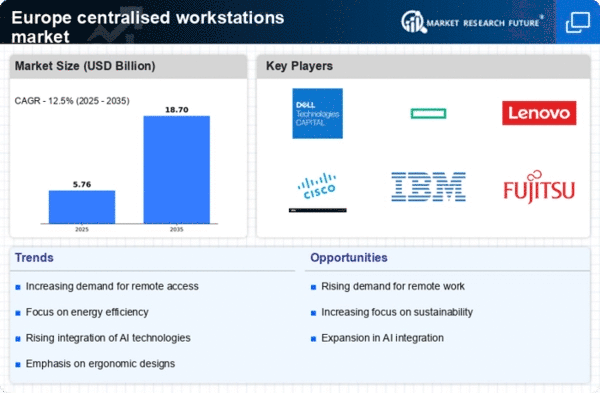
As per MRFR analysis, the Europe centralised workstations market size was estimated at 5.12 USD Billion in 2024. The Europe centralised workstations market is projected to grow from 5.76 USD Billion in 2025 to 18.7 USD Billion by 2035, exhibiting a compound annual growth rate (CAGR) of 12.5% during the forecast period 2025 - 2035.

Key Market Trends & Highlights

The Europe centralised workstations market is experiencing a robust shift towards remote work solutions and energy efficiency.

  • Germany remains the largest market for centralised workstations, driven by its strong industrial base and technological advancements.
  • The UK is emerging as the fastest-growing region, reflecting a rising demand for innovative collaboration tools and remote work capabilities.
  • There is a notable focus on integrating advanced security features to address growing concerns over data protection and regulatory compliance.
  • Key market drivers include the rising need for enhanced collaboration tools and a shift towards cloud-based solutions, which are reshaping the landscape of centralised workstations.

Market Size & Forecast

2024 Market Size 5.12 (USD Billion)
2035 Market Size 18.7 (USD Billion)
CAGR (2025 - 2035) 12.5%

Major Players

Dell Technologies (US), Hewlett Packard Enterprise (US), Lenovo (CN), Cisco Systems (US), IBM (US), Fujitsu (JP), Oracle (US), Supermicro (US)

Europe Centralised Workstations Market Trends

The centralised workstations market is currently experiencing a notable transformation, driven by advancements in technology and evolving workplace dynamics. Organizations are increasingly adopting centralized systems to enhance efficiency and streamline operations. This shift appears to be influenced by the growing demand for remote access and collaboration tools, which facilitate seamless communication among teams. Furthermore, the integration of cloud computing and virtualization technologies is reshaping how businesses deploy and manage their workstations. As a result, companies are likely to invest in robust infrastructure to support these centralized solutions, ensuring that they remain competitive in a rapidly changing environment. In addition, the emphasis on sustainability and energy efficiency is becoming more pronounced within the centralised workstations market. Organizations are recognizing the importance of reducing their carbon footprint and are seeking solutions that align with their environmental goals. This trend suggests a potential shift towards energy-efficient hardware and software solutions that not only optimize performance but also contribute to a greener future. Overall, the centralised workstations market is poised for growth, driven by technological advancements and a commitment to sustainability.

Increased Demand for Remote Work Solutions

The centralised workstations market is witnessing a surge in demand for solutions that support remote work. Organizations are increasingly investing in technologies that enable employees to access centralized systems from various locations, enhancing flexibility and productivity.

Focus on Energy Efficiency

There is a growing emphasis on energy-efficient solutions within the centralised workstations market. Companies are seeking to reduce operational costs and environmental impact by adopting hardware and software that consume less energy.

Integration of Advanced Security Features

As cyber threats continue to evolve, the centralised workstations market is seeing a trend towards the integration of advanced security measures. Organizations are prioritizing solutions that offer robust protection for sensitive data and ensure compliance with regulations.

Europe Centralised Workstations Market Drivers

Focus on Regulatory Compliance

In the context of the centralised workstations market, the emphasis on regulatory compliance is becoming increasingly critical for organizations operating in Europe. With stringent data protection regulations such as the General Data Protection Regulation (GDPR), businesses are compelled to adopt solutions that ensure compliance. Centralised workstations provide a controlled environment where data security measures can be effectively implemented, thereby reducing the risk of non-compliance. In 2025, it is estimated that 40% of companies will prioritize compliance-related investments, which will likely drive the demand for centralised workstations that offer robust security features. This focus on regulatory adherence not only protects organizations from potential fines but also enhances their reputation among clients and stakeholders.

Growing Emphasis on Cost Efficiency

Cost efficiency remains a pivotal driver in the centralised workstations market, particularly as organizations seek to optimize their operational expenditures. In 2025, it is projected that businesses will allocate approximately 20% of their IT budgets towards solutions that enhance cost-effectiveness. Centralised workstations can significantly reduce costs associated with hardware maintenance, software licensing, and energy consumption. By consolidating resources and centralizing management, organizations can achieve substantial savings while maintaining high performance levels. This focus on cost efficiency is likely to encourage more enterprises to invest in centralised workstations, as they seek to balance performance with budgetary constraints. Consequently, the centralised workstations market is expected to thrive as companies prioritize financial prudence.

Shift Towards Cloud-Based Solutions

The centralised workstations market is witnessing a significant shift towards cloud-based solutions, driven by the increasing need for flexibility and scalability in IT infrastructure. Organizations in Europe are increasingly migrating their operations to the cloud, which allows for easier access to applications and data from any location. This transition is supported by a 25% growth in cloud service adoption among enterprises in 2025. Centralised workstations equipped with cloud capabilities enable businesses to reduce hardware costs and improve data management efficiency. Furthermore, the ability to scale resources according to demand enhances operational agility, making cloud-integrated workstations an attractive option for many organizations. As a result, the centralised workstations market is likely to expand as more companies embrace cloud technologies.

Advancements in Technology and Innovation

The centralised workstations market is being propelled by rapid advancements in technology and innovation. As new technologies emerge, such as artificial intelligence and machine learning, organizations are increasingly looking to integrate these capabilities into their workstations. In 2025, it is anticipated that 35% of companies will invest in innovative technologies to enhance their operational efficiency. Centralised workstations that incorporate cutting-edge technologies can provide businesses with improved data analytics, automation, and enhanced user experiences. This trend not only boosts productivity but also positions organizations to remain competitive in a fast-evolving market. As a result, the centralised workstations market is likely to benefit from the continuous pursuit of technological advancements.

Rising Need for Enhanced Collaboration Tools

The centralised workstations market in Europe is experiencing a notable surge in demand for enhanced collaboration tools. As organizations increasingly adopt hybrid work models, the necessity for seamless communication and collaboration among remote and on-site employees becomes paramount. This trend is reflected in a reported 30% increase in investments towards collaborative technologies in 2025. Centralised workstations facilitate this by providing a unified platform where teams can interact, share resources, and manage projects efficiently. The integration of advanced software solutions within these workstations is likely to further drive their adoption, as businesses seek to improve productivity and streamline workflows. Consequently, the centralised workstations market is poised for growth as companies prioritize tools that foster teamwork and connectivity.


Market Segment Insights

By Type: 1-to-1 Workstations (Largest) vs. 1-to-Many Workstations (Fastest-Growing)

In the Europe centralised workstations market, the segment distribution reveals that 1-to-1 workstations represent the largest share, appealing to organizations that prioritize individual performance and customization. Conversely, 1-to-many workstations, while smaller in market share, are rapidly gaining traction as companies seek to optimize resource allocations and enhance collaborative environments through shared working spaces. Growth trends indicate a shift in corporate strategies, with an increasing preference for 1-to-many workstations driven by the rise in remote and hybrid working models. The flexibility and cost-effectiveness of these setups are attracting businesses aiming to balance collaboration and productivity, leading to their marked increase in adoption within the market.

1-to-1 Workstations (Dominant) vs. 1-to-Many Workstations (Emerging)

1-to-1 workstations are characterized by their focus on providing dedicated computing resources to individual users, making them the go-to choice for sectors requiring high performance and specialized software. Their dominance in the market is due to the enhanced productivity and satisfaction levels they offer, particularly in industries where precision and customization are critical. On the other hand, 1-to-many workstations, which allow multiple users to work within a shared environment, are emerging as a popular alternative, especially among startups and companies embracing flexible workspaces. This segment is characterized by its emphasis on collaboration and cost savings, making it an attractive option for organizations looking to adapt to evolving work dynamics.

By Operating System: Windows Centralized Workstations (Largest) vs. Linux Centralized Workstations (Fastest-Growing)

The operating system segment of the centralized workstation market is predominantly driven by Windows Centralized Workstations, which holds the largest market share, illustrating its robust presence and dominance in various business environments. In contrast, Linux Centralized Workstations, while smaller in share, are rapidly gaining traction due to their open-source nature and the increasing demand for customizable and secure solutions. This shift reflects a diversification of preferences among organizations seeking to optimize their IT infrastructure. Growth trends within the segment highlight the significant uptake of Linux Centralized Workstations, projected as the fastest-growing category. This growth is fueled by a rising interest in cost-effective and high-security alternatives, particularly in sectors focusing on innovation. The enhanced performance and flexibility of Linux systems are appealing to many businesses, enabling them to streamline operations while maximizing resource efficiency.

Windows (Dominant) vs. Linux (Emerging)

Windows Centralized Workstations represent the backbone of centralized network management, effectively catering to enterprise environments with extensive support and compatibility across numerous applications. Its widespread adoption is attributed to sturdy performance, user-friendly interfaces, and comprehensive security features that align with corporate compliance needs. Meanwhile, Linux Centralized Workstations are emerging as a compelling alternative, especially among tech-savvy organizations. They offer unparalleled customization, a strong emphasis on security, and the capability to run on a variety of hardware configurations, thus appealing to both startups and established firms looking to innovate while maintaining control over their operational costs.

By Enterprise Size: Large Enterprises (Largest) vs. Small and Medium-Sized Enterprise (SME) (Fastest-Growing)

In the Europe centralised workstations market, large enterprises hold a significant share due to their substantial IT infrastructure and investments in advanced technologies. These organizations leverage centralized workstations to enhance productivity, streamline operations, and improve collaboration across departments. Conversely, small and medium-sized enterprises (SMEs) represent the fastest-growing segment, driven by increasing digital transformation initiatives and the need for cost-effective solutions that boost operational efficiency. The growth trends for this segment indicate a marked shift as SMEs seek to capitalize on technological advancements without the complexities associated with large-scale deployments. Factors such as lower initial investment costs, scalability, and flexibility offered by centralized workstations make them an attractive option for SMEs. Additionally, increasing remote work arrangements and the demand for seamless connectivity further fuel this growth trend within the SME sector.

Large Enterprises (Dominant) vs. Small and Medium-Sized Enterprise (SME) (Emerging)

Large enterprises dominate the Europe centralised workstations market, characterized by their robust financial resources and the ability to invest heavily in top-tier technology solutions. These organizations are often at the forefront of adopting innovative workstation technologies, which enhances their competitive edge. On the other hand, small and medium-sized enterprises (SMEs) are emerging as a critical force in this market, driven by the need for adaptability and efficient resource management. SMEs typically prefer centralized workstations that offer cost benefits and simplified IT management, allowing them to focus on growth and innovation. With increasing digital transformation across various sectors, SMEs are rapidly integrating these solutions to enhance productivity and streamline operations, marking a significant shift in the market dynamics.

By Application: Healthcare (Largest) vs. Education (Fastest-Growing)

In the Europe centralised workstations market, the distribution of market share among different applications showcases a varied landscape. Healthcare holds the largest share, driven by the rising demand for advanced medical technologies and efficient patient management systems. Education follows, leveraging digital solutions to enhance learning environments, although it accounts for a smaller percentage in comparison with healthcare. Growth trends in this segment highlight the rapid evolution in sectors like Education, which is becoming increasingly important due to the shift towards hybrid learning models. The demand for centralised workstations in Banking and Finance is also significant, reflecting the need for secure and efficient data handling. Manufacturing and Media & Entertainment are witnessing stable growth, driven by the integration of advanced technologies that boost productivity and streamline operations.

Healthcare: Dominant vs. Education: Emerging

Healthcare stands as the dominant application in the Europe centralised workstations market, owing to its critical need for reliable and efficient systems to support complex operations and patient care. The integration of high-performance workstations facilitates better data management, telemedicine, and enhanced diagnostic tools. Conversely, Education is marked as an emerging application, with a growing number of institutions adopting modern computing solutions to support digital learning initiatives. This segment is benefiting from the increased investment in educational technology and infrastructure, fostering a collaborative and engaging environment for students and educators alike.

Get more detailed insights about Europe Centralised Workstations Market

Regional Insights

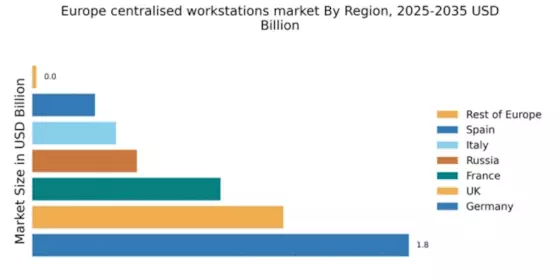
The Europe Centralized Workstations Market is experiencing steady growth across various countries, contributing significantly to the region's economy. Germany leads this competitive landscape, benefiting from its strong industrial base and demand for advanced computational solutions. The UK follows closely, supported by a robust technology sector that emphasizes efficiency and innovation. France also plays a vital role, driven by its commitment to digital transformation in enterprises. Russia is emerging, driven by increased investments in technology and modernization, while Italy is noteworthy for its focus on integrating centralized workstations into the public and private sectors.

Spain, along with the rest of Europe, showcases diversified strategies that cater to local industry needs, promoting cloud-based and virtualized solutions. This diversity in regional demands shapes the Europe Centralized Workstations Market segmentation, impacting decisions related to deployment strategies and hardware utilization. Overall, the market is propelled by trends such as remote working, enhanced data security needs, and evolving cloud services, all of which create opportunities for companies to innovate and expand their services within each market.

Europe Centralised Workstations Market Regional Image

Key Players and Competitive Insights

The centralised workstations market is currently characterized by a dynamic competitive landscape, driven by technological advancements and increasing demand for efficient computing solutions. Key players such as Dell Technologies (US), Hewlett Packard Enterprise (US), and Lenovo (CN) are strategically positioning themselves through innovation and regional expansion. Dell Technologies (US) focuses on enhancing its product offerings with cutting-edge technology, while Hewlett Packard Enterprise (US) emphasizes partnerships to bolster its service capabilities. Lenovo (CN) appears to be concentrating on sustainability initiatives, which may resonate well with environmentally conscious consumers. Collectively, these strategies contribute to a competitive environment that is both robust and evolving.

In terms of business tactics, companies are increasingly localizing manufacturing to mitigate supply chain disruptions and optimize operational efficiency. The market structure is moderately fragmented, with several key players exerting influence over various segments. This fragmentation allows for niche players to thrive, while larger corporations leverage their scale to dominate the market. The collective influence of these key players shapes the competitive dynamics, fostering an environment where innovation and customer-centric solutions are paramount.

In October 2025, Dell Technologies (US) announced a significant investment in AI-driven analytics for its centralised workstations, aiming to enhance performance and user experience. This strategic move underscores the company's commitment to integrating advanced technologies into its product line, potentially setting a new standard for performance in the market. By focusing on AI, Dell Technologies (US) may not only improve operational efficiency but also attract a broader customer base seeking high-performance solutions.

In September 2025, Hewlett Packard Enterprise (US) expanded its partnership with a leading cloud service provider to offer integrated solutions that combine cloud capabilities with centralised workstations. This collaboration is likely to enhance HPE's market position by providing customers with seamless access to cloud resources, thereby addressing the growing demand for hybrid solutions. Such strategic alliances may enable HPE to differentiate itself in a crowded market, appealing to businesses looking for comprehensive IT solutions.

In August 2025, Lenovo (CN) launched a new line of energy-efficient centralised workstations, emphasizing sustainability and reduced carbon footprint. This initiative aligns with global trends towards environmental responsibility and may attract clients prioritizing eco-friendly practices. By positioning itself as a leader in sustainable technology, Lenovo (CN) could enhance its brand reputation and capture market share among environmentally conscious consumers.

As of November 2025, the competitive trends in the centralised workstations market are increasingly defined by digitalization, sustainability, and AI integration. Strategic alliances are playing a crucial role in shaping the landscape, allowing companies to leverage complementary strengths. Looking ahead, competitive differentiation is likely to evolve from traditional price-based competition to a focus on innovation, technology integration, and supply chain reliability. This shift may redefine how companies approach market entry and customer engagement, emphasizing the importance of delivering value through advanced technological solutions.

Key Companies in the Europe Centralised Workstations Market market include

Industry Developments

The Europe Centralized Workstations Market has experienced significant activity in recent months, characterized by advancements in technology and collaboration among key players. Major companies such as Cisco and Oracle are increasingly investing in cloud computing solutions to enhance their product offerings. In September 2023, Supermicro announced a partnership with major European organizations to provide more energy-efficient workstations, aligning with sustainability goals prevalent in the region. Notably, in June 2023, Huawei unveiled a new line of workstations optimized for artificial intelligence workloads, catering to rising demands from tech companies.

Mergers and acquisitions have been prominent, with HP acquiring a software firm to bolster its service capabilities in May 2023, and Lenovo purchasing a European cloud startup in August 2023 to expand its market presence. The market valuation for companies within this sector has steadily increased, driven by a surge in remote working practices and the need for advanced computing solutions.

Historical trends show that demand for centralized workstations in Europe has surged, particularly in the last two years, reflecting shifting work habits and an emphasis on digital transformation across various sectors, specifically highlighted in reports from governmental and industry sources.

Future Outlook

Europe Centralised Workstations Market Future Outlook

The centralised workstations market is projected to grow at a 12.5% CAGR from 2024 to 2035, driven by technological advancements, increased demand for remote work solutions, and enhanced data security needs.

New opportunities lie in:

  • Development of AI-driven resource management tools
  • Integration of advanced cybersecurity features in workstations
  • Expansion of cloud-based workstation services for remote teams

By 2035, the market is expected to achieve substantial growth, reflecting evolving business needs and technological innovations.

Market Segmentation

Europe Centralised Workstations Market Type Outlook

  • 1-to-1 Workstations
  • 1-to-Many Workstations

Europe Centralised Workstations Market Application Outlook

  • Healthcare
  • Education
  • Banking and Finance
  • Manufacturing
  • Media & Entertainment
  • Engineering & Design
  • Others

Europe Centralised Workstations Market Enterprise Size Outlook

  • Large Enterprises
  • Small and Medium-Sized Enterprise (SME)

Europe Centralised Workstations Market Operating System Outlook

  • Windows Centralized Workstations
  • Linux Centralized Workstations
  • Unix Centralized Workstations
  • Others

Report Scope

MARKET SIZE 2024 5.12(USD Billion)
MARKET SIZE 2025 5.76(USD Billion)
MARKET SIZE 2035 18.7(USD Billion)
COMPOUND ANNUAL GROWTH RATE (CAGR) 12.5% (2024 - 2035)
REPORT COVERAGE Revenue Forecast, Competitive Landscape, Growth Factors, and Trends
BASE YEAR 2024
Market Forecast Period 2025 - 2035
Historical Data 2019 - 2024
Market Forecast Units USD Billion
Key Companies Profiled ["Dell Technologies (US)", "Hewlett Packard Enterprise (US)", "Lenovo (CN)", "Cisco Systems (US)", "IBM (US)", "Fujitsu (JP)", "Oracle (US)", "Supermicro (US)"]
Segments Covered Type, Operating System, Enterprise Size, Application
Key Market Opportunities Integration of advanced virtualization technologies enhances efficiency in the centralised workstations market.
Key Market Dynamics Rising demand for centralized workstations driven by technological advancements and evolving enterprise collaboration needs.
Countries Covered Germany, UK, France, Russia, Italy, Spain, Rest of Europe

Leave a Comment

FAQs

What is the expected market size of the Europe Centralized Workstations Market in 2024?

The Europe Centralized Workstations Market is expected to be valued at 5.81 USD Billion in 2024.

What will be the projected market size of the Europe Centralized Workstations Market by 2035?

By 2035, the market is projected to reach a value of 20.93 USD Billion.

What is the compound annual growth rate (CAGR) for the Europe Centralized Workstations Market from 2025 to 2035?

The market is expected to grow at a CAGR of 12.353% from 2025 to 2035.

Which region is expected to have the largest market share in the Europe Centralized Workstations Market?

Germany is projected to have the largest market share, valued at 1.52 USD Billion in 2024.

How is the market segmented by type within the Europe Centralized Workstations Market?

The market is segmented into 1-to-1 Workstations and 1-to-Many Workstations.

What are the expected market values for 1-to-1 Workstations in 2024 and 2035 in Europe?

1-to-1 Workstations are valued at 2.65 USD Billion in 2024, with a projection of 9.53 USD Billion by 2035.

What are the projected figures for 1-to-Many Workstations in 2024 and 2035?

1-to-Many Workstations are expected to be valued at 3.16 USD Billion in 2024 and 11.4 USD Billion by 2035.

Who are some key competitors in the Europe Centralized Workstations Market?

Key competitors in the market include Cisco, Oracle, Supermicro, Huawei, and Apple.

What is the anticipated market growth rate for the UK in the Europe Centralized Workstations Market?

In the UK, the market is expected to grow to 4.88 USD Billion by 2035 from 1.35 USD Billion in 2024.

Are there any emerging trends shaping the Europe Centralized Workstations Market?

Key emerging trends include increased demand for high-performance computing and remote collaboration solutions.

Download Free Sample

Kindly complete the form below to receive a free sample of this Report

Compare Licence

×
Features License Type
Single User Multiuser License Enterprise User
Price $4,950 $5,950 $7,250
Maximum User Access Limit 1 User Upto 10 Users Unrestricted Access Throughout the Organization
Free Customization
Direct Access to Analyst
Deliverable Format
Platform Access
Discount on Next Purchase 10% 15% 15%
Printable Versions