×
Request Free Sample ×

Kindly complete the form below to receive a free sample of this Report

Leading companies partner with us for data-driven Insights

clients tt-cursor
Hero Background

Europe E Learning Market

ID: MRFR/ICT/19992-HCR
128 Pages
Garvit Vyas
October 2025

Europe E-Learning Market Research Report Information By Delivery Mode (Online, LMS, Mobile, and Others), By Learning Mode (Self-Paced and Instructor-Led) By End User (Academic and Corporate) –and Europe Market Forecast Till 2035

Share:
Download PDF ×

We do not share your information with anyone. However, we may send you emails based on your report interest from time to time. You may contact us at any time to opt-out.

Europe E Learning Market  Infographic
Purchase Options

Europe E Learning Market Summary

As per MRFR analysis, the e learning market Size was estimated at 71.9 USD Billion in 2024. The e learning market is projected to grow from 80.53 USD Billion in 2025 to 250.0 USD Billion by 2035, exhibiting a compound annual growth rate (CAGR) of 12.0% during the forecast period 2025 - 2035.

Key Market Trends & Highlights

The Europe e-learning market is experiencing robust growth driven by technological advancements and increasing demand for personalized learning solutions.

  • Germany remains the largest market for e-learning in Europe, showcasing a strong preference for corporate training and development.
  • The UK is identified as the fastest-growing region, with a notable rise in mobile learning solutions among educational institutions.
  • Personalized learning experiences are becoming increasingly prevalent, catering to diverse learner needs across various sectors.
  • Technological advancements in e-learning and government initiatives are key drivers propelling market expansion across Europe.

Market Size & Forecast

2024 Market Size 71.9 (USD Billion)
2035 Market Size 250.0 (USD Billion)

Major Players

Coursera (US), Udemy (US), edX (US), LinkedIn Learning (US), Skillshare (US), Khan Academy (US), Pluralsight (US), FutureLearn (GB), Teachable (US)

Europe E Learning Market Trends

The e learning market is currently experiencing a notable transformation, driven by advancements in technology and changing educational needs. As digital platforms become increasingly integrated into traditional learning environments, there is a growing emphasis on personalized learning experiences. This shift appears to be fostering greater engagement among learners, as they can access tailored content that aligns with their individual learning styles and paces. Furthermore, the rise of mobile learning solutions is facilitating access to educational resources anytime and anywhere, thereby enhancing the overall learning experience. In addition, the demand for upskilling and reskilling in various industries is propelling the e learning market forward. Organizations are recognizing the necessity of continuous education to remain competitive in a rapidly evolving job market. This trend suggests that e learning is not merely a supplementary resource but is becoming an essential component of professional development strategies. As a result, the market is likely to witness increased investment from both educational institutions and corporate entities, aiming to leverage technology for effective learning outcomes.

Personalized Learning Experiences

The e learning market is increasingly focusing on personalized learning, allowing learners to engage with content that suits their individual preferences and needs. This trend is supported by adaptive learning technologies that analyze user performance and adjust the curriculum accordingly, enhancing learner satisfaction and retention.

Mobile Learning Solutions

Mobile learning is gaining traction within the e learning market, as learners seek flexibility in accessing educational materials. The proliferation of smartphones and tablets enables users to engage with content on-the-go, making education more accessible and convenient, which is particularly appealing to busy professionals.

Corporate Training and Development

Organizations are increasingly investing in e learning solutions for employee training and development. This trend reflects a growing recognition of the importance of continuous learning in maintaining a competitive edge. E learning platforms provide scalable and cost-effective training options, allowing companies to upskill their workforce efficiently.

Europe E Learning Market Drivers

Increased Internet Penetration

Increased internet penetration across Europe is a pivotal driver for the e learning market. With over 90% of the population having access to the internet, educational institutions and learners are increasingly turning to online platforms for education. This accessibility facilitates a broader reach for e learning providers, allowing them to cater to diverse audiences. Furthermore, the rise of mobile internet usage, which has grown by 30% in the last two years, enables learners to access educational content anytime and anywhere. This trend is expected to continue, further propelling the e learning market.

Government Initiatives and Funding

Government initiatives play a crucial role in the growth of the e learning market in Europe. Various European governments are investing in digital education strategies, aiming to enhance the quality of education through technology. For example, the European Commission has allocated substantial funding to support digital learning projects, with an estimated budget of €1 billion for the next five years. These initiatives are designed to improve access to e learning resources, particularly in underserved regions, thereby expanding the market. The commitment to digital education is likely to drive innovation and increase participation in the e learning market.

Rising Demand for Lifelong Learning

The e learning market in Europe is witnessing a rising demand for lifelong learning, driven by the need for continuous skill development in a rapidly changing job market. As industries evolve, professionals are seeking flexible learning solutions to upskill or reskill. Data indicates that approximately 70% of European workers are engaged in some form of lifelong learning. This trend is encouraging educational providers to develop more diverse and accessible e learning offerings, catering to various demographics. Consequently, the growth of lifelong learning initiatives is likely to bolster the e learning market significantly.

Shift Towards Flexible Learning Models

The e learning market in Europe is experiencing a notable shift towards flexible learning models, which cater to the diverse needs of learners. Traditional education systems are often rigid, whereas e learning offers customizable schedules and learning paths. This flexibility is particularly appealing to working professionals and students with varying commitments. Recent surveys indicate that 65% of learners prefer online courses due to their adaptability. As educational institutions recognize this preference, they are increasingly adopting hybrid models that combine online and offline learning, thereby enhancing the appeal of the e learning market.

Technological Advancements in E Learning

The e learning market in Europe is experiencing rapid technological advancements that are reshaping educational methodologies. Innovations such as artificial intelligence (AI), virtual reality (VR), and augmented reality (AR) are being integrated into e learning platforms, enhancing user engagement and interactivity. For instance, AI-driven analytics can personalize learning experiences, catering to individual student needs. According to recent data, the adoption of AI in educational technology is projected to grow by 45% by 2027 in Europe. This shift not only improves learning outcomes but also increases the efficiency of educational institutions, making them more competitive in the e learning market.

Market Segment Insights

By Learning Mode: Self-Paced Learning (Largest) vs. Blended Learning (Fastest-Growing)

In the Learning Mode segment, Self-Paced Learning holds the largest market share, driven by the flexibility it offers learners. Asynchronous Learning follows closely, providing opportunities for students to engage with content at their convenience. Meanwhile, Synchronous Learning, while smaller, still plays a vital role in live interactions and real-time feedback, fostering a collaborative learning environment. Blended Learning sits in the middle, combining online and traditional methods to meet diverse learning needs. Looking at growth trends, Blended Learning is emerging as the fastest-growing segment due to increasing demand for hybrid educational solutions. Educational institutions are rapidly adopting innovative technologies to enhance their offerings, catering to diverse learning preferences. The pandemic has accelerated this shift, highlighting the necessity for adaptable learning solutions that combine the strengths of various learning modes, facilitating improved engagement and knowledge retention.

Self-Paced Learning: Dominant vs. Blended Learning: Emerging

Self-Paced Learning appeals to a broad audience due to its convenient format, allowing learners to progress at their own speed without the constraints of a fixed schedule. This mode supports diverse learning styles and is especially favored in corporate training and personal development sectors. In contrast, Blended Learning is gaining momentum as an emerging choice, integrating both online and traditional classroom experiences. This approach not only enhances learner engagement but also allows educators to leverage interactive digital tools alongside face-to-face instruction, thereby appealing to a wider demographic. The synergy of these two modes is paving the way for a more flexible and customized learning experience in the e-learning landscape.

By End User: Corporate (Largest) vs. Individual Learners (Fastest-Growing)

In the End User segment, Corporate users dominate the market with a significant share, driven by the increasing emphasis on employee training and development. Academic Institutions also hold a substantial portion of the market, benefiting from the shift towards digital learning platforms. Government entities contribute to the market share, focusing on upskilling their workforce, while Individual Learners are emerging as a noteworthy segment as accessibility to online courses expands. Growth in this segment is fueled by technological advancements, the rise of remote learning solutions, and the increasing availability of e learning content across various disciplines. Corporates are investing heavily in tailored training programs, whereas Individual Learners are leveraging online platforms for personal development. This transformation indicates a shift towards a more flexible and accessible learning environment for all user types.

Corporate (Dominant) vs. Individual Learners (Emerging)

The Corporate segment is characterized by its focus on large-scale training initiatives that enhance employee competencies, thereby increasing productivity and innovation within organizations. Corporates generally have access to substantial budgets for training and development, making them the dominant force in the market. In contrast, Individual Learners represent an emerging demographic, driven by diverse motivations such as career advancement, skill acquisition, and personal interest. This group has gained traction due to the availability of affordable and varied online courses, indicating a significant shift towards self-directed learning that is reshaping the educational landscape.

By Delivery Method: Web-Based Learning (Largest) vs. Virtual Classrooms (Fastest-Growing)

In the market for e learning, web-based learning holds the largest share, dominating the landscape of delivery methods. This format appeals significantly to users seeking flexibility and accessibility. Mobile learning and interactive learning also contribute meaningfully to market dynamics but have not reached the same level of penetration as web-based solutions. Growth trends reveal that virtual classrooms are emerging as the fastest-growing delivery method, driven by the increasing demand for real-time interaction and collaboration among learners. The pivot toward remote education due to global events has further accelerated this trend. Furthermore, advancements in technology are enhancing the user experience across all platforms, thereby fostering a more engaging learning environment.

Web-Based Learning: Dominant vs. Virtual Classrooms: Emerging

Web-based learning is characterized by its extensive reach and adaptability, making it the dominant delivery method in the e learning landscape. It is well-suited for self-paced learning, allowing users to tailor their educational journeys according to individual needs. Conversely, virtual classrooms represent an emerging delivery method that fosters interactive, real-time learning experiences. They facilitate group discussions, peer interactions, and immediate feedback, appealing particularly to learners who thrive in collaborative settings. Both segments reflect distinct approaches to education, catering to diverse preferences within the market.

By Content Type: Video-Based Content (Largest) vs. Gamified Content (Fastest-Growing)

In the Content Type segment of the Europe e learning market, Video-Based Content holds the largest market share, reflecting its popularity among learners. This segment significantly outperforms others, mainly due to the engaging nature of videos, which facilitate easier understanding of complex topics. Text-Based Content remains a steady option for many, while Assessment and Certification content play a crucial role in formalizing the learning experience. Growth trends indicate that Gamified Content is emerging rapidly, with more educational institutions incorporating game-like elements to increase user motivation and retention. The rise of mobile learning and advancements in technology are key drivers, making this segment highly appealing. Video-Based Content continues to grow but at a slower pace than Gamified Content, indicating shifting preferences in learning methodologies.

Video-Based Content: Dominant vs. Gamified Content: Emerging

Video-Based Content has established itself as a dominant force in the Europe e learning market, primarily due to its ability to captivate and engage learners. This content type is characterized by rich multimedia, which facilitates effective learning experiences. On the other hand, Gamified Content is recognized as an emerging trend, leveraging interactive elements to enhance learning engagement. It incorporates challenges, rewards, and game mechanics to create a more compelling educational experience, appealing particularly to younger audiences. The growing emphasis on user experience positions Gamified Content as a strong competitor, likely to reshape content delivery methods in the years to come.

Get more detailed insights about Europe E Learning Market

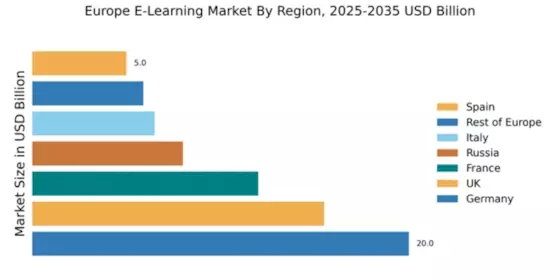
Regional Insights

Germany : Strong Growth Driven by Innovation

Germany holds a commanding 20.0% market share in the European e-learning sector, valued at approximately €3 billion. Key growth drivers include a robust digital infrastructure, increasing demand for upskilling, and government initiatives promoting lifelong learning. The German government has implemented policies to enhance digital education, including funding for educational technology and partnerships with private sectors to improve accessibility and quality of online learning.

UK : Innovation and Flexibility Drive Growth

The UK e-learning market accounts for 15.5% of the European share, valued at around €2.5 billion. Growth is fueled by a strong emphasis on flexible learning solutions and the rise of remote work. The UK government supports digital education through initiatives like the EdTech Strategy, which aims to improve technology integration in schools and universities. This has led to increased investment in e-learning platforms and resources.

France : Cultural Emphasis on Education

France captures 12.0% of the European e-learning market, valued at approximately €1.8 billion. The growth is driven by a cultural emphasis on education and government initiatives like the National Digital Education Plan, which promotes digital literacy. Demand for online courses is rising, particularly in professional development and language learning, reflecting changing consumption patterns among learners.

Russia : Rapid Growth Amidst Challenges

Russia holds an 8.0% share of the European e-learning market, valued at about €1.2 billion. Key growth drivers include a young population eager for online education and increasing internet penetration. However, regulatory challenges and varying quality of content remain issues. The government is investing in digital education initiatives to enhance accessibility and quality across the country.

Italy : Focus on Professional Development

Italy's e-learning market represents 6.5% of the European share, valued at approximately €1 billion. Growth is driven by a focus on professional development and government support for digital education through initiatives like the National Plan for Digital Education. Demand for online courses in sectors like hospitality and technology is increasing, reflecting local industry needs.

Spain : Diverse Learning Needs Addressed

Spain accounts for 5.0% of the European e-learning market, valued at around €800 million. The growth is fueled by diverse learning needs and increasing adoption of online education in both academic and professional settings. The Spanish government has launched initiatives to promote digital skills, enhancing the e-learning landscape and encouraging local startups to innovate in this space.

Rest of Europe : Diverse Markets with Unique Needs

The Rest of Europe holds a 5.9% share of the e-learning market, valued at approximately €900 million. This sub-region includes various countries with unique educational needs and regulatory environments. Growth is driven by increasing internet access and demand for localized content. Local players are emerging, focusing on niche markets and sector-specific applications, enhancing competition and innovation.

Europe E Learning Market  Regional Image

Key Players and Competitive Insights

The e learning market in Europe is characterized by a dynamic competitive landscape, driven by rapid technological advancements and an increasing demand for flexible learning solutions. Major players such as Coursera (US), FutureLearn (GB), and LinkedIn Learning (US) are strategically positioning themselves through innovative offerings and partnerships. Coursera (US) focuses on expanding its course catalog and enhancing user engagement through personalized learning experiences, while FutureLearn (GB) emphasizes collaboration with universities to provide accredited courses. LinkedIn Learning (US) leverages its vast professional network to integrate learning with career development, thereby enhancing its value proposition in the market. Collectively, these strategies contribute to a competitive environment that is increasingly centered around user-centric solutions and institutional partnerships.

Key business tactics within the e learning market include localization of content, strategic partnerships, and the optimization of digital platforms. The market structure appears moderately fragmented, with a mix of established players and emerging startups. This fragmentation allows for diverse offerings, yet the influence of key players remains substantial, as they set trends and standards that smaller entities often follow. The collective actions of these companies shape the market dynamics, fostering an environment where innovation and adaptability are crucial for success.

In October 2025, Coursera (US) announced a partnership with several European universities to co-develop specialized courses aimed at enhancing digital skills among professionals. This strategic move not only broadens Coursera's course offerings but also strengthens its ties with academic institutions, positioning it as a leader in the digital skills training sector. The collaboration is likely to enhance Coursera's credibility and attract a larger user base seeking recognized qualifications.

In September 2025, FutureLearn (GB) launched a new initiative focused on sustainability education, partnering with environmental organizations to create courses that address climate change and sustainable practices. This initiative reflects a growing trend towards integrating social responsibility into educational content, potentially attracting environmentally conscious learners and enhancing FutureLearn's brand image. Such strategic actions may also align with broader societal shifts towards sustainability, positioning FutureLearn favorably in a competitive market.

In August 2025, LinkedIn Learning (US) introduced AI-driven personalized learning paths that adapt to individual user preferences and career goals. This innovation signifies a shift towards more tailored educational experiences, which could enhance user engagement and retention. By leveraging AI technology, LinkedIn Learning (US) not only differentiates itself from competitors but also addresses the increasing demand for personalized learning solutions in the e learning market.

As of November 2025, current competitive trends in the e learning market include a pronounced focus on digitalization, sustainability, and the integration of AI technologies. Strategic alliances are increasingly shaping the landscape, as companies collaborate to enhance their offerings and reach broader audiences. Looking ahead, competitive differentiation is likely to evolve from traditional price-based competition towards a focus on innovation, technological advancements, and the reliability of supply chains. This shift underscores the importance of adaptability and forward-thinking strategies in maintaining a competitive edge in the rapidly changing e learning environment.

Key Companies in the Europe E Learning Market market include

Industry Developments

October 2021: The Integrity 3D-IC platform has been delivered, according to Cadence Design Systems, Inc. Design planning, system analysis, and 3D execution are all integrated into a single, unified cockpit, making it the first high-capacity, complete 3D-IC platform in the industry.

Future Outlook

Europe E Learning Market Future Outlook

The e learning market is projected to grow at a 12.0% CAGR from 2024 to 2035, driven by technological advancements, increasing demand for flexible learning, and the rise of digital content.

New opportunities lie in:

  • Development of AI-driven personalized learning platforms
  • Expansion of corporate training solutions for remote teams
  • Integration of VR and AR technologies in educational content

By 2035, the e learning market is expected to achieve substantial growth and innovation.

Market Segmentation

Europe E Learning Market End User Outlook

  • Corporate
  • Academic Institutions
  • Government
  • Individual Learners

Europe E Learning Market Content Type Outlook

  • Video-Based Content
  • Text-Based Content
  • Gamified Content
  • Assessment and Certification

Europe E Learning Market Learning Mode Outlook

  • Asynchronous Learning
  • Synchronous Learning
  • Blended Learning
  • Self-Paced Learning

Europe E Learning Market Delivery Method Outlook

  • Mobile Learning
  • Web-Based Learning
  • Virtual Classrooms
  • Interactive Learning

Report Scope

MARKET SIZE 202471.9(USD Billion)
MARKET SIZE 202580.53(USD Billion)
MARKET SIZE 2035250.0(USD Billion)
COMPOUND ANNUAL GROWTH RATE (CAGR)12.0% (2024 - 2035)
REPORT COVERAGERevenue Forecast, Competitive Landscape, Growth Factors, and Trends
BASE YEAR2024
Market Forecast Period2025 - 2035
Historical Data2019 - 2024
Market Forecast UnitsUSD Billion
Key Companies Profiled["Coursera (US)", "Udemy (US)", "edX (US)", "LinkedIn Learning (US)", "Skillshare (US)", "Khan Academy (US)", "Pluralsight (US)", "FutureLearn (GB)", "Teachable (US)"]
Segments CoveredLearning Mode, End User, Delivery Method, Content Type
Key Market OpportunitiesIntegration of artificial intelligence enhances personalized learning experiences in the e learning market.

Key Market DynamicsRising demand for personalized learning experiences drives innovation in the e learning market across Europe.
Countries CoveredGermany, UK, France, Russia, Italy, Spain, Rest of Europe

Leave a Comment

FAQs

How much is the E-Learning market?

The Europe E-Learning market size was valued at USD 102.21 Billion in 2024.

What is the growth rate of the E-Learning market?

The market is foreseen to grow at a CAGR of 8.6% during the forecast period, 2025-2034.

Who are the prime players in the E-Learning market?

The prime players in the market are Adobe Inc., Articulate Global Inc., Cegos Group, Cengage Learning Inc., Cisco Systems Inc., City and Guilds Group, D2L Corp., Docebo Inc., Hive Learning Ltd., and Hubken Group Ltd.

Which delivery mode led the E-Learning market?

The online category dominated the market in 2024.

Which end-user held the largest market share in the E-Learning market?

The academic category had the largest share in the market.

Download Free Sample

Kindly complete the form below to receive a free sample of this Report

Compare Licence

×
Features License Type
Single User Multiuser License Enterprise User
Price $4,950 $5,950 $7,250
Maximum User Access Limit 1 User Upto 10 Users Unrestricted Access Throughout the Organization
Free Customization
Direct Access to Analyst
Deliverable Format
Platform Access
Discount on Next Purchase 10% 15% 15%
Printable Versions