×
Request Free Sample ×

Kindly complete the form below to receive a free sample of this Report

* Please use a valid business email

Leading companies partner with us for data-driven Insights

clients tt-cursor
Hero Background

Europe Virtual Mobile Infrastructure Market

ID: MRFR/ICT/63202-HCR
200 Pages
Aarti Dhapte
October 2025

Europe Virtual Mobile Infrastructure Market Research Report By Deployment Type (Cloud-Based, On-Premises, Hybrid), By Application (Enterprise Mobility Management, Remote Desktop Access, Mobile Application Development), By End User (Large Enterprises, Small and Medium Enterprises, Government), By Service Type (Infrastructure as a Service, Platform as a Service, Software as a Service) and By Regional (Germany, UK, France, Russia, Italy, Spain, Rest of Europe)- Forecast to 2035

Share:
Download PDF ×

We do not share your information with anyone. However, we may send you emails based on your report interest from time to time. You may contact us at any time to opt-out.

Europe Virtual Mobile Infrastructure Market Infographic
Purchase Options

Europe Virtual Mobile Infrastructure Market Summary

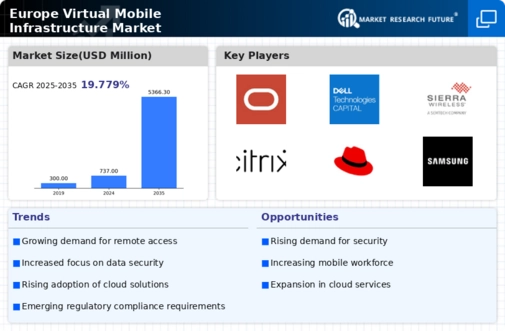
As per MRFR analysis, the virtual mobile-infrastructure market size was estimated at 739.46 USD Million in 2024. The virtual mobile-infrastructure market is projected to grow from 885.5 USD Million in 2025 to 5369.61 USD Million by 2035, exhibiting a compound annual growth rate (CAGR) of 19.75% during the forecast period 2025 - 2035.

Key Market Trends & Highlights

The Europe virtual mobile-infrastructure market is experiencing robust growth driven by technological advancements and evolving workforce needs.

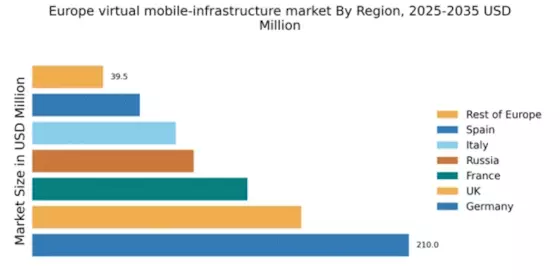
  • Germany remains the largest market for virtual mobile-infrastructure, reflecting a strong demand for innovative solutions.
  • The UK is emerging as the fastest-growing region, indicating a shift towards more agile mobile work environments.
  • There is a notable surge in cloud adoption and AI integration, enhancing operational efficiency across various sectors.
  • Rising demand for remote work solutions and advancements in network technologies are key drivers propelling market expansion.

Market Size & Forecast

2024 Market Size 739.46 (USD Million)
2035 Market Size 5369.61 (USD Million)
CAGR (2025 - 2035) 19.75%

Major Players

VMware (US), Citrix Systems (US), Microsoft (US), Amazon Web Services (US), IBM (US), Nokia (FI), Ericsson (SE), ZTE Corporation (CN), Huawei Technologies (CN)

Europe Virtual Mobile Infrastructure Market Trends

The virtual mobile-infrastructure market is currently experiencing a notable transformation, driven by advancements in technology and increasing demand for flexible mobile solutions. As organizations across various sectors seek to enhance operational efficiency, the adoption of virtual mobile infrastructures is becoming more prevalent. This shift is characterized by a growing emphasis on cloud-based services, which facilitate seamless access to applications and data from any location. Furthermore, the integration of artificial intelligence and machine learning into mobile infrastructures is likely to optimize performance and security, thereby attracting more businesses to this innovative approach. In addition, regulatory frameworks in Europe are evolving to support the expansion of the virtual mobile-infrastructure market. Governments are recognizing the importance of digital transformation and are implementing policies that encourage investment in mobile technologies. This supportive environment may lead to increased collaboration between public and private sectors, fostering innovation and driving growth. As the market continues to mature, it appears poised for further expansion, with potential opportunities for new entrants and established players alike to capitalize on emerging trends and technologies.

Cloud Adoption Surge

The shift towards cloud-based solutions is reshaping the virtual mobile-infrastructure market. Organizations are increasingly leveraging cloud technologies to enhance flexibility and scalability, allowing for more efficient resource management and reduced operational costs.

AI and Automation Integration

The incorporation of artificial intelligence and automation tools is becoming a defining trend. These technologies are expected to improve system performance, enhance security measures, and streamline operations, making virtual mobile infrastructures more attractive to businesses.

Regulatory Support and Investment

European governments are actively promoting digital transformation through supportive regulations and funding initiatives. This trend is likely to stimulate growth in the virtual mobile-infrastructure market, encouraging innovation and collaboration among stakeholders.

Europe Virtual Mobile Infrastructure Market Drivers

Growing Mobile Workforce

The expansion of the mobile workforce in Europe is a critical driver for the virtual mobile-infrastructure market. With an estimated 50% of employees expected to work remotely by 2027, organizations are compelled to invest in mobile infrastructure that supports this trend. The need for flexible, accessible, and efficient mobile solutions is paramount to accommodate a diverse workforce. Companies are increasingly adopting virtual mobile-infrastructure to facilitate collaboration and communication among employees, regardless of their location. This shift not only enhances operational efficiency but also positions organizations to attract and retain top talent, thereby fueling market growth.

Increased Focus on Cybersecurity

As cyber threats become more sophisticated, the virtual mobile-infrastructure market in Europe is witnessing a heightened focus on cybersecurity measures. Organizations are prioritizing the protection of sensitive data accessed through mobile devices, leading to increased investments in security solutions. Reports indicate that cybersecurity spending in Europe is projected to grow by 15% annually, reflecting the urgency to safeguard mobile infrastructures. This trend compels businesses to adopt comprehensive security frameworks that integrate seamlessly with their virtual mobile-infrastructure. The emphasis on cybersecurity not only protects organizational assets but also enhances customer trust, further driving the demand for secure mobile solutions.

Regulatory Compliance and Standards

The virtual mobile-infrastructure market in Europe is significantly influenced by regulatory compliance and standards. As data protection regulations, such as the General Data Protection Regulation (GDPR), become more stringent, organizations are required to implement robust mobile infrastructure that adheres to these guidelines. Compliance with such regulations is not merely a legal obligation; it also serves as a competitive advantage. Companies that prioritize compliance are likely to gain customer trust and loyalty, which can translate into increased market share. Consequently, the need for compliant virtual mobile-infrastructure solutions is expected to drive investment and innovation within the market.

Advancements in Network Technologies

Technological advancements in network infrastructure significantly influence the virtual mobile-infrastructure market in Europe. The rollout of 5G technology is particularly noteworthy, as it offers enhanced speed and reliability for mobile applications. With 5G expected to cover over 60% of the European population by 2026, businesses are increasingly leveraging this technology to improve their mobile infrastructure. Enhanced network capabilities facilitate real-time data access and support high-bandwidth applications, which are essential for modern enterprises. Consequently, organizations are likely to invest more in virtual mobile-infrastructure solutions that can harness these advancements, thereby propelling market growth.

Rising Demand for Remote Work Solutions

The virtual mobile-infrastructure market in Europe experiences a notable surge in demand for remote work solutions. As organizations increasingly adopt flexible work arrangements, the need for robust mobile infrastructure becomes paramount. This shift is evidenced by a reported 30% increase in remote work adoption across various sectors. Companies are investing in virtual mobile-infrastructure to ensure seamless connectivity and collaboration among distributed teams. The ability to access corporate resources securely from any location enhances productivity and employee satisfaction. Furthermore, this trend is likely to continue as businesses recognize the long-term benefits of remote work, thereby driving growth in the virtual mobile-infrastructure market.

Market Segment Insights

By Deployment Type: Cloud-Based (Largest) vs. Hybrid (Fastest-Growing)

The distribution of market share among the deployment types reveals that the Cloud-Based segment holds a significant portion of the overall virtual mobile-infrastructure market. This segment appeals to organizations looking for scalability and flexibility, offering the ability to deploy resources efficiently without the burden of hardware investment. Meanwhile, the On-Premises segment, while substantial, is experiencing slower growth due to the increasing preference for cloud solutions. In recent years, the Hybrid deployment type has emerged as the fastest-growing segment, driven by the necessity for businesses to balance flexibility and control. Organizations are increasingly adopting hybrid solutions to leverage both public and private cloud benefits, facilitating seamless data management across platforms. This trend reflects a growing awareness of the need for a more versatile infrastructure that adapts to dynamic business requirements.

Cloud-Based (Dominant) vs. On-Premises (Emerging)

The Cloud-Based deployment type is currently dominant in the virtual mobile-infrastructure sector, primarily due to its capacity for providing scalable solutions with lower initial costs. It allows organizations to quickly deploy virtual environments without extensive physical infrastructure, making it highly appealing for businesses focused on rapid growth and adaptability. In contrast, the On-Premises segment is emerging, as it offers greater control over data and security. However, its adoption is slowing as more companies recognize the strategic advantages of cloud solutions. Both segments cater to differing organizational needs, with cloud solutions leading in innovation and flexibility, while on-premises systems maintain relevance for businesses prioritizing compliance and data sovereignty.

By Application: Enterprise Mobility Management (Largest) vs. Mobile Application Development (Fastest-Growing)

In the virtual mobile-infrastructure market, Enterprise Mobility Management holds the largest market share, driven by the increasing need for businesses to manage and secure mobile devices effectively. Remote Desktop Access also plays a crucial role but comes in a close second, as enterprises increasingly embrace remote work. Mobile Application Development is gaining traction, representing a growing interest in creating mobile apps essential for business operations. Growth trends indicate that the demand for Enterprise Mobility Management is bolstered by the need for robust security solutions. In contrast, Mobile Application Development is witnessing rapid growth due to the surge in mobile app usage across various sectors. The shift in workforce dynamics, focusing on flexibility and remote accessibility, further drives these segments, leading to enhanced productivity and operational efficiency.

Enterprise Mobility Management (Dominant) vs. Mobile Application Development (Emerging)

Enterprise Mobility Management is characterized by its focus on providing comprehensive security, management, and monitoring solutions for mobile devices. This segment is critical for organizations aiming to safeguard their data while allowing employees the flexibility to work remotely. It holds a dominant position in the market due to its extensive capabilities in integrating various mobile technologies and maintaining compliance with data protection regulations. On the other hand, Mobile Application Development is an emerging segment that highlights the increasing importance of mobile applications in enhancing customer engagement and optimizing business processes. Companies are investing in app development to meet user demands for seamless mobile experiences, thereby supporting innovation and competitiveness in the market.

By End User: Large Enterprises (Largest) vs. Small and Medium Enterprises (Fastest-Growing)

Within the End User segment, Large Enterprises hold the largest share, reflecting their capacity to leverage extensive resources and integrate robust virtual mobile-infrastructure solutions. In contrast, Small and Medium Enterprises are rapidly gaining ground in this space, driven by the increasing recognition of virtualization benefits that enhance operational efficiency. Government entities maintain a significant presence, focusing on compliance and cybersecurity, but they lag behind the other two segments in terms of growth potential. The growth trend for Small and Medium Enterprises is particularly notable as they adopt agile methodologies to transition towards modern IT ecosystems. Factors such as rising digital transformation efforts, remote work incentives, and improved accessibility to advanced technologies are propelling this shift. Large Enterprises, while still dominating, are investing heavily in innovation and custom solutions to retain their edge, creating a competitive landscape that fuels continuous growth across the board.

Large Enterprises: Dominant vs. Small and Medium Enterprises: Emerging

Large Enterprises represent the dominant force in the End User segment, characterized by their established infrastructure, vast resources, and ability to implement comprehensive virtual mobile-infrastructure strategies. They typically focus on securing long-term contracts and developing tailored solutions to adapt to market needs. On the other hand, Small and Medium Enterprises are emerging rapidly in this domain, recognizing the importance of cloud-based technologies and flexible deployment options. These organizations are often more agile and willing to innovate, allowing them to implement virtual mobile infrastructures that closely align with current business demands. This agility gives them a competitive edge in rapidly evolving markets, even as they face challenges in scaling up like their larger counterparts.

By Service Type: Infrastructure as a Service (Largest) vs. Software as a Service (Fastest-Growing)

In the service type segment, Infrastructure as a Service (IaaS) holds the largest market share, driven by the increasing demand for scalable and flexible IT infrastructure solutions. This segment's strong position is attributed to businesses adopting cloud solutions, reducing the reliance on-premises hardware, and improving operational efficiency through cost management. In contrast, Software as a Service (SaaS) has emerged as the fastest-growing segment, appealing to organizations seeking accessible software solutions without the overhead of traditional licensing and maintenance, thus enhancing user engagement and productivity. The growth trends within these segments are influenced by the rapid digital transformation across industries in the region. IaaS continues to benefit from the shift to cloud-based solutions, enabling businesses to adapt efficiently to changing demands. Simultaneously, SaaS finds traction due to its user-friendly interfaces and subscription-based models, which allow organizations to rapidly scale software solutions without significant upfront costs, attracting a diverse range of enterprises looking to innovate and stay competitive in the digital landscape.

IaaS (Dominant) vs. SaaS (Emerging)

Infrastructure as a Service (IaaS) stands out as the dominant offering in the service type segment, providing robust solutions that facilitate the deployment of virtualized IT resources through the cloud. Its characteristics include flexibility, scalability, and pay-per-use pricing models, making it particularly attractive for enterprises keen on optimizing their IT budgets. On the other hand, Software as a Service (SaaS) is an emerging powerhouse characterized by its ease of access and user-centric designs. It allows businesses to leverage powerful applications through subscriptions, relieving them from the complexities of traditional software installations and updates. This segment is gaining momentum as firms increasingly prioritize operational efficiency and the ability to integrate with existing systems seamlessly.

Get more detailed insights about Europe Virtual Mobile Infrastructure Market

Regional Insights

Germany : Strong Growth and Innovation Hub

Key markets include Berlin, Munich, and Frankfurt, where major players like VMware, Microsoft, and IBM have established significant operations. The competitive landscape is characterized by a mix of local startups and global giants, driving innovation and service diversification. The business environment is favorable, with a strong emphasis on sectors such as finance, automotive, and telecommunications, which are increasingly adopting virtual mobile solutions.

UK : Innovation and Investment Drive Market

London, Manchester, and Birmingham are pivotal markets, hosting major players like Citrix Systems and Microsoft. The competitive landscape is vibrant, with numerous tech startups and established firms vying for market share. The local business environment is characterized by a strong emphasis on fintech, healthcare, and education sectors, which are increasingly leveraging mobile infrastructure solutions to enhance service delivery.

France : Strong Demand and Regulatory Support

Key markets include Paris, Lyon, and Marseille, where major players like IBM and Microsoft are actively expanding their presence. The competitive landscape features a mix of local and international firms, driving innovation and service offerings. The business environment is favorable, particularly in sectors such as public administration, healthcare, and retail, which are increasingly adopting mobile infrastructure solutions to improve efficiency and service delivery.

Russia : Regulatory Landscape and Demand Trends

Moscow and St. Petersburg are key markets, with significant presence from players like Huawei and ZTE Corporation. The competitive landscape is evolving, with local firms gaining traction alongside international giants. The business environment is complex, influenced by regulatory policies and economic conditions, particularly in sectors such as telecommunications, energy, and manufacturing, which are increasingly adopting mobile infrastructure solutions.

Italy : Digital Transformation and Investment Focus

Key markets include Rome, Milan, and Turin, where major players like Microsoft and IBM are expanding their operations. The competitive landscape features a mix of local and international firms, driving innovation and service diversification. The business environment is characterized by a strong emphasis on sectors such as manufacturing, retail, and public administration, which are increasingly leveraging mobile infrastructure solutions to enhance efficiency and service delivery.

Spain : Investment in Digital Infrastructure

Key markets include Madrid and Barcelona, where major players like VMware and Microsoft are actively expanding their presence. The competitive landscape is characterized by a mix of local startups and established firms, driving innovation and service offerings. The business environment is favorable, particularly in sectors such as tourism, retail, and telecommunications, which are increasingly adopting mobile infrastructure solutions to improve service delivery.

Rest of Europe : Varied Growth Across Sub-regions

Key markets include cities in Scandinavia, Eastern Europe, and the Balkans, where local players and international firms are vying for market share. The competitive landscape is diverse, with varying levels of market maturity and innovation. The business environment is influenced by sector-specific applications, particularly in industries such as logistics, healthcare, and education, which are increasingly adopting mobile infrastructure solutions to enhance service delivery.


Europe Virtual Mobile Infrastructure Market Regional Image

Key Players and Competitive Insights

The virtual mobile-infrastructure market is currently characterized by a dynamic competitive landscape, driven by rapid technological advancements and increasing demand for mobile solutions across various sectors. Key players such as VMware (US), Citrix Systems (US), and Microsoft (US) are strategically positioned to leverage their extensive portfolios and innovative capabilities. VMware (US) focuses on enhancing its cloud infrastructure offerings, while Citrix Systems (US) emphasizes user experience and security in its mobile solutions. Microsoft (US) continues to integrate its services with Azure, promoting a seamless mobile experience. Collectively, these strategies foster a competitive environment that prioritizes innovation and customer-centric solutions.

In terms of business tactics, companies are increasingly localizing their operations to better serve regional markets, optimizing supply chains to enhance efficiency. The market structure appears moderately fragmented, with several key players exerting considerable influence. This fragmentation allows for diverse offerings, yet the collective strength of major companies shapes the competitive dynamics, pushing smaller players to innovate or specialize.

In October 2025, VMware (US) announced a strategic partnership with a leading telecommunications provider to enhance its mobile cloud services. This collaboration aims to integrate advanced AI capabilities into mobile applications, thereby improving performance and user engagement. The significance of this move lies in VMware's commitment to staying at the forefront of technological innovation, which is crucial in a rapidly evolving market.

In September 2025, Citrix Systems (US) launched a new security framework designed specifically for mobile applications, addressing growing concerns over data privacy and security. This initiative not only strengthens Citrix's market position but also reflects a broader industry trend towards prioritizing security in mobile infrastructure. The strategic importance of this launch is underscored by the increasing regulatory scrutiny surrounding data protection, making it a timely and relevant development.

In August 2025, Microsoft (US) expanded its Azure platform to include enhanced mobile application development tools, facilitating faster deployment and integration for businesses. This expansion is indicative of Microsoft's strategy to dominate the cloud services market, particularly in mobile infrastructure. By providing robust tools for developers, Microsoft positions itself as a leader in enabling digital transformation across industries.

As of November 2025, current competitive trends are heavily influenced by digitalization, sustainability, and the integration of AI technologies. Strategic alliances are increasingly shaping the landscape, as companies recognize the value of collaboration in driving innovation. Looking ahead, competitive differentiation is likely to evolve, with a shift from price-based competition towards a focus on technological innovation and supply chain reliability. This transition suggests that companies will need to invest in R&D and strategic partnerships to maintain a competitive edge in the virtual mobile-infrastructure market.

Key Companies in the Europe Virtual Mobile Infrastructure Market market include

Industry Developments

The Europe Virtual Mobile Infrastructure Market has witnessed significant developments recently. Companies such as Oracle, VMware, Dell Technologies, and Citrix are actively enhancing their offerings to cater to the growing demand for mobile infrastructure solutions. In August 2023, Dell Technologies expanded its partnership with Nokia to provide advanced networking solutions, promoting greater mobility and connectivity for enterprises. Additionally, in September 2023, VMware announced a strategic collaboration with IBM to integrate cloud services, enhancing users' access to virtual mobile environments. 

Notably, in March 2023, Microsoft launched new features in its Teams platform, improving mobile collaboration for businesses across Europe. The market is experiencing robust growth, driven by the increasing adoption of remote work strategies, which prompted firms to invest in virtual mobile solutions. 

This is further evidenced by the rise in market valuation for companies like TeamViewer and Siemens, showcasing the strong impact of digital transformation. The last two years have seen a notable increase in demand, particularly during the COVID-19 pandemic, which pushed enterprises to rethink their mobile infrastructure to ensure productivity and connectivity in a hybrid work environment.

Future Outlook

Europe Virtual Mobile Infrastructure Market Future Outlook

The Virtual Mobile Infrastructure Market is projected to grow at a 19.75% CAGR from 2024 to 2035, driven by increasing demand for remote work solutions and enhanced mobile connectivity.

New opportunities lie in:

  • Development of AI-driven mobile management platforms
  • Expansion of 5G infrastructure to enhance service delivery
  • Integration of IoT solutions for improved operational efficiency

By 2035, the market is expected to achieve substantial growth, driven by technological advancements and evolving consumer needs.

Market Segmentation

Europe Virtual Mobile Infrastructure Market End User Outlook

  • Large Enterprises
  • Small and Medium Enterprises
  • Government

Europe Virtual Mobile Infrastructure Market Application Outlook

  • Enterprise Mobility Management
  • Remote Desktop Access
  • Mobile Application Development

Europe Virtual Mobile Infrastructure Market Service Type Outlook

  • Infrastructure as a Service
  • Platform as a Service
  • Software as a Service

Europe Virtual Mobile Infrastructure Market Deployment Type Outlook

  • Cloud-Based
  • On-Premises
  • Hybrid

Report Scope

MARKET SIZE 2024739.46(USD Million)
MARKET SIZE 2025885.5(USD Million)
MARKET SIZE 20355369.61(USD Million)
COMPOUND ANNUAL GROWTH RATE (CAGR)19.75% (2024 - 2035)
REPORT COVERAGERevenue Forecast, Competitive Landscape, Growth Factors, and Trends
BASE YEAR2024
Market Forecast Period2025 - 2035
Historical Data2019 - 2024
Market Forecast UnitsUSD Million
Key Companies Profiled["VMware (US)", "Citrix Systems (US)", "Microsoft (US)", "Amazon Web Services (US)", "IBM (US)", "Nokia (FI)", "Ericsson (SE)", "ZTE Corporation (CN)", "Huawei Technologies (CN)"]
Segments CoveredDeployment Type, Application, End User, Service Type
Key Market OpportunitiesIntegration of advanced security protocols enhances trust in the virtual mobile-infrastructure market.
Key Market DynamicsRising demand for secure remote access drives innovation in virtual mobile-infrastructure solutions across Europe.
Countries CoveredGermany, UK, France, Russia, Italy, Spain, Rest of Europe

Leave a Comment

FAQs

What is the expected market size of the Europe Virtual Mobile Infrastructure Market in 2024?

The Europe Virtual Mobile Infrastructure Market is expected to be valued at 737.01 million USD in 2024.

What is the projected market size by 2035 for the Europe Virtual Mobile Infrastructure Market?

By 2035, the Europe Virtual Mobile Infrastructure Market is projected to reach 5366.32 million USD.

What is the expected CAGR for the Europe Virtual Mobile Infrastructure Market from 2025 to 2035?

The expected CAGR for the Europe Virtual Mobile Infrastructure Market from 2025 to 2035 is 19.779%.

Which deployment type is expected to have the largest market value in 2035?

In 2035, the Cloud-Based deployment type is expected to have the largest market value at 2215.0 million USD.

Which region is projected to dominate the Europe Virtual Mobile Infrastructure Market by 2035?

Germany is projected to dominate the Europe Virtual Mobile Infrastructure Market with an expected value of 1210.0 million USD by 2035.

What is the expected market value for the UK in 2024?

The expected market value for the UK in 2024 is 180.0 million USD.

Who are the key players in the Europe Virtual Mobile Infrastructure Market?

Key players in the Europe Virtual Mobile Infrastructure Market include Oracle, Dell Technologies, VMware, and Citrix.

What is the expected market size for the On-Premises deployment type in 2035?

The expected market size for the On-Premises deployment type in 2035 is 1725.0 million USD.

What market size growth can be anticipated for Italy by 2035?

The market size for Italy is anticipated to grow to 1576.32 million USD by 2035.

What challenges and opportunities does the Europe Virtual Mobile Infrastructure Market face?

The market faces challenges such as security concerns while presenting opportunities in cost-saving and enhanced mobility solutions.

Download Free Sample

Kindly complete the form below to receive a free sample of this Report

Compare Licence

×
Features License Type
Single User Multiuser License Enterprise User
Price $4,950 $5,950 $7,250
Maximum User Access Limit 1 User Upto 10 Users Unrestricted Access Throughout the Organization
Free Customization
Direct Access to Analyst
Deliverable Format
Platform Access
Discount on Next Purchase 10% 15% 15%
Printable Versions