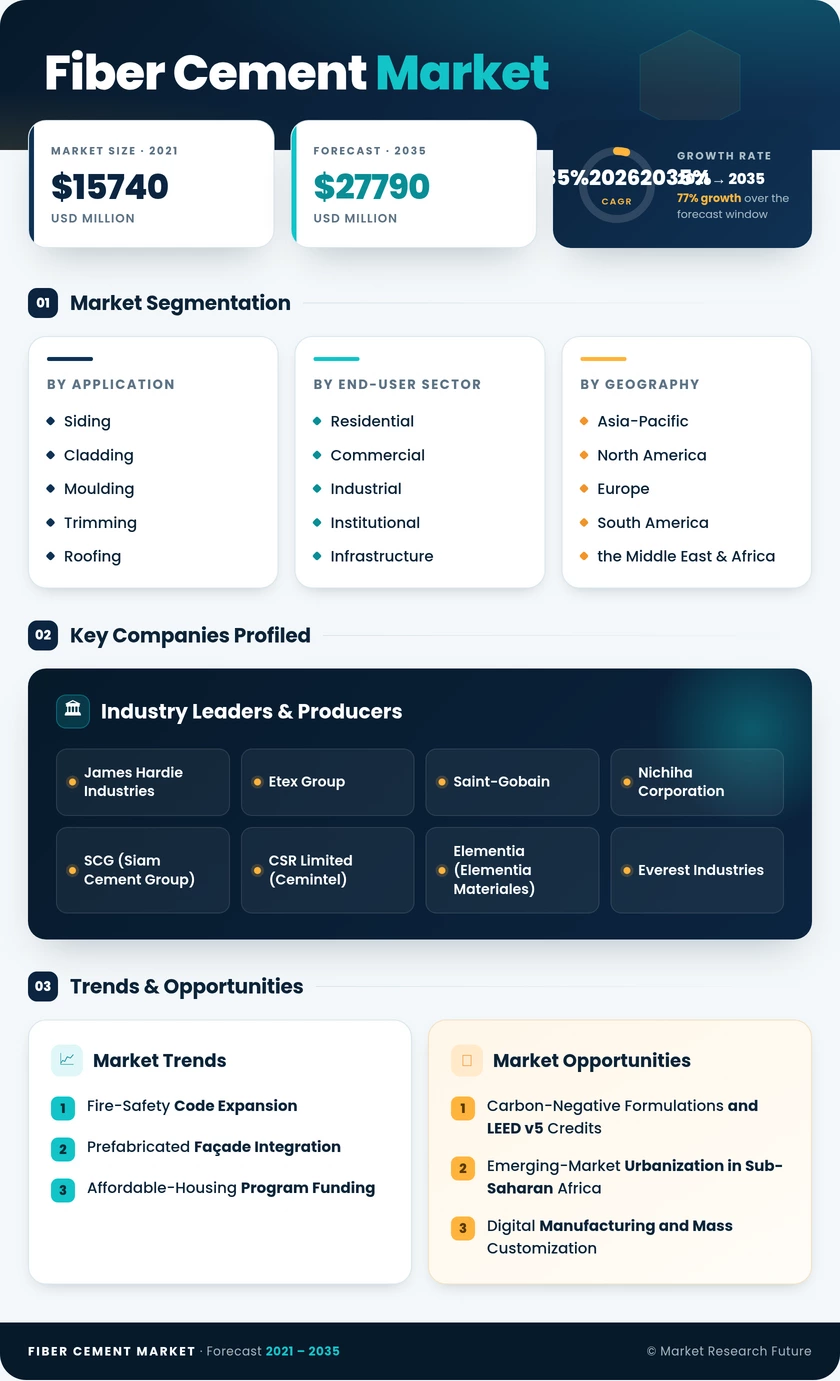
Fiber Cement Market

ID: MRFR/CnM/0372-CR
200 Pages
Chitranshi Jaiswal
Last Updated: June 16, 2026
Fiber Cement Market Research Report By Application (Siding, Roofing, Flooring, Interior Walls, Precast Structures), By End Use (Residential, Commercial, Industrial), By Product Type (Fiber Cement Board, Fiber Cement Slab, Fiber Cement Panel), By Manufacturing Process (Semi-Dry Process, Wet Process, Other Processes) and By Regional (North America, Europe, South America, Asia Pacific, Middle East and Africa)-Forecast to 2035
Download PDF ×

We do not share your information with anyone. However, we may send you emails based on your report interest from time to time. You may contact us at any time to opt-out.

  1. 1 Market Overview |
    1. 1.1 Study Assumptions & Market Definition |
    2. 1.2 Scope of the Study |
    3. 1.3 Research Methodology
  2. 2 Market Summary & Key Takeaways
  3. 3 Market Dynamics |
    1. 3.1 Market Drivers Analysis | |
      1. 3.1.1 Fire-Safety Code Expansion (NFPA 285, EN 13501) | |
      2. 3.1.2 Prefabricated Façade Integration | |
      3. 3.1.3 Affordable-Housing Government Programs | |
      4. 3.1.4 Insurance-Driven Adoption in Hazard Zones | |
      5. 3.1.5 Carbon-Negative Formulation R&D | |
      6. 3.1.6 Urbanization and Mid-Rise Construction Growth |
    2. 3.2 Market Restraints Analysis | |
      1. 3.2.1 Higher Upfront Material and Installation Costs | |
      2. 3.2.2 Weight and Transportation Logistics | |
      3. 3.2.3 Competition from Engineered Wood and Vinyl Alternatives | |
      4. 3.2.4 Skilled Labor Shortages for Specialized Installation | |
      5. 3.2.5 Silica Dust Exposure and Occupational Health Regulations |
    3. 3.3 Market Opportunity Analysis | |
      1. 3.3.1 Carbon-Negative Formulations and LEED v5 Credits | |
      2. 3.3.2 Emerging-Market Urbanization in Sub-Saharan Africa | |
      3. 3.3.3 Digital Manufacturing and Mass Customization | |
      4. 3.3.4 Drone-Assisted and Robotic Installation Systems | |
      5. 3.3.5 Data-Driven Lifecycle Services and BIM Integration |
    4. 3.4 Industry Value Chain Analysis |
    5. 3.5 Porter's Five Forces Analysis
  4. 4 Global Fiber Cement Market Size & Forecast (2021–2035) |
    1. 4.1 Historical Market Size (2021–2025) |
    2. 4.2 Current & Forecast Market Size (2026–2035) |
    3. 4.3 Market Size by Revenue (USD Million) |
    4. 4.4 Year-over-Year Growth Analysis
  5. 5 Segmentation Analysis |
    1. 5.1 By Application | |
      1. 5.1.1 Siding | |
      2. 5.1.2 Cladding | |
      3. 5.1.3 Moulding and Trimming | |
      4. 5.1.4 Roofing | |
      5. 5.1.5 Other Applications |
    2. 5.2 By End-User Sector | |
      1. 5.2.1 Residential | |
      2. 5.2.2 Commercial | |
      3. 5.2.3 Industrial and Institutional | |
      4. 5.2.4 Infrastructure
  6. 6 Regional Analysis |
    1. 6.1 North America | |
      1. 6.1.1 United States | |
      2. 6.1.2 Canada | |
      3. 6.1.3 Mexico |
    2. 6.2 Europe | |
      1. 6.2.1 Germany | |
      2. 6.2.2 United Kingdom | |
      3. 6.2.3 France | |
      4. 6.2.4 Italy | |
      5. 6.2.5 Spain | |
      6. 6.2.6 Nordic Countries | |
      7. 6.2.7 Russia | |
      8. 6.2.8 Rest of Europe |
    3. 6.3 Asia-Pacific | |
      1. 6.3.1 China | |
      2. 6.3.2 India | |
      3. 6.3.3 Japan | |
      4. 6.3.4 South Korea | |
      5. 6.3.5 ASEAN | |
      6. 6.3.6 Rest of Asia-Pacific |
    4. 6.4 South America | |
      1. 6.4.1 Brazil | |
      2. 6.4.2 Argentina | |
      3. 6.4.3 Rest of South America |
    5. 6.5 Middle East & Africa | |
      1. 6.5.1 Saudi Arabia | |
      2. 6.5.2 UAE | |
      3. 6.5.3 South Africa | |
      4. 6.5.4 Egypt | |
      5. 6.5.5 Rest of MEA
  7. 7 Competitive Landscape |
    1. 7.1 Market Share Analysis (2025) |
    2. 7.2 Competitive Benchmarking Matrix |
    3. 7.3 Company Profiles | |
      1. 7.3.1 James Hardie Industries | |
      2. 7.3.2 Etex Group | |
      3. 7.3.3 Saint-Gobain | |
      4. 7.3.4 Nichiha Corporation | |
      5. 7.3.5 SCG (Siam Cement Group) | |
      6. 7.3.6 CSR Limited (Cemintel) | |
      7. 7.3.7 Elementia (Elementia Materiales) | |
      8. 7.3.8 Everest Industries | |
      9. 7.3.9 Cembrit Holding | |
      10. 7.3.10 Ply Gem (Cornerstone Building Brands)
  8. 8 Future Outlook & Strategic Recommendations (2026–2035) |
    1. 8.1 Decarbonization and Embodied-Carbon Regulations |
    2. 8.2 Digitalization of Construction Supply Chains |
    3. 8.3 Prefabrication Supercycle |
    4. 8.4 Circular Economy and Recycling Infrastructure
  9. 9 Recent Developments & News
  10. 10 Frequently Asked Questions (FAQs)
  11. 11 Report Scope & Methodology |
    1. 11.1 Study Period & Base Year |
    2. 11.2 Data Sources & Citations |
    3. 11.3 Abbreviations
  12. 12 LIST OF TABLES |
  13. TABLE 1 Global Fiber Cement Market Size & Forecast, by Revenue (USD Million), 2021–2035 |
  14. TABLE 2 Global Fiber Cement Market — Year-over-Year Growth Analysis, 2021–2035 |
  15. TABLE 3 Global Fiber Cement Market — Driver Impact Analysis |
  16. TABLE 4 Global Fiber Cement Market — Restraint Impact Analysis |
  17. TABLE 5 Global Fiber Cement Market — Regional Summary, 2025 |
  18. TABLE 6 Global Fiber Cement Market Size, by Application, 2021–2035 (USD Million) |
  19. TABLE 7 Global Fiber Cement Market Size, by End-User Sector, 2021–2035 (USD Million) |
  20. TABLE 8 Global Fiber Cement Market Size, by Region, 2021–2035 (USD Million) |
  21. TABLE 9 North America Fiber Cement Market Size, by Country, 2021–2035 (USD Million) |
  22. TABLE 10 Europe Fiber Cement Market Size, by Country, 2021–2035 (USD Million) |
  23. TABLE 11 Asia-Pacific Fiber Cement Market Size, by Country, 2021–2035 (USD Million) |
  24. TABLE 12 South America Fiber Cement Market Size, by Country, 2021–2035 (USD Million) |
  25. TABLE 13 Middle East & Africa Fiber Cement Market Size, by Country, 2021–2035 (USD Million) |
  26. TABLE 14 Competitive Benchmarking Matrix — Global Fiber Cement Market, 2025 |
  27. TABLE 15 Company Profiles — Key Players, Global Fiber Cement Market |
  28. TABLE 16 Recent Developments & Strategic Announcements, 2023–2025 |
  29. TABLE 17 Report Scope & Methodology Summary |
  30. TABLE 18 Detailed Sources and Citations |
  31. TABLE 19 North America Fiber Cement Market Size, by Application, 2021–2035 (USD Million) |
  32. TABLE 20 North America Fiber Cement Market Size, by End-User Sector, 2021–2035 (USD Million) |
  33. TABLE 21 Europe Fiber Cement Market Size, by Application, 2021–2035 (USD Million) |
  34. TABLE 22 Europe Fiber Cement Market Size, by End-User Sector, 2021–2035 (USD Million) |
  35. TABLE 23 Asia-Pacific Fiber Cement Market Size, by Application, 2021–2035 (USD Million) |
  36. TABLE 24 Asia-Pacific Fiber Cement Market Size, by End-User Sector, 2021–2035 (USD Million) |
  37. TABLE 25 South America Fiber Cement Market Size, by Application, 2021–2035 (USD Million) |
  38. TABLE 26 South America Fiber Cement Market Size, by End-User Sector, 2021–2035 (USD Million) |
  39. TABLE 27 Middle East & Africa Fiber Cement Market Size, by Application, 2021–2035 (USD Million) |
  40. TABLE 28 Middle East & Africa Fiber Cement Market Size, by End-User Sector, 2021–2035 (USD Million)
  41. 13 LIST OF FIGURES |
  42. FIGURE 1 Global Fiber Cement Market Dynamics — Drivers, Restraints, and Opportunities |
  43. FIGURE 2 Value Chain Analysis — Fiber Cement Industry |
  44. FIGURE 3 Porter's Five Forces Analysis — Fiber Cement Market |
  45. FIGURE 4 Global Fiber Cement Market Size Trend (USD Million), 2021–2035 |
  46. FIGURE 5 Global Fiber Cement Market Share, by Application, 2025 |
  47. FIGURE 6 Global Fiber Cement Market Share, by End-User Sector, 2025 |
  48. FIGURE 7 Global Fiber Cement Market Share, by Region, 2025 |
  49. FIGURE 8 North America Fiber Cement Market Size Trend, 2021–2035 |
  50. FIGURE 9 Europe Fiber Cement Market Size Trend, 2021–2035 |
  51. FIGURE 10 Asia-Pacific Fiber Cement Market Size Trend, 2021–2035 |
  52. FIGURE 11 South America Fiber Cement Market Size Trend, 2021–2035 |
  53. FIGURE 12 Middle East & Africa Fiber Cement Market Size Trend, 2021–2035 |
  54. FIGURE 13 Competitive Landscape — Market Share Distribution, 2025 |
  55. FIGURE 14 Competitive Positioning Matrix — Key Players

Segmentation Quick Reference

DimensionSub-SegmentsDominant SegmentFastest Growing Segment
By ApplicationSiding, Cladding, Moulding and Trimming, Roofing, Other ApplicationsSiding (37.6% share, 2025)Cladding (4.90% CAGR)
By End-User SectorResidential, Commercial, Industrial and Institutional, InfrastructureResidential (48.2% share, 2025)Commercial (4.56% CAGR)
By GeographyAsia-Pacific, North America, Europe, South America, the Middle East & AfricaAsia-Pacific (46.2% share, 2025)Middle East & Africa (4.73% CAGR)


Market Segmentation Overview

By Application

Sub-SegmentKey Trend
SidingInsurance-mandated adoption in wildfire and hurricane corridors
CladdingPrefabricated commercial façade system integration
Moulding and TrimmingRenovation-driven replacement of wood trim products
RoofingTropical-climate durability replacing corrugated metal.
Other ApplicationsFlooring underlayment and partition board niches


Siding dominates application-level demand because single-family residential construction consumes the largest share of fiber cement boards globally. Cladding is closing the gap as commercial developers adopt factory-assembled construction cladding materials to compress project schedules and meet green-building certification requirements.

By End-User Sector

Sub-SegmentKey Trend
ResidentialAffordable-housing programs and suburban expansion
CommercialGreen-building certification driving specification shifts
Industrial and InstitutionalWarehouse, hospital, and educational facility construction
InfrastructureTransit stations, utility buildings, and public works


Residential end users account for the largest volume share because government-backed housing programs in India, Brazil, and China explicitly specify durable building panels in material procurement standards. Commercial-sector growth is outpacing residential on a CAGR basis as LEED v5 and BREEAM frameworks incentivize non-combustible exterior wall materials.