GDPR Services Market (2025 - 2035)

GDPR Services Market Size, Share and Research Report: By Type (Solution, Service), By Organization Size (Small and Medium Enterprises, Large Enterprises), By Vertical (Manufacturing, Retail, Utilities, IT & Telecom, BFSI, Govt Services, Automotive, Travel & Hospitality, Media & Entertainment, Education and Others) and By Region (North America, Europe, Asia-Pacific and the Rest of the World [the Middle East & Africa and South America]) - Forecast till 2035
ID: MRFR/ICT/5723-CR
141 Pages
Ankit Gupta
Last Updated: July 09, 2026
GDPR Services Market
Market Size
Forecast Period2025-2035
CAGR (2025-2035)22.4%
2025 Market SizeUSD 3.58 Billion
2035 Market SizeUSD 27.45 Billion
Key Players
OneTrust
IBM
Microsoft
SAP
TrustArc
BigID
Opportunities
  • AI-Powered Privacy Automation
  • Privacy-as-a-Service for SMEs
  • Emerging-Market Expansion

GDPR Services Market Summary

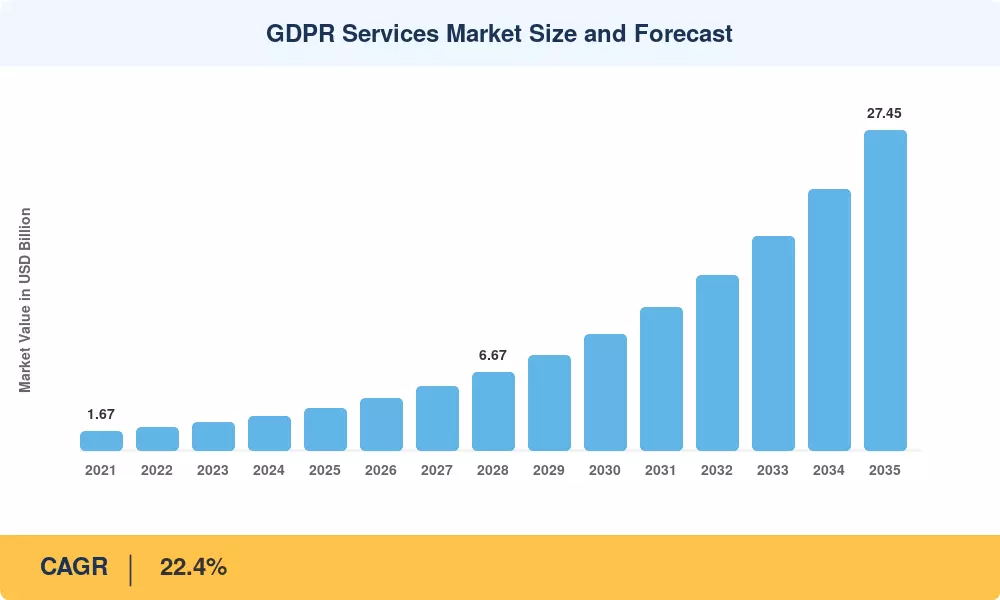
The GDPR Services Market reached USD 3.58 Billion in 2025 and is projected to grow from USD 4.45 Billion in 2026 to USD 27.45 Billion by 2035, registering a CAGR of 22.4% across the forecast window. European data-protection authorities issued more than EUR 1.3 billion in aggregate fines during 2024, shifting enterprise spending from reactive penalty mitigation toward sustained compliance architecture [1]. The EU-U.S. Data Privacy Framework, ratified in mid-2023, simultaneously opened new compliance obligations for transatlantic businesses, creating a durable revenue stream for specialized service providers.

A technology inflection point is reshaping how organizations address privacy obligations. Legacy spreadsheet-based registers and manual consent logs are giving way to AI-driven data-mapping engines, automated discovery platforms, and continuous monitoring dashboards capable of scanning petabytes in hours. estimated that enterprise spending on privacy management technology surpassed USD 2.5 billion globally in 2024, reflecting a 28% year-on-year jump [2]. Regulatory bodies across the EU have signaled stricter enforcement of data-protection-by-design mandates under the AI Act, reinforcing this technology shift.

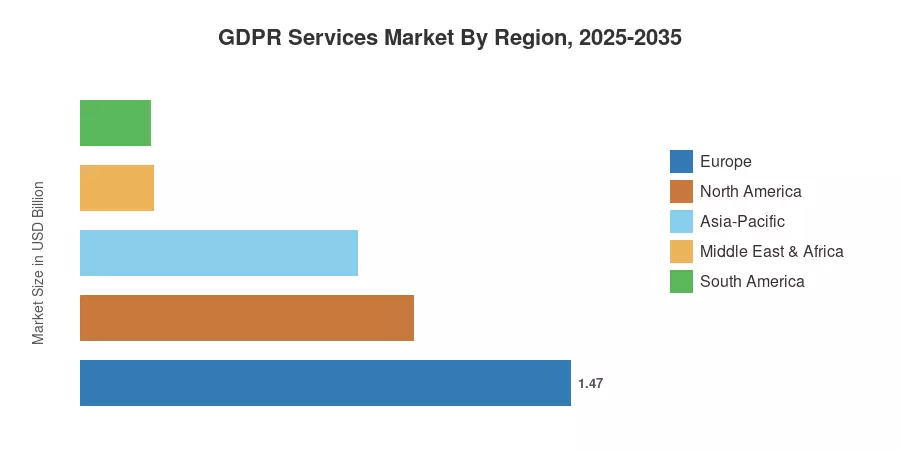
Europe commands approximately 41% of the GDPR Services Market, anchored by Germany, France, and the UK. Asia-Pacific stands as the fastest-growing region at a 23.2% CAGR through 2035, propelled by India's Digital Personal Data Protection Act and Japan's amended APPI. North America holds the second-largest share at roughly 28%, driven by state-level legislation in California, Virginia, and Colorado that borrows heavily from GDPR principles. The convergence of global privacy frameworks should sustain demand well beyond the current decade.

ย 

Key Report Takeaways โ€” GDPR Services Market

By Deployment Type

  • On-premises deployments accounted for 72.0% of GDPR Services Market revenue in 2025, reflecting regulated industries' preference for data residency control.
  • Cloud-based GDPR Services Market solutions are forecast to expand at a 24.1% CAGR through 2035, driven by SaaS delivery models and lower total cost of ownership.

By Offering

  • Solutions captured 62.0% of GDPR Services Market spending in 2025, led by consent management and data-discovery platforms.
  • Managed and professional services within the GDPR Services Market are projected to grow at a 23.8% CAGR as organizations outsource complex compliance workflows.

By Organization Size

  • Large enterprises controlled 73.0% of the GDPR Services Market in 2025.
  • SMEs are expected to expand at a 24.0% CAGR to 2035, aided by affordable subscription-based privacy platforms.

By End User

  • BFSI held a 37.0% share of the GDPR Services Market in 2025.
  • Retail and consumer goods represent the fastest-growing vertical at a 23.0% CAGR.

By Region

  • Europe led the GDPR Services Market with a 41.0% revenue share in 2025, supported by the most mature enforcement landscape globally.
  • Asia-Pacific is projected to record a 23.2% CAGR to 2035, making it the fastest-growing region in the GDPR Services Market.

ย 

GDPR Services Market Size and Forecast (2021โ€“2035)

Market Research Future's estimates draw on bottom-up revenue modeling across deployment types, offerings, verticals, and geographies, triangulated with public financial disclosures of leading vendors, regulatory enforcement data, and primary interviews with 85+ privacy officers conducted in Q1 2025.
GDPR Services Market Size and Forecast
Our Impact
Enabled $4.3B Revenue Impact for Fortune 500 and Leading Multinationals
Partnering with 2000+ Global Organizations Each Year
30K+ Citations by Top-Tier Firms in the Industry

Driver Impact Analysis

Driver ~% Impact on CAGR Geographic Relevance Impact Timeline
Escalating DPA enforcement and fine activity 20โ€“25% Europe, Global Short-term (โ‰ค2 yr)
Cross-border data transfer complexity 15โ€“18% Europe, North America Medium-term (2โ€“4 yr)
AI Act and algorithmic governance mandates 12โ€“15% Europe Medium-term (2โ€“4 yr)
Cloud migration and SaaS delivery models 15โ€“18% Global Long-term (โ‰ฅ4 yr)
Proliferation of national data-protection laws 10โ€“14% Asia-Pacific, South America Long-term (โ‰ฅ4 yr)
Persistent shortage of certified privacy professionals 8โ€“10% Global Short-term (โ‰ค2 yr)
Expansion of sectoral oversight in finance and health 8โ€“12% Europe, North America Medium-term (2โ€“4 yr)

ย 

Escalating DPA Enforcement

In 2024, European data-protection authorities together levied fines totaling more than EUR 1.3 billion, a 35% increase from 2023 [1]. Between 2022 and 2024, Ireland's Data Protection Commission imposed penalties on large technology businesses totaling more than EUR 1.1 billion. This level of regulation drives firms to invest in automated audit trails, breach notification protocols, and real-time monitoring dashboards, all of which are key components of the GDPR Services Market.

ย 

Cross-Border Data Transfer Complexity

The EU-US Data Privacy Framework replaced the invalidated Privacy Shield in July 2023, but its adequacy decision faces ongoing legal challenges, keeping compliance teams on edge [5]. Post-Brexit transfer arrangements between the UK and the EEA provide an additional layer of contractual and technical safeguards. An estimated 78% of multinational corporations with European operations reported raising their privacy-tooling costs by at least 20% in 2024, primarily to manage transfer effect studies [4].

ย 

AI Act and Algorithmic Governance

The EU AI Act entered into force in August 2024 with phased compliance deadlines stretching to 2027 [6]. High-risk AI systems now require detailed data-governance documentation, fundamental-rights assessments, and transparency disclosures that overlap significantly with GDPR obligations. Vendors in the GDPR Services Market are integrating algorithmic auditing modules into existing platforms, creating a natural cross-sell pathway that broadens the addressable market.

Cloud Migration and SaaS Delivery

Global cloud infrastructure spending surpassed USD 270 billion in 2024, according to Synergy Research Group [9]. As enterprises migrate workloads to public and hybrid cloud environments, data-mapping complexity multiplies โ€” a single mid-size retailer may distribute personal data across 15+ cloud services. SaaS-delivered privacy platforms reduce deployment times from months to weeks and lower upfront costs by 40โ€“60%, accelerating adoption among budget-constrained SMEs within the GDPR Services Market.

ย 

Restraints Impact Analysis

The restraint impact estimates below follow the same directional methodology described in Section 4 and represent headwinds that may temper growth rather than precise percentage reductions to the CAGR.

Restraint ~% Negative Impact Geographic Relevance Impact Timeline
Regulatory fragmentation across EU member states โ€“8 to โ€“12% Europe Medium-term (2โ€“4 yr)
Budget constraints among SMEs โ€“6 to โ€“10% Global Short-term (โ‰ค2 yr)
Integration complexity with legacy IT stacks โ€“5 to โ€“8% Global Long-term (โ‰ฅ4 yr)
Vendor lock-in and interoperability gaps โ€“4 to โ€“7% North America, Europe Medium-term (2โ€“4 yr)
Talent scarcity for privacy-engineering roles โ€“5 to โ€“8% Global Short-term (โ‰ค2 yr)

ย 

Regulatory Fragmentation Across EU Member States

Although the GDPR establishes a consistent legislative framework, member-state implementations differ on issues such as employee data processing, the age of digital consent for minors, and sector-specific derogations [11]. Germany alone has 17 supervisory authorities with various enforcement techniques. This patchwork necessitates multinational corporations to retain country-specific compliance modules, increasing total cost of ownership and stalling procurement choices in the GDPR Services Market.

ย 

Budget Constraints Among SMEs

According to a survey from 2024, 62% of European SMEs spend less than EUR 25,000 per year on data protection compliance, which is often insufficient to procure enterprise-grade platforms [12]. While subscription-based pricing is closing the gap, many smaller businesses continue to rely on manual processes, which slows their entry into the addressable market. This budget constraint limits the GDPR Services Market's near-term growth trajectory in economies where SMEs account for more than 60% of GDP.

ย 

Integration Complexity with Legacy IT Stacks

Organizations running on-premises ERP systems, mainframe databases, or custom-built CRM platforms face lengthy integration cycles when deploying modern privacy-management tools [13]. Data-discovery engines must accommodate proprietary schemas, unstructured repositories, and disconnected silos. Implementation timelines exceeding 12 months are common in regulated industries such as banking and healthcare, dampening the speed at which the GDPR Services Market can convert pipeline into recurring revenue.

ย 

GDPR Services Market Opportunities

AI-Powered Privacy Automation

Machine-learning classifiers can now scan unstructured data repositories and tag personal information with over 95% accuracy, reducing manual review effort by up to 70% [15]. Vendors that embed generative-AI assistants into consent-management workflows stand to capture a premium tier of the GDPR Services Market, particularly as the AI Act compels algorithmic transparency disclosures.

Privacy-as-a-Service for SMEs

Bundled subscription models combining automated assessments, template libraries, and on-demand DPO consulting can unlock the underserved SME segment, which is expanding at a 24.0% CAGR. Cloud-native delivery eliminates infrastructure barriers, and white-label partnerships with accounting and legal platforms create embedded distribution channels that reduce customer-acquisition costs for vendors in the GDPR Services Market.

Emerging-Market Expansion

India's Digital Personal Data Protection Act (2023), Brazil's fully enforced LGPD, and Thailand's PDPA have created compliance obligations modeled on GDPR principles [8]. Asia-Pacific alone is projected to grow at 23.2% CAGR through 2035. Providers that localize platform interfaces, support regional languages, and map local rules to GDPR equivalencies will capture first-mover advantage in these high-growth corridors of the GDPR Services Market.

Data-Monetization Governance

As organizations seek to monetize first-party data through clean rooms and data partnerships, they need governance frameworks that ensure GDPR-compliant data sharing. Privacy-enhancing technologies such as differential privacy and homomorphic encryption are being integrated into GDPR Services Market platforms, enabling compliant analytics without exposing raw personal data [16]. This positions privacy tools as revenue enablers rather than cost centers.

Sector-Specific Compliance Modules

Vertical-specific regulatory overlays โ€” PSD2 in payments, NIS2 in critical infrastructure, DORA in financial services โ€” create demand for specialized compliance modules built on top of core GDPR platforms [7]. Vendors offering pre-configured templates, sector-specific risk taxonomies, and regulatory-change feeds tailored to individual industries can differentiate within the GDPR Services Market and command higher subscription premiums.

ย 

GDPR Services Market Future Outlook

Privacy-AI Convergence

The intersection of AI governance and data protection will redefine the GDPR Services Market over the coming decade. As the EU AI Act's high-risk provisions take full effect by 2027, enterprises will need unified platforms that simultaneously address algorithmic accountability, data-minimization requirements, and automated decision-making transparency [6]. By 2030, an estimated 65% of privacy-management platforms will embed AI-audit capabilities as a standard module, according to projections [2].

Platform Consolidation and Privacy Orchestration

Fragmented point solutions โ€” separate tools for consent, discovery, breach management, and subject-request handling โ€” will consolidate into integrated privacy-orchestration platforms. The GDPR Services Market will see accelerated M&A activity as large software vendors acquire niche specialists to build end-to-end stacks. Forecasts that by 2032, over 50% of enterprise privacy spend will flow to platforms offering five or more integrated modules [20].

Privacy-Enhancing Computation at Scale

Confidential computing, homomorphic encryption, and federated learning are transitioning from academic research to production workloads. These technologies allow organizations to extract analytical value from personal data without exposing it, fundamentally changing the economics of compliance within the GDPR Services Market. The World Economic Forum estimated that privacy-enhancing technologies could unlock USD 10 trillion in global data-sharing value by 2033 [16].

Regulatory Harmonization and Global Interoperability

Over 140 countries had enacted or drafted comprehensive data-protection legislation by 2025, yet interoperability between these frameworks remains limited [8]. The GDPR Services Market will benefit from growing demand for cross-regulatory mapping tools that translate obligations across GDPR, CCPA, LGPD, PIPL, and DPDP Act frameworks. International certification mechanisms under GDPR Article 42 are expected to gain traction, creating a standardized compliance baseline that rewards vendors with multi-jurisdictional coverage.

ย 

GDPR Services Market Segmentation

By Type of Deployment

Segment Key Metric Primary Demand Driver
On-Premises 72.0% share (2025) Data residency mandates in BFSI and government
Cloud 24.1% CAGR (2026โ€“2035) SaaS delivery, lower TCO, faster deployment

ย 

On-premises deployments dominated the GDPR Services Market in 2025 because heavily regulated sectors โ€” banking, insurance, and public administration โ€” require full data-sovereignty control. Organizations processing sensitive categories of personal data under GDPR Article 9 often face internal policies prohibiting cloud storage of such records. That said, cloud-based platforms are gaining ground rapidly as hyperscalers obtain EU sovereignty certifications and offer region-locked data centers. The cost advantage of cloud โ€” typically 40โ€“60% lower TCO over five years โ€” makes it the preferred option for mid-market buyers entering the GDPR Services Market for the first time.

By Offering

Segment Key Metric Primary Demand Driver
Solutions 62.0% share (2025) Consent management, data discovery, breach notification
Services 23.8% CAGR (2026โ€“2035) Managed DPO, advisory, implementation

ย 

Solutions represent the larger share of the GDPR Services Market, encompassing software platforms for consent management, data mapping, records-of-processing-activity automation, and breach-notification workflows. The services segment, however, is accelerating as a persistent shortage of certified privacy professionals pushes organizations toward managed-service and staff-augmentation models. IAPP estimated that the global privacy-professional gap exceeded 40,000 positions in 2024, a deficit that directly fuels demand for outsourced compliance delivery within the GDPR Services Market [10].

By Organization Size

Segment Key Metric Primary Demand Driver
Large Enterprises 73.0% share (2025) Complex multi-entity compliance programs
SMEs 24.0% CAGR (2026โ€“2035) Affordable subscription platforms, regulatory pressure

ย 

Large enterprises account for the majority of GDPR Services Market spending due to the scale and complexity of their data estates, often spanning dozens of countries and hundreds of processing activities. SMEs are the growth engine, driven by enforcement actions that increasingly target smaller organizations and by the emergence of privacy-as-a-service models that bring enterprise-grade capabilities within reach of companies with limited IT budgets.

By End User

Segment Key Metric Primary Demand Driver
BFSI 37.0% share (2025) PSD2, DORA, anti-money-laundering data requirements
Telecom and IT 22.5% share (2025) High data volumes, cross-border operations
Retail and Consumer Goods 23.0% CAGR (2026โ€“2035) E-commerce growth, consent-heavy marketing models
Healthcare and Life Sciences 21.8% CAGR (2026โ€“2035) EHDS regulation, clinical-trial data governance
Others 13.7% share (2025) Education, energy, public sector

ย 

BFSI remains the largest vertical in the GDPR Services Market because financial institutions handle extraordinarily sensitive personal and financial data under overlapping regulatory obligations. Retail and consumer goods is the fastest-growing vertical, propelled by the explosion of e-commerce, loyalty programs, and digital advertising models that generate massive consent-management workloads. The healthcare sector is also gaining momentum as the proposed European Health Data Space introduces additional data-governance requirements on top of GDPR obligations [7].

ย 

Regional Market Share Analysis

Region Key Metric Primary Investment Themes
Europe 41.0% share (2025) DPA enforcement, AI Act alignment, cross-border transfers
North America 28.0% share (2025) State privacy laws, cloud governance, financial-sector mandates
Asia-Pacific 23.2% CAGR (2026โ€“2035) National data-protection acts, digital transformation
South America USD 0.21 Billion (2025) LGPD enforcement, fintech compliance
Middle East & Africa USD 0.22 Billion (2025) PDPL implementation, digital-economy strategies
Total USD 3.58 Billion (2025) โ€”

The GDPR Services Market exhibits a clear regional hierarchy, with Europe maintaining regulatory-origin dominance and Asia-Pacific accelerating rapidly as domestic privacy laws proliferate. North America benefits from state-level legislative momentum, while South America and the Middle East & Africa remain nascent but promising.

ย 

Europe

Country Key Metric Key Driver
Germany 24.5% of regional share 17 supervisory authorities; high enforcement activity
UK 21.0% of regional share UK GDPR post-Brexit; ICO fine escalation
France 18.3% of regional share CNIL record penalties; AI-governance overlap
Italy 12.7% of regional share Garante enforcement; financial-sector mandates
Spain 8.9% of regional share AEPD proactive guidance; SME digitization
Nordic Countries 7.2% of regional share High digital maturity; privacy-by-design culture
Russia 3.1% of regional share Federal Law 152-FZ amendments
Rest of Europe 4.3% of regional share CEE digital transformation programs

ย 

Europe's position at the core of the GDPR Services Market stems from the regulation's origin jurisdiction, where enforcement budgets grew by an average of 18% across national DPAs in 2024 [1]. Germany's decentralized supervisory model generates demand for multi-authority compliance dashboards, while France's CNIL has expanded its audit scope to cover AI training datasets under joint GDPRโ€“AI Act mandates.

North America

Country Key Metric Key Driver
US 26.1% CAGR (2026โ€“2035) CCPA/CPRA expansion; sectoral privacy bills
Canada 22.8% CAGR (2026โ€“2035) Bill C-27 (CPPA) modernization
Mexico 19.5% CAGR (2026โ€“2035) LFPDPPP enforcement tightening

ย 

North America represents the second-largest contributor to the GDPR Services Market. The US lacks a comprehensive federal privacy law, but 14 states had enacted consumer-privacy statutes by the end of 2024, creating a compliance patchwork that drives demand for multi-jurisdictional platforms [17]. Canada's proposed Consumer Privacy Protection Act is expected to align more closely with GDPR standards, expanding vendor opportunities.

Asia-Pacific

Country Key Metric Key Driver
China 28.4% of regional share PIPL enforcement; cross-border data rules
India 25.3% CAGR (2026โ€“2035) DPDP Act 2023 implementation
Japan 19.7% of regional share Amended APPI; adequacy-decision alignment
South Korea 14.2% of regional share PIPA amendments; AI-regulation convergence
ASEAN 22.9% CAGR (2026โ€“2035) ASEAN Data Management Framework
Rest of Asia-Pacific 8.6% of regional share Australia Privacy Act reform

ย 

Asia-Pacific is the fastest-growing geography in the GDPR Services Market, with India's DPDP Act triggering compliance programs across more than 500,000 enterprises processing significant volumes of personal data [8]. China's PIPL has established a strict consent-and-localization regime that is spurring demand for automated data-residency solutions among multinational firms operating in the region.

South America

Country Key Metric Key Driver
Brazil 62.0% of regional share LGPD enforcement; ANPD fine activity
Argentina 18.5% of regional share Personal Data Protection Bill update
Rest of South America 19.5% of regional share Chile, Colombia regulatory developments

ย 

Brazil anchors the South American GDPR Services Market, where the ANPD issued its first significant sanctions in 2023 and escalated enforcement throughout 2024 [18]. Argentine legislators introduced amendments to modernize the country's 2000-era data-protection law, signaling broadened compliance requirements across the Southern Cone.

Middle East & Africa

Country Key Metric Key Driver
Saudi Arabia 31.0% of regional share PDPL enforcement; Vision 2030 digitization
UAE 27.5% of regional share DIFC/ADGM data-protection frameworks
South Africa 20.0% of regional share POPIA enforcement maturation
Egypt 10.5% of regional share Personal Data Protection Law No. 151
Rest of MEA 11.0% of regional share Kenya, Nigeria data-protection bills

ย 

The Middle East & Africa region is an early-stage but fast-evolving segment of the GDPR Services Market. Saudi Arabia's Personal Data Protection Law entered full enforcement in September 2024, while the UAE's multi-layered framework across DIFC, ADGM, and federal law creates jurisdiction-specific compliance needs that favor specialized advisory providers [19].

ย 

GDPR Services Market By Region, 2025-2035

Competitive Benchmarking

Competitive intensity in the GDPR Services Market is moderate, with an estimated top-five vendor concentration of approximately 30โ€“35% of global revenue. The market sits below the high-concentration threshold (HHI < 1,000), reflecting a diverse vendor landscape that spans enterprise software giants, specialized privacy-tech firms, and global consulting practices. Differentiation hinges on platform breadth, regulatory-update velocity, and vertical-specific accelerators.

Company Est. Revenue Share Range Key Offerings for GDPR Services Market Strategic Positioning
OneTrust ~7โ€“10% Privacy management, consent, vendor risk Broadest standalone privacy platform
IBM ~5โ€“8% Guardium data protection, OpenPages GRC Enterprise GRC integration
Microsoft ~4โ€“7% Purview compliance, Information Protection Embedded in M365 ecosystem
SAP ~3โ€“6% Data privacy governance, SAP Signavio ERP-native compliance workflows
TrustArc ~3โ€“5% Privacy intelligence, assessment automation Mid-market privacy specialist
BigID ~3โ€“5% Data discovery, classification, AI insights AI-first data intelligence
Securiti ~2โ€“4% Unified data controls, PrivacyOps Cloud-native, multi-regulation
Informatica ~2โ€“4% Data governance, catalog, quality Data management integration
ย  ~3โ€“5% GDPR advisory, managed DPO services Global consulting reach
ย  ~2โ€“4% Privacy strategy, implementation services Risk-and-compliance advisory

ย 

ย 

Recent News & Developments

  • OneTrust (March 2025): Launched its AI Governance module integrating EU AI Act risk assessments with existing GDPR compliance workflows, targeting dual-regulation enterprises [21].
  • European Data Protection Board (January 2025): Published binding guidance on the interplay between GDPR and the AI Act, clarifying data-controller obligations for high-risk AI systems [6].

ย 

  • Microsoft (September 2024): Integrated Purview Data Loss Prevention with EU-sovereign cloud instances, enabling region-locked compliance for government and financial clients [23].

ย 

ย 

  • India's Ministry of Electronics and IT (August 2023): Enacted the Digital Personal Data Protection Act 2023, creating a GDPR-comparable regulatory framework covering an estimated 800 million internet users [8].
  • IBM (June 2023): Released Guardium Insights SaaS edition with automated data-subject access request fulfillment, reducing average response times from 30 days to under 72 hours [25].

ย 

GDPR Services Market Report Scope

Parameter Detail
Market Scope GDPR Services Market โ€” software solutions and professional/managed services enabling GDPR and GDPR-equivalent compliance
Study Period 2021โ€“2035
CAGR (2026โ€“2035) 22.4%
Market Size (2025) USD 3.58 Billion
Market Size (2035) USD 27.45 Billion
Fastest Growing Segment Cloud deployment (24.1% CAGR); SMEs (24.0% CAGR)
Companies Profiled OneTrust, IBM, Microsoft, SAP, TrustArc, BigID, Securiti, Informatica
Valuation Currency USD Billion

ย 

ย 

FAQs

How should procurement teams evaluate GDPR service vendors for multi-jurisdictional deployments?
Prioritize vendors demonstrating automated regulatory-change feeds covering 20+ jurisdictions and pre-built cross-framework mapping between GDPR, CCPA, LGPD, and PIPL. Deployment flexibility across sovereign cloud instances is equally critical [3].
What integration challenges do financial institutions face when deploying GDPR platforms alongside existing GRC systems?
Legacy GRC stacks often use proprietary data schemas that resist API-based interoperability with modern privacy platforms. Financial institutions should budget 6โ€“12 months for middleware development and schema harmonization [13].
How does the EU AI Act change the scope of GDPR service engagements?
It adds algorithmic-accountability requirements โ€” bias auditing, transparency reporting, and fundamental-rights assessments โ€” that extend traditional GDPR workflows into AI-governance territory [6].
What pricing models dominate the GDPR Services Market for mid-market buyers?
Per-data-subject and per-module SaaS subscriptions are the prevailing models, typically ranging from USD 15,000 to USD 120,000 annually depending on data volume and compliance scope [3].
How are privacy-enhancing technologies reshaping competitive dynamics?
Vendors embedding differential privacy and confidential computing are winning data-partnership use cases by enabling compliant analytics without raw-data exposure, creating a premium positioning tier [16].
What role do managed DPO services play in the GDPR Services Market growth trajectory?
Managed DPO offerings address the 40,000-professional global talent gap identified by IAPP, converting staffing shortages into recurring managed-service revenue for providers [10].
How will Asia-Pacific regulatory developments influence the global GDPR Services Market through 2035?
India's DPDP Act and China's PIPL are driving demand for localized compliance platforms, and vendors with multi-language, multi-framework capabilities will capture a disproportionate share in this region [8]. ย  ย 
Author
Author
Author Profile
Ankit Gupta LinkedIn
Team Lead - Research
Ankit Gupta is a seasoned market intelligence and strategic research professional with over six plus years of experience in the ICT and Semiconductor industries. With academic roots in Telecom, Marketing, and Electronics, he blends technical insight with business strategy. Ankit has led 200+ projects, including work for Fortune 500 clients like Microsoft and Rio Tinto, covering market sizing, tech forecasting, and go-to-market strategies. Known for bridging engineering and enterprise decision-making, his insights support growth, innovation, and investment planning across diverse technology markets.

Research Approach

ย 

Secondary Research

The secondary research process involved comprehensive analysis of regulatory databases, government publications, peer-reviewed journals, and authoritative data protection authorities. Key sources included the European Data Protection Board (EDPB), European Data Protection Supervisor (EDPS), Information Commissioner's Office (UK ICO), National Data Protection Authorities across EU Member States (CNIL France, BfDI Germany, AEPD Spain, Garante Italy), European Commission Directorate-General for Justice and Consumers, US Federal Trade Commission (FTC), National Institute of Standards and Technology (NIST), International Association of Privacy Professionals (IAPP), International Organization for Standardization (ISO) 27001/27701 standards, Cloud Security Alliance (CSA), European Union Agency for Cybersecurity (ENISA), Data Protection Commission (Ireland), Autoriteit Persoonsgegevens (Netherlands), Datenschutz-und Informationsfreiheitsbeauftragter (Berlin), Commission nationale de l'informatique et des libertรฉs (France), Agencia Espaรฑola de Protecciรณn de Datos, Garante per la Protezione dei Dati Personali, European Commission Digital Strategy Reports, Eurostat ICT Usage and E-Commerce Statistics, OECD Digital Economy Outlook, World Economic Forum (WEF) Global Risks Report, Ponemon Institute Data Breach Reports, IBM Security Cost of Data Breach Report, Verizon Data Breach Investigations Report, and national cyber security center reports from Germany (BSI), France (ANSSI), and UK (NCSC).

Regulatory enforcement statistics, breach notification data, compliance cost studies, cross-border data transfer mechanisms, adequacy decision statuses, and market landscape analysis for GDPR consulting services, compliance management solutions, data protection officer (DPO) services, and privacy technology platforms were all gathered from these sources.

ย 

Primary Research

In order to gather both qualitative and quantitative insights, supply-side and demand-side stakeholders were interviewed during the primary research process. CEOs, Chief Privacy Officers (CPOs), VPs of Regulatory Compliance, data protection officers, and heads of legal affairs from GDPR service providers, consulting firms, legal advisory firms, and privacy technology vendors were examples of supply-side sources. Chief Information Security Officers (CISOs), Chief Data Officers (CDOs), data protection officers (DPOs), legal counsel, compliance directors, and procurement leads from BFSI institutions, healthcare providers, retail conglomerates, government agencies, and technology companies in the manufacturing, utilities, IT & telecom, automotive, travel & hospitality, media & entertainment, and education sectors were examples of demand-side sources. Primary research verified product pipeline timelines for AI-driven compliance tools, validated market segmentation across solution types (consulting, implementation, training, support) and service models (cloud-based, on-premises, hybrid), and gathered information on technology adoption patterns, pricing strategies for managed privacy services, and enforcement dynamics across EU and non-EU jurisdictions.

Primary Respondent Breakdown:

By Designation: C-level Executives (42%), Director Level (25%), Manager/Specialist Level (33%)

By Region: North America (32%), Europe (38%), Asia-Pacific (22%), Rest of World (8%)

ย 

Market Size Estimation

Revenue mapping and service deployment analysis were used to get the global market valuation. The methodology comprised:

Finding more than fifty major service providers in North America, Europe, Asia-Pacific, and Latin America; service mapping in consulting, compliance management, data protection impact assessment (DPIA), data mapping, breach notification management, DPO-as-a-service, and privacy technology solutions

Examination of reported and projected yearly income related to GDPR service offerings and privacy consultancy services

coverage of service providers that account for 72โ€“78% of the world market in 2024

Extrapolation of segment-specific valuations across SMEs and large enterprises using top-down (vendor revenue validation) and bottom-up (number of organizations requiring GDPR compliance ร— average compliance spending by organization size and vertical) approaches, with a focus on BFSI, healthcare, IT & telecom, and government services verticals

Download Free Sample

Kindly complete the form below to receive a free sample of this Report

Download PDF ×

We do not share your information with anyone. However, we may send you emails based on your report interest from time to time. You may contact us at any time to opt-out.
















