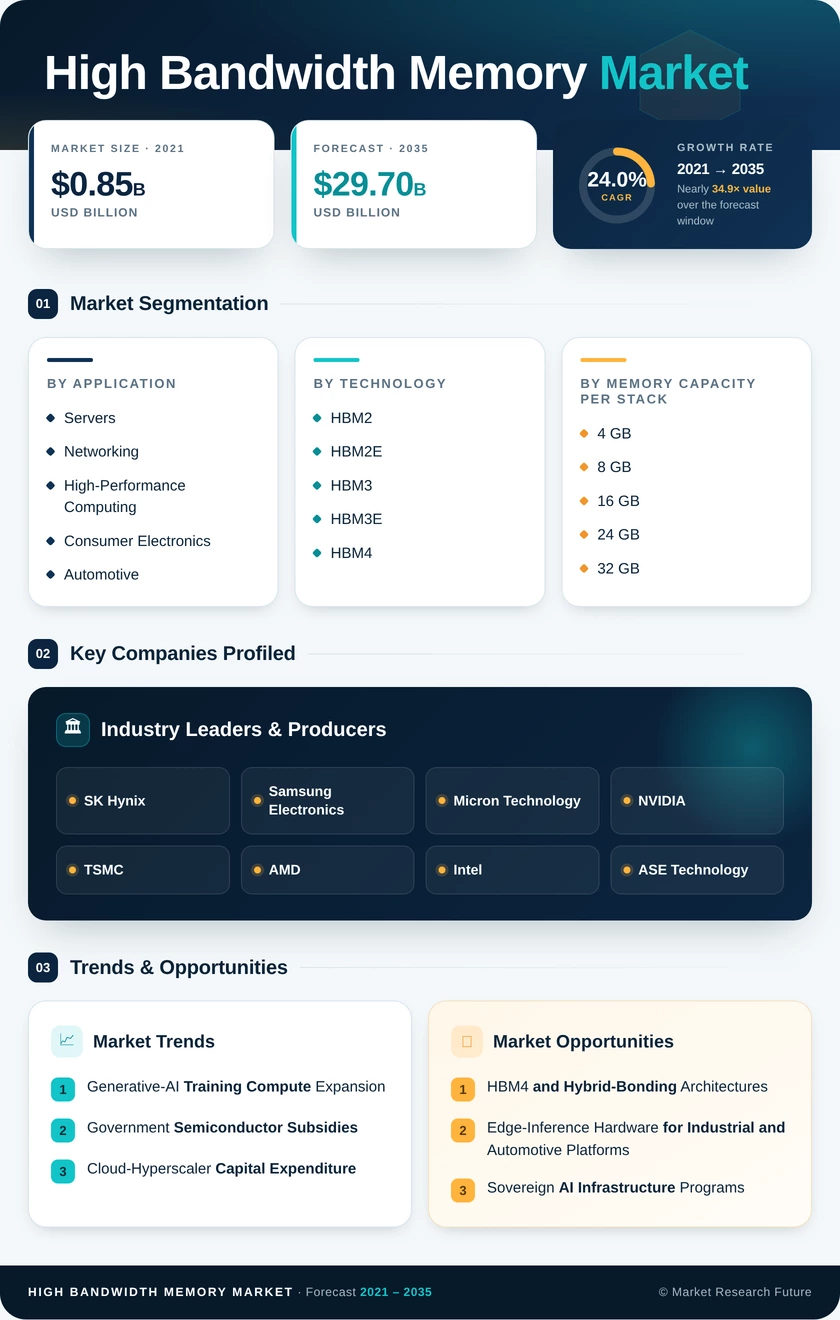
Segmentation Quick Reference
| Dimension | Sub-Segments | Dominant Segment | Fastest Growing Segment |
| Application | Servers, Networking, High-Performance Computing, Consumer Electronics, Automotive and Transportation | Servers | Automotive and Transportation |
| Technology | HBM2, HBM2E, HBM3, HBM3E, HBM4 | HBM3 | HBM4 |
| Memory Capacity Per Stack | 4 GB, 8 GB, 16 GB, 24 GB, 32 GB and Above | 16 GB | 32 GB and Above |
| Processor Interface | GPU, CPU, AI Accelerator/ASIC, FPGA, Other Interfaces | GPU | AI Accelerator/ASIC |
| Geography | North America, Europe, Asia-Pacific, South America, Middle East & Africa | Asia-Pacific | Asia-Pacific |
Market Segmentation Overview
By Application
| Sub-Segment | Key Trend |
| Servers | AI training cluster buildouts driving multi-stack HBM adoption per accelerator |
| Networking | High-throughput switch ASICs requiring on-package bandwidth scaling |
| High-Performance Computing | Weather modeling and drug discovery simulations demanding sustained memory bandwidth |
| Consumer Electronics | Next-gen gaming consoles and VR platforms exploring compact HBM integration |
| Automotive and Transportation | Level-3+ autonomous-driving platforms specifying HBM for sensor-fusion inference |
Server deployments account for the bulk of current demand as hyperscaler AI infrastructure continues expanding at double-digit rates. Automotive and transportation represents the highest-growth opportunity as autonomous-driving compute architectures mature.
By Technology
| Sub-Segment | Key Trend |
| HBM2 | Legacy installed base declining as platforms reach end-of-life |
| HBM2E | Transitional standard still serving mid-cycle HPC and networking designs |
| HBM3 | Dominant production standard across current AI accelerator families |
| HBM3E | Ramping into volume for next-generation GPU and ASIC platforms |
| HBM4 | Hybrid-bonding architecture targeting mass production from 2026–2027 |
HBM3 currently holds the largest technology share, but the transition toward HBM3E and eventually HBM4 will reshape the landscape as bandwidth requirements continue escalating.
By Memory Capacity Per Stack
| Sub-Segment | Key Trend |
| 4 GB | Minimal new design-ins; confined to legacy refresh orders |
| 8 GB | Steady demand from mid-range HPC and networking applications |
| 16 GB | Standard capacity for current-generation AI accelerator platforms |
| 24 GB | Increasing adoption for high-capacity training configurations |
| 32 GB and Above | Fastest-growing tier as models demand larger per-device memory footprints |
The 16 GB tier dominates current shipments, but OEMs are rapidly migrating to higher-capacity stacks as AI model parameter counts scale beyond one trillion.
By Processor Interface
| Sub-Segment | Key Trend |
| GPU | Primary consumer of HBM across AI training and inference workloads |
| CPU | Emerging integration in bandwidth-sensitive server processor designs |
| AI Accelerator/ASIC | Custom silicon from hyperscalers driving rapid share gains |
| FPGA | Niche demand for low-latency, reconfigurable compute applications |
| Other Interfaces | Neuromorphic and analog computing architectures in early exploration |
GPUs remain the dominant processor interface, but custom AI accelerators and ASICs are the fastest-growing segment as cloud providers diversify their compute architectures.