High Performance Computing Market Summary
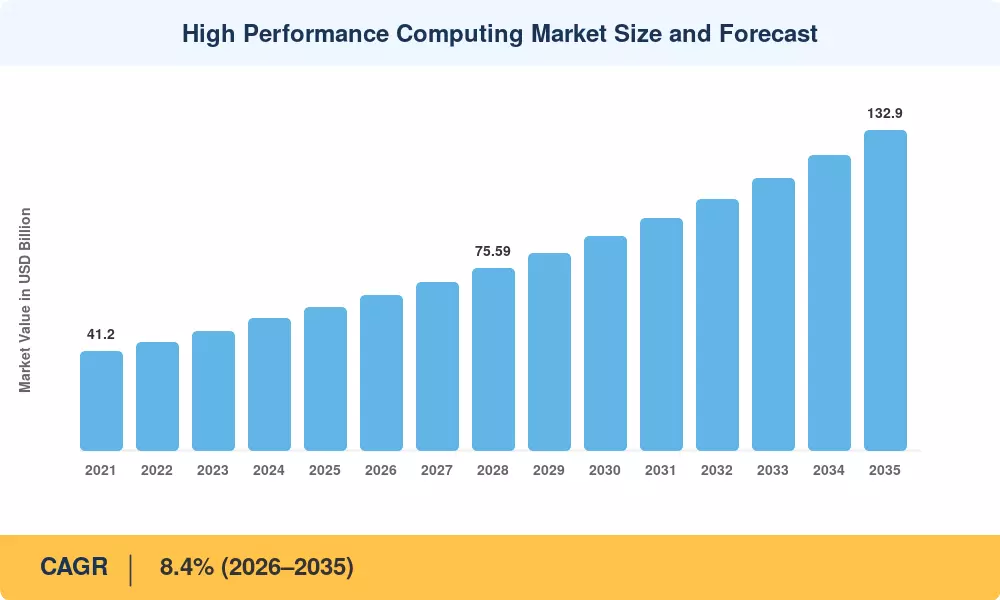
The High Performance Computing Market reached an estimated USD 59.35 billion in 2025 and is projected to grow from USD 64.33 billion in 2026 to USD 132.9 billion by 2035, registering a CAGR of 8.4% during the forecast period. This expansion is anchored in two converging forces: the global race toward exascale-class infrastructure — with the U.S. Department of Energy alone committing over USD 1.8 billion to its Exascale Computing Project [1] — and the explosive demand for compute capacity driven by large language model training and generative AI workloads [2]. Government mandates in the United States, the European Union, and China have turned national supercomputing capability into a strategic asset.
The technology landscape is shifting rapidly. Traditional CPU-centric clusters are giving way to heterogeneous architectures combining GPUs, FPGAs, and custom AI accelerators. NVIDIA's Grace Hopper Superchip architecture and AMD's Instinct MI300 series exemplify this transition, while cloud-based HPC offerings from AWS, Microsoft Azure, and Google Cloud are lowering the barrier to entry for mid-market enterprises and academic institutions [3]. The European Union's EuroHPC Joint Undertaking has pledged over EUR 7 billion through 2027 to develop sovereign supercomputing infrastructure across member states [4].
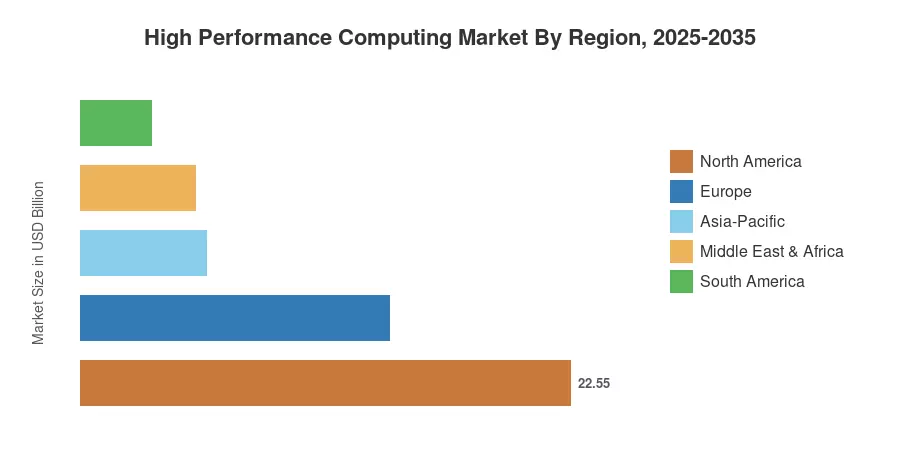
North America commands the largest share of the High Performance Computing Market at approximately 38%, driven by federal laboratory networks, hyperscaler capital expenditure, and a deep defense-industrial base. Asia-Pacific is the fastest-growing region, projected to expand at a CAGR of 9.8% through 2035, fueled by aggressive national computing strategies in China, Japan, and India. Europe holds the second-largest share at roughly 24%, with the EuroHPC program acting as the primary investment catalyst. The next decade will see the High Performance Computing Market increasingly shaped by energy efficiency mandates, quantum-classical hybrid deployments, and the democratization of supercomputing through cloud delivery models.
Key Report Takeaways
• By Component
- Hardware remains the dominant segment of the High Performance Computing Market, commanding approximately 48% of total revenue in 2025, underpinned by accelerator-dense server shipments.
- Services are the fastest-growing component, projected to expand at a CAGR of 9.6% through 2035 as managed HPC and consulting engagements proliferate.
- Software accounted for an estimated USD 11.9 billion in 2025, driven by workload orchestration, simulation platforms, and AI framework licensing.
• By Deployment Mode
- Cloud deployment captured nearly 36% of the High Performance Computing Market in 2025, with enterprises gravitating toward pay-per-use supercomputing access.
- On-premise installations still dominate in defense and classified research environments, representing approximately 42% of deployments.
• By Region
- North America leads the High Performance Computing Market with a 38% revenue share, anchored by U.S. national laboratories and hyperscaler data center buildouts.
- Asia-Pacific is forecast to reach USD 42.6 billion by 2035, making it the fastest-growing regional market over the study period.
High Performance Computing Market Size and Forecast (2021–2035)
Market Research Future's estimates are derived from a combination of bottom-up revenue modeling across hardware, software, and services segments, validated against publicly disclosed vendor revenues, government procurement records, and third-party syndicated data. Historical figures (2021–2024) reflect actual market performance; the 2025 base year is a calibrated estimate; and 2026–2035 projections apply the forecast CAGR with adjustments for anticipated investment cycles and technology adoption curves.